

Table of Contents
- Why French Press Coffee Tastes Bitter
- 1. Use the Best Grind Size for French Press
- 2. Control the Ideal Water Temperature for Coffee Brewing
- 3. Follow a French Press Brew Time Chart for Optimal Extraction
- 4. Get Your Coffee-to-Water Ratio Right
- 5. Use Fresh Beans and Remove the Crust
- 6. Choose the Right Roast Level and Water Chemistry
- 7. Upgrade Your Equipment and Filtration
Last Updated: August 24, 2026
Bitter coffee doesn't have to be inevitable. The problem isn't French press brewing itself, it's that most people approach it without understanding extraction mechanics. When coffee tastes harsh or astringent, one or more variables have pushed past the sweet spot. The good news: fixing bitterness is straightforward once you know what's happening in your cup. This guide from Cuppari Coffee covers seven concrete adjustments that eliminate bitterness and deliver a cleaner, more balanced cup.
Why French Press Coffee Tastes Bitter
Bitterness stems from over-extraction, when hot water pulls too many dissolved solids from the grounds, including harsh compounds. French press uses immersion brewing, meaning grounds sit in contact with water for several minutes, a strength for flavor development but a risk for overshooting into bitterness.
Several factors trigger over-extraction simultaneously: grind size too fine extends contact time, water temperature above optimal range accelerates extraction, brew time running too long compounds the problem, and coffee-to-water ratio that's too concentrated intensifies bitter notes. The mesh filter also contributes by allowing fine sediment and oils carrying tannins into your cup. Stale coffee oxidizes and develops off-flavors that taste more bitter than fresh coffee would under identical conditions.
You're aiming for roughly 18-22% of the coffee's mass to dissolve into your water (peer-reviewed research). Below that range, you get under-extraction (sour, thin). Above it, you get over-extraction (bitter, harsh, muddy). The seven adjustments below all work by keeping you in that sweet zone.
1. Use the Best Grind Size for French Press
The ideal grind size for French press is coarse, roughly the texture of breadcrumbs or sea salt. Coarse grounds have less surface area exposed to water, slowing extraction to match the longer brew time that French press requires. If you grind too fine, water over-extracts from high-surface-area particles over 4 minutes, producing bitterness.
A burr grinder, either conical or flat, produces consistent particle size that brews evenly. A blade grinder creates a chaotic mix of fine dust and larger chunks, where dust over-extracts while chunks under-extract, leaving an unbalanced, often bitter cup. Upgrading to a burr grinder is one of the highest-impact changes you can make.
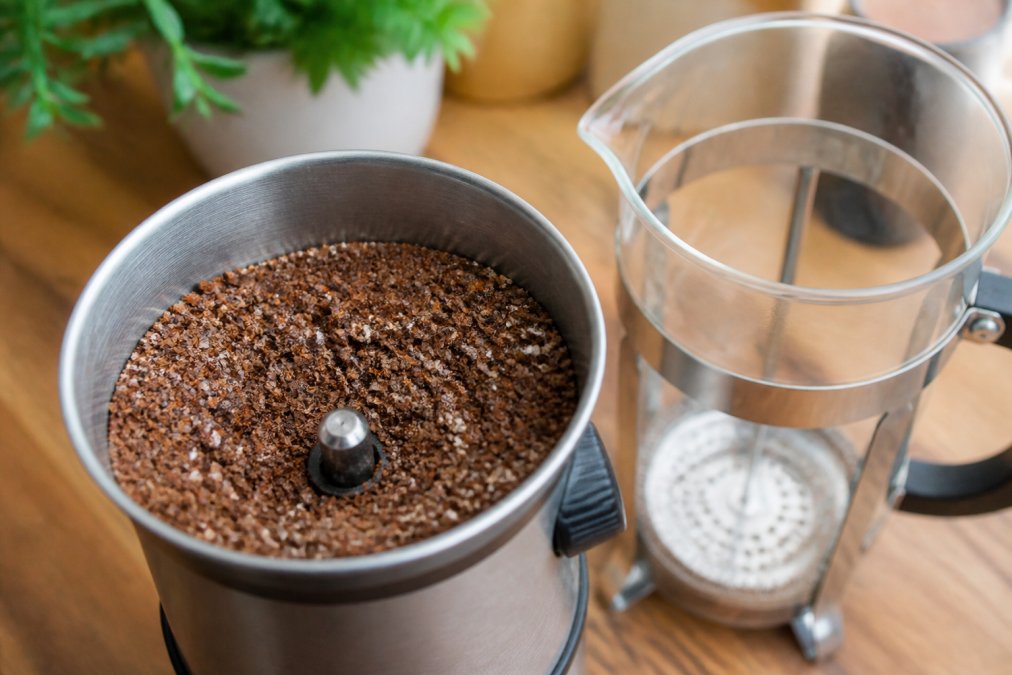
Grind consistency matters as much as coarseness. A quality burr grinder like the Baratza Encore holds grind size steady across 40 different settings, letting you dial in the exact coarse texture your French press needs.
2. Control the Ideal Water Temperature for Coffee Brewing
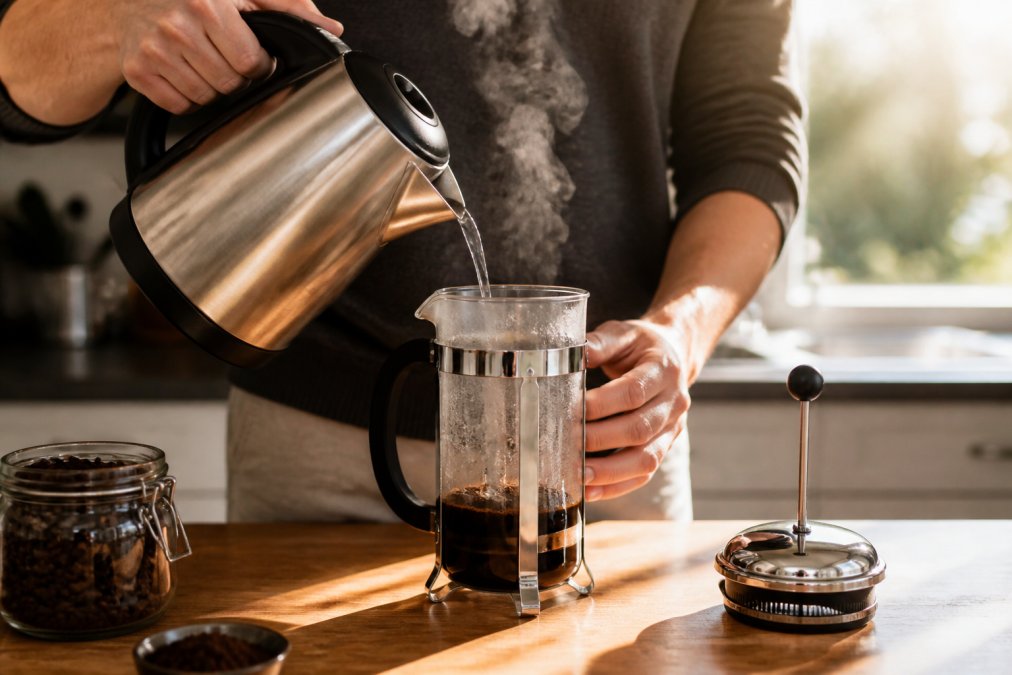
Water temperature is the thermostat for extraction speed. The ideal range for French press brewing is 195°F to 205°F, keeping extraction moving at the right pace during your 4-minute brew (peer-reviewed research). If your water hits 212°F (boiling), you're asking for over-extraction and bitterness. If it drops to 160°F, you'll get under-extraction and sourness.
Most home brewers use water straight off the boil, brewing at or near 212°F. The solution: let boiled water cool for 30 seconds before pouring. This simple pause brings temperature down into the optimal zone.
For precision, use an electric kettle with temperature control like the Cuisinart PerfecTemp, which lets you set your target (say, 200°F) and stops heating at that exact point. You pour immediately and hit your target every time.
Water chemistry also influences extraction speed. Hard water (high mineral content) extracts more slowly than soft water. If your tap water is very hard, extraction may run slow even at the right temperature, leaving sour notes. A water filter pitcher like Peak Water lets you adjust mineral content to optimize for coffee extraction.
3. Follow a French Press Brew Time Chart for Optimal Extraction
Brew time is your countdown to extraction completion. Start the timer when hot water first touches the grounds. For a standard French press with coarse grounds and 195-205°F water, aim for 4 minutes. This timing lets extraction reach that optimal 18-22% yield without overshooting into bitterness. Brewing for 3 minutes leaves coffee thin and sour; 6 minutes pushes deep into over-extraction and bitterness.
Brew time varies slightly based on grind coarseness. If your grind runs slightly finer than ideal, drop brew time to 3.5 minutes. If your grind is very coarse, you may need 4.5 minutes.
A precision scale with a built-in timer like the TIMEMORE Basic 2.0 removes guesswork. You measure your coffee and water by weight, start the timer when you pour, and stop at exactly 4 minutes. This consistency lets you identify which variable caused changes in flavor.
4. Get Your Coffee-to-Water Ratio Right
The coffee-to-water ratio sets the concentration of your final cup. Too much coffee over-extracts relative to water volume; too little under-extracts.
The standard ratio for French press is 1 part coffee to 15-17 parts water by weight. If you use 30 grams of coffee, add 450-510 grams of water. This ratio keeps extraction balanced and flavor development strong without tipping into bitterness. Many home brewers eyeball their ratios and end up with 1:12 or 1:10, too concentrated and tasting bitter. Switching to 1:16 immediately makes the cup cleaner and less harsh.
A kitchen scale is essential. A scale like the TIMEMORE Basic 2.0 measures both coffee and water to 0.1 gram precision, ensuring you hit the ratio every single brew.
5. Use Fresh Beans and Remove the Crust
Coffee freshness is non-negotiable. Stale beans oxidize, creating off-flavors that taste bitter and hollow. Beans should be roasted within 1-7 days before brewing (peer-reviewed research). Beans older than two weeks taste flat and bitter; older than a month taste distinctly stale.
When you brew with fresh beans, a layer of foam and sediment forms on top, the "crust." Breaking this crust 30 seconds into your brew ensures even extraction. Use a spoon to gently stir, submerging floating grounds. This eliminates pockets of under-extraction and produces a more balanced, less bitter cup.
Cuppari Coffee roasts beans only after your order is placed and ships the same day, so your beans arrive at peak freshness. This eliminates the staleness variable entirely.
The mesh filter allows fine sediment to pass into your cup, carrying tannins that amplify bitterness. If sediment bothers you, use paper filters designed for French press, like Caffi filters. These catch the fines, giving you a cleaner cup with noticeably less bitterness, though you'll lose a tiny bit of body.
6. Choose the Right Roast Level and Water Chemistry
Roast level influences how bitter a coffee can become. Dark roasts contain more bitter compounds by nature; the roasting process breaks down sugars and creates ashy, smoky, harsh compounds. A dark roast over-extracted tastes exponentially more bitter than a light roast over-extracted by the same margin.
If you're struggling with bitterness, start with a medium or medium-dark roast. These have enough body and flavor development without the inherent bitterness of very dark roasts.
Water chemistry affects extraction rate. Hard water (high in calcium and magnesium) extracts more slowly, potentially leaving coffee sour. Soft water extracts faster, potentially pushing toward bitterness. Ideally, your water should have moderate hardness: roughly 50-100 parts per million of total dissolved solids. A water filter pitcher like Peak Water can reduce mineral content to the sweet spot.
7. Upgrade Your Equipment and Filtration
Your French press itself influences bitterness. A low-quality press with a poor seal allows grounds to escape into your cup as you plunge, adding sediment and bitterness. A quality press with a tight seal keeps grounds contained and produces a cleaner cup.
Filter quality matters most. A mesh filter with large holes lets fine particles through; smaller holes reduce sediment. If your French press is old, the mesh may have corroded or warped. Replacing the mesh or upgrading to a French press with a tighter filter is a direct path to less bitterness.
Paper filters designed for French press offer the cleanest cup. Products like Caffi filters fit inside your press and trap sediment before it reaches your cup. Many brewers find it worth it to eliminate bitterness and sediment.
An electric kettle with temperature precision, a scale with a timer, and a quality burr grinder are the foundation of repeatable, less bitter French press coffee. For the beans themselves, Cuppari Coffee delivers freshly roasted coffee directly to your doorstep, with every order roasted and shipped the same day.
Bitter French press coffee is solvable. The seven adjustments above, grind size, water temperature, brew time, coffee-to-water ratio, bean freshness, roast level, and equipment quality, work together to keep extraction in the optimal zone. Start with the easiest changes: coarsen your grind, cool your water 30 seconds before pouring, and time your brew at 4 minutes. If bitterness persists, dial in your ratio and consider upgrading to a burr grinder. For the cleanest cup, use fresh beans from Cuppari Coffee and experiment with paper filters. The combination of technique precision and quality beans transforms French press into one that consistently produces balanced, flavorful coffee.
| Adjustment | Impact on Bitterness | Effort Level | Cost |
|---|---|---|---|
| Coarsen grind size | High | Low | Free (if you have a grinder) |
| Cool water to 195-205°F | High | Low | Free |
| Brew for exactly 4 minutes | High | Low | Free (timer only) |
| Use 1:16 coffee-to-water ratio | Medium | Low | Free (scale helpful) |
| Use fresh beans (within 7 days of roast) | High | Low | Cuppari Coffee delivers fresh |
| Remove the crust at 30 seconds | Medium | Low | Free |
| Use paper filters | Medium | Low | Pricing depends on quantity, dates, and delivery |
| Upgrade to quality burr grinder | Medium | Medium | Pricing depends on quantity, dates, and delivery |
=== FAQ ANSWERS (audit these too, same rules) ===
[1] Q: Why does my French press coffee always taste bitter? A: Bitterness in French press coffee results from over-extraction, which occurs when hot water pulls too many compounds from the grounds. This happens with fine grinds, water that's too hot, or brew times exceeding 4-5 minutes. The immersion brewing method in a French press makes it especially prone to over-extraction compared to other brewing methods. Using a coarser grind, cooler water (195-205°F), and timing your brew carefully prevents excessive extraction and reduces bitterness significantly.
[2] Q: What is the best grind size for French press? A: French press requires a coarse, consistent grind, similar to breadcrumbs or sea salt. A coarse grind slows water's passage through the grounds, preventing over-extraction. Burr grinders (conical or flat) produce uniform particle size better than blade grinders. If you use a fine grind, water extracts too quickly and pulls bitter compounds. Consistency matters as much as coarseness; inconsistent grinds lead to some particles over-extracting while others under-extract, creating an unbalanced, bitter cup.
[3] Q: What is the ideal water temperature for coffee brewing in a French press? A: The ideal water temperature for French press is 195-205°F (90-96°C). Water at this range extracts desirable flavors without pulling excessive bitter compounds and tannins. Boiling water (212°F) over-extracts immediately, while water cooler than 195°F under-extracts, producing a weak, sour cup. An electric kettle with temperature control ensures precision. If you don't have one, let boiling water cool for 30-45 seconds before pouring. Consistent temperature across all brews helps you dial in flavor accurately.
[4] Q: How long should I brew coffee in a French press? A: Brew for 3.5 to 4 minutes for a balanced cup. Start timing after you pour the water. At 3.5 minutes, you extract most desirable flavors with minimal bitterness. Brewing longer than 4-5 minutes increases over-extraction significantly, pulling tannins and bitter compounds. If you prefer a lighter cup, brew closer to 3 minutes. A French press brew time chart helps: coarser grinds can handle 4+ minutes, while slightly finer grinds should stop at 3.5 minutes. Use a timer for consistency.
[5] Q: Does using fresh beans really make a difference in reducing bitterness? A: Yes. Fresh beans, roasted within 1-14 days, produce a cleaner, less bitter cup. Older beans oxidize, developing stale, acrid flavors that compound bitterness. Cuppari Coffee roasts beans only after you order, shipping the same day, ensuring maximum freshness. Stale beans also extract differently, making it harder to control bitterness through technique alone. If your beans are more than 3 weeks old, bitterness becomes difficult to eliminate no matter how carefully you adjust grind, temperature, or time.
Frequently Asked Questions
Q: Why does my French press coffee always taste bitter?
A: Bitterness in French press coffee results from over-extraction, which occurs when hot water pulls too many compounds from the grounds. This happens with fine grinds, water that's too hot, or brew times exceeding 4-5 minutes. The immersion brewing method in a French press makes it especially prone to over-extraction compared to other brewing methods. Using a coarser grind, cooler water (195-205°F), and timing your brew carefully prevents excessive extraction and reduces bitterness significantly.
Q: What is the best grind size for French press?
A: French press requires a coarse, consistent grind, similar to breadcrumbs or sea salt. A coarse grind slows water's passage through the grounds, preventing over-extraction. Burr grinders (conical or flat) produce uniform particle size better than blade grinders. If you use a fine grind, water extracts too quickly and pulls bitter compounds. Consistency matters as much as coarseness; inconsistent grinds lead to some particles over-extracting while others under-extract, creating an unbalanced, bitter cup.
Q: What is the ideal water temperature for coffee brewing in a French press?
A: The ideal water temperature for French press is 195-205°F (90-96°C). Water at this range extracts desirable flavors without pulling excessive bitter compounds and tannins. Boiling water (212°F) over-extracts immediately, while water cooler than 195°F under-extracts, producing a weak, sour cup. An electric kettle with temperature control ensures precision. If you don't have one, let boiling water cool for 30-45 seconds before pouring. Consistent temperature across all brews helps you dial in flavor accurately.
Q: How long should I brew coffee in a French press?
A: Brew for 3.5 to 4 minutes for a balanced cup. Start timing after you pour the water. At 3.5 minutes, you extract most desirable flavors with minimal bitterness. Brewing longer than 4-5 minutes increases over-extraction significantly, pulling tannins and bitter compounds. If you prefer a lighter cup, brew closer to 3 minutes. A French press brew time chart helps: coarser grinds can handle 4+ minutes, while slightly finer grinds should stop at 3.5 minutes. Use a timer for consistency.
Q: Does using fresh beans really make a difference in reducing bitterness?
A: Yes. Fresh beans, roasted within 1-14 days, produce a cleaner, less bitter cup. Older beans oxidize, developing stale, acrid flavors that compound bitterness. Cuppari Coffee roasts beans only after you order, shipping the same day, ensuring maximum freshness. Stale beans also extract differently, making it harder to control bitterness through technique alone. If your beans are more than 3 weeks old, bitterness becomes difficult to eliminate no matter how carefully you adjust grind, temperature, or time.
This article was written using GrandRanker