

Table of Contents
- 1. Start With Fresh, High-Quality Tea Leaves
- 2. Use Loose-Leaf Tea and Measure How Much Loose Leaf Tea Per Cup
- 3. Get Your Tea Water Temperature Right for Every Tea Type
- 4. Dial In Your Tea Steeping Time
- 5. Fix the Water Before You Fix the Tea
- 6. Avoid These Common Tea Brewing Mistakes
- 7. Build a Repeatable Tasting and Adjustment Method
- Conclusion: Small Adjustments, Noticeably Better Tea Brewing
- Frequently Asked Questions
Last Updated: October 8, 2026
1. Start With Fresh, High-Quality Tea Leaves
Great tea brewing starts before the kettle. Old, stale leaves taste flat no matter how careful you are with temperature and timing.
Tea leaves lose aroma as they age, absorbing moisture and odors while the essential oils that carry flavor fade. That's why our loose-leaf teas, from English Breakfast to Jasmine, arrive ready to brew.
What does "fresh" mean in practice? A strong scent when you open the bag, whole leaves rather than dust and fannings, and a harvest or packing date if the seller provides one.
A common mistake is buying in bulk to save money, then storing it for a year, you end up with leaves that brew brown water with no character.
2. Use Loose-Leaf Tea and Measure How Much Loose Leaf Tea Per Cup
Loose-leaf tea gives you control tea bags can't match: you decide the quantity, steeping time, and strength. Bags are portioned for the average drinker, not your taste.
So how much loose leaf tea per cup should you use? Weight beats volume every time.
A kitchen scale fixes this. The standard starting ratio is 1 gram of leaf per 1 fluid ounce of water, or about 2.5 to 3 grams per 8-ounce cup.
Scaling the Ratio for a Cup, a Pot, and a Crowd
Once you know the ratio, scaling is simple multiplication:
| Vessel | Water | Light (2 g/8 oz) | Standard (2.5-3 g/8 oz) | Strong (3.5 g/8 oz) |
|---|---|---|---|---|
| Small cup | 6 oz | 1.5 g | 2 g | 2.6 g |
| Standard mug | 8 oz | 2 g | 2.5-3 g | 3.5 g |
| Large mug | 12 oz | 3 g | 3.75-4.5 g | 5.25 g |
| Small pot (2 cups) | 16 oz | 4 g | 5-6 g | 7 g |
| Standard pot (4 cups) | 32 oz | 8 g | 10-12 g | 14 g |
| Teapot for a group | 48 oz | 12 g | 15-18 g | 21 g |
Practical notes:
- Weigh the dry leaf, not the wet. Once leaves are steeped they hold water and their weight is meaningless for the next batch.
- Round to the nearest half gram. Precision beyond that is not worth the fuss for most teas.
- Adjust for leaf size. Large whole leaves (whole-leaf oolong, silver needle, some Darjeelings) often need the higher end of the range; broken or fannings-style leaves extract faster and need less.
- Adjust for your water. Soft water extracts more aggressively than hard, so the ratio is a starting point, not a law.
Why Weight Beats Volume
If you don't own a scale, a cheap digital one that reads to 0.1 grams costs less than a tin of good tea. Weigh your first ten cups of a new tea, note the numbers that taste best, and you can eyeball it with confidence from then on.
For our Earl Grey, the label calls for 2.5 grams per 12 ounces, right in the standard range above. Start there, then adjust to taste.
- Black tea: 2.5-3 g per 8 oz
- Green tea: 2-2.5 g per 8 oz
- Herbal blends: 2.5-3.5 g per 8 oz (herbals are bulky and often need more)
- Large-leaf oolong or white: 3-3.5 g per 8 oz
3. Get Your Tea Water Temperature Right for Every Tea Type
Water temperature is the biggest lever most people ignore. Boiling water scorches delicate green tea and turns a sweet cup bitter; too-cool water leaves black tea flat.
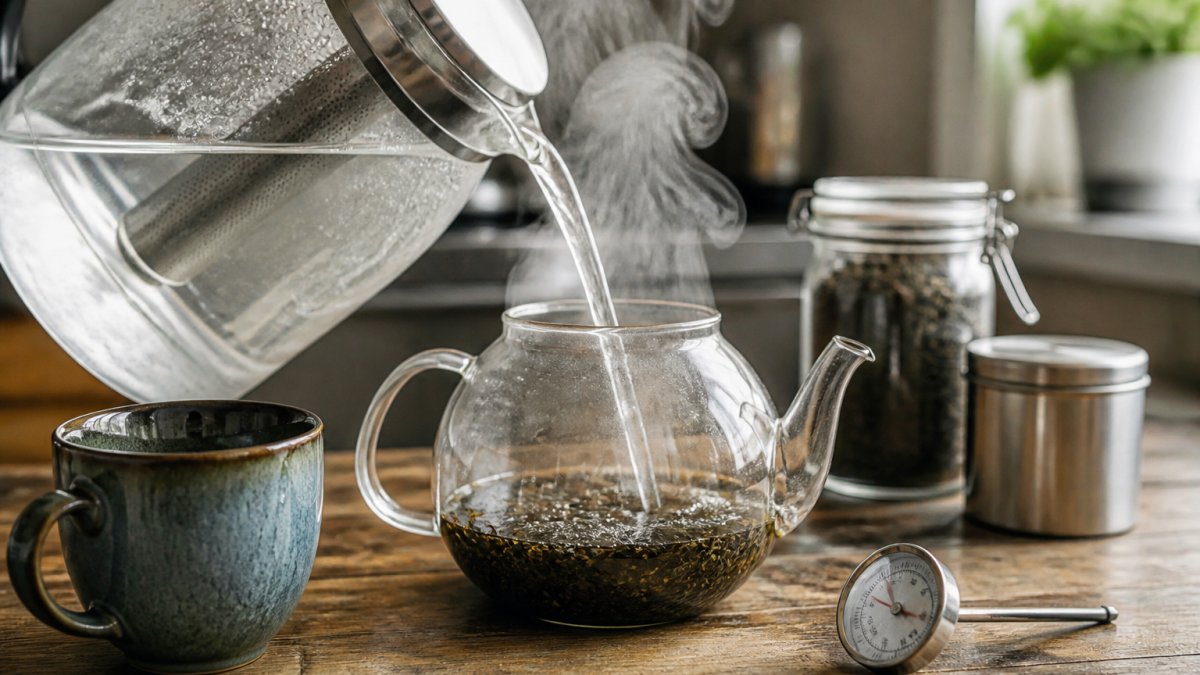
The fix is temperature control: an adjustable kettle makes it easy, or boil and let the water cool for a set time before pouring.
(/products/jasmine)) | 160-175 F | 1 tsp | 2-3 min || Matcha | 160-175 F | 1 tsp powder | Whisk, no steep |
|---|---|---|---|
| Herbal (Hibiscus Berry) | 212 F | 3 g / 12 oz | 5-10 min |
| Oolong | 185-195 F | 1 tsp | 3-4 min |
Cooling boiled water takes about 2 minutes for green tea and 30 seconds for oolong; add a little time in a cold kitchen.
4. Dial In Your Tea Steeping Time
The window is narrower than most people think, green teas go from perfect to bitter in 30 seconds, and black teas still punish over-steeping.
Re-steeping is where loose-leaf tea earns its keep. Many whole-leaf teas, like our Jasmine, hold up for multiple infusions, the second steep often tastes smoother.
A common mistake is squeezing the tea bag or pressing leaves against the cup, which releases extra tannins and makes the cup bitter.
5. Fix the Water Before You Fix the Tea
Water is 99% of your cup. If it tastes off from the tap, your tea will too. Fix the water before you spend more on leaves.
Fresh water matters as much as filtered. Reboiling concentrates minerals and drives off oxygen, leaving tea dull, so pour fresh cold water into the kettle each time.
What about bottled or distilled water? The EPA's guidance on drinking water quality is a useful starting point if you want to understand what's in your tap water.
6. Avoid These Common Tea Brewing Mistakes
Most bad cups trace back to a handful of repeat offenders, but the useful skill is reading what's wrong with the cup in front of you and knowing which dial to turn.
The Symptom-to-Fix Guide
Start with what you taste, not what you did. Match the symptom, apply the fix, and change one variable at a time.
| What you taste | Most likely cause | First fix to try | Second fix if needed |
|---|---|---|---|
| Weak, watery, no aroma | Too little leaf, or steep too short | Add 0.5 g of leaf | Add 30 seconds to the steep |
| Bitter, drying, astringent | Water too hot, or steep too long | Drop temperature 10-15 F | Shorten the steep by 30 seconds |
| Flat, dull, cardboard-like | Stale leaves, or reboiled water | Switch to fresh cold water | Open a fresher tin of tea |
| Chalky, mineral, or soapy | Hard water or heavy chlorine | Filter the water | Try spring water with moderate minerals |
| Metallic or sour | Over-extraction from squeezing leaves, or a dirty pot | Stop pressing the leaves | Wash the pot with hot water only, no soap |
| Thin but harsh at the same time | Too-hot water on delicate leaf | Cool the water | Use more leaf but a shorter steep |
| Great first cup, weak second cup | Re-steep time not extended | Add 15-30 seconds to the second steep | Raise temperature slightly for the second steep |
The Mistakes Behind the Symptoms
- Using boiling water for everything. Green and white teas need cooler water; boiling scalds them and pulls out bitterness before sweetness develops.
- Over-steeping. Forgetting the timer turns sweet tea bitter. Pull the leaves when time's up.
- Too little tea. A weak cup usually means too few leaves, not bad tea. Weigh instead of eyeballing.
- Stale leaves. Tea open for a year won't taste like much. Buy fresh and store it well.
- Reboiling water. Fresh water gives a cleaner, livelier cup; reboiled water has lost oxygen and concentrates minerals.
The pattern behind all of these is the same: small oversights compound. A slightly too-hot pour plus a slightly too-long steep equals a cup you won't finish, so fix one variable at a time to learn which one mattered.
7. Build a Repeatable Tasting and Adjustment Method
Improving your tea brewing skills comes down to one habit: taste, note, adjust.
Here's a simple method we recommend:
- Brew a baseline cup. Use the chart in section 3 as your starting point.
- Taste and name what you notice. Is it weak, bitter, flat, or just right? Use plain words.
- Change one variable. Add leaves, drop the temperature, or shorten the steep. Never change two things at once.
- Brew again and compare. Did the change fix the problem or create a new one?
- Write it down. A note on your phone is enough. "Jasmine, 170 F, 2 min, 1 tsp: too weak, try 1.5 tsp."
Weak tea needs more leaves or a longer steep; bitter tea needs cooler water or less time; flat tea points to stale leaves or poor water.
Every blend, from Masala Chai to Moroccan Mint, comes with brewing guidance because a starting point beats a blank page.
For cold tea, our Cold Brew Maker brews loose-leaf tea overnight with no heat and no guesswork. Fill, brew, pour.
Conclusion: Small Adjustments, Noticeably Better Tea Brewing
Better tea doesn't require new equipment or expensive leaves, just attention to four things: fresh tea, the right amount, the right temperature, and the right time.
Our loose-leaf teas, including English Breakfast, Earl Grey, and Jasmine, come with clear brewing guidance. Free shipping applies to all U.S. orders.
Ready to taste the difference fresh makes? Add a tin to your cart and brew your next cup with tea that still has something to say.
Frequently Asked Questions
How long should you steep different types of tea?
Steeping time depends on the tea type. Delicate green and white teas need roughly 2 to 3 minutes, oolong sits around 3 to 5 minutes, and black teas like English Breakfast or Earl Grey run 5 to 10 minutes. Herbal blends such as Hibiscus Berry Tea also call for 5 to 10 minutes at 212 F. Start at the low end, taste, then add time if the cup feels thin.
What is the best water temperature for brewing tea?
Match the temperature to the leaf. Tender green and white teas do best around 160 to 180 F, oolong sits near 185 to 195 F, and black teas like Earl Grey brew at 195 F. Herbal blends and hibiscus-based teas want fully boiled water at 212 F. Water that is too hot scorches delicate leaves and turns the cup bitter, so let boiled water cool for a minute or two before pouring.
How much loose-leaf tea should you use per cup?
A reliable starting point is about 2.5 grams of loose-leaf tea per 12 ounces of water, which is close to a rounded teaspoon for most black and green teas. Cuppari's Earl Grey lists exactly that ratio: 2.5g per 12oz. Herbal blends are heavier, so use closer to 3 grams per 12oz. Weigh the first few batches, then adjust up or down based on how strong the cup tastes.
Does the quality of water affect the taste of tea?
Yes, water makes up more than 99 percent of the cup, so its mineral content and odor shape the final flavor. Heavily mineralized or chlorinated tap water flattens aroma and can leave a dull, chalky finish. Filtered water gives leaves a cleaner base to express themselves. Start with cold water, filter it if your tap runs hard or smells of chlorine, and heat only as much as you need for the pot.
How can you make tea taste stronger without making it bitter?
Add more leaf rather than more time. Over-steeping pulls out harsh tannins, which is what makes tea bitter, while a larger dose of leaves deepens flavor without that astringent edge. You can also raise the water temperature slightly for black teas, or switch to a bolder blend like Masala Chai. For iced tea, cold brewing in a Cold Brew Maker extracts sweetness with almost no bitterness.