

Table of Contents
- Why Switch From Store Bought Tea Bags
- Loose Leaf Tea Benefits: Flavor, Freshness, and Value
- How to Use a Tea Infuser: A Step-by-Step Guide
- DIY Tea Bag Alternatives You Can Make at Home
- Comparing Loose Leaf Teas From Cuppari Coffee
- Common Mistakes When Ditching Tea Bags
- Conclusion: Finding Your Best Alternative
- Frequently Asked Questions
Last Updated: September 29, 2026
Why Switch From Store Bought Tea Bags
Store bought tea bags are convenient, but that convenience comes at a cost: most commercial bags are filled with dust and broken leaf fragments, known in the trade as "fannings," which brew a flat, one-dimensional cup. Loose leaf tea, by contrast, uses whole or large-cut leaves that unfurl during steeping and release far more aroma and complexity.
This guide from Cuppari Coffee covers the practical alternatives to store bought tea bags, from infusers and reusable cloth sacks to loose leaf blends you can order fresh.
Why does the swap matter? Three reasons. First, flavor: whole leaves hold their essential oils, which fannings lose during processing. Second, freshness: tea in a warehouse-aging box has often sat for months, while loose leaf bought in small batches tastes brighter. Third, value: a single serving of quality loose leaf often costs less per cup than a premium supermarket bag, because you control the dose.
Below, we'll show you exactly how to make the switch without buying a cabinet full of gear you'll never use.
Loose Leaf Tea Benefits: Flavor, Freshness, and Value
Loose leaf tea is tea in its whole or partially broken form, steeped without a paper or mesh bag, and it delivers three advantages that bagged tea struggles to match.
Start with flavor. Whole leaves contain intact essential oils and can be steeped more than once. A medium-bodied green tea like Cuppari Coffee's Jasmine, a hand-picked blend of jasmine blossoms and green tea, is explicitly built for multiple steepings. A bag of fannings gives you one decent cup and then nothing.
Freshness is the second edge. Because loose leaf is sold by weight and often packed close to the source, it spends less time degrading on a shelf. The third benefit is value. You measure your own dose, so a 2.5-gram serving goes exactly as far as you want it to.
- Flavor: whole leaves, more aroma, better mouthfeel
- Freshness: smaller batches, less warehouse time
- Value: you control the dose per cup
- Versatility: hot, iced, or cold-brewed
How to Use a Tea Infuser: A Step-by-Step Guide
Using a tea infuser is straightforward: measure loose leaf into the basket, lower it into hot water, steep for the time your tea requires, then lift it out. The variables that matter are water temperature, leaf quantity, and time.
Here's the process, step by step.
- Preheat your mug with hot water, then dump it. A warm vessel keeps the brew from cooling too fast.
- Measure the leaf. A common starting point is one teaspoon per 8 ounces of water, adjusted to taste.
- Heat water to the right temperature. Black and herbal teas take near-boiling water; green teas prefer cooler water so they don't turn bitter.
- Lower the infuser and start timing. Cuppari Coffee's Earl Grey, for example, brews at 195°F for 5 to 10 minutes.
- Remove the basket when the timer ends. Leaving it in keeps extracting tannins and turns the cup harsh.
- Re-steep if the leaf allows. Whole-leaf greens and oolongs often reward a second or third pour.
Choosing the Right Infuser Style
The right infuser comes down to how you brew and how many people you're serving. A basket infuser fits most mugs and gives leaves room to expand. A ball infuser is compact but crowds the leaf, which limits flavor. A teapot with a built-in strainer suits brewing for two or more.
| Infuser Style | Best For | Leaf Room | Cleanup |
|---|---|---|---|
| Basket infuser | Single mugs, daily brewing | Generous | Easy rinse |
| Ball infuser | Travel, tight storage | Limited | Fiddly |
| Teapot with strainer | Two or more cups | Generous | Moderate |
| Paper filter | Disposable convenience | Moderate | None |
DIY Tea Bag Alternatives You Can Make at Home
You can make your own tea bags at home with a few inexpensive supplies, and refillable options cut waste while letting you control exactly what goes in the cup.
The simplest route is a reusable cloth or mesh bag. Fill it with loose leaf, cinch the drawstring, and steep as usual. Empty it, rinse it, and it's ready for the next cup. For a disposable version, unbleached paper filter bags work the same way as a store bought tea bag but let you choose the tea.
Reusable Cloth and Mesh Options
Cloth and mesh bags are the workhorses of a DIY setup, and they pay for themselves quickly.
- Cotton muslin bags: soft, breathable, best for larger-leaf teas
- Fine mesh bags: better for small-cut or powdered teas like matcha
- Silicone tea sacks: hold shape well and rinse clean fast
- Stainless steel balls: durable, but watch the leaf room
One note on cleanup: rinse cloth and mesh immediately after steeping. Dried leaf residue is what makes a reusable bag smell stale after a few uses.
Comparing Loose Leaf Teas From Cuppari Coffee
Every blend below is loose leaf, so you skip the bag entirely.
The range covers black, green, and herbal, which means most daily-drinking preferences are covered in one order. Prices sit at $17 for most blends and $22 for the matcha and hojicha powders.
| Tea | Type | Price | Best For |
|---|---|---|---|
| Earl Grey | Black | $17.00 | Classic morning cup |
| Jasmine | Green | $17.00 | Multiple steepings |
| Masala Chai | Black | $17.00 | Milk and sugar |
| Moroccan Mint | Green | $17.00 | Iced tea |
| Peach Paradise | Herbal | $17.00 | Caffeine-free, hot or cold |
| Hibiscus Berry Tea | Herbal | $17.00 | Cold brew |
| Matcha | Green powder | $22.00 | Traditional preparation |
| Hojicha | Roasted green powder | $22.00 | Toasty, low-bitterness cups |
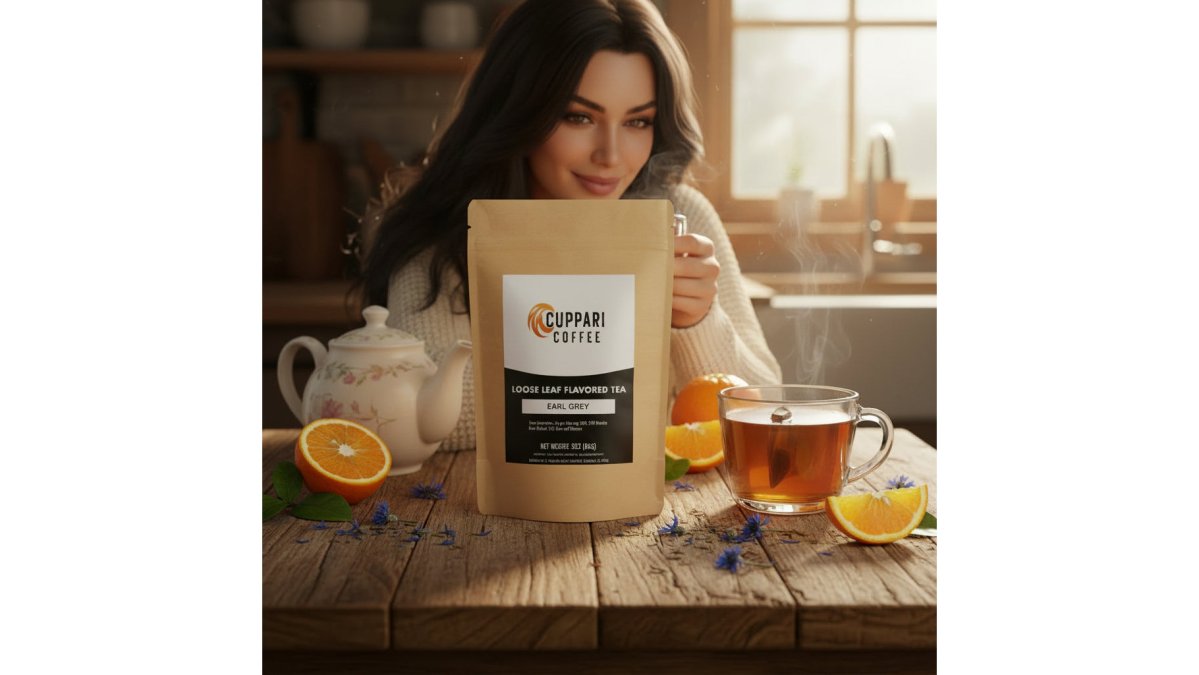
A few standouts. The Hibiscus Berry Tea is built for cold brewing, with organic hibiscus, rosehips, and rooibos. The Apple Cider Rooibos is naturally caffeine-free, so it works as an evening cup. The Earl Grey blends Ceylon black tea with bergamot oil and blue cornflowers, and it holds up to milk.
Free shipping applies to all U.S. orders, so there's no minimum-order math to work out before you try a blend.
Common Mistakes When Ditching Tea Bags
The biggest mistake people make when leaving store bought tea bags behind is treating loose leaf exactly like a bag: guessing the dose, using boiling water for everything, and leaving the leaf in the whole time.
Here are the pitfalls worth avoiding.
- Over-steeping. More time doesn't mean more flavor, it means more bitterness. Set a timer.
- Water that's too hot for green tea. Boiling water scorches delicate green and white teas. Let it cool slightly first.
- Too little leaf. A weak cup is usually under-measured, not under-steeped.
- Storing tea near light and heat. Keep it sealed and away from the stove.
- Reusing a dirty infuser. Old residue flavors the next cup, especially with herbal blends.
Conclusion: Finding Your Best Alternative
The alternatives to store bought tea bags range from a simple basket infuser to reusable cloth sacks to loose leaf blends ordered fresh. Which one fits depends on how you brew and how much control you want.
If you'd rather skip the guesswork, Cuppari Coffee offers loose leaf teas across black, green, and herbal styles, with freshness baked into the process: orders are roasted and shipped the same day, and shipping is free on all U.S. orders.
Frequently Asked Questions
Are store bought tea bags toxic?
Some conventional tea bags are sealed with food-grade plastic or contain polypropylene, which can shed microplastics when steeped in hot water. Paper bags may also be treated with chlorine bleach. If you want to avoid these materials, loose leaf tea brewed in a stainless steel or glass infuser is a straightforward alternative. Always check how a bag is sealed and whether the brand discloses its material.
What can I use instead of a tea bag?
You can brew loose leaf tea using a stainless steel infuser basket, a French press, a gaiwan, or reusable cloth bags. For a DIY option, place leaves in a paper coffee filter and tie it with unflavored dental floss. Cuppari Coffee offers loose leaf teas starting at $17.00, including Earl Grey and Jasmine, that work with any of these methods.
Is loose leaf tea better than tea bags?
Loose leaf tea generally delivers more flavor because the leaves are larger and have room to expand fully in water. Bagged tea often contains fannings, which are smaller particles that release tannins quickly and can turn bitter. Loose leaf also lets you adjust the amount per cup, so you control strength. The trade-off is a few extra seconds of cleanup.
How do you brew loose leaf tea without an infuser?
You can brew loose leaf tea without a dedicated infuser by using a French press, a teapot with a built-in strainer, or a simple two-cup method: steep the leaves directly in hot water, then pour through a fine mesh strainer into your mug. A paper coffee filter also works as a makeshift tea bag. Match water temperature to the tea type for the best results.
What are the benefits of switching to loose leaf tea?
Switching to loose leaf tea gives you fresher flavor, more control over strength, and less packaging waste. You can also re-steep many loose leaf varieties two or three times, which stretches the value of each purchase. For example, Cuppari Coffee's Jasmine is noted as good for multiple steepings, so a single serving goes further than a typical store bought tea bag.