

Table of Contents
- Understanding the Difference Between Arabica and Robusta Taste
- What is Arabica Coffee?
- What is Robusta Coffee?
- Flavor Profile Comparison: Arabica vs Robusta
- Caffeine Content in Arabica vs Robusta
- Arabica vs Robusta Acidity Levels and Body
- Best Coffee Beans for Espresso: Arabica, Robusta, or Blends?
- Growing Conditions, Altitude, and Bean Appearance
- Brewing Methods That Optimize Arabica and Robusta Flavors
- Sustainability and Environmental Impact of Each Species
- Frequently Asked Questions
Arabica vs Robusta Taste: Key Flavor Differences Explained
Last Updated: June 29, 2026
Understanding the Difference Between Arabica and Robusta Taste
Arabica and Robusta are two distinct coffee species with dramatically different chemical compositions, growing conditions, and sensory characteristics. When you taste Arabica's fruity, floral notes against Robusta's earthy, bitter punch, you're experiencing the result of millions of years of botanical divergence. Arabica dominates specialty coffee culture, commanding premium prices, while Robusta has been unfairly dismissed as "inferior" despite its critical role in espresso blends and unique sensory strengths.
What is Arabica Coffee?
Arabica (Coffea arabica) represents approximately 60-70% of global coffee production and dominates the specialty coffee market. It requires higher altitudes (typically 800-2,200 meters), cooler temperatures, and careful cultivation. The plant produces smaller yields than Robusta but compensates with complex, nuanced flavor profiles that justify its premium pricing.
Arabica beans are distinguished by their oval shape with a curved center line. The plant is more susceptible to pests and diseases, making cultivation labor-intensive. However, this has driven innovation in farming practices and selective breeding, resulting in hundreds of distinct Arabica varieties across different regions. Ethiopian Yirgacheffe tastes nothing like Colombian Geisha, despite both being Arabica.
Arabica naturally contains lower levels of chlorogenic acid (a compound that contributes to bitterness) and higher levels of sugars and volatile aromatics. This chemical profile creates the foundation for Arabica's reputation: bright acidity, floral aromatics, fruity undertones, and smooth body.
What is Robusta Coffee?
Robusta (Coffea canephora) comprises roughly 30-40% of global coffee production. The name itself reveals its nature, Robusta means "strong," and these plants live up to the label. They thrive at lower altitudes (200-800 meters), tolerate heat and humidity better than Arabica, and resist pests and diseases more effectively. A single Robusta plant produces nearly twice the yield of an Arabica plant.
Robusta beans are rounder and smaller than Arabica, with a straight center line. The plant's resilience made it the obvious choice for farmers facing climate pressures and disease outbreaks. Robusta contains roughly twice the caffeine of Arabica and significantly higher levels of chlorogenic acid, responsible for bitterness and astringency.
In espresso blends, Robusta provides the dark, chocolaty backbone and dense crema that defines traditional Italian espresso. Single-origin Robusta from quality producers reveals surprising complexity: nutty notes, cocoa, spice, and subtle fruit undertones that defy the "cheap coffee" stereotype.
Flavor Profile Comparison: Arabica vs Robusta
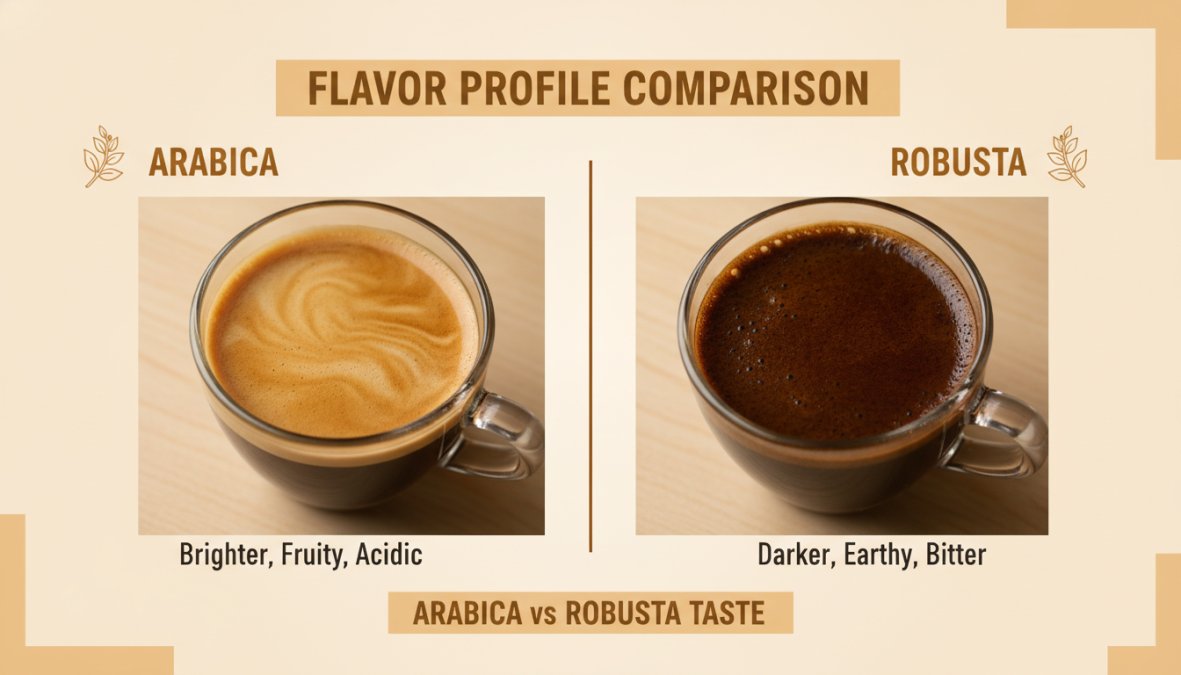
The difference between Arabica and Robusta taste becomes immediately obvious once you understand their flavor architecture. These are fundamentally different sensory experiences shaped by altitude, chlorogenic acid content, and sugar profiles.
Arabica Flavor Characteristics
Arabica presents as the "refined" coffee in direct comparison. The flavor profile leans toward brightness and complexity rather than boldness. You'll encounter fruity notes, berries, citrus, stone fruit, alongside floral aromatics like jasmine, hibiscus, or rose. These result from volatile compounds called esters that form during roasting, particularly in lighter roasts where more of these delicate molecules survive intact.
The acidity in Arabica is pronounced but pleasant, often described as "zesty" or "crisp." This acidity brightens the cup and adds complexity. The mouthfeel tends toward silky or tea-like, with a lighter body that lets individual flavor notes shine through. The finish is typically clean, with flavors fading relatively quickly rather than lingering intensely.
Robusta Flavor Characteristics
Robusta tastes bold, heavy, and earthy by comparison. Where Arabica reaches for floral and fruity notes, Robusta delivers dark chocolate, nuts, spice, and sometimes tobacco or leather undertones. The bitterness is intentional and structural, not a flaw but a core component of the flavor profile.
The body of Robusta is noticeably thicker and heavier than Arabica. Baristas often describe it as "syrupy" or "full-bodied." The mouthfeel is often described as astringent or peppery, with a drying sensation on the palate. The crema produced by Robusta is thicker, denser, and more persistent than Arabica's, which is why traditional Italian espresso blends contain 10-30% Robusta. The finish is longer and more lingering than Arabica, with bitter and earthy notes remaining on the palate for several seconds after swallowing.
Caffeine Content in Arabica vs Robusta
Robusta contains approximately 1.7-2.0% caffeine by weight, while Arabica contains roughly 0.8-1.4%. This means a cup of Robusta delivers roughly twice the caffeine punch of an equivalent cup of Arabica. A double shot of Robusta espresso delivers noticeably more stimulation than a double shot of Arabica.
However, brewing method matters significantly. A French press extracts more caffeine than a pour-over, regardless of bean type. Higher caffeine content in Robusta comes with higher chlorogenic acid content, which can increase gastric acidity for sensitive individuals.
Arabica vs Robusta Acidity Levels and Body
Acidity in coffee refers to brightness and complexity, not sourness. Arabica's higher acidity is one of its defining characteristics. The specific acids present, citric acid, malic acid, and others, contribute fruity, floral, and bright notes. This acidity is considered desirable in specialty coffee because it adds dimensionality and prevents the cup from tasting flat.
Robusta's lower acidity means fewer bright, fruity compounds. Instead, the flavor profile relies on earthy, bitter, and nutty notes. The reduced acidity also means Robusta is less likely to taste sour or sharp, even if brewed incorrectly, which is partly why it became the choice for commodity coffee and instant coffee production.
Body refers to the weight and texture of coffee in your mouth. Arabica's lighter body comes from lower lipid content and fewer suspended solids, allowing individual flavors to stand out clearly. Robusta's heavier body comes from higher lipid content and more suspended solids, creating a thicker, more viscous mouthfeel. In espresso, this heavy body is desirable because it creates a more luxurious sensory experience and contributes to dense crema.
Best Coffee Beans for Espresso: Arabica, Robusta, or Blends?
Pure Arabica espresso is increasingly popular in specialty shops and produces a cup with bright acidity, complex flavors, and lighter body. The extraction is challenging because Arabica's delicate structure can become over-extracted or under-extracted more easily than Robusta.
Traditional Italian espresso has historically used blends containing 10-30% Robusta for specific reasons: the Robusta provides thick crema, dark chocolate and nutty notes, and bitterness that balances Arabica's acidity. This blend creates a cup that's visually impressive, flavorful, and forgiving during extraction.
Modern espresso culture has shifted toward 100% Arabica blends, particularly in specialty coffee. However, quality matters more than species purity. A well-crafted 80/20 Arabica-Robusta blend often outperforms a poorly roasted 100% Arabica.
| Espresso Style | Best Bean Type | Flavor Profile | Crema Quality |
|---|---|---|---|
| Specialty/Modern | 100% Arabica | Bright, fruity, complex | Lighter, thinner |
| Traditional Italian | 80-90% Arabica + Robusta | Balanced, bold, rich | Thick, persistent |
| Commercial/Diner | High Robusta content | Dark, bitter, heavy | Very thick, stable |
| Single-Origin Focus | 100% Arabica | Region-specific, nuanced | Varies by origin |
Growing Conditions, Altitude, and Bean Appearance
Altitude and Growing Conditions
Arabica thrives at high altitude, typically between 800 and 2,200 meters above sea level. Cooler temperatures slow cherry ripening and allow sugars to develop more completely. The slower maturation extends the growing season, giving the plant more time to accumulate flavor compounds. High-altitude growing regions include the mountains of Ethiopia, Colombia, Central America, and parts of Indonesia.
Robusta grows at lower altitudes, typically 200-800 meters, in warmer climates. The plant tolerates heat, humidity, and rainfall variation better than Arabica. Growing regions include Vietnam (the world's largest Robusta producer), Indonesia, Uganda, and parts of Brazil. The lower altitude and warmer conditions mean faster plant growth and higher yields.
Bean Shape and Physical Differences
Arabica beans are distinctly oval, slightly elongated, with a curved center line (called the "S-cut"). The beans are typically larger than Robusta and have a more uniform appearance. Robusta beans are rounder and smaller, with a straight center line.
These physical differences matter during roasting. Arabica's larger size and different density mean it roasts slightly differently than Robusta. The shape also affects how water flows through the beans during brewing, influencing extraction rates.
Brewing Methods That Optimize Arabica and Robusta Flavors
Arabica shines in brewing methods that preserve delicate aromatics and highlight acidity. Pour-over methods (V60, Chemex, Kalita Wave) use paper filters that remove oils and suspend solids, creating a clean cup where individual flavor notes stand out. French press is less ideal for Arabica because the immersion method and metal filter allow more oils and suspended solids into the cup, which can muddy the delicate flavors.
Robusta performs better in methods that embrace its heavy body and bitterness. Espresso machines force hot water through finely ground coffee under pressure, extracting the bold, intense flavors that Robusta excels at. French press also works well with Robusta because the heavier body is an asset rather than a liability.
Robusta works best for: espresso, French press, Turkish coffee, and milk-based drinks where the bold flavors hold up to additional ingredients.
Sustainability and Environmental Impact of Each Species
Arabica's high-altitude requirement means farming often occurs on steep slopes prone to erosion. Large-scale Arabica plantations have contributed to deforestation in regions like Ethiopia and Colombia. However, quality-focused Arabica farming increasingly uses shade-grown methods, where coffee plants grow under a canopy of native trees. This approach restores habitat, improves soil health, and produces higher-quality coffee. The premium prices for specialty Arabica create economic incentives for sustainable farming.
Robusta's resilience makes it attractive for farmers facing climate pressures and pest threats. As climate change pushes growing zones higher in altitude, Robusta becomes viable in areas where Arabica struggles. However, the lower cost of Robusta production means sustainable farming practices are harder to implement economically.
Robusta's higher yields mean less land is required to produce equivalent coffee volume. A single hectare of Robusta produces roughly twice the coffee of a hectare of Arabica. From a pure land-use perspective, Robusta is more efficient.
The most sustainable choice isn't necessarily "pick Arabica" or "pick Robusta." Instead, seek out coffees with transparent sourcing information. Both Arabica and Robusta can be grown sustainably or destructively; the farming practices matter more than the species.
Understanding the difference between Arabica and Robusta taste transforms how you approach coffee. Once you recognize that Arabica's bright, fruity character and Robusta's bold, earthy intensity are features rather than one being objectively "better," you can choose coffee intentionally based on what you actually want to taste. Cuppari Coffee's diverse selection includes both single-origin Arabicas that showcase regional complexity and carefully selected Robusta options that reveal the species' true potential. With freshly roasted beans shipped the same day your order is placed, you'll experience these flavor differences at their peak. Start exploring the full spectrum of coffee flavor by trying both species side-by-side.
Frequently Asked Questions
What is the main taste difference between Arabica and Robusta coffee?
Arabica coffee typically offers a smoother, more complex flavor profile with fruity tones, zesty acidity, and subtle nutty or chocolaty notes. Robusta, by contrast, delivers a bolder, earthier taste with higher bitterness, less acidity, and a heavier body. The difference between Arabica and Robusta taste stems from their chemical composition, altitude requirements, and species genetics (Coffea arabica vs. Coffea canephora).
Does Robusta coffee have more caffeine than Arabica?
Yes. Robusta beans contain approximately 1.7-2% caffeine by weight, while Arabica contains about 1-1.5%. This higher caffeine content in Robusta contributes to its harsher, more bitter flavor profile. If you're seeking a higher caffeine boost, Robusta delivers more, though some prefer Arabica's smoother taste despite its lower caffeine levels.
Which coffee bean is better for espresso: Arabica or Robusta?
The best coffee beans for espresso depends on your preference. Arabica excels in single-origin espresso shots, delivering clarity and complexity. Robusta is traditionally used in espresso blends because its higher crema production, body, and bitterness complement Arabica's acidity. Many premium roasters blend both species to balance smoothness with richness and crema stability.
Why is Arabica coffee more expensive than Robusta?
Arabica commands higher prices due to its superior flavor profile, lower caffeine content (making it smoother), and more demanding growing conditions. Arabica requires higher altitude cultivation (600-2,000+ meters), cooler temperatures, and careful harvesting. Robusta is easier to grow at lower altitudes and more disease-resistant, making it cheaper to produce and market.
Can you mix Arabica and Robusta beans in the same brew?
Absolutely. Blending Arabica and Robusta is common in specialty coffee and espresso production. Robusta adds body, crema, and bitterness, while Arabica contributes complexity and acidity. A well-balanced blend can enhance mouthfeel and create a more interesting cup than either species alone. Freshly roasted blends from premium roasters like Cuppari Coffee deliver optimal flavor integration.
This article was written using GrandRanker