

Table of Contents
- What Does Ethically Sourced Coffee Really Mean?
- Fair Wages and Farmer Compensation: The Core Benefit
- Environmental Impact of Coffee Farming and Sustainability
- How to Identify Ethical Coffee Brands: Certifications and Verification
- Direct Trade vs. Fair Trade Coffee: Understanding the Difference
- Social Impact and Community Development Benefits
- Why Benefits of Buying Ethically Sourced Coffee Matter to You
- Conclusion: Making the Switch to Ethical Coffee
Benefits of Buying Ethically Sourced Coffee: A 2026 Guide
Last Updated: July 14, 2026
The specialty coffee market continues to expand as consumers increasingly prioritize where their purchases originate. The benefits of buying ethically sourced coffee extend far beyond a single cup, they reshape farming communities, protect ecosystems, and ensure that the people growing your morning brew earn fair compensation. Below, we'll show you how ethical sourcing works, why it matters, and how to identify genuinely ethical coffee versus greenwashing.
What Does Ethically Sourced Coffee Really Mean?
Ethically sourced coffee is coffee produced and traded in ways that prioritize fair compensation for farmers, environmental stewardship, and community investment throughout the entire supply chain. It means traceability from farm to cup, third-party verification of labor practices, and documented environmental management.
The term encompasses multiple frameworks: Fairtrade certification, Direct trade relationships, Organic farming practices, and sustainability standards like C.A.F.E. Practices and Rainforest Alliance. What unites them is a core commitment: ensuring that coffee farmers aren't trapped in poverty despite producing a commodity the world depends on.
Traditional coffee supply chains operate through multiple middlemen. A farmer sells to a local buyer, who sells to an exporter, who sells to an importer, who sells to a roaster. At each step, margins compress. The farmer often receives only 5-10% of the retail price. Ethical sourcing shortens this chain or adds transparency to it, ensuring farmers capture a larger share of the value they create.
Fair Wages and Farmer Compensation: The Core Benefit
Living Wages vs. Market Price
The commodity market price for coffee fluctuates daily based on global supply and demand. A farmer producing 10,000 pounds per year at $1.50 per pound earns $15,000 gross, before costs for seeds, labor, equipment, and transport. In coffee-growing regions where a family of four needs $8,000-$12,000 annually to meet basic needs, this leaves little margin.
A living wage for coffee farmers is typically $2.50-$3.50 per pound, depending on region and cost of living. This covers dignified living: children attending school, healthcare access, farm improvements, and emergency savings.
Ethically sourced coffee programs, particularly Fairtrade and Direct trade models, guarantee prices at or above these thresholds. When you buy ethically sourced coffee, you're directly funding the difference between subsistence and stability.
Income Stability for Smallholder Farmers
Market price volatility creates unpredictability. A farmer might see prices drop 40% between harvest cycles, forcing difficult choices: skip fertilizer, reduce labor, or pull children from school.
Ethical sourcing adds predictability through multi-year purchase commitments and price floors. A roaster buying through Direct trade might commit to purchasing 500 pounds annually at a fixed price, regardless of market swings. This allows farmers to plan, invest in soil health, and expand production without fear of catastrophic collapse.
Environmental Impact of Coffee Farming and Sustainability
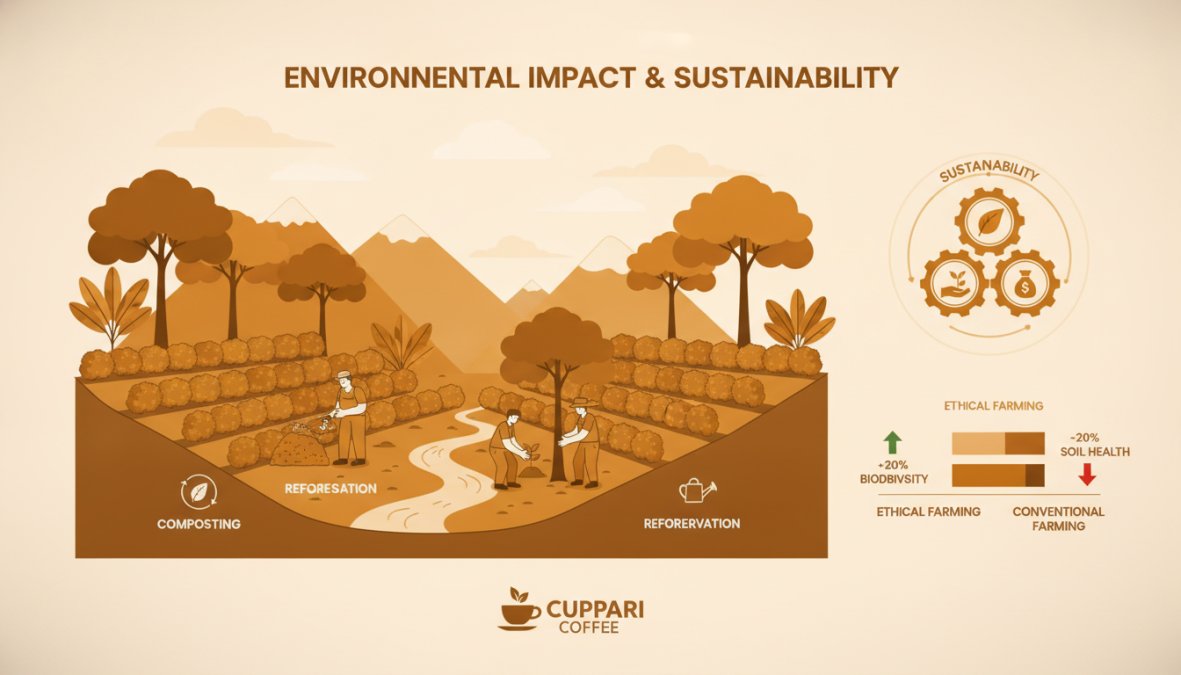
Coffee farming has historically driven deforestation in biodiversity hotspots. The environmental benefits of buying ethically sourced coffee are substantial and measurable.
Shade-Grown Coffee and Biodiversity
Shade-grown coffee is cultivated under a canopy of native trees rather than in full sun monocultures. Shade-grown farms host 50-90% of the bird species found in intact forests, compared to 5-10% on sun-grown plantations.
The trees prevent soil erosion, reduce water runoff, provide habitat for natural pest predators, and sequester carbon. Farmers practicing shade-grown methods report lower pesticide and fertilizer costs because natural predators manage pests.
Many ethically sourced certifications, particularly Rainforest Alliance and organic standards, require or incentivize shade-grown practices. When you buy this coffee, you're funding ecosystem preservation in biodiverse regions.
Carbon Footprint Reduction
A typical cup of coffee has a carbon footprint of 0.55 kg CO2-equivalent. The farming stage represents 40-50% of this footprint.
Ethical sourcing reduces carbon impact through reduced chemical inputs (organic methods eliminate energy-intensive synthetic fertilizer production), soil carbon sequestration (healthy soils store more carbon), shorter supply chains (fewer middlemen reduce transport), and renewable energy adoption in processing.
Moving from conventional to ethical sourcing might reduce footprint by 15-25%, which compounds across billions of cups annually.
How to Identify Ethical Coffee Brands: Certifications and Verification
Not all ethical coffee claims are equal. The market includes genuine commitments, greenwashing, and everything in between.
Third-Party Certifications: Fairtrade, Organic, Rainforest Alliance, C.A.F.E. Practices
Fairtrade ensures minimum prices, prohibits forced labor, requires democratic farmer cooperatives, and invests 5% of premiums into community development. The label is globally recognized and rigorously verified.
Organic certification prohibits synthetic pesticides and fertilizers, reducing chemical runoff and supporting farmer health.
Rainforest Alliance focuses on biodiversity protection, worker rights, and sustainable livelihoods.
C.A.F.E. Practices uses a points-based system assessing productivity, environmental performance, social responsibility, and quality.
| Certification | Price Floor | Focus | Verification |
|---|---|---|---|
| Fairtrade | $1.40/lb minimum | Fair wages, democracy | Annual audits |
| Organic | Market + 20-30% | Chemical-free farming | Yearly inspections |
| Rainforest Alliance | Market + 10-15% | Biodiversity, livelihoods | Annual certification |
| C.A.F.E. Practices | Market + varies | Productivity, sustainability | Triennial audits |
Look for at least one recognized certification on the bag.
Supply Chain Transparency and Traceability
Ethical brands provide traceability information: the specific farm or cooperative, region and elevation, farmer's name, processing method, and tasting notes. Many offer QR codes on packaging linking to supply chain details. If a brand claims ethical sourcing but provides no traceability information, that's a red flag.
Cuppari Coffee emphasizes transparency by roasting beans only after an order is placed, ensuring freshness and connecting you directly to the roasting process.
The Greenwashing Checklist
- Vague language: "Responsibly sourced," "ethically made" without specifics → Red flag
- Missing certification: Claims ethics but displays no third-party badge → Red flag
- No supply chain info: Can't name the farm or region → Red flag
- Price too low: If ethical coffee costs the same as commodity coffee → Red flag
- No farmer investment data: Claims to support farmers but doesn't show how → Red flag
Genuine ethical brands are happy to discuss sourcing, provide specific names and regions, and explain how much of the price goes to farmers.
Direct Trade vs. Fair Trade Coffee: Understanding the Difference
Direct Relationships with Coffee Roasters
Direct trade eliminates middlemen by connecting roasters directly to farms or farmer cooperatives. A roaster visits the farm, negotiates prices face-to-face, and builds long-term relationships.
Advantages: Higher farmer income (30-50% above commodity prices), quality focus, relationship building, and transparency. Disadvantages: No standardized verification, scale limitations, and farmer vulnerability if a roaster drops them.
Fair trade operates through certified cooperatives and standardized contracts. A roaster buys from a certified cooperative, which aggregates coffee from many small farmers. The Fairtrade organization audits both.
Advantages: Standardized protections, global scale, third-party verification, and risk distribution. Disadvantages: Less personal relationships, bureaucracy, and price ceilings.
The best ethical coffee often combines both: a roaster buying directly from a Fairtrade-certified cooperative.
Premium Pricing and Farmer Profitability
When you pay $14-$18 per pound for specialty ethically sourced coffee (versus $6-$8 for conventional), a typical breakdown for a $16 bag:
- Farmer/cooperative: $4-$5
- Exporter/importer: $1.50
- Roaster: $5-$6
- Retailer: $3-$4
The farmer receives 25-30% of retail price, compared to 5-10% for commodity coffee. That difference allows investment in soil health, equipment, education, and emergency reserves.
Social Impact and Community Development Benefits
Beyond Fair Pay: Education and Infrastructure
Fairtrade premiums, 5-10% of purchase price, fund community projects chosen by farmers themselves: school construction and scholarships, healthcare facilities, water systems, and cooperative equipment.
A 2026 study tracking Fairtrade communities found that farmers in certified regions had 40% higher school enrollment rates for children and 35% better access to healthcare compared to non-certified regions. These are measurable improvements in human welfare.
Post-Purchase Impact Tracking
Some ethical coffee brands now offer impact tracking: scan a QR code and see exactly which projects your purchase funded. A typical impact statement might read: "Your purchase contributed $0.47 to the Cooperative's education fund, helping fund scholarships for 12 children in the 2026 school year."
Why Benefits of Buying Ethically Sourced Coffee Matter to You
Quality, Freshness, and Taste Consistency
Ethical sourcing correlates with quality because farmers paid premium prices are incentivized to improve quality over volume. Traceability ensures consistency, you know the farm, harvest, and processing method. Ethically sourced coffee is often roasted to order or in small batches, preserving freshness.
Cuppari Coffee roasts beans only after an order is placed and ships the same day, guaranteeing peak freshness within days of roasting rather than months. Fresh, ethically sourced coffee tastes noticeably different: brighter acidity, more complex flavor notes, better body.
Ethical Consumption and Consumer Responsibility
The coffee industry employs 125 million people globally, most of them smallholder farmers in developing countries. Your purchasing decisions have real consequences.
Choosing ethically sourced coffee is one of the highest-impact consumer choices available. Unlike many ethical purchases requiring significant sacrifice, ethical coffee often tastes better and costs only marginally more than conventional specialty coffee. The ethical choice is also the selfish choice: you get better coffee, support farmers, protect ecosystems, and invest in community development.
Making the switch to ethically sourced coffee means choosing quality over convenience, knowing your money reaches farmers directly, and tasting the difference that care makes in every cup. Cuppari Coffee delivers premium, freshly-roasted beans roasted only after your order is placed and shipped the same day, ensuring guaranteed freshness while connecting you to transparent, ethical sourcing. With free shipping on all U.S. orders and a diverse selection of single-origin and blended options, you can experience the goodness of ethically sourced coffee without compromise.
Frequently Asked Questions
What does ethically sourced coffee actually mean?
Ethically sourced coffee refers to beans produced with fair wages for farmers, environmental stewardship, and transparent supply chains. It ensures smallholder farmers receive living wages, not just market prices, and that sustainable agriculture practices protect biodiversity and reduce carbon footprint. Third-party certifications like Fairtrade, Organic, and Rainforest Alliance verify these standards, while direct trade relationships offer traceability from farm to roaster.
How can you identify ethical coffee brands and avoid greenwashing?
Look for verified certifications from recognized bodies like Fairtrade, C.A.F.E. Practices, or Rainforest Alliance. Check for supply chain transparency, ethical roasters disclose farm origins and farmer names. Verify claims independently rather than trusting marketing alone. Ask roasters about premium pricing, farmer compensation, and community investment. Avoid vague terms like 'responsibly sourced' without third-party verification. Direct trade coffee roasters often provide detailed traceability information that proves genuine commitment beyond marketing.
What is the difference between fair trade and direct trade coffee?
Fair trade uses third-party certification to ensure minimum prices and labor standards across supply chains, benefiting many smallholder farmers through cooperatives. Direct trade eliminates middlemen, creating direct relationships between roasters and specific farms, often resulting in higher farmer profitability and better quality control. Direct trade offers greater transparency and traceability but reaches fewer farmers, while fair trade provides broader reach and income stability through certified cooperatives and guaranteed minimum prices.
Does buying ethically sourced coffee really make a difference for farmers?
Yes. Ethically sourced coffee ensures farmers earn living wages rather than volatile market prices, providing income stability for smallholder farmers and their families. Premium pricing from direct trade and fair trade models funds community development, schools, healthcare, and infrastructure. Sustainable agriculture practices improve long-term farm profitability by protecting soil health and biodiversity. Post-purchase impact tracking shows how your purchase directly supports farmer welfare, environmental conservation, and local economic growth in coffee-producing regions.
This article was written using GrandRanker