

Table of Contents
- Why the Benefits of Fresh Ground Coffee Go Beyond Taste
- The Enemies of Coffee Freshness: Air, Moisture, Heat, and Light
- How to Store Coffee Beans for Freshness: Short-Term vs. Long-Term Protocols
- Impact of Grind Size on Coffee Flavor: Why Grinding Fresh Changes Everything
- Choosing the Best Coffee Grinder for Home Use
- How Roast Level Affects Storage and the Benefits of Fresh Ground Coffee
- Troubleshooting Stale Coffee: How to Tell and What to Do
- Conclusion
Last Updated: May 28, 2026
The moment coffee is ground, a countdown begins. Volatile aromatic compounds start escaping, oxygen attacks the exposed surface area, and the flavor complexity you paid for starts collapsing within minutes. Understanding the benefits of fresh ground coffee is not just about taste preference; it is about recognizing the chemistry behind what separates a remarkable cup from a forgettable one. At Cuppari Coffee, we roast only after an order is placed and ship the same day, because freshness is not a marketing claim, it is the entire point. Below, we will show you exactly how to store, grind, and select coffee to preserve every bit of what makes a great bean worth buying.
Here is what most guides get wrong: they treat freshness as a single variable. It is not. Freshness has layers, roast date, grind timing, storage conditions, container materials, and even roast level all interact to determine what ends up in your cup.

Why the Benefits of Fresh Ground Coffee Go Beyond Taste
Fresh ground coffee is the practice of grinding whole beans immediately before brewing, preserving volatile aromatic compounds, carbon dioxide, and flavor oils that degrade rapidly once the bean's cell structure is broken open. The benefits extend well beyond a richer aroma, they include a more complex flavor profile, better extraction consistency, and a cup that actually reflects the origin characteristics the roaster intended.
What Happens to Coffee the Moment It's Ground
Grinding shatters the bean's protective structure. Before that moment, the bean acts as a natural barrier, trapping carbon dioxide produced during roasting and protecting the oils responsible for flavor. The instant grinding occurs, surface area increases dramatically, pre-ground coffee can have up to a thousand times more exposed surface area than whole beans, and oxidation begins immediately.
Within 15 minutes of grinding, measurable aromatic loss occurs. Within an hour, a significant portion of the volatile compounds responsible for brightness and complexity have dissipated. This is not a slow decline; it is a rapid one. Grinding fresh is the single highest-impact variable a home brewer controls.
Oxidation, Carbon Dioxide, and the Science of Staleness
Oxidation is the chemical reaction between coffee's organic compounds and atmospheric oxygen. It breaks down lipids, degrades chlorogenic acids, and produces flat, papery, or even rancid flavors. Carbon dioxide, produced during roasting through the Maillard reaction, acts as a natural preservative inside whole beans by displacing oxygen. Once ground, that protective CO2 releases within minutes rather than days.
This is why third-wave roasters rest whole beans for 24-72 hours after roasting, a process called degassing, before packaging. The beans need to off-gas excess CO2 before sealing, otherwise pressure builds inside the bag. But after that initial rest, the remaining CO2 is an asset, and grinding destroys it. As documented in the Specialty Coffee Association's research on coffee freshness and degassing, CO2 retention is a primary indicator of bean freshness and directly influences extraction quality.
The Enemies of Coffee Freshness: Air, Moisture, Heat, and Light
Four variables destroy coffee faster than anything else: air, moisture, heat, and light. Every guide on the internet lists them. Almost none explain how they interact differently depending on your roast level, and that distinction changes what you should actually do about each one.
- Air: Oxygen triggers oxidation, breaking down lipids, volatile aromatic esters, and chlorogenic acids within hours of exposure. The mechanism is not uniform: lighter roasts, which retain more intact cell structure, resist oxidation slightly longer than dark roasts, whose porous, oil-coated surfaces present dramatically more reactive area to atmospheric oxygen.
- Moisture: Coffee is hygroscopic, meaning it actively absorbs water vapor from the surrounding environment. This property is more dangerous for light roasts than most people realize, because light roasts retain more of their original moisture content from the green bean stage, additional ambient moisture pushes them toward microbial activity faster than a dark roast at the same humidity level.
- Heat: Elevated temperatures accelerate every chemical degradation process, including the Maillard-derived compound breakdown that strips coffee of its roast character. Heat above roughly 25°C (77°F) meaningfully shortens shelf life; a bag stored near an oven or on a sun-warmed counter can stale in days rather than weeks.
- Light: UV and visible light catalyze oxidation and degrade chlorogenic acids, the compounds responsible for brightness and perceived acidity. This is not a slow process, direct sunlight on a clear glass jar of beans can produce measurable flavor degradation within a single day of exposure.
How Roast Level Changes Your Exposure to Each Enemy
This is the nuance almost no storage guide addresses: the same four enemies hit light and dark roasts differently, which means the correct defensive strategy is not identical for both.
Dark roasts are the most vulnerable to air and heat. The roasting process breaks down the bean's cellular walls more aggressively, creating a porous, sponge-like structure. Surface oils, the visible sheen on a dark roast bean, are already partially oxidized from the roasting process itself. Exposure to air accelerates rancidity in those oils rapidly. A dark roast left in a loosely sealed bag at room temperature near a warm appliance can turn noticeably flat within five to seven days of opening.
Light roasts are denser and less porous, which provides some natural resistance to air. Their greater vulnerability is moisture. Because light roasts are pulled from the roaster earlier, they retain more residual moisture in the bean matrix. In a humid kitchen environment, common in summer months or near a stovetop, a light roast can absorb enough ambient moisture to begin clumping and developing off-flavors before oxidation becomes the primary problem. For light roast storage, humidity control matters more than it does for dark roasts.
Medium roasts sit in between: moderate porosity, moderate oil development, moderate moisture retention. They are the most forgiving of the three categories under imperfect storage conditions, which is one reason medium roasts dominate commercial retail, they survive the supply chain better.
Why the Refrigerator Is a Compounding Mistake
The refrigerator is a perfect storm of three of the four enemies. It introduces moisture through condensation every time the door opens, a cycle that repeats dozens of times daily in a typical household. Coffee's hygroscopic nature means it absorbs both that moisture and every ambient food odor in the refrigerator simultaneously. The same property that makes coffee grounds useful for deodorizing a freezer makes storing coffee near leftovers, onions, or aged cheese a serious flavor contamination risk.
Critically, the refrigerator does not compensate for these problems by being cold enough to meaningfully slow oxidation. True preservation-level cold requires freezer temperatures. The refrigerator's temperature range, typically 1°C to 4°C (34°F to 39°F), is cold enough to cause condensation damage on every retrieval but not cold enough to slow chemical degradation to the degree that would justify the moisture risk. It delivers the worst of both worlds.
The Hygroscopic Problem in Practice
Hygroscopic means a substance readily absorbs moisture from the air. For coffee, this plays out in two practical ways that most guides understate.
First, moisture absorption accelerates oxidative rancidity. Water molecules act as a transport medium for oxygen, allowing it to reach lipid compounds inside the bean more efficiently than dry-air oxidation alone. According to food science principles well established in the study of lipid-rich foods, even small increases in water activity, a measure of available moisture, significantly accelerate rancidity development. Coffee, with its high lipid content (particularly in dark roasts), is directly subject to this mechanism.
Second, moisture causes clumping in ground coffee that disrupts dosing accuracy and grind consistency. If you notice your ground coffee clumping together in the bag or container, moisture infiltration is almost always the cause, and it means the staling process is already well underway.
A cool, dry environment with low ambient humidity is non-negotiable. In practice, this means a cabinet away from the stovetop, sink, and dishwasher, all of which generate steam and heat that elevate the local humidity around whatever is stored nearby.
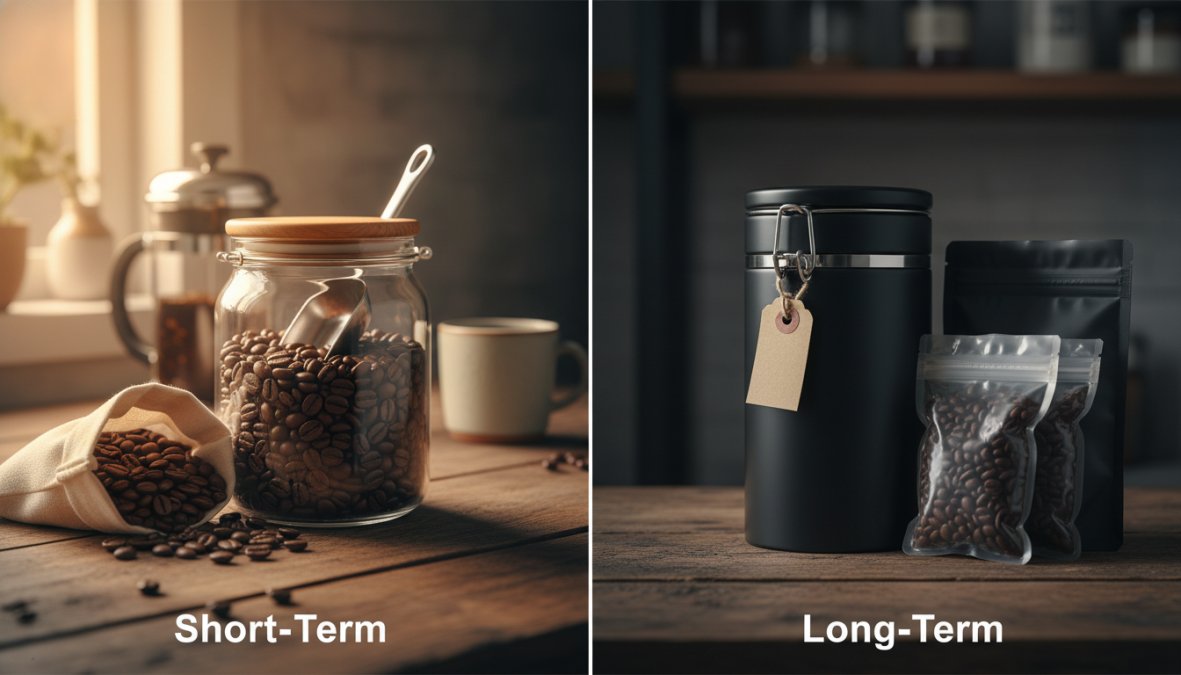
How to Store Coffee Beans for Freshness: Short-Term vs. Long-Term Protocols
Proper coffee storage depends on your consumption timeline. Short-term and long-term protocols differ significantly, and conflating them leads to most of the common mistakes.
Short-term storage (within 2-4 weeks of roast date):
- Store in an opaque, airtight container at room temperature
- Keep away from direct sunlight, heat sources, and strong odors
- Avoid opening the container more than once daily
- Do not refrigerate
Long-term storage (beyond 4 weeks):
- Divide beans into single-use portions before freezing
- Vacuum seal each portion to eliminate oxygen
- Freeze in airtight, opaque containers or vacuum-sealed bags
- Thaw at room temperature without reopening until fully thawed, condensation is the enemy
The Role of the Original Retail Bag and One-Way Valve Packaging
The retail bag from a quality roaster is more sophisticated than it looks. Most specialty coffee bags include a one-way valve, a small circular component that allows carbon dioxide to escape during degassing while preventing oxygen from entering. This design solves a real engineering problem: freshly roasted beans off-gas aggressively, and sealing them completely without a valve would cause the bag to burst.
The original retail bag is genuinely good short-term storage, provided it can be resealed tightly after opening. Many bags include a ziplock-style seal for exactly this reason. Where it falls short is after repeated opening, which allows oxygen infiltration. At that point, transferring to a dedicated airtight container makes sense.
Airtight Containers: Opaque vs. Clear, and Which Materials Win
Container choice matters more than most guides acknowledge. Here is a direct comparison of the most common materials:
| Container Type | Light Protection | Seal Quality | CO2 Management | Best For |
|---|---|---|---|---|
| Opaque ceramic with rubber seal | Excellent | Good | Passive only | Short-term, daily use |
| Stainless steel with airtight lid | Excellent | Excellent | Passive only | Short-term, heavy use |
| Vacuum-sealed canister (e.g., Airscape) | Excellent | Excellent | Active CO2 displacement | Short-term, optimal choice |
| Clear glass mason jar | None | Good | Passive only | Avoid for light-exposed storage |
| Original retail bag (one-way valve) | Good | Moderate | Active degassing | First 1-2 weeks post-roast |
| Plastic containers | Variable | Variable | Poor | Not recommended |
Clear glass mason jars are popular and inexpensive, but they offer zero light protection. Store them in a dark cabinet and they become adequate. Leave them on a sunlit counter and they accelerate staling noticeably. Vacuum-sealed canisters that actively displace oxygen are the strongest short-term option for home use.
Should You Freeze Coffee Beans? The Truth About the Freezer
Freezing coffee beans is one of the most debated topics in specialty coffee, and the answer is more nuanced than a simple yes or no.
Freezing works, but only under specific conditions. The problem is not the freezer itself; it is the freeze-thaw cycle and moisture exposure. Every time frozen beans are removed and partially thawed before being returned to the freezer, condensation forms on the cold beans, introducing moisture that accelerates staling dramatically.
The correct protocol: portion beans into single-use quantities before freezing, vacuum seal each portion, and never return a thawed portion to the freezer. Thaw at room temperature in the sealed bag, then use within a week. This approach can extend shelf life to 2-3 months without meaningful flavor loss, according to food science guidance from the National Coffee Association on coffee storage best practices.
Freezer burn is a real risk for improperly sealed beans. It occurs when moisture evaporates from the bean's surface, leaving dry, papery patches that taste exactly as bad as they sound.
Impact of Grind Size on Coffee Flavor: Why Grinding Fresh Changes Everything
Grind size is the variable that most directly controls extraction rate. Too fine and you over-extract, producing bitterness and astringency. Too coarse and you under-extract, producing sourness and thin body. The impact of grind size on coffee flavor is only fully realized when the grind is fresh, stale pre-ground coffee produces flat, muted results regardless of how precisely it is sized.
Fresh grinding gives you two advantages simultaneously: you control the particle size for your specific brew method, and you capture the volatile aromatics at their peak. These two benefits compound each other.
Matching Grind Size to Brew Method: Pourover, French Press, and More
Different brew methods require different grind sizes because they use different contact times between water and coffee.
- Espresso: Extra fine (resembles table salt), short contact time, high pressure
- Pourover (V60, Chemex): Medium-fine to medium, 3-4 minute total brew time
- Drip machine: Medium (resembles coarse sand), 5-6 minute brew cycle
- French press: Coarse (resembles sea salt), 4-minute immersion steep
- Cold brew: Extra coarse, 12-24 hour cold immersion
The French press is particularly sensitive to grind consistency. Uneven particles produce both over-extracted fines (bitter) and under-extracted coarse chunks (sour) in the same cup. This is where grinder quality becomes as important as grinding fresh.
Choosing the Best Coffee Grinder for Home Use
The best coffee grinder for home use is a burr grinder, specifically a conical burr model for most home brewers, because it produces consistent particle sizes across the full grind range rather than the chaotic, uneven fragments a blade grinder creates. But the reason consistency matters is directly tied to the freshness argument: grinding fresh only delivers its full benefit when the grind itself is uniform. An inconsistent grind from a blade grinder wastes the volatile aromatics you just unlocked by grinding fresh, because uneven particles extract at different rates and muddy the flavor the fresh grind was supposed to preserve.
Blade vs. Burr Grinders: The Mechanism Behind the Difference
Blade grinders chop beans randomly using a spinning metal blade, the same mechanism as a spice grinder or blender. The result is a bimodal distribution: a mixture of fine dust and large chunks. This is not a matter of technique or grind time, it is a structural limitation of the cutting mechanism. No amount of pulsing or shaking produces a uniform particle size from a blade grinder.
The practical consequence: in a single dose of blade-ground coffee, some particles are fine enough to over-extract within seconds, producing bitterness and astringency, while larger chunks under-extract and contribute sourness and thin body. The cup tastes like both at once, not because the beans are bad or the brewing is wrong, but because the grind distribution makes consistent extraction physically impossible.
Burr grinders crush beans between two abrasive surfaces, the burrs, set at a precise, adjustable distance. Every particle that passes through exits at approximately the same size, determined by the gap setting. This is what allows you to dial in a specific grind size for pourover, reproduce it the next morning, and adjust it meaningfully when you switch brew methods. The grind becomes a controllable variable rather than a random one.
Conical vs. Flat Burr: Which Matters for Home Use
This distinction is worth understanding because it affects both performance and maintenance, though it is often overstated in consumer marketing.
Conical burr grinders use a cone-shaped inner burr rotating inside a ring-shaped outer burr. Beans feed by gravity and are crushed as they move downward through the narrowing gap. Conical burrs tend to produce a slightly bimodal distribution, a small percentage of fines alongside the target particle size, which many brewers find adds body to the cup. They run at lower RPM, generate less heat during grinding, and are generally easier to clean. For most home brewing methods, pourover, French press, drip, and even entry-level espresso, a conical burr grinder is the practical choice.
Flat burr grinders use two parallel ring-shaped burrs facing each other. They tend to produce a more uniform, unimodal particle distribution, which translates to cleaner, more precise extraction. This precision matters most for espresso, where the narrow margin between under- and over-extraction makes particle uniformity critical. Flat burr grinders at the home-use price range also tend to retain more ground coffee between doses (called retention), which means some of what you grind stays in the grinder rather than making it to your cup, a minor freshness consideration worth noting.
For most home brewers not focused on espresso, the conical vs. flat distinction is less important than the blade vs. burr distinction. A mid-range conical burr grinder produces a more noticeable improvement in cup quality than the jump from conical to flat burr at equivalent price points.
Grinder Quality and the Freshness Connection
Here is the angle most grinder guides miss: grinder quality and grinding fresh are not independent variables, they compound each other.
When you grind fresh, you release volatile aromatic compounds at their peak concentration. Those compounds are present for a narrow window, measurable aromatic loss begins within 15 minutes of grinding. A blade grinder's inconsistent particle distribution means a significant portion of those freshly released aromatics are trapped in over-sized chunks that will under-extract, or lost in the fine dust that over-extracts and turns bitter. You captured the freshness but wasted it in the brew.
A quality burr grinder ensures that the aromatic compounds released by fresh grinding are actually extracted into the cup at the right rate. The two practices, grinding fresh and grinding consistently, are designed to work together. Optimizing one without the other leaves meaningful cup quality on the table.
Practical Grinder Recommendations by Brew Method
Rather than a single recommendation, match the grinder type to how you actually brew:
- Pourover (V60, Chemex, Kalita Wave): Conical burr grinder with stepless or fine-stepped adjustment. Grind consistency at medium-fine settings is the priority. Hand grinders in this category, such as those from Comandante or 1Zpresso, produce results competitive with electric grinders at two to three times the price, and their slower grinding speed generates less frictional heat.
- French press and cold brew: Any quality conical burr grinder performs well at coarse settings, where the larger particle size is more forgiving of minor inconsistencies. This is the most accessible entry point for burr grinder use.
- Drip machine: A mid-range conical burr grinder at medium settings. The drip machine's fixed brew cycle limits how much grind precision you can actually leverage, making this the least demanding application.
- Espresso: Flat burr grinders or high-quality conical burr grinders with fine-stepped or stepless adjustment. Espresso is the most demanding application, small grind changes produce large extraction changes at high pressure, and it is the one context where investing in a higher-quality grinder produces the most measurable return.
The Dark Roast Grinder Maintenance Factor
One practical consideration that connects grinder choice back to roast level: dark roast beans coat burrs with oils significantly faster than light or medium roasts. These residual oils oxidize between uses and can impart rancid, stale flavors to subsequent grinds, effectively contaminating fresh beans with the byproduct of previous sessions.
If you primarily drink dark roasts, clean your burr grinder every two to three weeks using a dry brush or grinder cleaning tablets. Flat burr grinders, with their more complex geometry, are harder to clean thoroughly at home than conical burr models, another practical point in favor of conical burrs for dark roast drinkers. Blade grinders, with their open chamber design, accumulate oily residue rapidly and are nearly impossible to clean completely, which is an additional freshness argument against them beyond particle consistency.
How Roast Level Affects Storage and the Benefits of Fresh Ground Coffee
Roast level changes the physical structure of the bean in ways that directly affect storage behavior. Light roasts are denser, retain more moisture, and off-gas less aggressively than dark roasts. Dark roasts are more porous, oil-rich, and volatile, they stale faster and require more careful storage.
This means the benefits of fresh ground coffee are most pronounced with dark roasts, where the aromatic compounds are most fragile and the degradation timeline is shortest. A dark roast left as pre-ground for three days will taste dramatically flatter than the same beans ground fresh. A light roast shows the same degradation but on a slightly longer timeline.
Practical implications by roast level:
- Light roast: Shelf life as whole beans is 4-6 weeks post-roast; grind within 30 minutes of brewing
- Medium roast: Shelf life 3-4 weeks post-roast; grind within 20 minutes of brewing
- Dark roast: Shelf life 2-3 weeks post-roast; oils on bean surface accelerate oxidation; grind immediately before brewing
Oil-coated dark roast beans also clog grinder burrs faster than light roasts. Clean your burr grinder every 2-3 weeks if you primarily drink dark roasts, residual oils turn rancid and contaminate subsequent grinds.
Troubleshooting Stale Coffee: How to Tell and What to Do
Stale coffee has a distinctive set of characteristics that are easy to identify once you know what to look for. The most reliable diagnostic is the bloom test: pour a small amount of hot water over your grounds and watch for CO2 release. Fresh coffee blooms vigorously, with bubbles and expansion. Stale coffee produces little to no bloom, the CO2 is already gone.
Additional signs of stale coffee:
- Flat aroma: Fresh beans smell complex and distinct; stale beans smell faint or like cardboard
- Oily surface on dark roasts that smells rancid: Surface oils have oxidized
- Flat, one-dimensional cup: No brightness, no finish, no complexity
- Sour without acidity: Under-extraction symptoms even at correct grind settings
What to do with stale beans: do not throw them out immediately. Stale beans still make acceptable cold brew, where the long extraction time and cold water compensate for some flavor loss. They also work in baked goods where coffee flavor is a supporting note rather than the star. For espresso or pourover, though, stale beans produce a cup that no technique can rescue.
The most effective prevention is buying in smaller batches more frequently. A 250g bag consumed within two weeks beats a 1kg bag that sits open for six weeks every time. As noted in guidance from the Specialty Coffee Association on consumer freshness standards, peak flavor for most roasted coffee occurs between 7 and 21 days post-roast, with a steep quality decline after 30 days once the bag is opened.
Cuppari Coffee addresses this directly: beans are roasted only after an order is placed and shipped the same day, which means the coffee arrives at peak freshness rather than after weeks in a warehouse. The sealed capsule format keeps oxygen out entirely, and the improved filter design captures more grounds for a consistently clean, lively cup.
Most coffee drinkers are not getting the cup their beans are capable of producing. The gap between what fresh ground coffee can taste like and what stale pre-ground delivers is not subtle, it is the difference between a flat, forgettable morning ritual and something genuinely worth stopping for. Cuppari Coffee roasts every order to order and ships the same day, so you start the freshness chain at its strongest possible point. Add to cart and experience what peak-roast whole beans, ground fresh at home, actually taste like.
Frequently Asked Questions
Does fresh ground coffee really taste better than pre-ground?
Yes, the benefits of fresh ground coffee on flavor are significant. Once coffee is ground, it exposes a much larger surface area to air, causing rapid oxidation that dulls aroma and flattens flavor. Whole bean coffee retains its volatile aromatic compounds until the moment of grinding. Grinding just before brewing preserves the full flavor profile, producing a noticeably brighter, more complex cup compared to pre-ground coffee that may have been sitting for days or weeks.
How long does coffee stay fresh after grinding?
Ground coffee begins losing freshness within minutes of grinding due to oxidation and the rapid release of carbon dioxide. For the best results, grind only what you need immediately before brewing. If you must store ground coffee, keep it in an airtight container away from heat, moisture, and direct sunlight, and use it within one to two weeks. Whole bean coffee stored properly stays fresh for two to four weeks after the roast date.
What grind size should I use for my brew method, and does it affect freshness?
Grind size has a major impact on coffee flavor and extraction. A coarse grind suits French press, a medium grind works well for drip and pourover, and a fine grind is ideal for espresso. Grinding fresh to the correct size for your brew method maximizes both extraction efficiency and flavor. Using the wrong grind size, even with fresh beans, can produce under-extracted (sour) or over-extracted (bitter) results, undermining the benefits of fresh ground coffee.
What equipment do I need to start grinding coffee at home?
The best coffee grinder for home use is a burr grinder, either manual or electric. Burr grinders crush beans uniformly to a consistent grind size, which directly improves extraction and flavor. Blade grinders chop unevenly and generate heat that can slightly degrade aroma. Entry-level burr grinders are available at accessible price points and make a noticeable difference. Pair your grinder with an airtight, opaque storage container and whole bean coffee with a visible roast date for best results.
Should you store coffee beans in the refrigerator or freezer?
Avoiding the refrigerator is strongly recommended, coffee is hygroscopic, meaning it readily absorbs ambient moisture and odors, and the fridge is full of both. For short-term use (within two weeks), store beans in an airtight opaque container at room temperature away from heat and light. Freezing is acceptable for long-term storage only if beans are vacuum-sealed in airtight, single-use portions to prevent freezer burn and condensation when thawing.
This article was written using GrandRanker