

Table of Contents
-
What to Look for in a Budget Espresso Machine
- Manual Lever Machines: Total Control, Steepest Curve
- Semi-Automatic Machines: The Standard for Home Baristas
- Automatic and Super-Automatic Machines: Push-Button Convenience
- The Grinder: The Real Key to Great Espresso
- Portafilter Size and Basket Type: Your Growth Ceiling
- The Bottom Line for Beginners
- The 5 Best Affordable Home Espresso Machines for Beginners
- How to Dial In Espresso for Beginners
- Best Coffee Beans for Espresso
- Essential Espresso Accessories for Home Baristas
- Common Beginner Mistakes and How to Fix Them
- The Real Cost of Home Espresso: Budget and Maintenance
- Which Affordable Espresso Machine Should You Pick?
- Frequently Asked Questions
Last Updated: September 9, 2026
The path to great espresso at home starts with a machine that fits your budget and skill level, not with a $3,000 commercial setup. An affordable home espresso machines guide from Cuppari Coffee helps you cut through the noise.
The best budget espresso machines balance three things: consistent pressure, decent temperature control, and a steam wand that actually textures milk. Below, we break down the five models that earned their place on our counter, plus the habits that turn decent shots into cafe-quality pulls.
What to Look for in a Budget Espresso Machine
Before comparing price tags, understand the three main types of espresso machines. Each offers a different balance of control, convenience, and learning curve.
Manual Lever Machines: Total Control, Steepest Curve
A manual lever machine, like the Flair Neo or the Cafelat Robot, has no pump. You supply the pressure by pulling down on a lever, giving you complete control over the pressure profile, but it also means you are the machine. There is no steam wand, so you will need a separate milk frother for lattes or cappuccinos.
Semi-Automatic Machines: The Standard for Home Baristas
Semi-automatic machines, which include every model on our list, use a pump to push water through the coffee at a consistent pressure. You control the grind size, dose, and when to stop the shot. Within it, there are two important sub-types:
- Single Boiler (SB): One boiler heats water for both brewing and steaming. You must wait for the boiler to switch temperature between pulling a shot and steaming milk. This is common on budget machines like the De'Longhi Stilosa. It is a minor inconvenience, not a deal-breaker, especially if you mostly drink straight espresso or Americanos.
- Thermojet or Thermocoil: Instead of a traditional boiler, these systems heat water on demand as it passes through a heating block. The Breville Bambino Plus uses a Thermojet, which reaches brewing temperature in about 3 seconds (breville.com). This eliminates the wait time entirely and is a major advantage for beginners who want a quick latte.
Automatic and Super-Automatic Machines: Push-Button Convenience
Automatic machines, like the Breville Barista Express Impress, automate parts of the process, such as grinding, dosing, and tamping. Super-automatic machines, like those from Philips or Jura, do everything at the touch of a button. While these are the easiest to use, they typically cost more and offer less control over the final flavor.
The Grinder: The Real Key to Great Espresso
Every expert guide, from Home-Barista to the Specialty Coffee Association, will tell you the same thing: the grinder matters more than the machine. A $500 espresso machine paired with a $50 blade grinder will produce worse coffee than a $150 machine paired with a $200 burr grinder. You need a burr grinder, which crushes beans between two abrasive surfaces to create uniform particles.
For beginners, look for a grinder with a wide range of fine settings. The Baratza Encore ESP and the Fellow Opus are two popular entry-level burr grinders that cost between $150 and $200. If you are buying a machine without an integrated grinder, budget for one of these from the start.
Portafilter Size and Basket Type: Your Growth Ceiling
A standard 58mm portafilter, found on commercial machines and models like the Gaggia Classic and MiiCoffee Apex, gives you access to a vast ecosystem of aftermarket baskets, tampers, and distribution tools. Smaller, pressurized portafilters use a plastic insert that creates pressure artificially. They are forgiving of uneven grinds, but they limit shot quality.
The Bottom Line for Beginners
Your first machine should not be your last. It should be a platform for learning. Prioritize a semi-automatic machine with a standard 58mm portafilter, a non-pressurized basket, and a reliable burr grinder.
The 5 Best Affordable Home Espresso Machines for Beginners
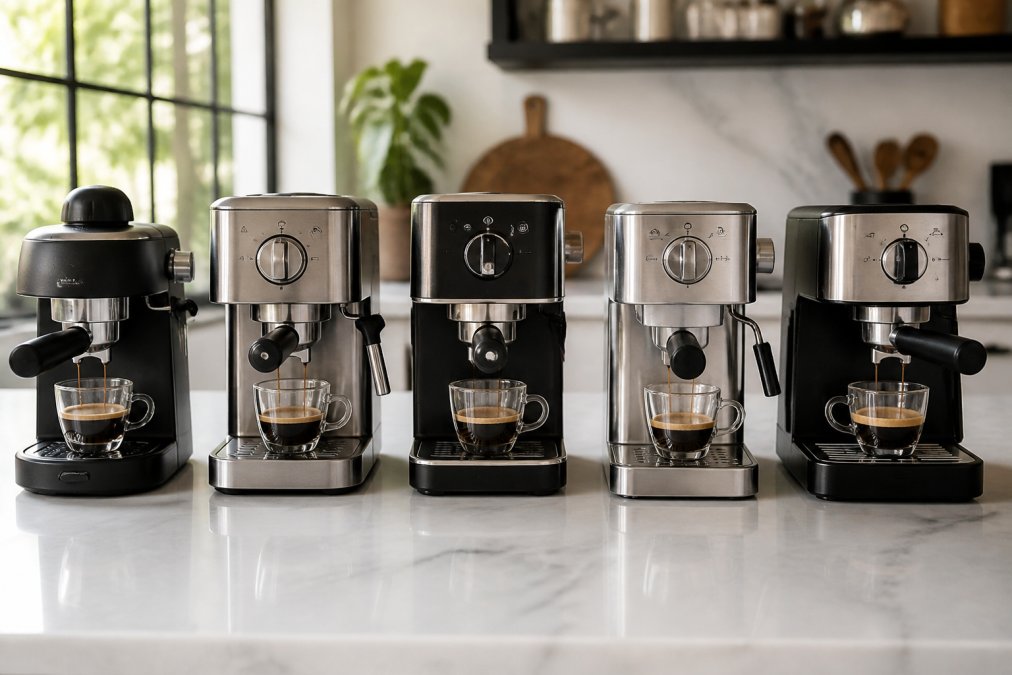
We tested these five machines over several weeks, pulling multiple shots daily and tracking consistency, heat-up time, and milk texturing.
| Machine | Starting Price | Best For | Standout Feature |
|---|---|---|---|
| De'Longhi Stilosa | $149 | Budget entry | 15-bar pump, manual frother |
| Breville Bambino Plus | $500 | Easy milk drinks | 3-second heat-up, auto steam |
| Gaggia Classic | $450 | Durability | Commercial portafilter, repairable |
| MiiCoffee Apex | $499 | Manual skills | 58mm portafilter, pressure control |
| Breville Barista Express Impress | $650 | All-in-one | Integrated grinder, assisted tamping |
De'Longhi Stilosa: The Best Budget Entry Point
The Stilosa is the machine to start with when you are not sure home espresso will stick. At roughly $149, it delivers 15-bar pump pressure and a manual steam wand.
The tradeoffs are real: plastic components feel light, and temperature control is limited. Expect to dial in with pressurized baskets until you upgrade.
For the price, the Stilosa teaches you whether you enjoy the ritual before you commit to a pricier unit.
Breville Bambino Plus: Best for Easy Milk Drinks
The Bambino Plus solves the two biggest beginner frustrations: waiting for heat and failing at milk texture. Its ThermoJet system hits extraction temperature in about 3 seconds, and the automatic steam wand textures milk hands-free.
The compact footprint fits under most cabinets. The catch: it lacks a grinder.
If your daily order is a latte or cappuccino, the Bambino Plus delivers cafe-quality milk drinks with minimal effort.
Gaggia Classic: Best for Long-Term Durability
The Gaggia Classic is the machine you buy once and keep for a decade. Its commercial-style 58mm chrome-plated brass portafilter and three-way solenoid valve produce dry pucks and easy cleanup.
The machine lacks advanced temperature stability, so expect to temperature-surf for optimal shots. Its strength is repairability.
For a buy-it-for-life approach, the Gaggia Classic is the affordable home espresso machine that grows with your skills.
MiiCoffee Apex: Best for Learning Manual Skills
The MiiCoffee Apex uses a professional-style 58mm portafilter and adjustable pressure settings, giving you hands-on control over every variable.
The learning curve is steeper than automatic models, but the payoff is a genuine understanding of extraction.
Breville Barista Express Impress: Best All-in-One for Beginners
The Barista Express Impress bundles an integrated conical burr grinder with assisted tamping, removing the two hardest parts of the workflow.
The tradeoff is the price, the highest on this list. But for beginners who want a complete setup without buying separate equipment, the Impress reduces mess.
It is the easiest path from unboxing to a solid shot for a complete beginner.
How to Dial In Espresso for Beginners
Dialing in is the process of adjusting grind size and dose to hit a target extraction time and yield. Start with a 1:2 ratio: 18 grams of coffee in, 36 grams out, in 25 to 30 seconds (sca.coffee).
Change one variable at a time. Adjust grind size first, then dose, then tamping pressure. Keep a notebook or use an app to track what works for each bean. Specialty Coffee Association brewing resources outlines the standard extraction parameters that home baristas should learn.
A common beginner mistake is changing multiple variables at once, which makes it impossible to know what fixed the shot.
Best Coffee Beans for Espresso
Fresh beans matter more than the machine. Espresso amplifies staleness, so buy beans roasted within the last two weeks and use them within a month.
At Cuppari Coffee, every order is roasted only after an order is placed and shipped the same day, ensuring guaranteed freshness.
The best coffee beans for espresso are the freshest ones you can find, roasted for the brewing method you use.
Essential Espresso Accessories for Home Baristas
A few tools separate frustrating shots from consistent ones. A quality burr grinder is non-negotiable. A digital scale with 0.1-gram precision lets you dose accurately. A tamper that fits your basket snugly ensures even pressure.
A knock box keeps your station clean, and microfiber cloths handle the daily mess.
Invest in the grinder and scale first; they deliver the biggest return on your effort.
Common Beginner Mistakes and How to Fix Them
Most beginners blame the machine when the real culprit is technique or beans. Stale beans produce weak, sour shots regardless of equipment. Grinding too fine chokes the machine, while too coarse yields watery espresso.
The fix for each is straightforward: buy fresh beans, adjust grind size in small increments, and tamp level with consistent pressure. A quick troubleshooting checklist:
- Beans roasted within the last month
- Grind size adjusted for a 25-30 second extraction
- Tamp level and firm, around 15-20 pounds of pressure
- Machine warmed up for at least 15 minutes
The Real Cost of Home Espresso: Budget and Maintenance
The sticker price on an espresso machine is the least important number you will look at. The true cost of home espresso is the Total Cost of Ownership (TCO), the sum of the machine, the grinder, the accessories, the beans, and the maintenance over the first year.
The Hidden Costs: Grinder, Scale, and Tamper
A $149 De'Longhi Stilosa is not a $149 investment. To pull a decent shot, you need a few non-negotiable tools:
- Burr Grinder: $150 - $250. This is the most important purchase you will make. The Baratza Encore ESP ($199) and the Fellow Opus ($195) are solid entry points. Without a burr grinder, your $149 machine will produce bitter, sour, or watery shots.
- Digital Scale: $15 - $30. You need 0.1-gram precision to dose consistently. The AWS-2kg scale is a popular budget option at around $20.
- Tamper: $20 - $50. A 58mm tamper that fits your basket snugly is essential. The Crema Coffee Products tamper is a reliable choice at around $30.
- Distribution Tool or WDT: $10 - $30. This breaks up clumps in the ground coffee before tamping, preventing channeling. A simple WDT tool from Etsy costs about $15.
- Knock Box: $20 - $40. You need somewhere to dump spent pucks. A simple stainless steel knock box from Cafelat runs about $35.
Total upfront accessory cost: $215 - $350. This is on top of the machine price. For a $149 machine, the real first-year cost is closer to $400 - $500.
The Cost of Beans: The Recurring Expense
Freshly roasted beans are not a luxury; they are a requirement. Stale beans produce flat, lifeless espresso. Expect to pay $15 - $25 per 12-ounce bag for specialty-grade espresso beans.
That is roughly $60 - $100 per month, or $720 - $1,200 per year. Over a year, your bean cost will exceed the cost of your machine and accessories combined.
Maintenance: The Cost of Keeping It Running
Budget machines are not maintenance-free. Here is what to budget for annually:
- Descaling Solution: $10 - $20 per year. If you have hard water, you will need to descale every 2-3 months. A bottle of Dezcal or Urnex Cafiza costs about $15.
- Backflush Tablets: $10 - $15 per year. If your machine has a three-way solenoid valve (like the Gaggia Classic), you should backflush weekly. A jar of Cafiza tablets costs about $12.
- Group Gasket and Screen: $15 - $30 every 1-2 years. These wear out with daily use. Replacing them is a simple DIY task.
- Water Filter: $20 - $40 per year. Using filtered water reduces scale buildup and improves taste. A Brita pitcher filter costs about $25 and lasts two months.
Total annual maintenance cost: $55 - $105. This is a small price to pay to keep a $500 machine running for a decade.
The Used and Refurbished Market: A Smarter Path
If you are on a tight budget, the secondary market is your friend. High-end machines like the Gaggia Classic and the Rancilio Silvia are built to last and appear regularly on Craigslist, Facebook Marketplace, and r/coffeeswap. You can often find a used Gaggia Classic for $200 - $300. Before you buy used, ask the seller for a video of the machine pulling a shot.
The Bottom Line: What It Really Costs
Here is a realistic first-year budget for a beginner who buys a $300 machine (like the Gaggia Classic on sale) and a $200 grinder:
| Item | Cost |
|---|---|
| Espresso Machine | $300 |
| Burr Grinder | $200 |
| Scale, Tamper, WDT, Knock Box | $100 |
| Beans (12 months at $80/month) | $960 |
| Maintenance and Descaling | $75 |
| Total First-Year Cost | $1,635 |
That is $4.48 per day for two shots, about the price of a single latte at a cafe. The second year drops to around $1,100 because you are not buying accessories. Home espresso is not a cheap hobby, but it is significantly cheaper than buying coffee out every day.
Which Affordable Espresso Machine Should You Pick?
Your choice comes down to your priorities. The De'Longhi Stilosa is the best budget espresso machine for testing the waters. The Breville Bambino Plus excels at milk drinks. The Gaggia Classic offers the best long-term value. The MiiCoffee Apex teaches manual skills, and the Breville Barista Express Impress is the most complete beginner package.
Pair any of these machines with freshly roasted beans, and you will pull better shots than most cafes serve.
Frequently Asked Questions
What is the best espresso machine for beginners on a budget?
The De'Longhi Stilosa is often the best starting point for a tight budget, typically priced around $149. It uses a simple 15-bar pump and a manual steam wand, which is perfect for learning the fundamentals without a large investment. For a more capable machine with faster heat-up and automatic milk texturing, the Breville Bambino Plus is a strong step up. Both prove that a quality shot is possible without spending over $500.
Do I need a separate coffee grinder for my espresso machine?
Yes, for most machines. Only all-in-one models like the Breville Barista Express Impress include a grinder. With a separate grinder, you control the grind size, which is the most critical variable for flavor. A dedicated burr grinder designed for espresso, not a blade grinder, gives you the fine adjustments needed to dial in beans properly. A good grinder often matters more than the machine itself for shot quality.
What features should a beginner look for in an espresso machine?
Beginners should prioritize a machine with a pressurized basket, which forgives imperfect tamping and grind size while you learn. Look for a fast heat-up time, ideally under 15 minutes, and a steam wand that can produce decent microfoam. A removable water tank simplifies cleaning. As you improve, features like a 58mm portafilter and PID temperature control, found on machines like the MiiCoffee Apex, offer more room to grow.
Is it worth buying a cheap espresso machine?
A very cheap machine under $100 can be worth it as a trial to see if you enjoy the ritual, but it will likely struggle with consistent pressure and temperature. A better strategy is to start with a machine in the $150 to $500 range, such as the Gaggia Classic or De'Longhi Stilosa. These offer enough control to produce cafe-quality shots and are built to last longer, providing more value over time.
Fresh beans are the variable most beginners overlook, and they are the difference between a good machine and a great cup. At Cuppari Coffee, we roast only after you order and ship the same day, so your beans arrive at peak flavor. Explore our single origins, blends, and espresso pods, all with free shipping on U.S. orders. Get started with Cuppari Coffee and taste what freshly roasted espresso really means.