

Table of Contents
- Best Brewing Methods for Single Origin Coffee: Overview
- Why Brewing Method Matters for Single Origin Beans
- Pour-Over Brewing for Single Origin: Hario V60, Kalita Wave, and Chemex
- Best Grind Size for Single Origin Coffee by Brewing Method
- Water Temperature for Single Origin Coffee: Extraction Optimization
- Pour Over vs French Press for Single Origin: Which Method Wins
- Coffee Brewing Ratios for Beginners: Finding Your Sweet Spot
- AeroPress and Hybrid Brewing: Speed Meets Consistency
- Troubleshooting Extraction Issues with Single Origin Beans
- Frequently Asked Questions
Last Updated: July 9, 2026
Best Brewing Methods for Single Origin Coffee: Overview
Single-origin beans reveal their most distinctive characteristics when brewed with precision. The best brewing method depends on roast level, bean density, and flavor profile. Matching your brewing method to your specific beans produces dramatically better cups than generic techniques.
This guide covers five brewing methods that highlight single-origin coffee's unique qualities: which dripper suits light roasts, why immersion brewing changes your options, and how to troubleshoot extraction problems. These strategies produce clearer flavor profiles, reduce sourness and bitterness, and help you taste the tasting notes your beans promise.
Why Brewing Method Matters for Single Origin Beans
The brewing method controls extraction, pulling soluble compounds from grounds into water. Different methods expose grounds to water for different lengths of time, at different temperatures, and with different agitation patterns. This determines whether you taste a bean's actual origin character or a muddy, over-extracted mess.
Single-origin beans are prized for distinct flavor profiles shaped by altitude, soil, processing, and climate. A light-roast Ethiopian Yirgacheffe should taste bright, floral, and tea-like. A medium-roast Colombian should offer chocolate sweetness with balanced acidity. These flavors only emerge at proper extraction, typically 18-22% extraction yield. Too little extraction leaves the cup sour and thin; too much produces bitterness and astringency.
Pour-over methods like the Hario V60 emphasize clarity by preventing over-extraction. Immersion methods like the French press develop fuller body and sweetness. The AeroPress splits the difference. Each method reveals different facets of the same bean.
Research from the Specialty Coffee Association shows that brewing temperature, grind size, and brew time account for roughly 70% of flavor variation. Cuppari Coffee roasts beans only after your order ships, ensuring the freshness that makes these techniques work.
Pour-Over Brewing for Single Origin: Hario V60, Kalita Wave, and Chemex
Pour-over brewing remains the gold standard for single-origin coffee because it gives you the most control over extraction. Water flows through grounds under gravity, extracting as it passes. This approach highlights the clarity and complexity that make single-origin beans worth the investment.
Hario V60: Maximizing Clarity and Acidity
The Hario V60 ceramic dripper excels at bringing out bright, floral, and fruity notes in light-roast single origins. Its cone shape and spiral ribs create a large drainage hole that encourages fast water flow, preventing over-extraction and preserving delicate flavor compounds.
The V60 requires more technique than other drippers. Pour speed and water temperature matter significantly. Most brewers find their rhythm within 5-10 brews.
Brew ratio: 1 gram coffee to 16-17 grams water. Total brew time: 2.5-3 minutes. Start with a 30-second bloom, then pour in concentric circles to maintain even saturation. Hario's official brewing guide
:::pro The V60's spiral ribs create micro-channels that prevent the coffee bed from collapsing and blocking water flow. This is why knockoff cone drippers often underperform. :::
Kalita Wave: Consistent Extraction for Balanced Sweetness
The Kalita Wave's flat bottom and three small drainage holes promote even extraction by distributing water flow uniformly across grounds. This design prevents channeling and produces more balanced, sweeter cups with less bitterness.
Brew ratio: 1 to 16 grams water. Total brew time: 3-3.5 minutes. The Wave's forgiving nature means pouring technique matters less than with the V60.
Wave-specific filters are crucial, they prevent grounds from touching the dripper walls, which would accelerate extraction in those areas.
Chemex: Clean, Sediment-Free Single Origin Expression
The Chemex's borosilicate glass body and proprietary thick filters produce the cleanest cup possible. Oils and fine particles are removed entirely, leaving pure clarity where every flavor note stands alone.
This extreme clarity works beautifully for delicate, complex single origins. The trade-off: you lose some body and mouthfeel. Chemex brewing is slower, typically 4-5 minutes total. Brew ratio: 1 to 17 grams water. Use a gooseneck kettle for pour control.
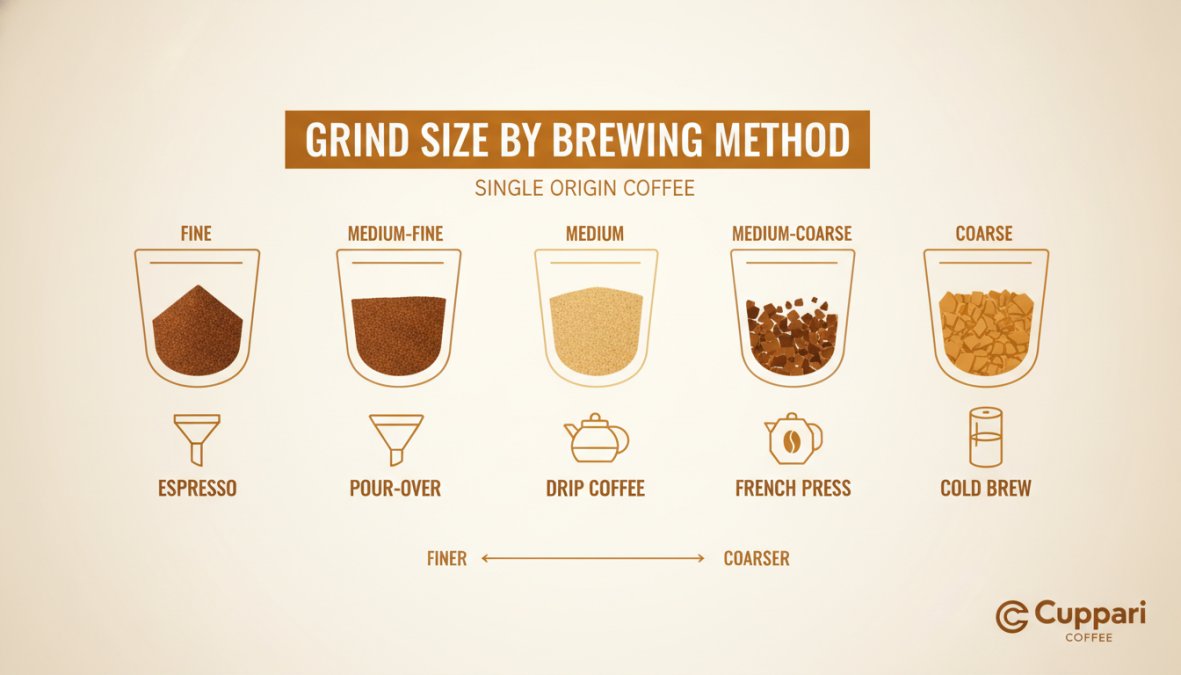
Best Grind Size for Single Origin Coffee by Brewing Method
Grind size controls water flow speed and surface area exposure. For single-origin coffee, hitting the right grind size is often the difference between tasting the bean's origin character and tasting extraction mistakes.
Pour-over methods (V60, Kalita Wave, Chemex) require medium-fine grinds, think sea salt texture. This gives 2.5-3.5 minutes of contact time while maintaining good flow.
Immersion methods (French press, cold brew) need coarser grinds, closer to sea salt crystals. Longer contact time (4-12 minutes) means finer grinds would over-extract dramatically.
Espresso demands very fine, consistent grinds to allow proper extraction in 25-30 seconds.
AeroPress uses medium-fine to medium grind, splitting the difference between immersion and pressure.
Invest in a burr grinder, not a blade grinder. Burr grinders produce uniform particle size; blade grinders produce chaotic mixes of dust and chunks. With single-origin beans, inconsistent grind size masks the flavor complexity you're paying for.
Water Temperature for Single Origin Coffee: Extraction Optimization
Water temperature controls extraction speed. Hotter water extracts faster; cooler water extracts slower. Temperature profiles should shift based on roast level.
Light roasts are denser and contain delicate, volatile compounds that over-extract if water is too hot. Ideal temperature: 195-200°F.
Medium roasts tolerate hotter water. Ideal range: 200-205°F.
Dark roasts need hotter water, 205-210°F, to pull out enough soluble compounds.
The Specialty Coffee Association's brewing standards recommend 195-205°F for most coffees. This narrow range is why a thermometer or temperature-controlled kettle becomes essential for serious single-origin brewing.
Temperature Profiles by Roast Level
Light Roast Single Origins:
- Target: 195-200°F
- Brew time: 2.5-3.5 minutes (pour-over)
- Preserves floral, fruity, and tea-like notes
Medium Roast Single Origins:
- Target: 200-205°F
- Brew time: 3-4 minutes (pour-over)
- Extracts chocolate, caramel, and balanced acidity
Dark Roast Single Origins:
- Target: 205-210°F
- Brew time: 3.5-4.5 minutes (pour-over)
- Compensates for density created by extended roasting
Pour Over vs French Press for Single Origin: Which Method Wins
Pour-over emphasizes clarity and acidity. Water passes through grounds quickly, extracting bright, delicate compounds while paper filters remove oils. You taste individual flavor notes distinctly.
French press emphasizes body and sweetness. Grounds steep for 4 minutes, then a metal mesh filter allows oils into your cup. These oils add mouthfeel and amplify sweetness.
Neither is objectively better. Light roasts generally shine on pour-over because clarity highlights their delicate character. Medium and dark roasts work beautifully on either method.
Immersion vs Percolation: Flavor Profile Differences
Percolation (pour-over):
- Contact time: 2.5-4 minutes
- Paper filters remove oils
- Flavor: bright, clear, acidic, tea-like
- Best for: light roasts, floral and fruity single origins
Immersion (French press, cold brew):
- Contact time: 4-12 minutes
- Metal mesh keeps oils in cup
- Flavor: full-bodied, sweet, sometimes heavy
- Best for: medium and dark roasts, natural-process beans
For single-origin beans, the choice often hinges on processing method. Washed coffees (which emphasize acidity and clarity) shine on pour-over. Natural-process coffees (which are already sweet and fruity) work beautifully on French press.
Coffee Brewing Ratios for Beginners: Finding Your Sweet Spot
Brewing ratio, the weight of coffee to water, is one of the easiest variables to control and one of the most impactful. The standard ratio is 1:16 (one part coffee to sixteen parts water by weight). This produces balanced strength and extraction.
Ratios can shift based on preference:
- 1:15 produces stronger, more concentrated cups.
- 1:17 produces weaker, more delicate cups.
- 1:13 produces very strong cups for espresso and AeroPress.
Use a kitchen scale to dial in your ratio. Weigh your dry beans, brew, and weigh the final cup. If it tastes too strong, increase water next time. Most people find their preferred ratio within 3-4 brews.
AeroPress and Hybrid Brewing: Speed Meets Consistency
The AeroPress combines immersion (steeping) with pressure (plunging) to produce a cup faster than pour-over but more forgiving than espresso. It brews a single cup in 2-3 minutes and is durable and lightweight.
The method is remarkably forgiving. Even imperfect grind size or pouring technique produces a clean, balanced cup. Steep grounds for 30-45 seconds, then plunge slowly over 20-30 seconds. Fast plunging increases pressure and can over-extract.
For single-origin beans, use medium-fine grinds, a 1:16 brew ratio, and 200-205°F water. The resulting cup has clarity similar to pour-over but with slightly more body.
Hario Switch: Hybrid Brewing for Flexibility
The Hario Switch is a V60 dripper with a valve underneath. Close the valve for immersion brewing; open it for pour-over. This hybrid design lets you combine both methods: steep grounds for 1-2 minutes, then open the valve and let water percolate through. This produces cups with both clarity and body.
Hario's hybrid brewing recipes
Troubleshooting Extraction Issues with Single Origin Beans
Over-Extraction vs Under-Extraction: Identifying the Problem
Under-extraction tastes sour, thin, and tea-like. The cup lacks sweetness and body. Water didn't spend enough time with the grounds.
Over-extraction tastes bitter, harsh, and astringent. Your mouth might feel dry. Water spent too much time with the grounds.
For under-extraction:
- Grind finer
- Use hotter water
- Slow your pour
- Increase brew time
For over-extraction:
- Grind coarser
- Use cooler water
- Pour faster
- Decrease brew time
Start with one change at a time to understand how each variable affects your beans.
Method-Specific Fixes for Bitterness and Sourness
Bitterness on pour-over: Usually over-extraction. Grind coarser or reduce water temperature by 5 degrees.
Sourness on pour-over: Usually under-extraction. Grind finer, use hotter water, or pour more slowly.
Bitterness on French press: Reduce brew time from 4 minutes to 3.5 minutes or use slightly cooler water.
Sourness on French press: Increase brew time to 4.5 minutes or grind slightly finer.
Bitterness on AeroPress: Slow your plunge to 25-30 seconds and use gentle pressure.
Sourness on AeroPress: Grind finer or try a longer steep time of 45 seconds instead of 30.
Single-origin coffee demands precision, but the reward is tasting flavors that commodity coffee cannot offer. Each brewing method, pour-over, immersion, AeroPress, and hybrid approaches, brings out different facets of the same beans. Cuppari Coffee's freshly roasted single-origin beans are roasted only after your order ships, guaranteeing the freshness that makes these techniques deliver on their promise. The difference between stale and fresh beans is dramatic when using precise brewing methods. Start with excellent beans, dial in your grind size and water temperature, and you'll taste single-origin coffee the way it's meant to taste.
Frequently Asked Questions
Does brewing method affect single origin coffee flavor?
Yes, brewing method significantly impacts how single origin coffee flavors are expressed. Pour-over methods like the Hario V60 emphasize clarity and bright acidity, while immersion methods like French press produce fuller body and deeper sweetness. Water temperature, extraction time, and filter type all influence which flavor notes, floral, fruity, or chocolatey, come forward in your cup.
What is the best grind size for single origin coffee?
Grind size depends on your brewing method. For pour-over (V60, Kalita Wave), use medium-fine grounds similar to sea salt. For French press, use coarse grounds to prevent sediment. For AeroPress, medium grounds work best. Light-roast single origins often benefit from slightly finer grinds to maximize extraction of delicate flavor compounds.
What water temperature should I use for single origin coffee?
Optimal water temperature for single origin coffee ranges from 195-205°F (90-96°C). Light roasts typically prefer slightly cooler water (195-200°F) to avoid over-extraction of bright acidity, while medium and dark roasts tolerate hotter water (200-205°F). Experiment within this range based on your specific bean's roast level and your taste preferences.
Is pour-over better than French press for single origin beans?
Neither is inherently better, it depends on your goals. Pour-over methods highlight clarity, acidity, and delicate floral or fruity notes in light-roast single origins. French press produces a fuller-bodied, richer cup that emphasizes sweetness and chocolate notes. For maximum flavor complexity in specialty single origins, pour-over is often preferred by enthusiasts, but French press is more forgiving for beginners.
This article was written using GrandRanker