

Table of Contents
- Why Grinder Quality Matters for Fresh Beans
- Burr vs Blade Grinder for Fresh Beans: Which Delivers Better Results
- Coffee Grind Size Chart for Different Brewing Methods
- Benefits of Grinding Coffee Beans Right Before Brewing
- Top Electric Grinders for Consistent Results
- Manual Grinders for Control and Portability
- Maintenance and Calibration for Long-Term Performance
- Pairing Your Grinder with Fresh Beans
- Frequently Asked Questions
Last Updated: August 31, 2026
Why Grinder Quality Matters for Fresh Beans
The difference between a mediocre cup and an exceptional one often comes down to how you grind your beans. A poor grinder destroys what a quality roaster built. When beans are ground inconsistently, some particles extract too fast (becoming bitter) while others barely extract at all (tasting sour). A quality grinder solves this by producing uniform particles that extract evenly, revealing the actual flavor profile locked inside those fresh beans.
Fresh beans demand precision. They have volatile aromatics and delicate flavor compounds that only fully express themselves when extraction is uniform. This is why serious coffee enthusiasts obsess over grinder choice. It's not snobbery. It's physics.
Burr vs Blade Grinder for Fresh Beans: Which Delivers Better Results
A burr grinder crushes beans between two abrasive surfaces, producing uniform particle sizes. A blade grinder spins sharp blades that chop beans randomly, creating a chaotic mix of fine powder and large chunks. For fresh beans, the choice is straightforward: burr grinders win decisively.
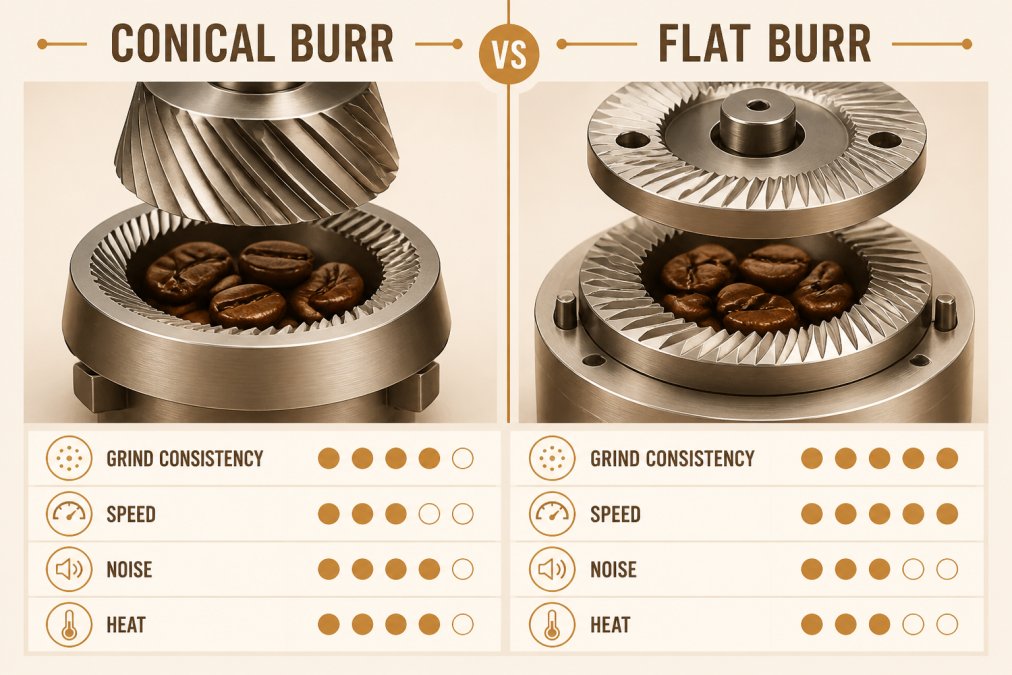
Blade grinders are cheap and fast, but they're inconsistent by design. With fresh beans, especially those roasted the same day like Cuppari Coffee's offerings, blade grinders waste the investment.
Burr grinders come in two types: conical and flat. Conical burrs nest inside each other, producing a grind through crushing and shearing. Flat burrs sit parallel and grind through pure crushing force. Both work well for fresh beans, though flat burrs generally produce slightly more uniform particle size distribution.
The real advantage of burr grinders for fresh beans is control. You can dial in your grind size precisely, adjusting for variables like bean origin, roast date, brewing method, and water chemistry. This level of control is essential when extracting maximum flavor from beans at their flavor peak.
Coffee Grind Size Chart for Different Brewing Methods
Grind size controls extraction speed. Finer grinds expose more surface area, speeding up extraction. Coarser grinds slow it down. For fresh beans, getting this right is critical because fresh beans extract faster than stale ones.
Fine Grinds: Espresso and Turkish Coffee
Espresso demands a fine, consistent grind, typically in the 200-300 micron range (peer-reviewed research). The water passes through the grounds under pressure for just 25-30 seconds, so you need maximum surface area exposure. Fresh beans grind to espresso fineness beautifully because their oils and aromatics are still intact.
Turkish coffee requires an even finer grind, almost powder-like. Fresh beans produce a cleaner, more aromatic Turkish coffee than stale beans because the fines carry the volatile aromatics that define the cup.
Medium Grinds: Drip and Pour-Over
Drip machines and pour-over methods typically use a medium grind, around 600-800 microns (peer-reviewed research). Water contact time is longer than espresso but shorter than French press, usually 4-6 minutes. Fresh beans shine in this range because the medium particle size allows the water to extract the bright, nuanced flavors that roasters work to develop.
Pour-over specifically benefits from fresh beans because the pouring technique gives you control over extraction. You can adjust water temperature, pour rate, and timing to dial in the perfect extraction.
Coarse Grinds: French Press and Cold Brew
French press uses a coarse grind, around 1000-1200 microns, with a long steep time of 4 minutes (peer-reviewed research). Fresh beans in a French press produce a full-bodied, clean cup because the longer steep time extracts the bean's natural oils without over-extracting bitter compounds.
Cold brew demands the coarsest grind, often 1200+ microns, because it steeps for 12-24 hours in cold water. Fresh beans cold brew beautifully because the cold water preserves aromatic compounds that heat would drive off, resulting in a smooth, naturally sweet cup.
Benefits of Grinding Coffee Beans Right Before Brewing
The moment beans are ground, their surface area explodes and oxidation accelerates. Grinding right before brewing locks in the aromatics and volatile compounds that define fresh coffee's character.
Fresh beans lose flavor measurably within minutes of grinding. A light roast single-origin bean ground an hour before brewing tastes noticeably flatter and less nuanced than the same bean ground immediately before brewing. Grinding right before brewing also prevents staling through oxidation and gives you consistency by eliminating variables like humidity and temperature that affect pre-ground coffee.
Top Electric Grinders for Consistent Results
Electric grinders offer speed and consistency, making them the default choice for most home coffee enthusiasts. The best models for fresh beans deliver uniform particle size distribution and precise control over grind size.
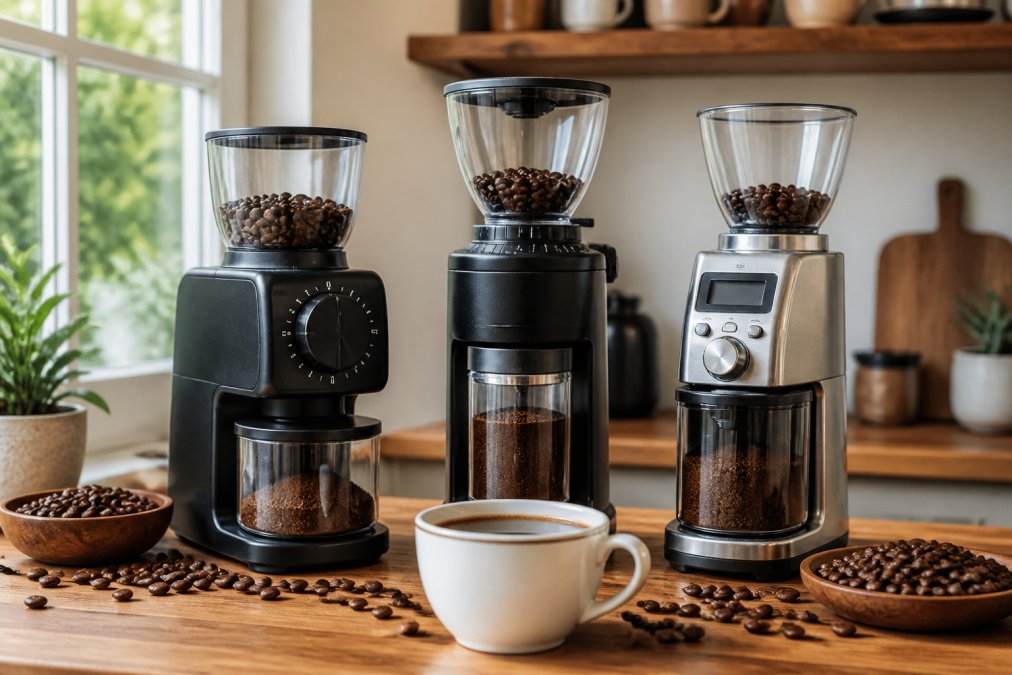
Baratza Encore: Budget-Friendly Reliability
The Baratza Encore sits at the entry level but delivers results far above its price point. It uses conical burrs and offers 40 grind settings, covering everything from Turkish-fine to French press-coarse. For fresh beans, the Encore's consistency is impressive, with uniform particle size distribution ideal for pour-over and drip methods.
The Encore's real strength is reliability. The conical burrs are durable, the motor runs quietly, and the grinder handles fresh beans without producing excessive heat. One limitation: it's not ideal for espresso grinding, as the burrs can struggle with the ultra-fine adjustments espresso demands.
Fellow Ode Brew Grinder Gen 2: Premium Brewed Coffee Focus
The Fellow Ode is purpose-built for filter coffee methods: pour-over, drip, AeroPress, and batch brew. It uses 64mm flat stainless steel burrs and offers 31 stepped grind settings. The flat burrs produce exceptional particle uniformity, which matters when working with fresh beans that demand precise extraction.
What sets the Ode apart is its anti-static technology and magnetic catch cup. Static electricity causes ground coffee to cling to the grinder, creating retention and inconsistency. The Ode minimizes this problem, crucial when switching between fresh bean origins. The quiet operation is a bonus.
Niche Zero: Single-Dosing Excellence
The Niche Zero is a single-dosing grinder, meaning you load whole beans directly and grind only what you need immediately. This eliminates retention, the problem of old grounds clinging to the grinder's internals. For fresh beans, single-dosing is transformative because you're never mixing old grounds with new ones.
The Niche uses 63mm hardened steel conical burrs and offers stepless infinite adjustment. Particle size distribution is exceptional, and the straight-through design means almost nothing stays in the grinder after grinding. The trade-off is price and workflow: single-dosing requires weighing beans before grinding, which adds a step.
Manual Grinders for Control and Portability
Manual grinders require human effort, but they offer advantages electric grinders can't match: precise control, low heat generation, and portability. For fresh beans, manual grinders deliver excellent grind consistency because the grinding process is slower and more controlled.
Comandante C40 MK4 Nitro: Premium Hand Grinding
The Comandante is handcrafted in Germany and uses patented high-nitrogen stainless steel burrs. It offers 35 click levels for grind adjustment and produces exceptional particle uniformity across all grind sizes. Grinding with the Comandante takes 2-3 minutes per cup, but the process is meditative and the results are exceptional. Fresh beans grind smoothly through the Comandante's burrs, and the lack of heat means volatile aromatics stay intact.
1Zpresso JX-Pro: Precision on a Budget
The 1Zpresso JX-Pro offers precision grind adjustment at a fraction of the Comandante's price. It uses a 48mm stainless steel conical burr with a fine adjustment dial offering 40 clicks per rotation, giving you espresso-level precision without espresso-level price.
The JX-Pro grinds smoothly and produces consistent results across all grind sizes. Tool-free disassembly makes cleaning easy, important if you're switching between fresh bean origins frequently. Manual grinding is slower than electric, and capacity is smaller (35g of beans at a time), but for someone who brews one or two cups daily and values precision and portability, it's an excellent choice.
Maintenance and Calibration for Long-Term Performance
A quality grinder is a long-term investment, and maintenance directly affects how long it lasts and how consistently it performs. Clean your grinder regularly, at least monthly if grinding daily. Oils from coffee beans accumulate on the burrs and can become rancid, affecting flavor. For electric grinders, use a grinder cleaning product designed to break down oils. For manual grinders, disassemble and wipe burrs with a dry cloth.
Calibration matters more with fresh beans because their extraction characteristics change as they age. A grind setting that's perfect for a bean on day two might need adjustment on day eight. Check burr alignment periodically, as misaligned burrs produce inconsistent particle size. Minimize static electricity by grinding into a slightly damp container, using an anti-static mat, or choosing a grinder with anti-static technology like the Fellow Ode.
Pairing Your Grinder with Fresh Beans
The grinder-bean relationship is symbiotic. A quality grinder reveals what a quality roaster built. When using fresh beans roasted the same day they ship, like Cuppari Coffee's guaranteed-fresh selection, the grinder becomes the tool that unlocks that freshness.
Match your grinder to your brewing method. If you primarily brew pour-over or drip, a burr grinder with consistent medium-grind capability is sufficient. If you switch between espresso and filter methods, you need a grinder with a wider adjustment range. If you value switching between bean origins without cross-contamination, single-dosing becomes essential.
Consider your workflow. Manual grinders suit small-batch brewing and ritual-focused routines. Electric grinders suit speed and consistency. The right choice depends on how you actually brew coffee and what you value in that process.
The investment in a quality grinder pays dividends when paired with fresh beans. A mediocre grinder with premium beans is wasted potential. A quality grinder with mediocre beans is wasted capability. Get both right, and you'll taste the difference every morning.
Fresh beans demand respect through proper grinding. The particle size distribution, heat management, consistency, and retention control all matter more with fresh beans. Choose your grinder thoughtfully, maintain it properly, and you'll extract every bit of flavor that a roaster worked to develop.
The quality of your morning cup starts with how you grind your beans. When using fresh coffee beans roasted the same day they arrive, the grinder becomes your most critical piece of equipment. Cuppari Coffee delivers premium freshly-roasted beans that reach peak flavor only when ground correctly, and the right grinder makes all the difference. Choose a burr grinder that matches your brewing method, maintain it properly, and you'll experience the full potential of beans roasted with care. Start with fresh beans, add a quality grinder, and discover why consistency in particle size transforms your daily brew.
Frequently Asked Questions
Q: What type of grinder is best for fresh coffee beans?
A: Burr grinders, either conical or flat, are best for fresh beans because they produce uniform particle size distribution, which ensures even extraction and preserves the full flavor of freshly roasted coffee. Electric burr grinders offer speed and consistency, while manual burr grinders provide greater control. Blade grinders create uneven, inconsistent particles that lead to over-extraction and bitter flavors, especially noticeable with premium fresh beans.
Q: How does grinding fresh beans right before brewing improve flavor?
A: Grinding immediately before brewing maximizes flavor because whole beans retain volatile aromatic compounds that dissipate rapidly once ground. Fresh grinding also ensures optimal extraction, the coffee particles haven't oxidized, and they release their full spectrum of flavors when they meet hot water. This is why grinding fresh beans produces noticeably brighter, more vibrant coffee than pre-ground.
Q: What grind size should I use for pour-over coffee?
A: Pour-over coffee requires a medium-fine grind, similar to sand texture. This grind size allows water to flow through the grounds in 2.5 to 4 minutes, extracting sweetness and clarity without bitterness. If your pour-over tastes sour or weak, your grind is too coarse; if it tastes bitter or slow to brew, it's too fine. Using a grinder with precise adjustment, like conical burrs with multiple settings, lets you dial in the exact grind size for your specific brewing method and water chemistry.
Q: How often should I clean my coffee grinder?
A: Clean your burr grinder every 1-2 weeks if you use it daily. Remove the hopper, empty remaining beans, and use a small brush to clear grounds from the burrs and chute. For deeper cleaning, some grinders allow burr removal, check your manual. Oily beans require more frequent cleaning because residual oils can build up and affect grind consistency. Regular maintenance preserves grind uniformity and prevents rancid flavors from old coffee residue affecting your fresh beans.
This article was written using GrandRanker