

Table of Contents
- What to Look for in a Manual Coffee Grinder for French Press
- Coarse Grind Setting for French Press
- Manual vs Electric Coffee Grinder for French Press
-
Top Manual Coffee Grinders for French Press
- 1Zpresso J-Max S: Precision Across All Brew Methods
- Comandante C40 MK4 Nitro Blade: Unmatched Uniformity
- Timemore Chestnut C2: Budget-Friendly Reliability
- Hario Skerton Pro: Large Capacity, Easy Adjustments
- Orphan Espresso Lido 3: Premium Build and Capacity
- Porlex Mini: Maximum Portability
- Zassenhaus Santiago: Traditional German Craftsmanship
- How to Clean a Manual Coffee Grinder
- Portability and Travel-Friendly Designs
- Which Grinder Should You Choose?
- Conclusion
Last Updated: August 27, 2026
What to Look for in a Manual Coffee Grinder for French Press
Choosing the right manual coffee grinder for French press comes down to understanding core mechanics. French press demands a coarse, uniform grind that extracts flavor without over-extracting bitter compounds. A quality burr grinder delivers the evenness that French press needs, while cheap blade grinders produce wildly inconsistent particle sizes.
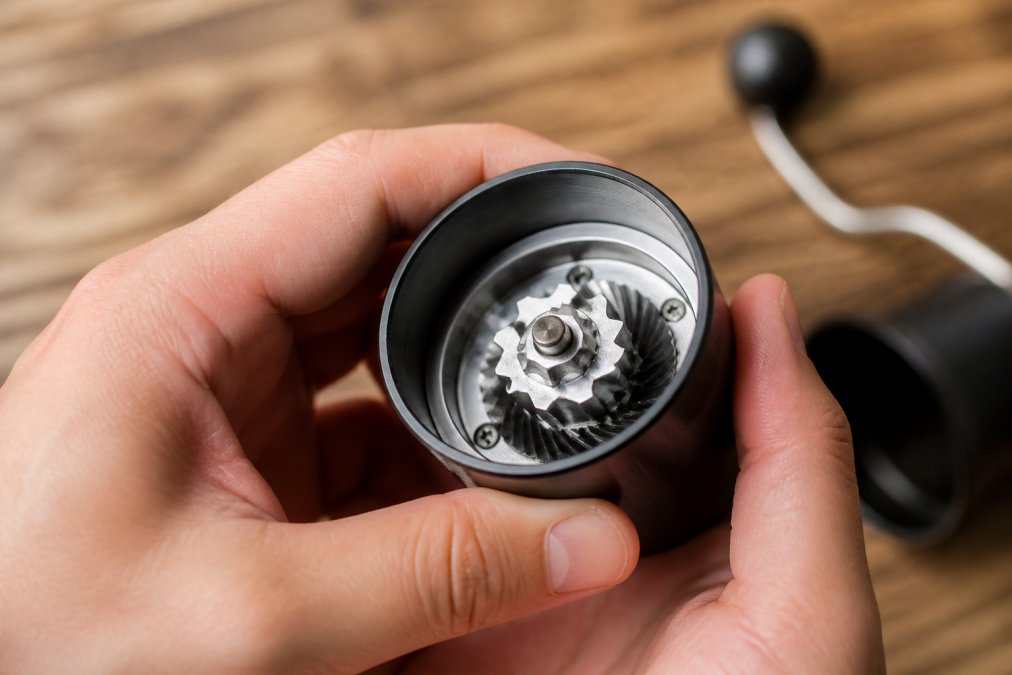
The best manual coffee grinders for French press share three traits: burr geometry that handles coarse settings without clogging, grind consistency that minimizes fines (ultra-fine powder), and ease of adjustment so you can dial in the exact coarseness your beans require.
Burr Material: Ceramic vs. Stainless Steel
Ceramic burrs stay cooler during grinding, preserving volatile aromatics (peer-reviewed research). Stainless steel burrs handle coarse grinding with more stability and produce tighter particle distribution. For French press specifically, stainless steel wins. The coarse grind setting pushes ceramic burrs to their limits, and high-alloyed stainless steel, especially titanium-coated varieties, resists wear and maintains burr geometry consistency over years of grinding.
Grind Consistency and Particle Size
Grind uniformity matters more for French press than most brewers realize. When particles range from powder to pebble-sized chunks, fines over-extract while coarse particles under-extract, creating muddiness and bitterness. A quality grinder minimizes fines and produces particles within a narrow size range.
Stepped adjustment with 30-35 clicks across the coarse range is usually sufficient for French press. What matters more is bearing stability, if burrs wobble during grinding, particle distribution suffers.
Ease of Adjustment and Dial Mechanisms
External adjustment lets you dial in mid-grind without disassembling, which French press brewers appreciate when testing different coarseness levels. Look for grinders with micrometer adjustment, where small incremental turns produce measurable changes in grind size. Numbered settings or click feedback let you repeat your ideal grind size session after session.
Coarse Grind Setting for French Press
French press brewing requires a coarse grind, roughly the texture of breadcrumbs or sea salt. This coarseness prevents over-extraction during the 4-minute steep and keeps sediment minimal in your cup (peer-reviewed research). A coarse grind reduces fines and allows water to move through the coffee bed evenly.
Most budget grinders struggle at coarse settings. Ceramic burrs can clog, and loose bearing systems produce inconsistent particle distribution. Premium manual grinders maintain burr geometry stability even at the coarser end of their range. Test your grinder's coarse-setting performance by grinding a small batch and observing particle distribution. You should see mostly uniform chunks with minimal powder.
Manual vs Electric Coffee Grinder for French Press
Manual grinders offer precision, portability, and the ability to grind fresh without electricity. You control the grinding pace, and hand-crank action produces less heat than electric burr friction, preserving volatile compounds. The tradeoff is effort and time, a manual grinder requires 2-5 minutes of physical work per brew.
For French press specifically, manual grinders often outperform entry-level electric models on grind uniformity at coarse settings. But if you brew multiple cups daily or have physical limitations, a quality electric grinder delivers consistency without labor. The choice depends on your volume and whether you value the ritual of hand-grinding over convenience.
Top Manual Coffee Grinders for French Press
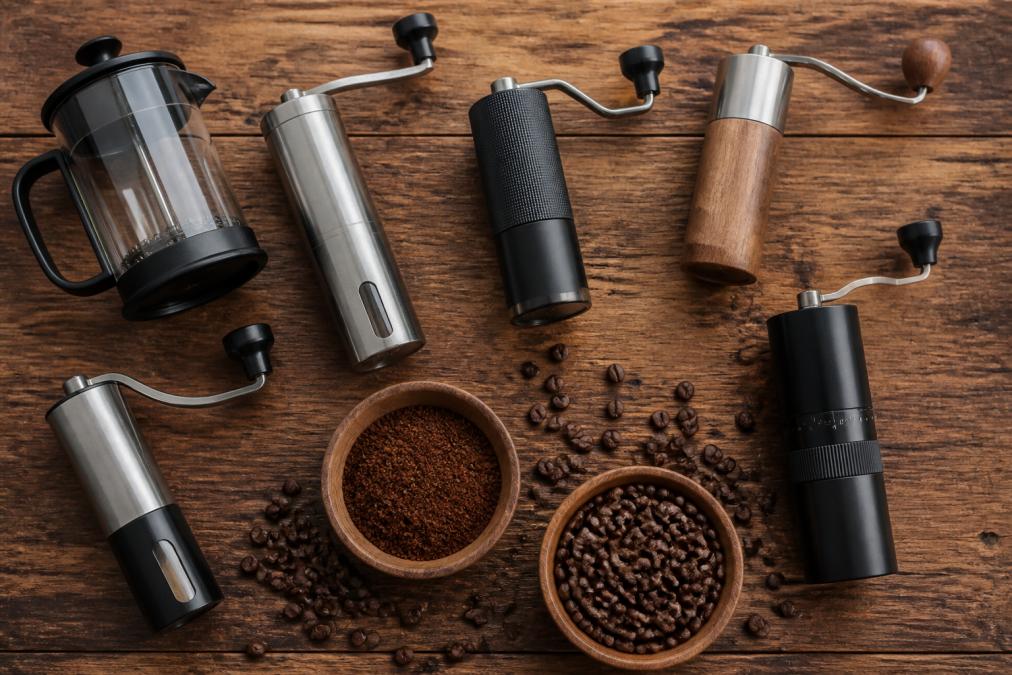
1Zpresso J-Max S: Precision Across All Brew Methods
The 1Zpresso J-Max S delivers exceptional grind precision with 48mm titanium-coated stainless steel burrs and 90 clicks per rotation, meaning 8.8 microns of adjustment per click (nist.gov). External adjustment lets you change settings mid-grind without disassembling. The magnetic catch cup keeps grounds contained, and the foldable handle adds portability. For French press, the J-Max S excels at producing uniform coarse particles without clogging.
Pros:
- Exceptional precision with 8.8-micron adjustments
- Fast grinding speed at coarse settings
- Durable titanium-coated burrs
- Foldable design for travel
Cons:
- Higher price point
- Requires stable surface during grinding
- Slower at very fine settings
Comandante C40 MK4 Nitro Blade: Unmatched Uniformity
The Comandante C40 MK4 represents the gold standard for grind uniformity among manual grinders. Its high-nitrogen stainless steel Nitro Blade burrs are manufactured to exacting tolerances, and two micro ball bearings ensure consistent rotation without wobble. With 35 click levels, adjustment is precise without being overwhelming.
The C40 MK4 includes two jars, each holding about 40 grams of beans. The burr geometry excels at coarse settings, producing remarkably uniform particles ideal for French press. Handcrafted in Germany with meticulous quality control, the C40 MK4 justifies its premium price through consistency and durability.
Pros:
- Unmatched grind uniformity and consistency
- Durable premium build quality
- Suitable for all grind sizes, coarse to ultra-fine
- Two included jars for convenience
Cons:
- High price point
- Small 40g capacity
- Slower grinding speed compared to some competitors
Timemore Chestnut C2: Budget-Friendly Reliability
The Timemore Chestnut C2 proves you don't need to spend a high amount to get a capable manual grinder. Its 38mm stainless steel conical burrs produce respectable grind consistency. The easy-to-adjust dial spans from fine to coarse, and the compact 30g capacity suits travel or single-cup brewing.
For French press specifically, the C2 handles coarse grinding adequately, though particle distribution isn't as tight as higher-end models. Low retention means minimal coffee waste in the grinder mechanism.
Pros:
- Very affordable entry point
- Good grind consistency for the price
- Low retention
- Compact and portable
Cons:
- Grind uniformity not as tight as premium grinders
- Smaller 30g capacity
- Less durable long-term than higher-end models
Hario Skerton Pro: Large Capacity, Easy Adjustments
The Hario Skerton Pro addresses the biggest complaint about its predecessor: burr wobble. The new stabilizer bar reduces lateral movement of the grinding mechanism, improving consistency at all settings. Ceramic conical burrs transfer less heat to beans, and the large 100g hopper capacity lets you grind for multiple cups without refilling.
The glass body is dishwasher-safe, and the burr adjustment is straightforward. The larger hopper reduces the number of hand-crank cycles needed per brew.
Pros:
- Large 100g bean capacity
- Improved consistency over previous version
- Ceramic burrs preserve aroma
- Dishwasher-safe glass body
Cons:
- Some burr wobble can develop long-term
- Less precise than premium stepless grinders
- Not ideal for espresso-focused brewing
Orphan Espresso Lido 3: Premium Build and Capacity
The Lido 3 combines premium Swiss-made steel conical burrs with a large 70-gram hopper capacity and micrometric stepless external adjustment. The diecast folding crank handle collapses for storage, and the overall build quality feels substantial. The stepless adjustment system offers infinite grind-size control without discrete clicks.
For French press, the Lido 3 excels at producing uniform coarse particles. The large capacity reduces hand-crank effort, and the stepless system lets you dial in the exact coarseness you prefer.
Pros:
- Exceptional grind quality and consistency
- Large 70g capacity reduces grinding cycles
- Durable Swiss-made burrs
- Stepless adjustment for infinite control
Cons:
- Higher price point
- Heavier than compact grinders
- Requires more physical effort due to weight
Porlex Mini: Maximum Portability
The Porlex Mini is the grinder for travelers and minimalists. Its compact design fits inside an AeroPress, and the 20-gram capacity suits single-cup brewing. Ceramic conical burrs handle many grind sizes, and stainless steel construction resists corrosion.
The tradeoff is capacity and effort. Twenty grams requires multiple hand-crank cycles for a French press brew, and the smaller burr set produces more fines than larger grinders.
Pros:
- Extremely portable and fits in an AeroPress
- Durable stainless steel construction
- Affordable entry point for hand grinding
Cons:
- Produces more fines, risking excess silt in French press
- Small 20g capacity requires multiple cycles
- Less suitable for regular home brewing
Zassenhaus Santiago: Traditional German Craftsmanship
The Zassenhaus Santiago is a traditional "knee mill" style grinder, you place it between your legs and grind with both hands, which distributes effort and provides stability. German-made high-carbon steel conical burrs offer infinitely adjustable settings from coarse French press to ultra-fine espresso. Beechwood construction with a removable drawer adds aesthetic appeal.
The infinite adjustment allows you to dial in the exact coarseness without discrete steps. The burr mechanism carries a 25-year warranty, reflecting confidence in durability.
Pros:
- Preserves coffee aroma by minimizing heat build-up
- Infinitely adjustable for high precision
- Durable German-made burrs with 25-year warranty
- Beautiful traditional design
Cons:
- Higher price point
- Requires learning the knee mill technique
- Not portable
- Small grounds drawer capacity (approximately 30g)
How to Clean a Manual Coffee Grinder
Regular cleaning keeps your grinder performing optimally and prevents rancid oil buildup that degrades flavor. Most manual grinders disassemble without tools, the crank handle pulls free, and the burr set lifts out for access.
Start by removing loose grounds with a dry brush. For deeper cleaning, disassemble completely and brush all internal surfaces. Avoid water unless your grinder has a removable hopper and glass body that are explicitly dishwasher-safe, as moisture in the bearing mechanism causes rust and grinding issues.
For stubborn oil residue, grind a small amount of uncooked rice through the grinder. The rice absorbs oils and exits as powder, cleaning the burrs. Monthly deep cleaning extends grinder life, disassemble completely, brush all surfaces, and inspect burrs for wear or damage.
Portability and Travel-Friendly Designs
Compact models like the Porlex Mini and Orphan Espresso Fixie weigh under 400 grams and fit in carry-on luggage. The 1Zpresso J-Max S and Comandante C40 MK4 fold their handles, reducing footprint without sacrificing burr quality.
The tradeoff is capacity. Portable grinders hold 20-40 grams of beans, requiring multiple hand-crank cycles per brew. If you're grinding for two people or brewing multiple cups, a larger grinder like the Hario Skerton Pro or Lido 3 makes more sense despite reduced portability.
Which Grinder Should You Choose?
Your ideal manual coffee grinder depends on three factors: budget, grinding volume, and grind consistency priorities.
For premium grind quality and daily home brewing: The Comandante C40 MK4 or Orphan Espresso Lido 3 deliver exceptional uniformity and durability. Both excel at coarse French press settings and handle years of regular use.
For budget-conscious entry: The Timemore Chestnut C2 or Hario Skerton Pro offer real grind quality at affordable prices.
For precision and versatility: The 1Zpresso J-Max S excels across all grind sizes with its fine-tuning capability.
For travel and portability: The Porlex Mini or Orphan Espresso Fixie minimize weight and volume.
For traditional craftsmanship: The Zassenhaus Santiago delivers beautiful engineering and infinite adjustment.
The best manual coffee grinders for French press share consistent burr geometry, minimal fines production, and ease of adjustment. Your choice ultimately reflects how often you brew, whether you value portability, and how much you're willing to invest in grind quality. Cuppari Coffee's freshly roasted beans deserve a grinder that brings out their full potential, investing in the right burr grinder pays dividends in cup quality, and that improvement is immediate and noticeable.
Choosing the right grinder transforms your French press experience. The best manual coffee grinders for French press deliver uniform coarse particles that extract flavor without bitterness. Once you've dialed in your grinder, pair it with premium freshly roasted beans from Cuppari Coffee's single-origin and blend selection, roasted only after your order ships the same day. Fresh beans ground to your exact specification create French press coffee that tastes noticeably better than grocery-store alternatives, that's the real payoff of investing in a quality manual grinder.
=== FAQ ANSWERS (audit these too, same rules) ===
[1] Q: What type of grind is best for French press coffee? A: French press requires a coarse grind with uniform particle distribution. This coarse grind setting allows water to extract coffee properly during the 4-minute steep without over-extracting or producing excessive fines (fine powder particles). Inconsistent grind sizes lead to uneven extraction, affecting body and mouthfeel. A quality manual grinder with burr geometry designed for consistency delivers the uniform coarse particles French press brewing demands.
[2] Q: Are manual coffee grinders any good for French press? A: Manual grinders excel for French press brewing. They offer precise grind uniformity, stepless or stepped adjustment for dialing in the exact coarse setting you need, and low retention (minimal grounds left in the grinder). Hand-crank models preserve bean aroma by generating less heat than electric grinders. For French press specifically, manual grinders provide excellent consistency and control, making them ideal for achieving optimal extraction yield and body.
[3] Q: How do manual and electric coffee grinders compare for French press? A: Manual grinders offer superior grind uniformity and lower heat generation, preserving coffee flavor and aroma for French press. They provide precise calibration through stepped or stepless adjustment, giving you exact control over coarse grind settings. Electric grinders are faster but generate more torque and heat, which can affect bean quality. For French press brewing, manual grinders typically deliver better particle distribution and consistency, though electric models work adequately for casual brewing.
[4] Q: What should I look for in a manual grinder for French press? A: Prioritize burr geometry (stainless steel or ceramic burrs for uniform particle size), stepped or stepless adjustment for precise coarse grind dialing, and sufficient hopper capacity for your typical brew size. Bearing stability ensures consistent grinding torque. Look for grinders with low retention to minimize grounds left behind. Consider ergonomic design and build quality for durability. Models specifically praised for coarse grind performance and grind uniformity work best for French press immersion brewing.
Frequently Asked Questions
What type of grind is best for French press coffee?
French press requires a coarse grind with uniform particle distribution. This coarse grind setting allows water to extract coffee properly during the 4-minute steep without over-extracting or producing excessive fines (fine powder particles). Inconsistent grind sizes lead to uneven extraction, affecting body and mouthfeel. A quality manual grinder with burr geometry designed for consistency delivers the uniform coarse particles French press brewing demands.
Are manual coffee grinders any good for French press?
Manual grinders excel for French press brewing. They offer precise grind uniformity, stepless or stepped adjustment for dialing in the exact coarse setting you need, and low retention (minimal grounds left in the grinder). Hand-crank models preserve bean aroma by generating less heat than electric grinders. For French press specifically, manual grinders provide excellent consistency and control, making them ideal for achieving optimal extraction yield and body.
How do manual and electric coffee grinders compare for French press?
Manual grinders offer superior grind uniformity and lower heat generation, preserving coffee flavor and aroma for French press. They provide precise calibration through stepped or stepless adjustment, giving you exact control over coarse grind settings. Electric grinders are faster but generate more torque and heat, which can affect bean quality. For French press brewing, manual grinders typically deliver better particle distribution and consistency, though electric models work adequately for casual brewing.
What should I look for in a manual grinder for French press?
Prioritize burr geometry (stainless steel or ceramic burrs for uniform particle size), stepped or stepless adjustment for precise coarse grind dialing, and sufficient hopper capacity for your typical brew size. Bearing stability ensures consistent grinding torque. Look for grinders with low retention to minimize grounds left behind. Consider ergonomic design and build quality for durability. Models specifically praised for coarse grind performance and grind uniformity work best for French press immersion brewing.
This article was written using GrandRanker