

Table of Contents
- Why Freezing Coffee Beans Works: The Science Behind Cold Storage
- The Best Way to Defrost Frozen Coffee Beans: Step-by-Step
- How Long Do Frozen Coffee Beans Last in Your Freezer
- Does Freezing Coffee Beans Ruin Them: Separating Fact from Myth
- Grinding Frozen Coffee Beans vs. Room Temperature: Which Method Wins
- Storage Methods That Prevent Refreezing and Condensation
- Common Mistakes When Defrosting Frozen Coffee Beans
- Conclusion: Keeping Your Defrosted Beans Fresh
Last Updated: July 13, 2026
Why Freezing Coffee Beans Works: The Science Behind Cold Storage
Freezing coffee beans is one of the most misunderstood preservation techniques in the coffee world. Cold slows oxidation dramatically: for every 10-degree Celsius drop in temperature, oxidation rates decrease by 50% or more. A bean stored at room temperature (20°C) will stale roughly four times faster than one kept in a freezer at -18°C. This exponential relationship explains why freezing works, but it also reveals the critical danger of the thaw-refreeze cycle.
How Condensation and Moisture Threaten Thawed Beans
When frozen beans transition to room temperature, water vapor condenses on their surface. This condensation creates an oxygen-rich microenvironment where oxidation accelerates rapidly. Cold air holds less moisture than warm air; when you remove beans from a -18°C freezer and place them in a 20°C kitchen, the relative humidity around each bean jumps dramatically, causing water molecules to condense on the cold bean surface and dissolve volatile flavor compounds.
Research from the Specialty Coffee Association's storage guidelines emphasizes that condensation is the primary threat to frozen beans during thawing. The longer beans sit at room temperature before grinding, the more flavor loss occurs.
Understanding Oxidation and Flavor Degradation
Oxidation is the chemical process where oxygen reacts with organic compounds in roasted coffee, producing stale, papery, or cardboard-like notes that mask the bean's origin characteristics. The flavor compounds most susceptible to oxidation are volatile aromatics, esters, aldehydes, and ketones, that give coffee its brightness and complexity.
Thermal shock, the rapid temperature change from freezer to room temperature, can accelerate oxidation in the short term by making cell membranes more permeable and allowing oxygen to penetrate deeper into the bean structure. This is why thawing at room temperature, rather than in a warm environment, is critical.
The Best Way to Defrost Frozen Coffee Beans: Step-by-Step
The best way to defrost frozen coffee beans follows a simple principle: minimize exposure to moisture and oxygen while allowing the bean's internal temperature to equalize.
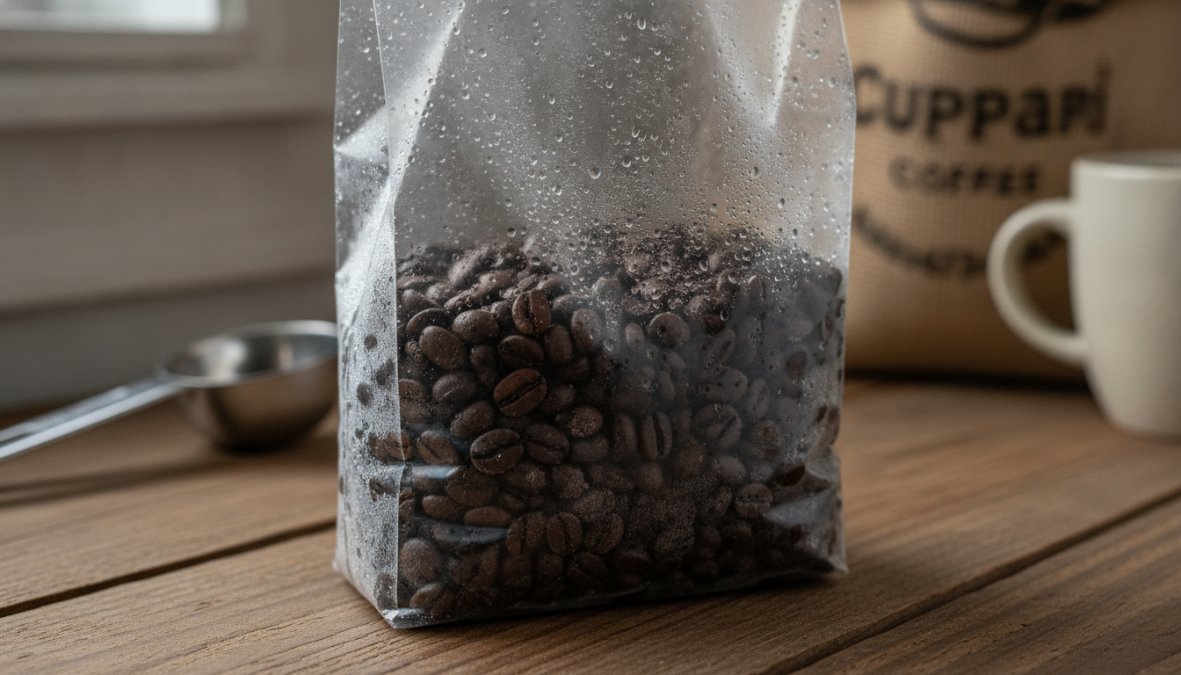
Step 1: Choose Your Thawing Container
Your thawing vessel determines how much condensation forms during the process. The best containers are airtight and opaque: vacuum-sealed bags are ideal, as are glass mason jars or plastic containers with tight-sealing lids. The container must remain sealed throughout the thawing process, creating a microclimate where the beans can warm up without encountering fresh, oxygen-rich air.
Avoid open bowls, colanders, or mesh containers, which expose beans to ambient humidity and allow oxygen to circulate freely.
Step 2: Plan Your Thawing Time
A standard 12-ounce bag of beans typically requires 2-4 hours to reach room temperature when left on a kitchen counter. Larger quantities (5+ pounds) may need 6-8 hours. Do not attempt to speed up thawing by placing beans in warm water, near heat sources, or in a microwave. Slow, ambient-temperature thawing is always superior.
A practical approach is to remove beans from the freezer in the morning and use them by evening, or remove them the night before and grind the next morning.
Step 3: Thaw at Room Temperature
Room temperature thawing, approximately 18-22°C (65-72°F), is non-negotiable. Do not use warm water, ovens, or any active heating method. During thawing, the beans' internal temperature gradually rises and water vapor inside the sealed container reaches equilibrium with the beans' surface, minimizing condensation.
Step 4: Avoid Opening the Container
Do not open the container during thawing. Every opening exposes beans to fresh ambient air, causing condensation to form immediately. Even a brief opening can cause measurable flavor loss. If you need to check progress, gently shake the container without opening it.
Step 5: Return to Airtight Storage
Once beans reach room temperature, grind them immediately or transfer them to an airtight storage container. Do not leave thawed beans exposed to ambient air for more than 15-20 minutes. If not grinding immediately, transfer beans to a vacuum-sealed container or an airtight canister with a one-way valve.
Never refreeze thawed beans. The freeze-thaw cycle causes ice crystals to form within the bean's cell structure, and when thawed again, these damaged cells release their contents more readily, accelerating oxidation and flavor loss.
How Long Do Frozen Coffee Beans Last in Your Freezer
Properly frozen coffee beans maintain acceptable quality for 3-4 months in a standard home freezer at a consistent -18°C or colder. Temperature fluctuations caused by frequent door openings reduce this window significantly. Commercial freezers with consistent temperatures extend the window to 6+ months.
For optimal results, use frozen beans within 2-3 months. For specialty, single-origin beans, this shortened timeline is worth respecting, as these beans are prized for their nuance, which deteriorates faster than standard blends.
Does Freezing Coffee Beans Ruin Them: Separating Fact from Myth
Freezing does not ruin coffee beans if done correctly. The myth persists because improper thawing, not freezing itself, causes flavor loss. When beans are frozen in vacuum-sealed containers and thawed slowly at room temperature without opening the container, they retain nearly all their original flavor compounds.
Impact on Bean Integrity and Cell Structure
Freezing alters the bean's physical structure at a microscopic level. Ice crystals form within the bean's cell walls, creating tiny fractures. When frozen beans are ground, the burrs encounter a more brittle material, producing a wider distribution of particle sizes. However, this effect is modest and noticeable only in precise brewing methods like espresso or pour-over. For filter coffee, the difference is negligible.
The cell structure damage is permanent; thawing does not reverse the fractures created by ice crystal formation. This is one reason that avoiding refreezing is critical.
Thermal Shock and Flavor Profile Changes
Thermal shock occurs when beans transition rapidly from cold to warm. However, this effect is largely theoretical in home settings. A bean moving from -18°C to 20°C over 2-4 hours experiences minimal thermal shock. The flavor profile of frozen beans, when properly thawed, is nearly identical to fresh beans.
Grinding Frozen Coffee Beans vs. Room Temperature: Which Method Wins
The answer depends on your brewing method and grinder type.
Grinder Burr Temperature Impact on Particle Size
When you grind frozen beans, the burrs stay cooler throughout the grinding process. Cold beans are more brittle, producing a wider range of particle sizes with more fines (very small particles) and more large fragments. Room-temperature beans are slightly more pliable, producing a more uniform particle size distribution, which is desirable for most brewing methods.
The heat generated by grinding itself is another factor. Friction between the burrs and beans produces heat. Frozen beans start at -18°C, allowing the burrs to grind longer before the beans warm significantly. Room-temperature beans warm up faster during grinding, potentially reaching 40-50°C by completion, which can accelerate oxidation in the ground coffee.
For espresso, where ground coffee sits for 20-30 seconds before extraction, this heat-induced oxidation can noticeably degrade flavor. For filter coffee, where ground coffee is immediately saturated with water, the effect is minimal.
Understanding Fines and Extraction Quality
Fines are particles smaller than 75 microns. They dissolve rapidly in water and can create a bitter, over-extracted character. Frozen beans produce more fines because their brittleness causes them to shatter into smaller pieces. The ideal grind distribution is a bell curve centered around your target particle size, with minimal fines and minimal large fragments.
For espresso, where particle uniformity directly impacts shot quality, grinding room-temperature beans in a quality burr grinder is optimal. For filter coffee, either method works fine.
Single-Dose vs. Bulk Grinding Strategies
Single-dosing, grinding only the beans you need for one cup immediately before brewing, minimizes the time ground coffee spends exposed to oxygen. Frozen beans are excellent for single-dosing: you remove a small portion from the freezer, grind it immediately, and brew.
Bulk grinding is less compatible with frozen beans. Ground coffee oxidizes rapidly; after 30 minutes at room temperature, it has noticeably staled. For bulk grinding, room-temperature beans are slightly superior because you can grind and immediately brew without the thawing step.
At Cuppari Coffee, we recommend single-dosing for maximum freshness, whether using frozen or room-temperature beans. Grinding immediately before brewing is the most important variable in preserving flavor.
Storage Methods That Prevent Refreezing and Condensation
Vacuum-Sealed Containers and Freezer Bags
Vacuum-sealed bags remove oxygen, the primary driver of oxidation, creating an anaerobic environment where oxidation proceeds at a negligible rate. This is the gold standard for freezer storage. The FoodSaver Vacuum Sealer is popular for portioning beans into single-dose bags before freezing, eliminating the need to thaw a large quantity and preventing refreezing entirely.
Freezer bags, even "freezer-grade" bags, are inferior to vacuum-sealed bags because they contain air, allowing oxidation to proceed. For long-term freezer storage beyond 2-3 months, vacuum sealing is essential.
Mason Jars and Climate-Specific Storage Solutions
Mason jars are a reusable, eco-friendly alternative to vacuum bags. Standard mason jars provide an airtight seal but contain air inside, allowing slow oxidation. For short-term freezer storage (2-3 weeks), mason jars are acceptable. For longer periods, consider using a vacuum sealer attachment designed for mason jars.
Climate matters significantly. In humid climates, condensation forms more readily during thawing, making sealed containers absolutely critical. In dry climates, oxidation proceeds faster because the air is more oxygen-rich, making vacuum sealing even more important.
The Airscape Coffee Canister uses a patented plunger system that pushes air out of the container. For room-temperature storage, it's excellent. For freezer storage, it's less effective than vacuum-sealed bags.
Common Mistakes When Defrosting Frozen Coffee Beans
Opening the container during thawing is the single most common error. Even a brief opening introduces fresh, drier air that causes condensation to form immediately.
Using warm water or heat sources to speed thawing creates thermal shock and accelerates oxidation. Beans thawed this way taste noticeably stale.
Refreezing thawed beans damages cell structure, and repeating it compounds the damage. After a second freeze-thaw, beans produce noticeably more fines when ground.
Storing thawed beans for extended periods before grinding is another common mistake. Thawed beans should be ground within 24 hours, ideally immediately after reaching room temperature.
Using non-airtight containers for freezing allows freezer burn, indicating sublimation has removed moisture from the beans, making them more brittle.
Freezing beans immediately after roasting before degassing is complete traps CO₂ in the bean structure. When thawed, trapped gas can cause uneven expansion, affecting grinding behavior. Wait 24-48 hours after roasting before freezing.
The best way to defrost frozen coffee beans is simple: thaw slowly in a sealed container at room temperature, grind immediately, and never refreeze. Freezing is a legitimate preservation technique when done correctly. Many coffee professionals freeze beans specifically to extend their useful life.
If you're serious about coffee quality, consider purchasing from sources that prioritize freshness from the start. Cuppari Coffee roasts beans only after your order is placed and ships the same day, ensuring your beans arrive at peak freshness. However, if you do freeze beans, the methods outlined here will preserve their quality far better than common shortcuts.
| Thawing Method | Duration | Condensation Risk | Best Use Case |
|---|---|---|---|
| Sealed container, room temperature | 2-4 hours | Minimal | Standard approach for all bean types |
| Sealed container, cool pantry | 4-6 hours | Very low | Optimal for specialty beans |
| Warm water | 30-45 minutes | High | Not recommended |
| Oven or microwave | 10-20 minutes | Very high | Avoid entirely |
| Refrigerator (sealed) | 12-24 hours | Low | Acceptable for large quantities |
Frequently Asked Questions
What is the best way to defrost frozen coffee beans without losing flavor?
The best way to defrost frozen coffee beans is to thaw them in a sealed, airtight container at room temperature for 1-2 hours without opening it. This prevents condensation from forming on the beans, which can degrade flavor. Keep the container sealed until the beans reach ambient temperature, then transfer to a vacuum-sealed or airtight storage container immediately. Avoid refrigerator thawing, which extends moisture exposure and promotes oxidation.
How long do frozen coffee beans last, and when should I use them after thawing?
Frozen coffee beans can last 3-4 months in the freezer when stored in vacuum-sealed bags or airtight containers. Once thawed, use them within 1-2 weeks for optimal freshness and flavor. Grind and brew within a few days of thawing for best extraction and taste. Avoid refreezing thawed beans, as repeated freeze-thaw cycles damage cell structure and accelerate flavor degradation.
Can I grind frozen coffee beans directly without thawing them first?
Yes, you can grind frozen coffee beans directly without thawing, which actually offers advantages: grinding frozen beans produces more uniform particle size and reduces fines (ultra-fine powder particles). However, frozen grinding generates more burr friction and heat, which can temporarily raise grinder temperatures. For espresso and filter coffee, grinding frozen beans can improve extraction consistency. Single-dose grinding from frozen eliminates condensation risk entirely.
Does freezing coffee beans ruin them or affect the taste?
Freezing coffee beans does not ruin them if done correctly with proper vacuum-sealing to prevent oxidation and moisture migration. When stored airtight in the freezer, beans retain flavor and aroma for months. However, improper thawing, especially repeated freeze-thaw cycles or exposure to condensation, can cause thermal shock and flavor degradation. The key is sealing beans before freezing and keeping them sealed during thawing to preserve bean integrity and freshness.
This article was written using GrandRanker