

Table of Contents
- Why Degassing Matters: Understanding the Coffee Bean Degassing Process
- How to Tell If Coffee Beans Are Fresh and Ready to Brew
- Mastering Coffee Grind Size Chart for Fresh Roasts
- Water Temperature and Chemistry: Brewing Fresh Roasted Coffee at Home
- Water to Coffee Ratio for Pour Over and Other Brewing Methods
- Storage and Freshness Preservation for Optimal Results
- Common Brewing Mistakes to Avoid with Fresh Roasted Beans
- Conclusion
Brew Fresh Roasted Coffee at Home: A Complete Guide
Last Updated: July 11, 2026
Learning how to brew fresh roasted coffee at home transforms your daily ritual into something genuinely exceptional. The difference between stale supermarket beans and freshly roasted coffee is the difference between a flat, one-dimensional cup and a vibrant, complex experience. Below, we'll walk you through the complete system: understanding degassing, identifying bean readiness, adjusting your grind, dialing in water chemistry, and executing the brew that brings everything together.
The freshness window is narrow. Most home brewers miss this entirely, which is why their fresh beans never taste as good as they should.
Why Degassing Matters: Understanding the Coffee Bean Degassing Process
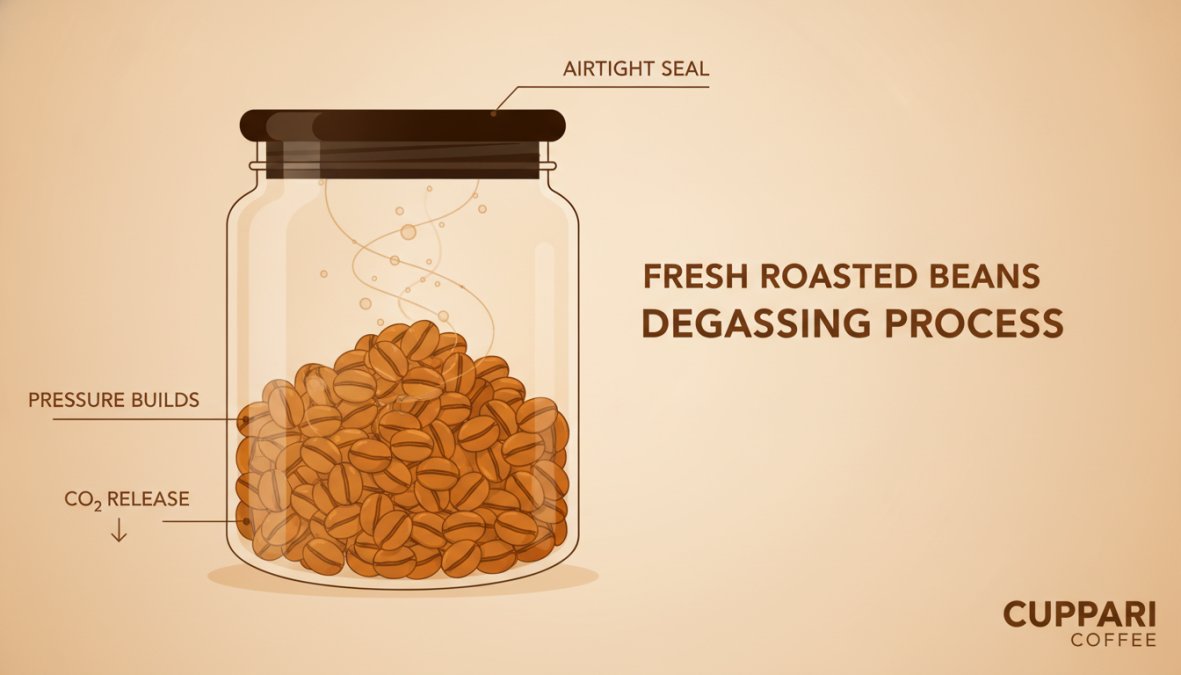
Degassing is non-negotiable if you want to brew fresh roasted coffee at home properly. When beans roast, they absorb heat energy that causes water inside the bean to turn to steam and CO2 to form as a byproduct. That CO2 needs to escape, or it will interfere with extraction and ruin your cup.
CO2 is trapped inside the bean structure immediately after roasting. Over the next 24-72 hours, this gas gradually releases through the bean's surface. If you brew too early, excess CO2 creates uneven water contact, leaving some areas saturated and others dry. The result is sour, thin coffee with inconsistent flavor. Wait too long, and the beans begin oxidizing, losing brightness and complexity.
The timeline matters more than most guides acknowledge. Beans reach peak flavor somewhere between 12 hours and 5 days post-roast, depending on roast profile and bean density. Light roasts degas faster (12-24 hours). Dark roasts take longer (48-72 hours). Medium roasts sit in the middle (24-48 hours).
Visual and Sensory Signs of Degassing
You don't need expensive equipment to tell if your beans have finished degassing.
Surface appearance: Freshly roasted beans look matte and slightly oily. As they degas, the surface becomes less shiny and more uniform in color. If you see visible moisture beading on the surface, degassing is still very active.
Smell test: Immediately post-roast, you'll smell sharp, acrid roasting aromas. As degassing progresses, these fade and you'll detect the origin's actual flavor notes, floral, fruity, nutty characteristics. When you smell the bean's true character instead of roasting heat, degassing is nearly complete.
The bloom test: Grind a small amount and pour hot water over it. Immediately post-roast, the bloom will be aggressive with lots of visible bubbling as CO2 rushes out. By day 2-3, the bloom is gentler and more controlled.
How to Tell If Coffee Beans Are Fresh and Ready to Brew
Bean freshness determines everything that follows. A bean that's fresh but past its degassing window behaves completely differently than one that's mid-degas.
The roast date is your primary reference point. If the bag doesn't have one, you have no way to know if the beans are 2 days or 2 months old.
Use this readiness checklist:
- Days 1-2 post-roast: Actively degassing. Bloom will be aggressive. Better to wait.
- Days 3-5 post-roast: Peak degassing window. Bloom is controlled but still present. Extraction is clean and even. This is the ideal brewing zone.
- Days 6-10 post-roast: Degassing is nearly complete. Beans are stable and forgiving. Flavor is still excellent.
- Days 11-21 post-roast: Beans are fully degassed but oxidation is accelerating. Flavor is still good but brightness is fading.
- Days 22+ post-roast: Oxidation is advanced. Acidity drops. Flavors flatten.
The visual bloom test is your real-time indicator. A vigorous, chaotic bloom with lots of visible bubbling means significant CO2 is still present. A gentle, controlled bloom with minimal bubbling means most CO2 has released and extraction will be even.
Mastering Coffee Grind Size Chart for Fresh Roasts
Grind size is the single most adjustable variable in your brewing process, and it changes dramatically when you're working with freshly roasted beans. Fresh beans are less dense because they've released water and CO2, so their cellular structure is slightly more porous. This affects how water moves through the grounds.
For fresh roasted coffee at home, you need a grind size chart that accounts for bean age and roast profile:
| Brewing Method | Bean Age (Days Post-Roast) | Grind Size | Rationale |
|---|---|---|---|
| Pour Over | 3-5 days | Medium-fine | Fresh beans extract quickly; finer grind slows water contact |
| Pour Over | 6-10 days | Medium | Standard pour-over grind; beans are stable |
| French Press | 3-5 days | Medium-coarse | Fresh beans release flavors aggressively; coarser prevents over-extraction |
| French Press | 6-10 days | Coarse | Standard French press grind; longer steep time compensates |
| Espresso | 3-5 days | Fine, tamped firm | Fresh beans have more CO2; firm tamp controls flow rate |
| Espresso | 6-10 days | Fine | Standard espresso grind; adjust tamp pressure as needed |
| AeroPress | 3-5 days | Medium | Fresh beans extract quickly; medium grind balances speed and clarity |
| AeroPress | 6-10 days | Medium-fine | Slightly finer than pour-over; 60-second immersion extracts well |
Adjusting Grind for Fresh Bean Density
Fresh roasted beans are less dense than aged beans. This matters because density affects how water flows through the coffee bed. Less dense beans have more space between particles, so water moves faster. To maintain the same extraction time and prevent under-extraction, grind slightly finer.
If you're using beans that are 3-5 days post-roast, grind about one notch finer than you would for 10-day-old beans. Test this by watching the bloom. If water seems to rush through the grounds, your grind is too coarse. If water pools on top, your grind is too fine. The goal is a bloom that's controlled but active, with water moving steadily through the grounds over 30-45 seconds.
Water Temperature and Chemistry: Brewing Fresh Roasted Coffee at Home
Water temperature is where most home brewers make a critical mistake. They use the same temperature for fresh beans as they do for aged beans, then wonder why the cup tastes sour and thin.
Fresh roasted beans have more soluble compounds available because they haven't oxidized yet. Higher water temperature extracts more of these compounds faster. If you use standard brewing temperature (195-205°F) on beans that are only 3-5 days old, you'll over-extract. Lower the temperature by 5-10°F when brewing fresh roasted coffee at home. Instead of 200°F, brew at 190-195°F. This slows extraction slightly, giving you more control and preventing aggressive over-extraction.
As beans age past day 7-8, they become less soluble. Raise the temperature back toward standard (200-205°F) to maintain consistent extraction.
Water Chemistry Impact on Extraction
Water chemistry, mineral content, pH, and hardness, directly affects how efficiently coffee extracts.
Soft water (low mineral content) extracts too quickly, resulting in under-extracted, sour coffee. Hard water (high mineral content) extracts too slowly, resulting in over-extracted, bitter coffee. The ideal is water with moderate mineral content (50-150 ppm total dissolved solids).
If your tap water is very soft or very hard, use filtered water, blend tap water with distilled water, or add a pinch of baking soda to distilled water. For fresh roasted coffee at home, slightly softer water works better because fresh beans extract aggressively. You want water that moves through the grounds at a controlled pace.
Water to Coffee Ratio for Pour Over and Other Brewing Methods
The coffee-to-water ratio is your foundation. The standard ratio is 1:16 (1 gram coffee to 16 grams water), but fresh roasted beans behave differently.
Method-Specific Ratio Adjustments
Pour Over (Chemex, V60, Kalita Wave):
- Standard ratio: 1:16
- For fresh beans (3-5 days): 1:15 (slightly less water, more concentrated cup)
- For aged beans (10+ days): 1:17 (slightly more water, cleaner extraction)
French Press:
- Standard ratio: 1:15
- For fresh beans (3-5 days): 1:14 (stronger, more body)
- For aged beans (10+ days): 1:16 (longer steep compensates)
AeroPress:
- Standard ratio: 1:16
- For fresh beans (3-5 days): 1:15
- For aged beans (10+ days): 1:17
Espresso:
- Standard ratio: 1:2 to 1:2.5 (18g coffee → 36-45g shot)
- For fresh beans (3-5 days): 1:2 (shorter pull, more intensity)
- For aged beans (10+ days): 1:2.5 (longer pull, more sweetness)
Fresh beans have more volatile compounds and release flavors more aggressively. A slightly stronger ratio (less water) gives you more body and intensity. As beans age and become less soluble, a slightly weaker ratio (more water) ensures you're extracting enough.
Storage and Freshness Preservation for Optimal Results
How you store your beans after roasting determines whether they degas properly and when they hit their peak flavor window.
The ideal storage container: Airtight, opaque, and at room temperature. Light, heat, and oxygen are the enemies. If you're buying beans in bags, transfer them to an airtight container immediately after opening.
Temperature: Room temperature (65-75°F) is ideal. Don't refrigerate or freeze beans; condensation forms when they warm up, introducing moisture that accelerates oxidation.
Location: Keep beans away from sunlight, heat sources, and strong-smelling foods. Coffee is hygroscopic and absorbs odors and moisture from its environment.
The timeline:
- Days 1-2: Store in original sealed bag or airtight container. Beans are actively degassing.
- Days 3-10: Peak window. Brew during this period.
- Days 11-21: Still good, but brightness is fading. Brew soon.
- Days 22+: Oxidation is advanced. Flavor is noticeably flat.
Once you open a bag or container, use the beans within 7-10 days of opening for optimal flavor.
Common Brewing Mistakes to Avoid with Fresh Roasted Beans
Fresh roasted beans forgive less than aged beans. They're more volatile, extract faster, and have more flavor to lose.
Brewing too early (under 12 hours post-roast): CO2 is still escaping aggressively. Water contact is uneven. Result: sour, thin, inconsistent cup. Solution: Wait at least 12 hours, ideally 24 hours.
Using standard water temperature on fresh beans: Fresh beans extract faster because they're less dense. Standard temperature causes over-extraction. Result: bitter, harsh cup. Solution: Drop to 190-195°F for beans 3-5 days old.
Grinding too coarse: Fresh beans need a slightly finer grind than aged beans. Too coarse and water rushes through. Result: under-extracted, sour cup. Solution: Grind one notch finer than you would for 10-day-old beans.
Not adjusting for water chemistry: If your tap water is very soft or very hard, extraction will be uneven. Solution: Use filtered water or blend tap water with distilled water.
Brewing with the wrong ratio: Too much water and fresh beans under-extract. Too little water and they over-extract. Solution: Use 1:15 ratio for fresh beans instead of standard 1:16.
Storing beans in clear containers or at temperature fluctuations: Light and heat accelerate oxidation. Condensation introduces moisture. Solution: Use opaque, airtight containers at stable room temperature.
Not accounting for roast profile: Light roasts degas faster (brew at 24 hours). Dark roasts degas slower (brew at 48-72 hours). Solution: Adjust your brew timing based on roast level.
Conclusion
Brewing fresh roasted coffee at home isn't complicated once you understand the science. Fresh beans demand precision, they extract faster, degas unpredictably, and lose flavor if you wait too long. You can't use the same technique that works for week-old supermarket beans.
The difference between mediocre fresh coffee and exceptional fresh coffee comes down to these details: slightly finer grind, lower water temperature, adjusted ratios, and proper storage. Master them, and every cup reflects the roaster's actual work.
External Sources
Research from the Specialty Coffee Association's brewing standards confirms that water temperature adjustments of 5-10°F significantly impact extraction efficiency on fresh beans. Additionally, coffee science research from UC Davis documents how CO2 release rates vary by roast profile and bean density, validating the degassing timeline differences across roast levels. For storage best practices, the National Coffee Association's freshness guide recommends airtight, opaque containers at stable room temperature to preserve flavor compounds during the post-roast window.
Frequently Asked Questions
How long should you let fresh roasted coffee rest before brewing?
Fresh roasted beans typically need 12-24 hours to degas after roasting, though some home-baristas prefer waiting 3-5 days for optimal flavor development. The coffee bean degassing process releases CO2 trapped during roasting. Brewing too early can result in sour, under-extracted coffee. Start tasting at 24 hours and adjust based on your roast profile and brewing method.
What water temperature should I use when brewing fresh roasted coffee at home?
Water temperature for fresh roasts typically ranges from 195-205°F (90-96°C). Fresh beans often require slightly cooler water than aged beans to avoid over-extraction and excessive acidity. Start at 200°F and adjust downward if your brew tastes bitter or overly bright. Water chemistry also matters, filtered water with balanced mineral content extracts more balanced flavor notes than distilled or overly hard water.
Do I need to grind fresh roasted coffee beans differently?
Yes. Fresh roasted beans have lower bean density and release CO2, requiring a slightly coarser grind than aged beans to prevent over-extraction and sourness. Use your coffee grind size chart as a baseline, then adjust coarser by one setting. For espresso, you may need to dial in more frequently due to bean maturity changes. Monitor extraction time and flavor to find your sweet spot.
How should I store fresh roasted coffee beans to keep them fresh?
Store beans in an airtight storage container away from light, heat, and moisture. Avoid the refrigerator or freezer, which introduce condensation and oxidation. A cool, dark pantry at room temperature is ideal. Keep beans in their original sealed bag if possible, many roasters use one-way valves that allow CO2 to escape while preventing oxygen entry. Use beans within 2-4 weeks for peak flavor.
This article was written using GrandRanker