

Table of Contents
- How to Find Coffee and Bean Near Me: A Step-by-Step Guide
- Local Coffee Roasters: What Makes Them Different
- Specialty Coffee Beans: Understanding Quality and Origin
- Freshly Roasted Coffee Near Me: Why Timing Matters
- Coffee Bean Delivery Options: Local Pickup vs. Shipped Orders
- Sustainability and Ethical Sourcing in Coffee Roasting
- Brewing at Home: Making the Most of Your Freshly Roasted Beans
- Why Freshness Matters More Than You Think
Coffee and Bean Near Me: Find Local Roasters & Fresh Delivery
Last Updated: July 28, 2026
When you're searching for coffee and bean near me, you want freshness, quality, and roasters that match your taste. Finding the right local coffee source transforms your daily brew from forgettable to exceptional. At Cuppari Coffee, we've built a guide to help you navigate local roasters, understand specialty coffee, and know what to look for when sourcing beans.
How to Find Coffee and Bean Near Me: A Step-by-Step Guide
Start by searching Google Maps for "specialty coffee roasters near me" or "local coffee shops." This surfaces independent roasters with real-time hours, reviews, and locations. Many maintain websites with sourcing details and current inventory. Call ahead if seeking a specific bean, as smaller roasters often sell out of particular lots.
For online discovery, check Specialty Coffee Association directories or local coffee forums. These connect you with roasters you won't find through standard search. If you prefer delivery, subscription services and direct-to-consumer roasters ship freshly roasted beans to your door, often roasted the same day they ship.
| Discovery Method | Best For | Time to Receive | Cost Factor |
|---|---|---|---|
| Local roaster visit | Immediate access, sampling | Same day | Variable by roaster |
| Specialty coffee directory | Finding specific origins | 1-2 days | Retail pricing |
| Online subscriptions | Consistent freshness | 2-5 days | Subscription model |
| Direct-to-consumer roasters | Guaranteed same-day roasting | 2-5 days | Competitive pricing |
Using Store Locators and Maps
Google Maps is your fastest tool for finding coffee and bean retailers. Type "coffee roasters" or "specialty coffee" and the map populates nearby options with ratings, hours, and reviews. Check customer feedback for mentions of "roast date" or "single origin", these signal freshness prioritization. Comments mentioning "stale" or "over-roasted" are red flags.
Store locators on roaster websites often filter by product type: "single origin," "blends," or "espresso-specific" beans.
Identifying Independent Roasters vs. Chains
Independent roasters typically roast in-house and maintain tight control over freshness. Chain retailers source pre-roasted beans from larger distributors, meaning beans may have been roasted weeks earlier. Ask a roaster how often they roast. Those roasting multiple times per week prioritize freshness; those roasting once monthly prioritize volume.
Local Coffee Roasters: What Makes Them Different
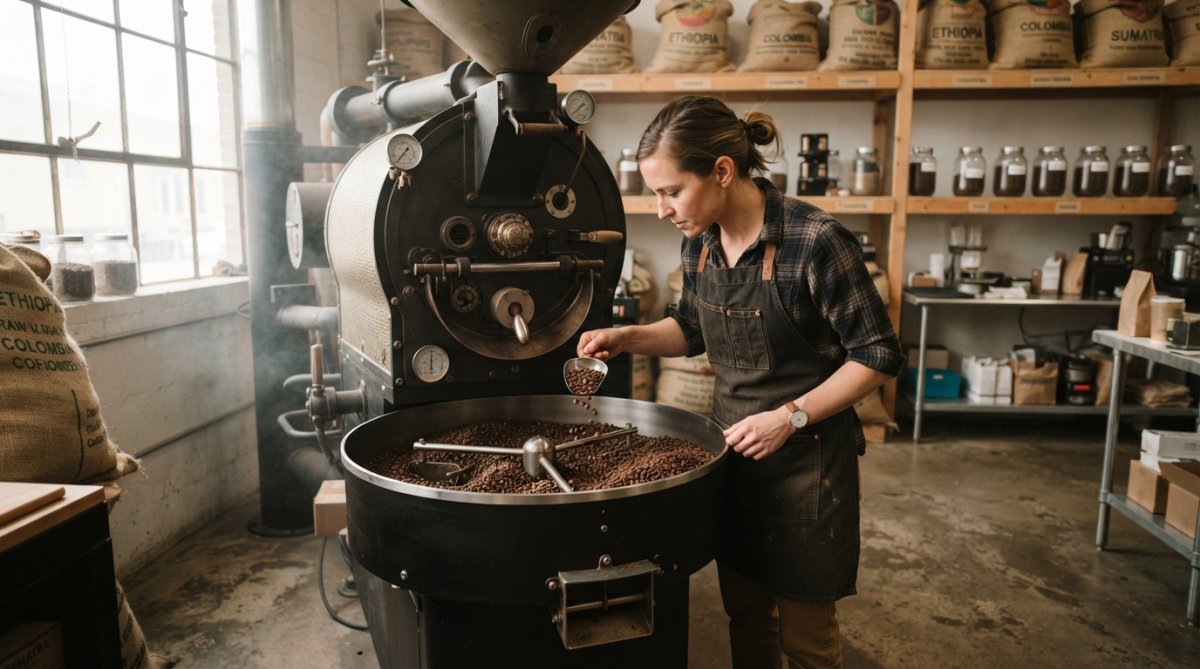
Independent roasters compete on quality and sourcing, not price. A local roaster's business depends on producing exceptional coffee; a chain's depends on volume.
Local roasters build direct relationships with coffee farmers, often visiting farms personally. They can tell you the farmer's name, elevation, harvest date, and processing method. This transparency ensures farmers receive fair compensation.
The roasting process is where local roasters excel. They adjust roast profiles based on each bean's density, moisture content, and desired flavor outcome. Chain retailers use standardized profiles that work adequately for most beans but optimize for none.
Single Origin vs. Blends
Single origin coffee comes from one specific farm, region, or country, showcasing that location's terroir, altitude, soil, and climate. Blends combine beans from multiple origins to create balanced flavor profiles. A roaster might blend Brazilian beans (heavy body, low acidity) with Ethiopian beans (bright acidity, floral notes) to create something neither origin achieves alone.
Single origins let you taste the farmer's work and region's character. Blends let you taste the roaster's skill. Single origins excel for pour-over brewing; blends excel for espresso.
Roast Profiles and Flavor Development
Roast profiles determine how much a bean develops before cooling. Light roasts preserve origin flavors. Medium roasts balance origin character with roast-induced sweetness. Dark roasts emphasize body and roast flavors.
Roast date matters more than roast level. A dark roast roasted yesterday tastes better than a light roast roasted three weeks ago.
Specialty Coffee Beans: Understanding Quality and Origin
Specialty coffee is defined by quality standards. The Specialty Coffee Association grades beans on a 100-point scale. Coffees scoring 80+ points are specialty grade. Most commercial coffee scores 70-75 points.
Origin matters because different regions produce distinct flavor profiles. Ethiopian coffees tend toward floral and fruity notes. Brazilian coffees tend toward chocolate and nut notes. Kenyan coffees tend toward berry and wine-like notes.
Arabica vs. Robusta: Bean Types Explained
Arabica accounts for roughly 60-70% of global coffee production. It's grown at higher altitudes, produces more complex flavors, and contains less caffeine than Robusta. Specialty coffee is almost exclusively Arabica.
Robusta grows at lower altitudes and produces higher yields. It contains twice the caffeine of Arabica and has a harsher, more bitter flavor profile. You'll rarely find specialty roasters selling pure Robusta.
Flavor Profiles, Acidity, and Body
Acidity in coffee refers to brightness and liveliness, not pH. High-acidity coffees taste crisp and vibrant. Low-acidity coffees taste smooth and mellow. Pour-overs highlight acidity; espresso mutes it.
Body refers to how heavy or light the coffee feels in your mouth. Full-bodied coffees feel thick and substantial. Light-bodied coffees feel delicate. Darker roasts have more body; French press produces fuller body than pour-over.
Flavor notes describe what the coffee tastes like beyond "coffee." These aren't added flavors but naturally occurring compounds that develop during roasting. A roaster's skill determines whether these flavors are clear and pleasant or muddled.
Cuppari Coffee's approach emphasizes these flavor dimensions by roasting beans only after an order is placed, ensuring every bag arrives at peak flavor.
Freshly Roasted Coffee Near Me: Why Timing Matters
Finding freshly roasted coffee near me is harder than it sounds because "fresh" is relative. A bag roasted two weeks ago tastes significantly different from one roasted two days ago.
Coffee reaches peak flavor 3-7 days after roasting. Before three days, the coffee is still off-gassing CO2 from roasting, which interferes with extraction. After seven days, oxidation begins breaking down delicate compounds that create complexity.
Local roasters have a massive advantage over retail chains. A local roaster can roast Monday and sell Wednesday. A chain's beans were roasted weeks ago, then distributed and shelved.
The 3-7 Day Sweet Spot After Roasting
By day three, CO2 has mostly escaped and flavors are clean and bright. By day seven, oxidation is beginning to dull brightness. By day fourteen, the coffee tastes noticeably flat and one-dimensional.
Ask roasters when they roasted the beans you're considering. Reputable roasters print roast dates on every bag. If a roaster won't disclose roast dates, they're likely hiding that beans are older than they should be.
How to Verify Roast Dates
Every bag of specialty coffee should display the roast date prominently. When you get home, check the roast date against today's date. Beans roasted within the past three days are still degassing; store them in an airtight container for a day or two before brewing. Beans roasted three to seven days ago are in the sweet spot. Beans roasted more than two weeks ago are past their prime.
For online orders, track the shipping date. Beans roasted Monday and shipped Tuesday should arrive Thursday or Friday, at day three or four of the ideal window. Cuppari Coffee's same-day roasting and shipping model ensures beans arrive at customers at peak freshness.
Coffee Bean Delivery Options: Local Pickup vs. Shipped Orders
You have three main options: visit a local roaster in person, order for pickup, or order from a roaster that ships directly.
Local pickup combines freshness with the ability to ask questions and sample beans before buying. You get beans at peak freshness and can learn directly from the roaster. The downside is limited selection; a local roaster typically has 5-15 origins available.
Shipped orders expand selection dramatically. You can access beans from roasters across the country. Shipping takes 2-5 days, meaning beans are slightly less fresh than same-day pickup. However, if a roaster roasts the day your order ships, beans still arrive in the ideal 3-7 day window.
Same-Day Roasting and Shipping Advantages
When a roaster roasts beans the day they ship, you get maximum freshness. Beans arrive 2-3 days later, still within the peak flavor window. This eliminates old inventory sitting on shelves.
Same-day roasting requires a different business model. The roaster must have capacity to roast multiple times daily and coordinate with shipping for fast delivery. Most traditional roasters can't do this; they roast in large batches and hold inventory.
Drive-Thru and Order Ahead for Convenience
Some specialty roasters offer drive-thru or order-ahead options combining convenience with quality. You order online, they prepare your beans, and you pick them up without leaving your car.
Order-ahead services let you request specific roast dates or bean origins before you visit, ensuring the roaster has exactly what you want ready.
Sustainability and Ethical Sourcing in Coffee Roasting
How coffee is sourced matters for farmers and your conscience. Specialty coffee roasters have made sustainability and fair compensation central to their business model. When you buy from a roaster that sources directly from farmers, more of your money goes to the people who actually grew the coffee.
Fair Trade and Direct Trade Practices
Fair Trade certification ensures farmers receive a minimum price for their beans, regardless of market fluctuations. Direct Trade goes further, roasters buy directly from farmers, eliminating middlemen entirely. Farmers receive significantly more per pound than Fair Trade minimums. Direct Trade roasters often visit farms and build relationships.
Organic Beans and Environmental Responsibility
Organic certification means the farm doesn't use synthetic pesticides or fertilizers. Ask roasters about their sourcing practices. A roaster that can explain why they chose a specific farm and what sustainable practices that farm uses is more credible than one that just buys "organic certified" beans.
Environmental responsibility extends beyond the farm. Consider how beans are packaged and shipped. Roasters using compostable packaging or minimizing waste are making conscious environmental choices.
Brewing at Home: Making the Most of Your Freshly Roasted Beans
Once you've sourced excellent beans, brewing method determines whether you taste their full potential. The three variables that matter most are grind size, water temperature, and brew time.
Grinding, Water Temperature, and Timing
Grind size must match your brewing method. Pour-over requires medium-fine grind. French press requires coarse grind. Espresso requires very fine grind. A burr grinder is essential; blade grinders produce inconsistent particle sizes. Water temperature should be 195-205°F for most brewing methods. Water that's too hot over-extracts and tastes bitter; water that's too cool under-extracts and tastes sour.
Brew time varies by method. Pour-over takes 3-4 minutes. French press takes 4 minutes. Espresso takes 25-30 seconds. Timing is critical; brew too long and you over-extract, brew too short and you under-extract.
Common Mistakes When Brewing Fresh Coffee
The most common mistake is using water that's too hot. Many people use boiling water (212°F) because they assume hotter is better. Let water cool for 30 seconds after boiling, or use a thermometer to hit 200°F.
The second mistake is grinding too fine, which causes over-extraction and bitterness. The third mistake is brewing too long. A pour-over that takes five minutes is over-extracted. Aim for 3-4 minutes.
Why Freshness Matters More Than You Think
The difference between fresh coffee and stale coffee is stark. A bean roasted three days ago tastes vibrant and complex. The same bean roasted three weeks ago tastes flat and one-dimensional. Most people have never experienced truly fresh coffee.
This is why sourcing matters. It's the difference between tasting what the farmer and roaster worked to create versus tasting oxidized, stale beans. Once you've experienced peak-fresh coffee, you can't go back to month-old beans from a grocery store shelf.
Finding coffee and bean near me that's actually fresh requires knowing where to look and what questions to ask. Local roasters with visible roast dates, online roasters that ship quickly, and services that roast to order all prioritize freshness.
Finding quality coffee and bean near me doesn't have to be complicated, but it does require knowing what separates fresh beans from stale ones. Cuppari Coffee addresses this directly: beans are roasted only after an order is placed and shipped the same day, guaranteeing they arrive at peak freshness. With free shipping on all U.S. orders and a diverse selection of single origins, blends, and specialty pods, you get premium freshly roasted coffee delivered straight to your doorstep. The difference in taste is immediate and unmistakable. Add to cart and experience what fresh coffee actually tastes like.
Frequently Asked Questions
How do I find specialty coffee beans and local coffee roasters near me?
Start by searching 'specialty coffee beans near me' or 'local coffee roasters' on Google Maps to locate independent roasters in your area. Check their websites for store hours, menu offerings, and whether they offer order ahead or delivery. Many specialty roasters also maintain social media pages showcasing their latest single origin and blend releases. Visit in person to ask baristas about their sourcing practices and flavor profiles, this personal interaction helps you discover beans matched to your taste preferences.
What's the difference between coffee and bean delivery services?
Coffee bean delivery services ship whole beans directly to your home, often roasted to order for maximum freshness. Many guarantee roasting and shipping the same day, ensuring your beans arrive in their optimal 3-7 day flavor window. This differs from buying pre-roasted bags at retail locations, which may have been roasted weeks earlier. Delivery services eliminate the need to visit a cafe, offer free shipping on all U.S. orders with some providers, and provide flexibility to pause or skip months if needed, ideal for drip coffee drinkers who prefer convenience over immediate gratification.
How can I tell if coffee beans are actually fresh?
Check the roast date on the bag, freshly roasted beans should show a date within the last 7-14 days. Avoid bags with no roast date or vague 'best by' dates instead. Fresh beans release carbon dioxide for 24-48 hours after roasting; if a bag has a one-way valve and feels slightly puffy, that's a positive sign. When you open the bag, fresh beans smell vibrant and aromatic, not stale or musty. Taste is the ultimate test: fresh beans produce brighter acidity, fuller body, and more nuanced flavor profiles compared to older beans, which taste flat and bitter.
Should I buy whole beans or pre-ground coffee for the best flavor?
Whole beans maintain freshness far longer than pre-ground coffee because grinding dramatically increases surface area, causing rapid oxidation. For optimal flavor, purchase whole beans and grind them just before brewing, ideally within 15 minutes. If you don't own a grinder, many local coffee roasters and specialty shops offer free grinding services or sell affordable burr grinders. Pre-ground coffee is convenient but loses aromatic compounds and flavor complexity within days of grinding. For regular drip coffee drinkers, investing in a basic conical burr grinder transforms the taste and justifies the cost of premium freshly roasted beans.
This article was written using GrandRanker