

Table of Contents
- Is Coffee Subscription Cheaper Than Buying Locally? The Real Numbers
- How Subscription Pricing Works
- How Local Roastery and Supermarket Pricing Works
- Subscription vs. Local Roaster Pricing: Side-by-Side Comparison
- Cost Per Gram and Cost Per Cup Analysis
- Best Coffee Subscription Services for Value
- How to Save Money on Specialty Coffee
- Coffee Subscription Frequency: Finding Your Sweet Spot
- Quality vs. Convenience: What You're Really Paying For
- When Coffee Subscriptions Make Financial Sense
- Frequently Asked Questions
Last Updated: July 5, 2026
Is Coffee Subscription Cheaper Than Buying Locally? The Real Numbers
When asking "is coffee subscription cheaper than buying locally," the answer depends on your consumption habits, local market prices, and what you value most. According to National Coffee Association consumption trends, Americans spend an average of $164 annually on coffee. The comparison isn't straightforward, shipping, freshness guarantees, and volume discounts create hidden cost advantages that shift the equation in ways many guides overlook.
The core tension: subscription services promise convenience and freshness, while local roasteries offer immediacy and often competitive pricing. Which wins depends on how much you drink, how far you live from specialty coffee sources, and whether you prioritize roast dates over price tags.
How Subscription Pricing Works
Subscription coffee services charge between $10 and $20 per shipment for specialty coffee, though pricing varies by roaster quality and bean selection. Some services charge a flat monthly fee for curated selections, while others let you customize frequency and bag size.
Cuppari Coffee delivers freshly roasted beans roasted and shipped the same day with free shipping on all U.S. orders, eliminating the shipping fee variable. Blue Bottle Coffee starts at $11 per shipment, while Atlas Coffee Club offers single-origin options at $9 per half-bag.
Volume discounts typically unlock 10-15% savings when you commit to quarterly or annual prepayment, though this creates subscription cancellation friction.
How Local Roastery and Supermarket Pricing Works
Local roasteries typically cost between $14 and $22 per pound, depending on positioning and bean origin. A 12-ounce bag might cost $10-15, putting you in the $0.83-1.25 per ounce range, competitive with subscriptions but without commitment.
Supermarket coffee costs $5-8 per pound for standard brands and $12-18 for specialty options. The trade-off is freshness: supermarket beans sit on shelves for weeks or months, losing flavor compounds that make freshly roasted coffee worth the premium.
The real advantage of local roasteries is freshness and customization. Many roast in-house daily, meaning beans might be 1-3 days old. You can ask about origin, roast profile, and brewing recommendations. However, local roasteries have geographic constraints, if the nearest specialty roaster is 30+ miles away, driving time and gas become hidden costs that make local buying less economical.
Subscription vs. Local Roaster Pricing: Side-by-Side Comparison
| Factor | Subscription | Local Roastery | Supermarket |
|---|---|---|---|
| Cost per ounce | $1.10-1.75 | $0.83-1.50 | $0.35-0.75 |
| Shipping included | Yes (often free) | No (travel cost) | No (travel cost) |
| Freshness (days old) | 1-7 days | 1-3 days | 30-90 days |
| Customization | Limited | High | None |
| Roast date visibility | Always | Usually | Rarely |
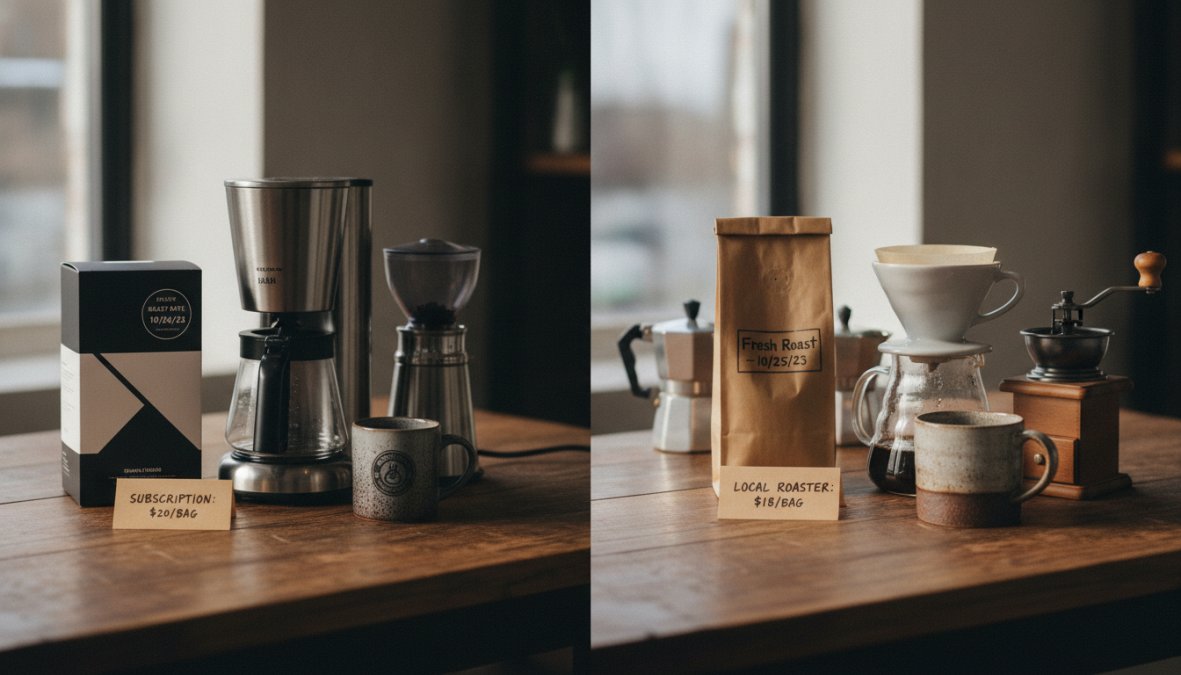
Local roasteries offer slightly lower per-ounce costs and superior freshness, but subscriptions eliminate travel friction and guarantee delivery. For someone drinking three cups daily (roughly 1.5 ounces per cup), the difference between $1.50/ounce and $1.00/ounce adds up to $27 per month.
Cost Per Gram and Cost Per Cup Analysis
The most honest evaluation is calculating your actual cost per cup brewed. A typical cup uses 15-18 grams of beans. A 12-ounce bag yields roughly 18-23 cups depending on brewing method and strength.
Subscription example: A $15 bag of 12 ounces yields 20 cups at $0.75 per cup with free shipping.
Local roastery example: A $14 bag of 12 ounces yields 20 cups at $0.70 per cup. A 5-mile drive costs roughly $1.40 in fuel at current rates, adding $0.07 per cup for a total of $0.77 per cup.
Supermarket example: A $7 bag yields 20 cups at $0.35 per cup in beans, plus $0.07 driving cost equals $0.42 per cup. However, beans are 60 days old, resulting in noticeably flatter flavor.
Best Coffee Subscription Services for Value
Cuppari Coffee eliminates the shipping cost variable by roasting and shipping the same day with free shipping on all U.S. orders. The diverse selection includes single-origin, blends, and coffee pods, providing flexibility within a subscription.
Atlas Coffee Club focuses on global single-origin beans from over 50 countries, starting at $9 per half-bag with tasting notes and origin information. However, shipping fees are charged separately, increasing effective cost by $3-5.
MistoBox offers personalized curation through human coffee experts, appealing to people seeking guidance. The downside is higher pricing and separate shipping fees.
Blue Bottle Coffee maintains exceptional quality standards with flexible bag sizes and subscriber-only discounts. At $11 per shipment, it's mid-range pricing but offers whole bean only.
How to Save Money on Specialty Coffee
Most people overestimate consumption. A typical drinker consumes 1-2 cups daily, translating to 1.5-3 ounces of beans. A 12-ounce bag lasts 4-8 days. Weekly delivery accumulates unused inventory that goes stale.
Biweekly delivery of two bags balances freshness with shipping efficiency. Coffee peaks in flavor 5-14 days after roasting; month-old bags are noticeably flatter.
Bulk discounts from local roasteries often exceed subscription discounts. Buying five pounds at once might unlock 15-20% savings. With proper freezer storage (airtight, cool, dark), quarterly bulk purchases from local roasters can undercut subscription pricing.
Coffee Subscription Frequency: Finding Your Sweet Spot
Weekly delivery makes sense only for 3+ cups daily drinkers prioritizing extreme freshness.
Biweekly delivery is optimal for typical drinkers. Two 12-ounce bags every two weeks delivers 40-50 cups monthly, matching 1-1.5 cups daily consumption while keeping beans within the optimal freshness window.
Monthly delivery works for light drinkers or those with freezer storage, though beans roasted 25+ days ago show noticeable flavor degradation.
Ask local roasteries for roast dates, reputable roasters stamp them on every bag. If they won't tell you or seem uncertain, it's a red flag.
Quality vs. Convenience: What You're Really Paying For
The difference between a $7 supermarket bag and a $16 specialty bag is transformative, specialty beans taste 5-10x better. However, quality improvements plateau above $18 per pound. The sweet spot for value is $14-18 per pound specialty coffee.
Roaster-direct subscriptions often undercut local roasteries because they eliminate retail markup (typically 40-50%). Local roasteries must cover rent, staff, and equipment, so they mark up beans higher.
Geographic cost-of-living variations mean different answers in different places. In San Francisco, specialty bags cost $18-22 locally, making $15 subscriptions look cheap. In rural areas, the nearest specialty roastery might be 100 miles away, making subscriptions the only practical option.
When Coffee Subscriptions Make Financial Sense
Subscriptions win in specific scenarios:
You live far from specialty roasteries. Driving 30+ miles costs $0.15-0.25 per cup, making subscriptions cheaper.
You value maximum freshness. Cuppari Coffee's same-day roasting guarantees beans roasted within 24 hours of purchase.
You're uncertain about preferences. Subscriptions with curation let you experiment before committing to bulk purchases.
You drink enough to justify bulk shipping. Someone drinking 4+ cups daily benefits from larger, less frequent shipments.
You have storage constraints. Smaller, more frequent deliveries make sense without freezer space.
Annual expenditure comparison shows the stakes. A light drinker (1 cup daily) spending $0.75 per cup via subscription costs $274 annually. Local roastery buying at $0.77 per cup costs $281, nearly identical. Supermarket coffee at $0.42 per cup costs $153, saving $121 yearly. For heavy drinkers (4 cups daily), subscription costs $1,095 annually versus $1,122 local and $612 supermarket.
The math reveals that for light drinkers, subscription versus local is nearly cost-neutral. The biggest savings opportunity is choosing specialty coffee over supermarket coffee, which delivers 2-3x better flavor at only 2x the cost.
Choosing between coffee subscriptions and buying locally requires honest assessment of your consumption patterns, geographic constraints, and priorities. If you prioritize maximum freshness with zero shipping costs, Cuppari Coffee delivers beans roasted and shipped the same day with free shipping on all U.S. orders. For most coffee drinkers, the per-cup cost difference is negligible. The real decision is whether you value subscription convenience and freshness guarantees or local immediacy and flexibility. Test both approaches for a month, track your actual costs and satisfaction, then commit to whichever aligns with your habits and preferences.
Frequently Asked Questions
Is coffee subscription cheaper than buying locally?
It depends on your consumption habits and location. Coffee subscriptions typically offer lower per-bag prices due to roaster-direct pricing and bulk discounts, but shipping fees and subscription frequency can offset savings. Local roasters may charge more per bag but eliminate shipping costs. For regular, high-volume drinkers, subscriptions often win; occasional buyers may find local purchases more economical. Calculate your cost per cup based on your brewing method and consumption patterns to determine which option truly saves money.
How do I calculate the cost per cup of coffee?
Divide the total cost of beans (including shipping) by the number of cups you'll brew. For example, if a 12 oz bag costs $14 with shipping and yields 15 cups, your cost per cup is approximately $0.93. Account for your brewing method, espresso uses more beans per cup than drip coffee. Compare this across subscription services and local options to find the best value. Track roast dates and freshness since older beans may require more coffee to achieve desired strength, increasing your per-cup cost.
What are the hidden costs of coffee subscriptions?
Beyond the advertised price, consider shipping fees (though some services like Cuppari Coffee offer free U.S. shipping), subscription cancellation friction that may delay stopping orders, packaging waste and environmental overhead, and the risk of subscription fatigue if you over-order. Some services charge different prices for recurring orders versus one-time purchases. Carefully review billing cycles and frequency options before committing, as changing delivery schedules can sometimes trigger price increases or minimum order requirements.
Which offers better quality: coffee subscriptions or local roasters?
Quality depends on the specific roaster, not the delivery method. Premium subscription services emphasizing freshness, like those roasting beans only after an order is placed and shipping the same day, can match or exceed local roastery quality. Single-origin and specialty coffee profiles are available through both channels. The advantage of subscriptions is consistency in roasting standards and access to diverse single-origin beans from multiple roasters. Local roasters offer the benefit of tasting before buying and supporting community businesses, though specialty coffee quality varies by location.
This article was written using GrandRanker