

Table of Contents
- Why Freshly Roasted Coffee Transforms Your Cold Brew
- How to Grind Coffee for Cold Brew
- Cold Brew Coffee Ratio: Finding Your Perfect Balance
- Steeping Time for Cold Brew: Mastering Immersion Extraction
- Best Coffee Beans for Cold Brew
- Step-by-Step Cold Brew Recipes With Freshly Roasted Coffee
- Storage, Shelf Life, and Maintaining Freshness
- Frequently Asked Questions
Last Updated: July 3, 2026
Why Freshly Roasted Coffee Transforms Your Cold Brew
Cold brew made with freshly roasted beans (roasted within 7-14 days) produces noticeably brighter acidity, cleaner flavor notes, and smoother mouthfeel compared to older coffee. Cold brew's extended steeping process (12-24 hours) extracts compounds differently than hot brewing. Freshly roasted coffee still contains active CO2 and permeable cellular walls, exactly what cold brew extraction demands. Research from the Specialty Coffee Association's brewing standards shows that approximately 40% of volatile flavor compounds are lost within the first two weeks of roasting; by week four, you're looking at 65-70% loss.
How Bean Freshness Impacts Oxidation and Extraction
Freshly roasted beans contain active CO2 that protects the interior from oxygen exposure. When you use these beans for cold brew, that remaining CO2 enhances extraction by helping water penetrate the bean more evenly during the 12-24 hour steep. Older beans lose this protective CO2 within 3-4 weeks, becoming denser and more resistant to water penetration.
How to Grind Coffee for Cold Brew
Cold brew demands coarsely ground coffee, finer than French press but significantly coarser than drip. Grind size directly controls extraction rate during the long steeping period. Too fine creates bitter, muddy flavors; too coarse leaves you with weak, sour cold brew.
Coarsely Ground Coffee: The Essential Foundation
Coarsely ground coffee particles should resemble sea salt or breadcrumbs, individual pieces you can see and feel. This size creates the right surface area for water interaction during a 12-24 hour steep and makes filtering easier. A burr grinder, either flat or conical, produces consistent particle size. Blade grinders create uneven chunks and powder, leading to inconsistent extraction and sediment problems. Grind your beans immediately before brewing.
Cold Brew Coffee Ratio: Finding Your Perfect Balance
The coffee-to-water ratio determines both strength and extraction efficiency. Cold brew isn't forgiving with ratios, the extended steeping time means miscalculations compound over 12-24 hours.
Concentrate vs. Ready-to-Drink Ratios
Cold brew concentrate uses a 1:4 ratio (one part coffee to four parts water by weight), producing a syrup-like concentrate you dilute when serving. Ready-to-drink cold brew uses a 1:8 to 1:10 ratio, producing a finished beverage you can drink straight from the fridge. For freshly roasted coffee, start with 1:8 ratio (by weight) as your baseline for ready-to-drink cold brew. Measure by weight, not volume, coffee density varies, and volume measurements introduce too much guesswork.
Water Chemistry and Filtered Water Impact
The water you use matters significantly. According to the Specialty Coffee Association's water chemistry guidelines, water with 50-150 PPM (parts per million) total dissolved solids produces optimal extraction. Most filtered water falls in this range. Use filtered water for all cold brew, the cost is minimal and the improvement is noticeable.
Steeping Time for Cold Brew: Mastering Immersion Extraction
Steeping time is where cold brew becomes an art. The same ratio and grind size can produce vastly different results depending on how long you let it sit.
Temperature, Time, and Flavor Development
Cold brew steeps at room temperature (68-72°F) or refrigerated (38-42°F). Room temperature steeping extracts faster because water molecules move more freely at higher temperatures. Most cold brew steeps for 12-24 hours. The lower end (12 hours) works best for finer grinds or higher coffee-to-water ratios. The upper end (24 hours) is ideal for coarser grinds or lower ratios. Anything beyond 24 hours risks over-extraction.
Troubleshooting Bitter or Sour Batches
Sour cold brew indicates under-extraction. Fix it by steeping longer (add 4-6 hours), using slightly finer grounds, or steeping at room temperature instead of refrigerated. Bitter cold brew indicates over-extraction. The fix is shorter steeping time (reduce by 4-6 hours), coarser grounds, or using fresher beans.
Best Coffee Beans for Cold Brew
Not all coffee beans perform equally in cold brew. The brewing method's characteristics, long steeping, oxygen-limited extraction, room or cold temperature, favor certain roast profiles and bean origins.
Single-Origin vs. Blends for Cold Brew
Single-origin beans showcase distinct flavor characteristics. For cold brew, single-origins with naturally higher sweetness and lower acidity work best. African coffees (Ethiopian, Kenyan) tend toward bright, fruity notes that shine in cold brew. Central American coffees (Honduras, Costa Rica) often deliver chocolate and nutty flavors that develop beautifully during long steeping. Blends combine beans from multiple origins to create balanced flavor profiles and are more forgiving than single-origins.
Tasting Notes and Flavor Profile Matching
Coffee tasting notes tell you what flavor compounds the roaster emphasized. For cold brew, choose beans described as "smooth," "balanced," or "sweet" for better results. Beans with chocolate, caramel, or nut tasting notes typically shine in cold brew. Medium to medium-dark roasts generally perform better because they're engineered to taste good without the brightness that hot water brings.
Step-by-Step Cold Brew Recipes With Freshly Roasted Coffee
These recipes use specific ratios, grind sizes, and steeping times optimized for freshly roasted beans.
Classic Mason Jar Method
What You'll Need:
- One quart-sized mason jar
- Freshly roasted coffee beans (roasted within 7-14 days)
- Filtered water
- Burr grinder
- Kitchen scale
- Cheesecloth or fine mesh strainer
Step 1: Measure Your Coffee (5 minutes)
Weigh out 85 grams of freshly roasted coffee beans for a 1:8 ratio in a quart jar.
Step 2: Grind Your Beans (3 minutes)
Grind your 85 grams of beans to a coarse consistency (breadcrumb-sized pieces) immediately before brewing.
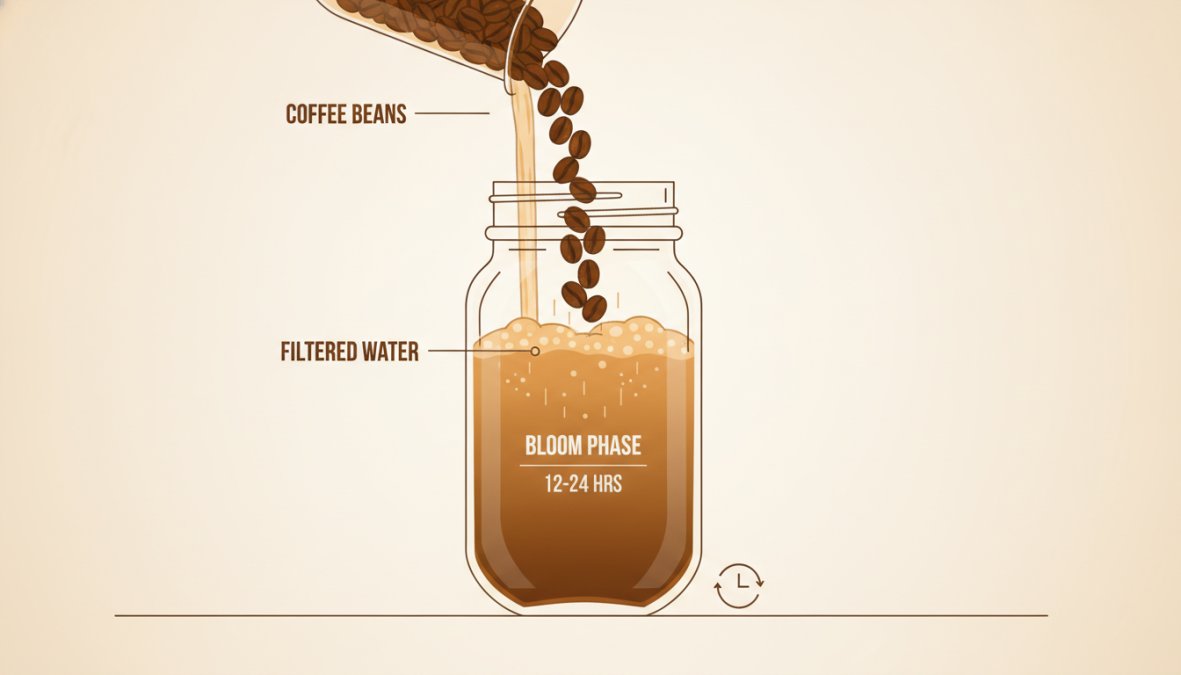
Step 3: Add Water and Stir (2 minutes)
Pour 680 grams of filtered water into your mason jar. Add the ground coffee. Stir well for 30-45 seconds to ensure all grounds are wet.
Step 4: Steep (12-16 hours at room temperature, or 18-24 hours refrigerated)
Cover the jar loosely. Room temperature steeping extracts faster and produces fuller body. Refrigerated steeping produces brighter, cleaner flavors.
Step 5: Strain (5 minutes)
Pour the cold brew through cheesecloth or a fine mesh strainer into a clean container.
Step 6: Dilute and Serve (1 minute)
Your concentrate is now ready. Dilute with equal parts water for ready-to-drink cold brew, or use 1 part concentrate to 2-3 parts water/milk for stronger drinks.
French Press Cold Brew Technique
A French press creates excellent cold brew because the metal filter allows more oils through than paper filters, producing richer mouthfeel.
What You'll Need:
- French press (34-51 oz capacity)
- Freshly roasted coffee beans
- Filtered water
- Burr grinder
- Kitchen scale
Step 1: Measure and Grind (8 minutes)
For a standard French press, use 45 grams of freshly roasted coffee and 360 grams of filtered water (1:8 ratio). Grind to coarse consistency immediately before brewing.
Step 2: Combine and Steep (12-16 hours)
Add grounds to the French press, then pour in water. Stir gently. Place the lid on top without pressing the plunger down. Steep at room temperature for 12-16 hours or refrigerated for 18-24 hours.
Step 3: Press and Serve (2 minutes)
Press the plunger down slowly over 30 seconds. The metal filter allows more oils through, creating a fuller-bodied cold brew.
Batch Brewing for Café-Quality Results
If you're making cold brew regularly, batch brewing in larger quantities saves time and ensures consistency.
What You'll Need:
- Large glass container (2-3 quart capacity)
- Freshly roasted coffee beans (340-510 grams)
- Filtered water (2.7-4 liters)
- Burr grinder
- Kitchen scale
- Fine mesh strainer or cheesecloth
Step 1: Calculate Your Ratio
Decide whether you want concentrate (1:4 ratio) or ready-to-drink (1:8 ratio). For a 2-quart batch at 1:8 ratio, use 255 grams of freshly roasted coffee and 2 liters of filtered water.
Step 2: Grind in Batches
Grind your beans in 100-gram batches if your grinder has capacity limits. All grinding should happen within 15 minutes of steeping.
Step 3: Layer and Combine
Add half your ground coffee to the container, then half your water. Stir well. Add remaining coffee and water. Stir again to eliminate dry pockets.
Step 4: Steep and Stir
For concentrate (1:4 ratio), steep for 24 hours at room temperature. For ready-to-drink (1:8 ratio), steep for 16-18 hours at room temperature or 20-24 hours refrigerated.
Step 5: Strain Through Multiple Stages
First strain through a coarse mesh strainer to remove most grounds. Then strain through fine cheesecloth into your final storage container.
| Recipe Type | Coffee Amount | Water Amount | Ratio | Steep Time | Yield | Best For |
|---|---|---|---|---|---|---|
| Mason Jar | 85g | 680g | 1:8 | 12-16 hrs (room temp) | 24 oz | Individual servings |
| French Press | 45g | 360g | 1:8 | 12-16 hrs (room temp) | 12 oz | Small batches |
| Batch Concentrate | 340g | 1.36L | 1:4 | 24 hrs (room temp) | 1.7L concentrate | Flexible servings |
| Batch Ready-to-Drink | 255g | 2L | 1:8 | 16-18 hrs (room temp) | 2L finished | Week's supply |
Storage, Shelf Life, and Maintaining Freshness
Cold brew's shelf stability is one of its biggest advantages over hot coffee. The cold temperature and low oxygen environment slow oxidation dramatically.
Refrigeration Best Practices and Shelf Stability
Cold brew concentrate stays fresh for 7-10 days in an airtight container in the refrigerator. Store in glass containers with airtight lids; plastic can absorb flavors and allow minor oxygen exchange. Ready-to-drink cold brew lasts 5-7 days refrigerated. Once you dilute concentrate with water or milk, you've introduced more water and oxygen, which accelerates oxidation. Refrigerators that maintain consistent 38-42°F preserve cold brew better than those with temperature fluctuations.
Filtering Techniques: Cheesecloth vs. Paper Filter
Cheesecloth creates a coarser filter, allowing more oils and fine particles through, producing fuller-bodied, richer cold brew. Paper filters create a finer filter, removing more oils and producing cleaner, brighter cold brew. For freshly roasted coffee, start with cheesecloth to preserve the oils and aromatics. A two-stage filtering approach (coarse mesh first, then cheesecloth) produces the best results.
Cold brew recipes with freshly roasted coffee represent the intersection of two simple ideas: use the freshest beans available, and brew them with a method designed to highlight what makes fresh beans special. With beans roasted within 7-14 days, you're starting with optimal flavor potential, the CO2 is still active, oxidation is minimal, and extraction efficiency is at its peak. Use the recipes and techniques in this guide, and you'll taste the dramatic difference that freshness makes.
Frequently Asked Questions
Does using freshly roasted coffee make a difference in cold brew?
Yes, freshly roasted coffee significantly impacts cold brew quality. Freshly roasted beans have optimal aromatics and volatile compounds that extract more fully during immersion brewing. Within 2-4 weeks of roasting, beans deliver the best flavor profile and acidity balance. Older beans lose complexity and can produce flat-tasting cold brew concentrate. Freshness also reduces oxidation during the steeping process, preserving the coffee's intended tasting notes.
What is the ideal coffee-to-water ratio for cold brew concentrate?
The standard cold brew coffee ratio is 1:4 (coffee to water by weight) for concentrate, or 1:5 for a slightly lighter version. For example, use 200g coarsely ground coffee with 800ml filtered water for concentrate. If brewing ready-to-drink cold brew, use 1:8 or 1:10 ratio. These ratios account for immersion extraction efficiency and allow proper dilution when serving over ice or with milk.
How long should I steep cold brew for the best flavor?
Steeping time for cold brew typically ranges from 12 to 24 hours at room temperature or refrigeration. Most cold brew recipes recommend 16-20 hours for optimal extraction without over-extraction bitterness. Freshly roasted beans may require slightly less time due to higher solubility. Longer steeping (24+ hours) can intensify flavor but risks extracting excessive tannins, resulting in bitter batches. Test your specific roast profile to find your ideal steeping window.
Can I use a French press to make cold brew?
Yes, a French press works excellently for cold brew using the same immersion brewing method. Add coarsely ground coffee and filtered water in the 1:4 or 1:5 ratio, stir gently to bloom, then let steep 12-24 hours in the refrigerator. The French press plunger helps with sediment separation at the end. This method is ideal for smaller batches and delivers café-quality results with freshly roasted beans, though a fine cheesecloth or paper filter may be needed for extra clarity.
This article was written using GrandRanker