

Table of Contents
- Why Coffee Packaging Has a Waste Problem
- Coffee Bag Material Types: What's Actually in Your Bag
- Compostable Coffee Bags: How They Break Down and Where
- Recyclable Coffee Packaging: What Can Actually Go in Your Bin
- The Cost-Benefit Reality for Small-Batch Roasters
- Regulatory Compliance and Labeling Standards in the U.S.
- Conclusion
- Frequently Asked Questions
Last Updated: September 21, 2026
Why Coffee Packaging Has a Waste Problem
Most coffee drinkers toss their empty bag into the recycling bin and assume they've done their part. They haven't. This guide from Cuppari Coffee explains the gap between what coffee packaging looks like and what actually happens to it, because the answer shapes every purchase decision you make as a roaster or a daily drinker.
Coffee Bag Material Types: What's Actually in Your Bag
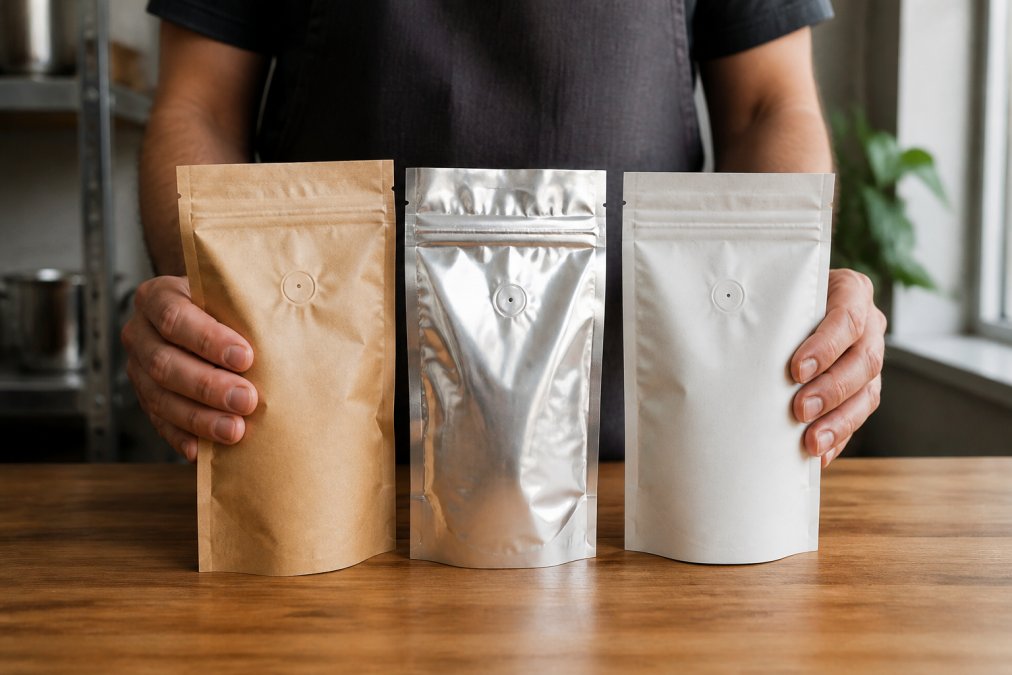
Coffee bag material types fall into three broad families: multi-layer laminates, mono-material constructions, and compostable films. Each behaves differently at end of life, and the label rarely tells you which one you're holding.
Mono-Material vs Multi-Layer: The Recycling Divide
Mono-material packaging is built from a single polymer type, which makes it far easier to recycle because no separation step is required. Multi-layer packaging bonds different materials together, typically including low-density polyethylene, aluminum foil, and a barrier layer, to block oxygen and moisture.
Barrier Layers and Degassing Valves: Why Freshness Complicates Recycling
A degassing valve is a one-way valve that lets carbon dioxide escape while keeping oxygen out. It's essential for roasted coffee, which releases CO2 for days after roasting. Without it, bags inflate and beans stale faster.
| Material Type | Recyclability | Compostability | Freshness Protection |
|---|---|---|---|
| Multi-layer laminate | Very low | No | Excellent |
| Mono-material (LDPE) | Moderate | No | Good |
| Kraft paper (unlined) | Moderate | Yes | Poor |
| PLA / plant-based film | Low | Industrial only | Moderate |
Compostable Coffee Bags: How They Break Down and Where
Compostable coffee bags are designed to break down into non-toxic components under specific conditions. The critical detail most guides skip: those conditions almost never exist in a home backyard.
Plant-Based Plastics and PLA: What Compostable Really Means
Plant-based plastics are derived from renewable sources rather than petroleum. The most common is polylactic acid, or PLA, typically made from corn starch or sugarcane.
Recyclable Coffee Packaging: What Can Actually Go in Your Bin
Recyclable coffee packaging exists, but "recyclable" describes a theoretical capability, not a guarantee your local program accepts it. The gap between the two is where most consumer confusion lives, and where most bags actually end up in the trash.
The Resin Code Is the First Filter
Flexible coffee packaging is almost always a film, and film recycling is a separate stream from rigid containers. The resin identification code on the bag tells you which stream you are dealing with:
- #2 HDPE and #4 LDPE film, the two film resins with the widest acceptance. Mono-material bags are typically built from one of these, which is exactly why mono-material is the recyclability story.
- #7 Other, a catch-all that includes most multi-layer laminates and many bio-based films. In practice, #7 film is not accepted in curbside programs.
- No code at all, common on imported bags. Treat it as non-recyclable unless the roaster publishes the material spec.
Curbside vs. Store Drop-Off: Two Different Answers
Most curbside programs accept rigid plastics and reject film, even when the film carries a #2 or #4 code. The reason is mechanical: film wraps around sorting equipment and jams it, so facilities either reject it by policy or pull it out by hand.
The Three Failure Modes That Get a Bag Rejected
- Contamination. Residual coffee oils, flavoring, or moisture cause a bale to be downgraded or landfilled. Rinse and fully dry the bag if it held flavored or oily coffee.
- Mixed-material components. The degassing valve, tin tie, and any zipper are different materials glued or welded onto the film. Remove what you can; a bag with a permanently bonded valve is a weaker candidate for any film stream.
- Wish-cycling. Placing a multi-layer or foil-lined bag in the bin hoping it gets sorted out is the single most damaging behavior in the system. Contaminated loads can cause an entire batch of otherwise recyclable material to be diverted to landfill.
End-of-Life Disposal: A Step-by-Step Guide for Consumers
This is the part most packaging guides leave out. Here is what to actually do with an empty bag:
- Check the bag's material label. Look for "mono-material," a #2 or #4 resin code, or a compostability certification.
- Remove the degassing valve and any tin tie. These are mixed materials and contaminate recycling streams.
- Rinse and dry the bag if it held flavored or oily coffee. Residue causes rejection at sorting facilities.
- Check your municipal recycling guidelines for film acceptance before placing it in the bin. If film is not listed, do not put it in.
- If film is not accepted curbside, check for a store drop-off bin at a nearby grocery or big-box retailer.
- For certified compostable bags, confirm whether a local industrial composting facility accepts them, home compost is a different standard and usually does not apply.
- If neither applies, the bag goes in the trash. That is an honest outcome, not a failure on your part.
The Cost-Benefit Reality for Small-Batch Roasters
For small roasters, sustainable packaging is a margin decision before it is a values decision. The premium is real, and it is not uniform across material families. Understanding where the cost comes from, and which levers actually move it, is what separates a workable switch from an expensive rebrand.
What Drives the Per-Unit Premium
Four cost drivers account for most of the gap between a conventional laminate bag and a sustainable alternative:
- Resin and film cost. Compostable films and mono-material barrier films generally cost more per pound than conventional multi-layer laminates, because the polymers are produced at lower volume and the barrier performance is harder to achieve in a single layer.
- Minimum order quantity (MOQ). This is the single biggest penalty for small roasters. A converter that runs 25,000-unit minimums on a custom-printed compostable bag will not run 2,000. Small runs either pay a surcharge, buy stock (unprinted) bags, or use digital short-run printers that cost more per unit but carry no MOQ.
- Print method. Flexographic printing is cheap at volume and expensive at low volume because of plate costs. Digital printing flips that: higher per-unit cost, near-zero setup, which is why it dominates the small-batch tier.
- Valve and fitment. Degassing valves are a purchased component with their own MOQ and per-unit cost, and compostable valve options are a narrower market than conventional ones.
The Decision Framework
The calculation that matters is not "is the sustainable bag more expensive", it almost always is. It is: does the premium per bag cost more than the customer loyalty and price tolerance it earns?
A practical way to frame it:
- Values-driven customer base (subscription roasters, farmers-market regulars, direct-to-consumer with an audience that reads your sourcing page): the premium is usually recoverable, either through price or through retention.
- Commodity or wholesale-focused operation (grocery shelf, food service, price-sensitive accounts): the math rarely works on a full material swap, and the buyer is not paying for the bag.
- Hybrid operations: the middle path is usually reduce total material rather than switch material entirely. A smaller bag, a lighter-gauge film, dropping an unnecessary outer box or a plastic window, or moving from a rigid tin to a flexible pouch cuts material use without a full material overhaul, and often without a per-unit cost increase.
Levers That Cut Cost Without Cutting the Claim
- Buy stock bags first. Run your label as a sticker or a stamp on an unprinted stock compostable or mono-material bag to test customer response before committing to a custom print run.
- Right-size the bag. Over-sized bags are the most common hidden cost: you pay for film you do not need, and the headspace accelerates staling.
- Consolidate SKUs. Fewer bag sizes means larger runs per size, which means better pricing and less dead inventory.
- Ask for the certification documentation, not just the spec sheet. A supplier who cannot produce the certification paperwork is a supplier whose claim you cannot legally repeat on your own label.
Regulatory Compliance and Labeling Standards in the U.S.
Packaging claims in the U.S. are governed by the Federal Trade Commission's Green Guides, which set the standard for when terms like "recyclable," "compostable," and "biodegradable" can be used. A claim must be substantiated and qualified if the relevant recycling or composting facility isn't available to a substantial majority of consumers.
Conclusion
The real challenge with eco friendly coffee packaging isn't finding a sustainable material. It's matching the material to the disposal infrastructure your customers actually have access to. Compostable bags without composting access, and recyclable bags without recycling access, are just landfill with better branding.
Frequently Asked Questions
What is the difference between compostable and recyclable coffee bags?
Compostable coffee bags break down into organic matter through microbial action, typically in industrial composting facilities that maintain high temperatures. Recyclable coffee packaging is processed into new materials at recycling centers. Compostable bags often use plant-based plastics like PLA, while recyclable options lean toward mono-material designs such as low-density polyethylene. The key difference is end-of-life: compostable bags need specific conditions to decompose, while recyclable bags need access to proper recycling streams. Neither works well in a standard landfill.
How does sustainable packaging impact coffee freshness?
Coffee freshness depends on blocking oxygen, moisture, and light. Barrier layers, often made from thin films of low-density polyethylene or aluminum, prevent oxygen transmission that stales beans within days. Degassing valves let carbon dioxide escape without letting oxygen in. Compostable and recyclable options can match traditional packaging on shelf life when they include proper barrier layers, but the material science matters. A compostable bag without a good moisture barrier will let beans go stale faster than a mono-material recyclable bag with a high-quality valve.
What certifications should I look for on coffee packaging?
Look for the Biodegradable Products Institute (BPI) logo for compostable claims, which verifies the product meets ASTM D6400 standards for industrial composting. For recyclable packaging, check for the How2Recycle label, which tells you exactly where the package can be recycled. The Forest Stewardship Council (FSC) certification indicates that paper or kraft paper components come from responsibly managed forests. These certifications are verified by third parties, so they carry more weight than a brand's own claim of being eco-friendly.
Are plastic-free coffee bags actually better for the environment?
Plastic-free coffee bags can reduce environmental impact, but the answer depends on disposal. A plastic-free bag made from kraft paper and a compostable liner only breaks down properly in a commercial composting facility, which most U.S. households cannot access. If that bag ends up in a landfill, it decomposes slowly and releases methane, similar to conventional plastic. The bigger win comes from mono-material designs that fit curbside recycling or from brands that offer refill programs. The material matters, but so does what happens after you finish the coffee.
The gap between a packaging claim and a packaging reality is where most sustainability efforts quietly fail. Cuppari Coffee closes a different gap: the one between roast date and your doorstep, by roasting only after you order and shipping the same day with free shipping on all U.S. orders. Browse single origin, blends, and pods, and add to cart to taste coffee at its freshest.