

Table of Contents
- Why Fresh Coffee Changes Your Espresso Machine Settings
- Start with the Right Coffee Dose for Espresso
- Setting the Grind Size for Fresh Beans
- How to Dial In Espresso by Taste
- Troubleshooting Sour vs. Bitter Shots
- Adjusting for Roast Profile and Seasonal Changes
- The Impact of Grinder Retention and Burr Maintenance
- Conclusion: Consistency Comes From Fresh Beans and Small Adjustments
- Frequently Asked Questions
Last Updated: September 6, 2026
Fresh coffee is a moving target. The moment beans leave the roaster, they begin off-gassing carbon dioxide and changing chemically, so espresso machine settings that worked on day three will not work on day ten. This guide from Cuppari Coffee walks through the exact adjustments needed to keep pulling balanced shots as your beans age, covering dose, grind size, and troubleshooting habits.
Why Fresh Coffee Changes Your Espresso Machine Settings
Most home baristas set their grinder once and expect it to work forever, but freshly roasted coffee behaves differently than supermarket beans that have sat on shelves for weeks.
Freshly roasted coffee contains trapped carbon dioxide that resists water, so it extracts more slowly and requires a coarser grind (peer-reviewed research). As beans age and degas, extraction speeds up, and you will need to grind finer to maintain the same flow rate.
Your grinder dial is not a set-and-forget control. Plan to make micro-adjustments every few days with a fresh bag of coffee; a single bag typically requires three or four grind adjustments over its lifespan.
Start with the Right Coffee Dose for Espresso
Dose is the amount of ground coffee in your portafilter basket and the foundation your espresso machine settings build upon, typically ranging from 16 to 20 grams depending on basket capacity.
Start with the basket capacity printed on your portafilter basket, usually 18 grams for standard double baskets. Weigh your dose using a scale rather than volume, because bean density varies by roast level.
A common mistake is changing dose to fix a bad shot when the real issue is grind size. Keep your dose constant while adjusting the grind; only change it if you are consistently hitting the wrong yield or your basket is visibly overfilled or underfilled. Consistency in dose makes every other variable easier to diagnose.
Setting the Grind Size for Fresh Beans
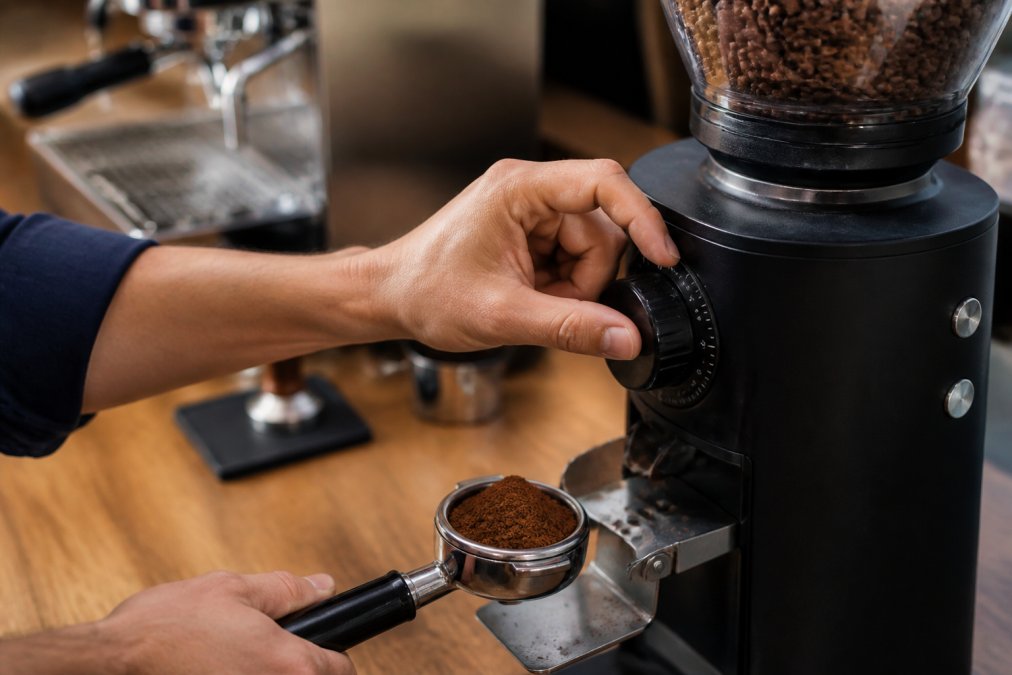
Grind size is the single most powerful tool in your espresso machine settings. A proper espresso grind has a fine granularity similar to table salt or powdered sugar, but the exact setting depends on your grinder and your beans.
A burr grinder is essential for espresso because it produces a uniform particle distribution. Blade grinders create uneven particles that lead to channeling and sour, bitter shots in the same cup. If you are using a blade grinder, upgrading to a burr grinder will improve your espresso more than any other equipment change.
The Relationship Between Grind and Espresso Extraction Time
Espresso extraction time is the water contact time between your first drop and the end of the shot. Finer grounds slow the flow of water, extending extraction time, while coarser grounds speed it up.
For a standard double shot, aim for an extraction time between 25 and 30 seconds from the moment you start the pump (sca.coffee). If your shot runs through in 15 seconds, your grind is too coarse and the coffee will taste sour and under-extracted. If it takes 40 seconds and drips slowly, your grind is too fine, producing bitter, over-extracted coffee.
How to Dial In Espresso by Taste
Most guides tell you to adjust by taste but stop short of giving a repeatable method. Here is a step-by-step process that isolates one variable at a time.
Step 1: Lock Your Dose and Yield
Before touching the grind dial, decide on a fixed dose and yield. Use the basket's rated capacity as your dose (usually 18 grams) and set your target yield at a 1:2 ratio, 36 grams out for 18 grams in. These are your control variables; do not change them during dialing in.
Step 2: Establish a Baseline Grind Setting
Start with a grind setting slightly coarser than your previous bag, since fresh beans are still off-gassing and extract slowly. This prevents a first shot that chokes the machine. If you have no prior reference, set your grinder to a medium-fine setting, roughly the texture of table salt, and pull a shot.
Step 3: Pull a Shot and Measure the Time
Time the extraction from the moment you engage the pump to the moment you stop it. Your target window is 25 to 30 seconds for a 1:2 ratio. Record the time and taste the shot, but do not change anything yet.
Step 4: Change Only One Variable, Grind Size
This is the core of the scientific method: change one variable at a time. Keep your dose and yield locked at 18 grams in and 36 grams out. Adjust the grind dial by one small increment, one number or one click on most home grinders. Pull another shot, time it, and taste it, moving finer if it runs fast and tastes sour, or coarser if it runs slow and tastes bitter.
Step 5: Use the 3-Shot Rule
Most home baristas land in the acceptable range within three to four shots. If you have not found a balanced shot after four attempts, stop and check your other variables: is your dose level? Is your tamp even? Is grinder retention adding stale grounds? Do not keep chasing the grind dial if the problem is elsewhere.
Step 6: Fine-Tune by Taste, Not Just Time
Once you hit the 25-to-30-second window, stop timing and start tasting. A shot that runs 28 seconds can still be slightly sour or bitter depending on the bean's roast profile and age. Make micro-adjustments, half a number on your grind dial, and taste again, aiming for sweetness, pleasant acidity, and no harsh bitterness.
The One-Variable-at-a-Time Principle
The single biggest mistake home baristas make is changing dose and grind simultaneously. If you change two variables and the shot tastes different, you cannot know which one caused the change. Locking dose and yield creates a controlled experiment where grind size is the only independent variable.
Troubleshooting Sour vs. Bitter Shots
Sour and bitter shots are the two most common failures. Sourness indicates under-extraction, too little flavor pulled from the coffee. Bitterness indicates over-extraction, too much pulled, including harsh compounds.
Sour shots taste sharp and acidic, like lemon juice; the fix is usually a finer grind or slightly higher dose. Bitter shots taste harsh and drying; the fix is a coarser grind or slightly lower dose.
Channeling, when water finds a path through the coffee bed instead of extracting evenly, is another culprit behind inconsistent shots, often caused by uneven tamping or a clumpy grind. Use a distribution tool or tap the portafilter to level the bed before tamping.
| Problem | Taste | Likely Cause | Adjustment |
|---|---|---|---|
| Sour, fast shot | Sharp, acidic | Grind too coarse | Grind finer |
| Bitter, slow shot | Harsh, drying | Grind too fine | Grind coarser |
| Inconsistent shot | Sour one day, bitter next | Channeling or uneven tamp | Level bed, tamp evenly |
| Weak, thin body | Watery, flat | Dose too low | Increase dose 1-2 grams |
Adjusting for Roast Profile and Seasonal Changes
Roast profile and environmental conditions shift your espresso machine settings more than most guides acknowledge. Light roasts are denser and less soluble, requiring a finer grind and often a slightly higher dose. Dark roasts are more porous and extract easily, needing a coarser grind to avoid bitterness. Your kitchen's environment changes day to day, and your grinder dial must follow.
The Humidity Mechanism
Coffee beans are hygroscopic, absorbing moisture from the air (sciencedirect.com). On a humid day, above 60 percent relative humidity, beans become softer and fracture differently, producing more fines and a slower extraction. Your usual grind setting will now run slow, so you may need to grind slightly coarser.
In dry winter months, indoor heating drops relative humidity to 20 or 30 percent, making beans brittle. They shatter more cleanly, producing fewer fines and a faster extraction, so you will need to grind finer. These shifts are measurable in your shot time.
The Temperature Variable
Room temperature also matters, though less than humidity. A hot kitchen, above 80°F, accelerates degassing, so beans age faster and extract quicker. If your kitchen swings between seasons, expect your dial-in to drift even within the same bag.
A Practical Seasonal Workflow
Instead of chasing the dial every day, adopt a simple routine. When you open a new bag, note the grind setting that produces a balanced shot. When the weather shifts, pull one test shot with your existing setting. If it runs fast and tastes sour, grind finer; if it runs slow and tastes bitter, grind coarser.
Tracking Your Settings Over Time
Keep a notebook or notes app with three columns: date, grind setting, and shot time. Over a few weeks, a pattern correlating with weather changes will emerge. A single bag requires three or four grind adjustments over its lifespan, not because the beans are inconsistent, but because the environment around them is.
The Roast Profile Interaction
Roast profile compounds these effects. Light roasts are denser and more sensitive to humidity because their cellular structure is less porous. Dark roasts, being more porous, absorb and release moisture faster, making them more reactive to sudden weather shifts. Switching between a light roast in summer and a dark roast in winter means adjusting for two variables at once, so expect a steeper learning curve and plan for more test shots.
The Impact of Grinder Retention and Burr Maintenance
Grinder retention and burr maintenance are the two most overlooked factors in espresso machine settings. Retention is the ground coffee that stays inside the grinder after each dose, mixing stale grounds into fresh coffee and throwing off yield.
A single dose workflow helps manage retention. Weigh your beans before grinding, then purge the grinder by running it for a second or two after the dose finishes. Many home grinders retain several grams of coffee, enough to noticeably alter your shot if not cleared.
Burr alignment and maintenance are equally important. Over time, burrs dull and accumulate coffee oils, producing inconsistent particle sizes. Clean your burrs every few weeks with a brush, and consider grinder cleaning tablets monthly. Dull or misaligned burrs cannot produce the uniform grind fresh espresso requires.
Conclusion: Consistency Comes From Fresh Beans and Small Adjustments
Espresso machine settings are not a destination; they are a continuous calibration between your beans, your grinder, and your kitchen's conditions. The starting point is coffee that is actually fresh, because stale beans will never produce the sweet, complex shots you are chasing.
At Cuppari Coffee, we roast beans only after you place your order and ship them the same day, so your coffee arrives at its peak for dialing in. Every bag arrives ready to teach you something about your grinder, and our free shipping on all U.S. orders means you can keep a steady supply of fresh beans without the guesswork of store shelves. Get started with Cuppari Coffee and taste the difference that genuinely fresh coffee makes in your espresso.
Frequently Asked Questions
Why does my espresso taste sour or bitter based on my machine settings?
Sour espresso usually means the shot is under-extracted. This often happens when the grind is too coarse, the water is too cool, or the espresso extraction time is under 25 seconds. Bitter espresso points to over-extraction, typically from a grind that is too fine or an extraction time over 30 seconds. Adjust one variable at a time. If it is sour, grind finer. If it is bitter, grind coarser. Your espresso machine settings for fresh coffee will need to change as the beans age.
What is the ideal espresso extraction time?
For a standard double shot, aim for an espresso extraction time between 25 and 30 seconds. This clock starts the moment you engage the pump, not when coffee first appears. If your shot hits the target yield in under 25 seconds, grind finer. If it takes longer than 30 seconds, grind coarser. Freshly roasted beans produce more crema and can slow the flow rate, so you may need to adjust your grind setting slightly coarser than you did with older beans.
How much coffee should I use for a double shot?
Most standard portafilter baskets are designed for a coffee dose for espresso between 18 and 20 grams for a double shot. Check your basket's capacity, as using too little coffee leaves gaps that cause channeling. Weigh your dose for shot consistency. Pair that dose with a yield of 36 to 40 grams of liquid espresso, which is a 1:2 brew ratio. Adjust the grind to hit your target extraction time.
How does bean freshness affect my espresso grind setting?
Freshly roasted coffee releases carbon dioxide for days after roasting. This gas creates resistance during extraction, which can slow the flow rate. Beans roasted within the last week may need a slightly coarser grind compared to older beans. As the coffee degasses over the following weeks, you will need to adjust your espresso machine settings and grind finer to maintain the same extraction time. Always dial in by taste and use the shot timer as your guide.