

Table of Contents
- What Are Coffee Pods and Espresso Capsules?
- Espresso Capsules vs Coffee Pods: Core Differences
- Coffee Pod Machine vs Espresso Machine: Equipment Differences
- E.S.E. Pods Explained: A Third Option
- How to Make Espresso with Coffee Pods
- Ease of Use and Convenience Comparison
- Environmental Impact and Sustainability
- Which Should You Choose? Pros and Cons Breakdown
Last Updated: July 19, 2026
Understanding the difference between espresso and coffee pods requires looking at how each system brews, what they're designed for, and which fits your daily routine. At Cuppari Coffee, we've helped thousands of customers navigate this choice by breaking down the brewing mechanics, flavor profiles, and convenience factors that separate these two popular single-serve options.
The confusion is understandable, both are convenient, pre-measured, and designed for specific machines. But they're fundamentally different products built on different brewing principles. According to the National Coffee Association's brewing standards, espresso extraction requires 9 bars of pressure or higher, while drip coffee relies on gravity and time. This single difference cascades into distinct flavor profiles, caffeine content, machine requirements, and environmental impacts.
What Are Coffee Pods and Espresso Capsules?
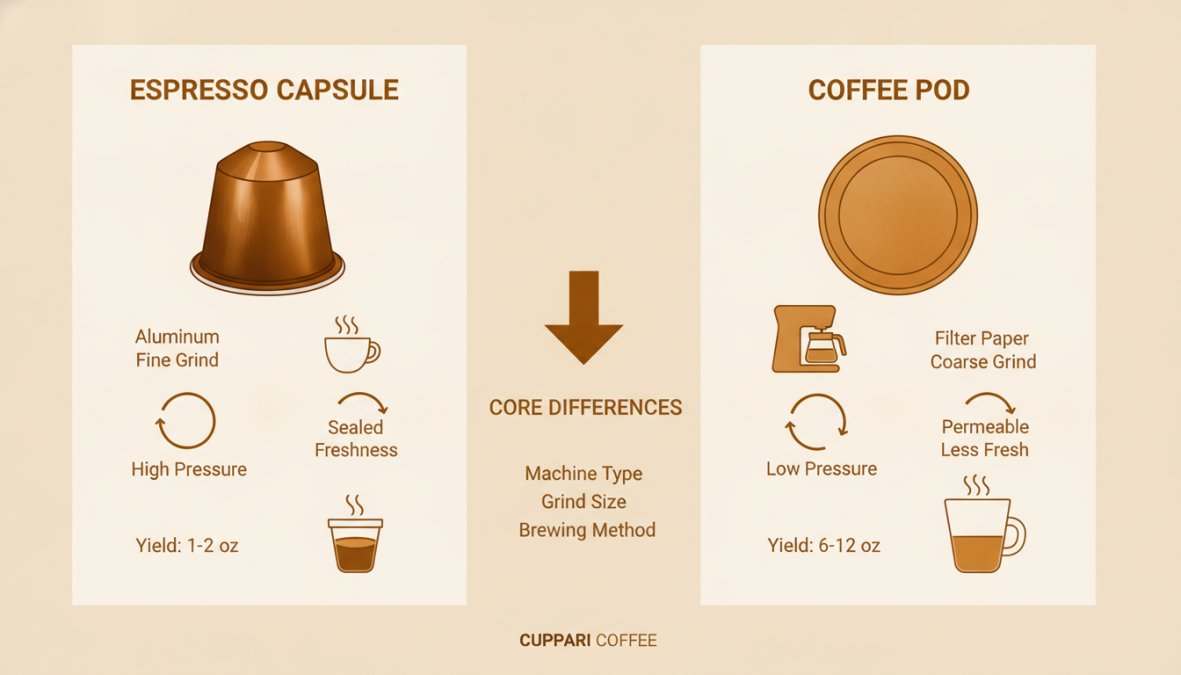
Coffee pods are flat, circular discs of finely ground coffee wrapped in filter paper, designed for gravity-based brewing where hot water flows through grounds over 3-5 minutes. The grounds inside are typically medium-coarse, optimized for longer contact time with water.
Espresso capsules are small, rigid containers filled with finely ground espresso coffee, designed for high-pressure machines that force hot water through grounds at 9+ bars of pressure in 25-30 seconds. The capsule itself is part of the extraction process; the machine punctures it and forces water through at extreme pressure.
The key distinction: coffee pods rely on time and gravity; espresso capsules rely on pressure and speed.
Espresso Capsules vs Coffee Pods: Core Differences
Brewing Method and Pressure Requirements
Espresso extraction demands 9-15 bars of pump-driven pressure to force hot water through densely packed, finely ground coffee in 25-30 seconds. This high-pressure process pulls out oils, solubles, and compounds that create the thick body and rich crema characteristic of espresso.
Coffee pods use atmospheric pressure and gravity. Hot water slowly drips through medium-coarse grounds over 3-5 minutes. The longer contact time allows for full extraction without needing pressure, producing a lighter body, less crema, and a cleaner cup.
The Nespresso Original Line machines deliver 19 bars of pressure, while Nespresso Vertuo uses centrifusion technology (spinning the capsule at high speed) to achieve similar extraction results. Keurig and similar drip pod machines operate at standard atmospheric pressure with no pressure mechanism.
Grind Size and Pre-Measured Doses
Espresso requires a fine powder, nearly as fine as flour. This texture is crucial because pressure needs to force water through a dense puck of grounds in seconds.
Coffee pods use a coarse grind, more like sea salt. The larger particle size allows water to flow through gradually during the 3-5 minute brew cycle.
An espresso capsule typically contains 5-8 grams of ground coffee, designed to produce a single 1-2 ounce shot. A coffee pod contains 10-15 grams of grounds, designed to brew an 8-12 ounce cup.
Flavor Intensity and Roast Profiles
Espresso capsules produce concentrated, intense flavors with a thick mouthfeel and pronounced sweetness. Espresso blends are often darker roasts, which develop the oils and caramelized sugars that shine in espresso's concentrated format.
Coffee pods produce lighter, more nuanced flavors. The slower extraction allows for clarity; you taste individual notes rather than a concentrated blend. A light roast coffee pod might taste bright and acidic; the same bean as espresso would taste thin and sour.
Coffee Pod Machine vs Espresso Machine: Equipment Differences
Bar Pressure and Extraction Yield
Bar pressure is the defining specification. A coffee pod machine operates at 0 bars (atmospheric pressure). An espresso machine operates at 9-15 bars minimum. This pressure difference is why espresso machines are more expensive, requiring a pump, pressure valve, and heating system that maintains consistent pressure.
Espresso extraction yields 18-22% of the coffee's mass as liquid. A 9-gram dose produces roughly 2 ounces of espresso. Coffee pod extraction yields 15-18% over a longer brew time. A 12-gram dose produces roughly 8-10 ounces of coffee.
Machine Compatibility and Third-Party Pod Risks
Espresso systems are proprietary. Nespresso Original capsules work only in Nespresso Original machines. Lavazza A Modo Mio capsules work only in Lavazza machines. While third-party capsule manufacturers exist, they carry risks. A poorly-made capsule might burst under pressure, jam the machine, or deliver inconsistent extraction.
Coffee pod systems are more open. Keurig machines accept K-Cup pods from dozens of manufacturers. This flexibility is convenient but creates quality variance.
Machine-specific pressure profiles matter. The Nespresso Original Line is optimized for 19-bar extraction. A third-party capsule designed for 15-bar machines will extract differently in a 19-bar machine.
E.S.E. Pods Explained: A Third Option
Easy Serving Espresso (E.S.E.) pods represent a middle ground between coffee pods and espresso capsules. They're pre-measured doses of ground coffee wrapped in filter paper, designed for espresso machines.
An E.S.E. pod contains 7 grams of finely ground espresso coffee in a small filter paper disc. You place it directly into the espresso machine's portafilter, and the machine brews it under 9+ bars of pressure. The filter paper contains the grounds while the machine forces water through.
E.S.E. pods are cheaper than capsules (around $0.30-$0.50 per pod versus $0.70-$1.10 for capsules) and more environmentally friendly. However, they're less convenient than capsules and less consistent; the paper can tear or grounds can escape. They work best for espresso enthusiasts who own a traditional espresso machine and want convenience without sacrificing the ritual of pulling a shot.
How to Make Espresso with Coffee Pods
This is a common question with a straightforward answer: you can't make true espresso with coffee pods. But you can approximate it.
Compatibility Considerations
Coffee pods are designed for gravity-based brewing. If you force them into an espresso machine, the coarse grind won't create a proper pressure seal, and water will channel through gaps rather than extracting evenly. You won't get crema, and the resulting shot won't taste like espresso.
If you're committed to using coffee pod grounds in an espresso machine, dose heavily (10-12 grams), tamp firmly (30+ pounds of pressure), and pull the shot slowly (30-40 seconds). Expect mediocre results, weaker than true espresso, with less crema and less body.
If you regularly drink espresso, investing in an espresso machine and capsules is far better than compromising with coffee pods.
Ease of Use and Convenience Comparison
Coffee pods are the simplest option. Insert the pod, press a button, and in 3-5 minutes you have a full cup. There's no pressure to manage, no tamping, no technique required.
Espresso capsules are equally simple but require more ritual. Insert the capsule, press a button, and in 30 seconds you have a shot. But a single shot isn't a full cup; you typically need to add milk or water. If you're making a cappuccino, you also need to steam milk, which adds steps.
The real convenience difference emerges over time. Coffee pods produce a full cup immediately; espresso requires additional preparation for most drinks. Black coffee drinkers prefer coffee pods. Milk-based drink enthusiasts prefer espresso capsules because they can build their exact drink in one machine.
Environmental Impact and Sustainability
Aluminum Capsules and Recycling Programs
Espresso capsules are typically aluminum, which is infinitely recyclable. Nespresso, Lavazza, and illy all operate capsule recycling programs. The catch: recycling participation rates are low. Many people simply throw capsules in the trash. An aluminum capsule in a landfill takes 200+ years to decompose.
Coffee pods use filter paper and plastic, which are not infinitely recyclable. Most K-Cups end up in landfills. The plastic and paper break down faster than aluminum, but they still persist for decades.
Biodegradable Options and Lifecycle Analysis
Some manufacturers now offer biodegradable or compostable capsules made from plant-based materials. However, they require commercial composting infrastructure, which isn't available everywhere.
A full lifecycle analysis reveals that the production of the machine itself represents the largest environmental cost. A machine used for 10+ years amortizes that impact. Single-serve pods have a higher per-cup environmental footprint than bulk coffee because of packaging waste.
The most sustainable option is buying whole beans and brewing with a reusable filter. Single-serve pods rank lower environmentally, though aluminum capsules with active recycling are better than plastic-based coffee pods without recycling.
Which Should You Choose? Pros and Cons Breakdown
| Factor | Coffee Pods | Espresso Capsules | Winner |
|---|---|---|---|
| Speed to full cup | 3-5 minutes | 30 seconds + milk prep | Coffee pods |
| Flavor complexity | Nuanced, origin-focused | Bold, concentrated | Espresso for intensity |
| Equipment cost | $50-150 | $150-500+ | Coffee pods |
| Per-cup cost | $0.50-0.80 | $0.70-1.10 | Coffee pods |
| Milk-based drinks | Requires separate steamer | Integrated with machine | Espresso |
| Black coffee experience | Excellent | Weak (requires water) | Coffee pods |
| Environmental impact | Moderate (plastic/paper) | Better (aluminum recyclable) | Espresso capsules |
| Learning curve | None | Minimal | Coffee pods |
| Drink variety | Limited (coffee only) | High (espresso, cappuccino, latte) | Espresso |
When Espresso Pods Win
Choose espresso capsules if you drink milk-based espresso drinks, value intensity and crema, want versatility, are willing to invest upfront, or prioritize environmental impact. One espresso machine handles shots, milk steaming, and drink preparation. The Nespresso Original Line is the standard for espresso capsules, producing excellent crema with extensive capsule variety.
When Coffee Pods Win
Choose coffee pods if you drink black coffee only, want zero learning curve, need speed and simplicity, have a tight budget, live alone or drink inconsistently, or want flavor variety. Hundreds of coffee pod brands exist, from single-origin light roasts to dark blends.
The difference between espresso and coffee pods isn't just technical, it's about your daily ritual and what you want from your coffee. Espresso demands an investment in equipment but rewards you with versatility and intensity. Coffee pods offer simplicity and a full cup of nuanced coffee without complexity. Neither is objectively better; each solves a different problem.
If you're ready to experience the freshness advantage that makes single-serve coffee actually taste good, Cuppari Coffee delivers both espresso capsules and coffee pods roasted to order and shipped the same day.
Frequently Asked Questions
Are espresso pods and coffee pods the same thing?
No. The main difference between espresso and coffee pods lies in their design and brewing method. Espresso capsules are engineered for high-pressure extraction (typically 9+ bars), producing a concentrated shot with crema. Coffee pods are designed for standard drip brewing or lower-pressure machines, creating a full cup of coffee. Espresso pods contain finely ground coffee in precise pre-measured doses, while coffee pods may use coarser grinds suited for filter paper or mesh systems.
Can you use a coffee pod to make espresso?
Technically, you can attempt this, but results will be disappointing. Coffee pods are designed for lower-pressure brewing and contain grind sizes optimized for drip extraction, not espresso's high-pressure requirements. To achieve true espresso extraction with proper crema and intensity rating, you need a machine capable of generating 9+ bars of pressure and a capsule with finely ground coffee designed for that pressure profile. Attempting espresso with regular coffee pods risks under-extraction and poor flavor.
What are E.S.E. pods and how do they differ from other options?
Easy Serving Espresso (E.S.E.) pods are standardized espresso pods containing pre-measured doses of finely ground coffee wrapped in filter paper. They're designed for espresso machines with a standard 9-bar pressure and are compatible across multiple brands, unlike proprietary capsule systems. E.S.E. pods offer a middle ground: more convenient than loose grounds but more standardized than brand-specific capsules. They produce authentic espresso with good crema and are often more affordable than branded capsule systems.
Which system has better environmental impact: espresso pods or coffee pods?
Environmental impact depends on the specific system. Aluminum capsules offer excellent aroma retention and freshness but require industrial composting or recycling programs. Biodegradable options exist but vary in true compostability. Coffee pods with filter paper may be more readily recyclable or compostable in home systems. Lifecycle analysis shows that pod convenience often outweighs environmental concerns for regular users compared to larger coffee purchases that may go stale. Cuppari Coffee's sealed capsules with improved filter design maintain freshness while minimizing waste through efficient brewing.
Do espresso pods produce the same quality as freshly ground espresso?
Quality depends on the pod system and coffee freshness. Premium espresso capsules from brands like Nespresso Original and illy iperEspresso produce excellent crema and flavor intensity comparable to café espresso. Pre-measured doses ensure consistency in extraction yield. However, freshness matters significantly, coffee's solubility and aroma diminish over time. Freshly roasted pods maintain superior flavor compared to older stock. The key advantage of quality espresso pods is that they deliver reliable bar pressure and optimized water flow, which are harder to control with manual brewing.
This article was written using GrandRanker