

Table of Contents
- Why Freshness Matters: How Long After Roasting Is Coffee Best?
- The Coffee Degassing Process Explained
- Resting Times by Roast Level: Light, Medium, and Dark
- Resting Coffee Beans for Espresso vs. Drip: What Changes?
- How to Store Roasted Coffee Beans to Preserve Peak Flavor
- Signs of Stale Coffee Beans: A Visual and Sensory Guide
- Is Coffee Safe to Drink After Months? Shelf Life Explained
- How Long After Roasting Coffee Is Best: Quick-Reference Summary
- Conclusion
Last Updated: May 25, 2026
Knowing how long after roasting coffee best suits your cup is the single question that separates a flat, lifeless brew from one that genuinely sings. At Cuppari Coffee, we roast every order fresh and ship the same day precisely because this window matters more than most people realize. The short answer: most coffees hit peak flavor between 5 and 14 days post-roast, but that range shifts dramatically based on roast level, brew method, and how you store the beans. Below, we'll show you exactly how to time your brew, what the degassing process is doing to your coffee, and how to read the sensory signs that tell you whether your beans are at their best or past it.
Here's what most guides get wrong: they treat "fresh" as a single point in time. Fresh-off-the-roaster coffee is actually too fresh for most brewing methods. The carbon dioxide trapped inside newly roasted beans actively interferes with extraction, pushing water away from the grounds and producing an uneven, gassy, underdeveloped cup. Freshness has a window, not a moment.
Why Freshness Matters: How Long After Roasting Is Coffee Best?
Coffee is a perishable agricultural product, and its flavor profile degrades in two distinct phases after roasting. The first phase is off-gassing: CO2 escapes rapidly and the bean's volatile aromatic compounds evolve into the nuanced flavors specialty coffee drinkers seek. The second phase is oxidation: oxygen attacks those same compounds and the coffee goes stale.
The practical implication is that both extremes hurt you. Brew too early and CO2 disrupts the bloom and extraction. Brew too late and oxidation has stripped the acidity, aroma, and mouthfeel that made the coffee worth buying in the first place. According to Specialty Coffee Association's research on coffee freshness, roasted coffee begins losing volatile aromatics measurably within days of roasting if left unsealed.
Understanding this two-phase decay is the foundation for every resting recommendation in this guide. The goal is to catch your beans in the sweet spot: enough CO2 has vented to allow clean extraction, but not so much time has passed that oxidation has flattened the cup.
The Coffee Degassing Process Explained
Degassing is the process by which roasted coffee beans release carbon dioxide that was generated and trapped during roasting. Understanding it at a mechanical level, not just 'CO2 comes out', is what allows you to make precise decisions about when to brew rather than guessing.
During roasting, two key reactions drive CO2 production: the Maillard reaction (which begins around 150°C / 302°F and produces the browning and flavor development most associated with roasted coffee) and pyrolysis at higher temperatures. Both reactions generate CO2 inside the bean's cellular matrix. The bean's structure at this stage acts like a pressure vessel: the gas is partially dissolved in the bean's oils and partially trapped in micropores within the cellular walls. When roasting ends and the bean cools, that pressure begins to equalize with the surrounding atmosphere.
The release is not linear. Degassing follows a curve with two distinct phases:
Phase 1, Rapid outgassing (hours 0 to 48): The majority of surface-level and loosely bound CO2 exits quickly. This is the phase where a freshly roasted bag will visibly puff if sealed without a one-way valve. Dark roasts, with their more porous and fractured cellular structure, lose a disproportionately large share of their total CO2 in this window, sometimes the majority of it within the first 24 hours.
Phase 2, Slow diffusion (days 2 through 14+): CO2 that is more deeply embedded in the bean's oils and denser cellular regions diffuses outward slowly. This phase is where roast level, bean density, and storage temperature all exert their strongest influence. A light roast from a high-altitude, dense origin can still be actively degassing at day 10 or 11. A low-density dark roast may be largely inert by day 4.
Grinding collapses both phases almost instantly. When you grind whole beans, you shatter the cellular walls that were metering the slow Phase 2 release, exposing the interior directly to air. The CO2 that would have taken days to diffuse out of a whole bean exits ground coffee in minutes. This is the real reason grinding immediately before brewing matters: you are not just preserving aromatics, you are controlling the timing of Phase 2 degassing so it happens in the brewer rather than in a bag or canister.
How CO2 Affects Extraction and Bloom
CO2 directly affects extraction by creating a physical barrier between water and coffee grounds. When you pour hot water over freshly roasted grounds, the CO2 escaping the beans pushes water away from the particles, reducing contact time and solubility. The result is under-extraction: the cup tastes thin, sour, or hollow.
The bloom step in pour over brewing is specifically designed to manage this. Pouring a small amount of water, typically twice the weight of the dry dose, over the grounds first allows CO2 to vent rapidly before the main extraction begins. You can actually see this happening: the grounds puff up and bubble vigorously if the coffee is very fresh. A gentle, controlled bloom suggests the beans have rested adequately. No bloom at all is a sign the coffee is stale and CO2 has already fully dissipated.
For espresso, excess CO2 creates inconsistent crema and channeling. The high pressure of espresso extraction (typically 9 bar) compresses the puck and forces water through at speed, but CO2 bubbles nucleating inside the puck create micro-channels that water follows preferentially, bypassing large portions of the grounds entirely. This is why espresso requires a longer rest period than filter methods, and why a shot pulled from beans roasted yesterday will often run fast, taste sour, and show unstable, large-bubbled crema that collapses within seconds.
A practical visual guide to reading degassing in real time:
| What you observe | What it means | Action |
|---|---|---|
| Bloom rises dramatically, grounds dome above the dripper | Very active degassing, beans likely under 5 days old | Rest 2-4 more days before brewing |
| Bloom rises steadily, controlled bubbling, grounds settle evenly | Optimal degassing range | Brew now |
| Minimal bloom, grounds barely rise, water absorbs quickly | CO2 largely dissipated | Check roast date; may be past peak |
| No bloom, flat surface, water pools briefly | Stale; CO2 fully gone | Adjust grind finer to compensate for reduced extraction resistance |
| Espresso crema: thick, tiger-striped, persists 60+ seconds | Good CO2 balance | On target |
| Espresso crema: large white bubbles, collapses in under 10 seconds | Excess CO2 or channeling | Rest beans longer |
| Espresso crema: thin, pale, disappears immediately | CO2 depleted | Beans past peak or ground too coarse |
Home Roasting vs. Commercial Roasting: Does Degassing Differ?
Home roasting and commercial roasting produce meaningfully different degassing timelines, and this distinction is almost never discussed in standard guides.
Commercial drum roasters apply heat more evenly and consistently than most home roasting setups, using precise airflow control and drum rotation speed to ensure uniform heat penetration across the entire bean mass. The result is a more uniform bean structure with predictable CO2 distribution throughout the cellular matrix. Home roasters using air poppers, drum attachments, or small fluid bed roasters often produce beans with uneven heat penetration, the outer layers of the bean may reach target temperature while the core lags behind. Some parts of the bean may degas faster than others, creating an inconsistent rest window where the same batch can taste ready and not-ready simultaneously depending on which beans end up in a given dose.
A practical rule: add two to three extra days to your resting estimate for home-roasted beans, and taste-test more frequently rather than relying on a fixed target date. Tools like Artisan open-source roast profiling software can help home roasters track their roast curves and identify whether their profiles are producing consistent development times, the ratio of time spent in the Maillard phase to total roast time is a useful proxy for how evenly CO2 was generated and distributed. If your home-roasted coffee tastes good at day 7 one week and day 12 the next, inconsistent development ratios across batches are likely the cause, not random variation in the beans.
Resting Times by Roast Level: Light, Medium, and Dark
Roast level is the single biggest variable in determining the right rest period. Light, medium, and dark roasts each have distinct cellular structures, CO2 retention rates, and flavor development timelines.
 beans side by side, one pale tan light roast, one warm brown medium roast, one deep near-black dark roast, arranged on a rustic wooden surface with handwritten roast date tags beside each bowl, photographed in soft natural window light](https://cdn.grandranker.com/articles/how-long-after-roasting-is-coffee-best-a-full-guide-content-1-1779672619.jpg)
Light roast: Rest for 7 to 14 days before brewing. Light roasts retain the most CO2 because the bean structure is denser and less porous. The flavor profile, which tends toward bright acidity and floral or fruit-forward notes, takes longer to develop and stabilize. Brewing a light roast at day 2 or 3 often produces a grassy, sour, or underdeveloped cup. Patience pays off here.
Medium roast: Rest for 5 to 10 days. Medium roasts degas faster than light roasts and their flavor profile is more forgiving across a broader window. Many drinkers find medium roasts most approachable at around day 7, when CO2 has vented sufficiently but the more delicate flavor notes remain intact.
Dark roast: Rest for 2 to 5 days. Dark roasts have a more porous, brittle structure that releases CO2 very rapidly. They reach their usable window quickly but also go stale faster. The bold, low-acid flavor profile of a dark roast can survive into week two, but the aroma tends to flatten noticeably after day 10.
Altitude and Bean Density: The Hidden Variable in Resting Times
Bean density is a factor almost no mainstream guide addresses. Beans grown at higher altitudes develop under more stress, which produces a denser cellular structure with more complex sugars and, crucially, a higher capacity to retain CO2 after roasting.
High-grown, dense beans from regions like Ethiopia, Kenya, or Guatemala will typically need a longer rest period than lower-density beans from lower-altitude origins. A dense Ethiopian natural process light roast may need the full 14-day rest window. A lower-density Brazilian natural medium roast might be ready by day 5.
If you want to take this seriously, tools like the Lighttells MD-500 moisture and density meter give professional roasters hard data on bean density before roasting, allowing them to predict degassing behavior with real precision. For most home brewers, the practical shortcut is this: the higher the altitude listed on the bag, the more rest time you should allow.
Resting Coffee Beans for Espresso vs. Drip: What Changes?
The brewing method you use changes the optimal rest period, sometimes significantly. This is where many home brewers get confused: they follow a single "rest 7 days" rule and then wonder why their espresso tastes gassy while their pour over tastes flat.
Espresso requires the longest rest period of any common brew method. The high pressure involved in espresso extraction amplifies the effect of CO2. Excess gas creates uneven crema, channeling, and erratic shot timing. Most specialty coffee professionals recommend resting espresso beans for a minimum of 7 days post-roast, with many preferring 10 to 14 days for lighter roasts used in espresso. Dark roast espresso blends are the exception: their rapid degassing means 4 to 7 days is often sufficient.
Pour over and drip brewing are more forgiving because water at atmospheric pressure is less affected by CO2 interference. The bloom step handles much of the residual gas. Most pour over coffees are excellent from day 5 onward, with light roasts peaking between days 7 and 21.
French press and immersion methods sit in the middle. The extended contact time compensates somewhat for excess CO2, but a very fresh bean will still produce a noticeably uneven extraction.
| Brew Method | Minimum Rest | Peak Window | Max Freshness |
|---|---|---|---|
| Espresso (dark) | 4 days | 5-10 days | 21 days |
| Espresso (light/medium) | 7 days | 10-21 days | 30 days |
| Pour over / drip | 4 days | 5-14 days | 28 days |
| French press | 3 days | 5-12 days | 25 days |
| Cold brew | 3 days | 5-14 days | 30 days |
How to Store Roasted Coffee Beans to Preserve Peak Flavor
Proper storage does not extend the peak flavor window indefinitely, but it absolutely determines whether your beans arrive at that window in good condition or already degraded. The four enemies of roasted coffee are oxygen, moisture, heat, and light, and the right storage choice depends not just on which enemies you are fighting, but on where your beans are in the rest timeline when you store them. This is the distinction almost no guide makes, and it is the reason two people can follow the same 'store in an airtight container' advice and get completely different results.
The core tension is this: freshly roasted beans need to off-gas CO2, but they also need protection from oxygen. A fully sealed, oxygen-free environment on day 1 traps CO2 inside and can cause pressure buildup or, in a rigid canister, simply slow the degassing process and push your rest window later than expected. A fully open container lets CO2 escape freely but exposes the beans to oxygen the entire time. The best storage solution changes depending on which phase of degassing your beans are in.
The Storage Decision Framework: Match Your Container to Your Rest Stage
Use this framework to choose the right container at the right time:
Days 0-5 (active degassing phase): One-way valve bag
This is the correct environment for freshly roasted beans. A one-way CO2 valve allows gas to exit continuously without letting oxygen enter. This is why specialty roasters ship in valve bags rather than vacuum-sealed pouches, vacuum sealing on day 1 would either require venting the bag repeatedly or risk the seal failing from internal pressure. Keep the bag rolled tightly closed between uses to minimize the headspace exposed to air each time you open it. Do not transfer to a canister yet.
Days 5-14 (slow degassing / peak flavor phase): Vacuum canister
Once the rapid Phase 1 degassing is complete and beans have entered the slower Phase 2, transferring to a vacuum canister is the single most effective thing you can do to extend the peak flavor window. By actively removing oxygen from the headspace, you dramatically slow oxidation without interfering with the remaining slow CO2 diffusion. The Fellow Atmos Vacuum Canister removes oxygen via a built-in twist pump and includes a vacuum indicator that drops when the seal is lost, a useful reminder to re-pump after each use. The Airscape Canister uses a patented inner plunger lid that you press down to the surface of the beans, physically displacing air rather than pumping it out. Both outperform standard airtight jars by a meaningful margin for beans in this window.
Days 14+ or long-term storage (30+ days): Freezer in airtight, moisture-proof bags
Freezing is the most misunderstood storage option in coffee. The objection, that freezing introduces moisture, is valid only if done incorrectly. The correct method: portion beans into single-use quantities before freezing, seal each portion in a zip-lock freezer bag with as much air removed as possible, and never return thawed beans to the freezer. Thaw a portion at room temperature, still sealed, before opening. The sealed bag equilibrates to room temperature before you open it, preventing condensation from forming on the beans. Beans stored this way can maintain acceptable flavor quality for several months, though they will not taste identical to a fresh week-2 cup.
Storage Container Comparison at a Glance
| Container Type | Best Stage | Oxygen Protection | CO2 Venting | Practical Notes |
|---|---|---|---|---|
| One-way valve bag (original) | Days 0-14 | Good | Yes, valve allows outgassing | Roll and clip tightly; best for beans you'll use within 2 weeks |
| Standard airtight jar (no valve) | Days 5+ only | Moderate | No, CO2 can build pressure | Acceptable if beans have already degassed; not ideal for fresh beans |
| Vacuum canister (Fellow Atmos, Airscape) | Days 5-30 | Excellent | Minimal, fine for post-peak-degassing beans | Best investment for extending the peak window; re-pump after every use |
| Valve canister (Coffee Gator) | Days 0-30 | Good | Yes | Budget-friendly entry point; built-in date tracker is useful for tracking rest days |
| Freezer (airtight, portioned) | Long-term 30+ days | Excellent when sealed | Not needed at this stage | Single-use portions only; never refreeze |
What Storage Cannot Fix
Storage quality affects the rate of degradation, not the starting point. Beans that were already 3 weeks old when you bought them from a grocery shelf cannot be restored by a vacuum canister. This is why roast date transparency matters more than any container: a bag with no roast date printed on it is a bag where the seller is not confident the beans are fresh. Beans roasted to order and shipped in valve bags arrive with the full rest window ahead of them and respond best to the framework above.
According to research on coffee oxidation and storage from the Journal of Agricultural and Food Chemistry, exposure to oxygen is the primary driver of flavor degradation in roasted coffee, outpacing moisture and light as a staling factor. The practical implication: if you can only optimize one variable, minimize oxygen exposure during the peak flavor window (days 5-14), and the other factors become secondary.
Signs of Stale Coffee Beans: A Visual and Sensory Guide
Stale coffee announces itself clearly once you know what to look for. The problem is that most people only notice staleness after it has already ruined the cup.
Visual signs:
- Faded, dull surface with no sheen (fresh beans, especially medium and dark roasts, have a visible oily or slightly glossy surface)
- Uniform gray-brown color rather than the rich, varied tones of a fresh roast
- Visible white or chalky patches on the bean surface
Tactile signs:
- Beans feel dry and brittle rather than slightly waxy
- Grounds clump less when freshly ground (loss of oils reduces static and cohesion)
Aroma signs:
- Flat or cardboard-like smell when you open the bag
- Absence of the sharp, bright, complex aroma that fresh roasted coffee produces
- A faint rancid or paper note in darker roasts
Brew signs:
- No bloom or minimal CO2 release during the pour over pre-infusion step
- Flat crema on espresso, or crema that dissipates almost immediately
- The cup tastes dull, lacking acidity and aroma even with correct brewing parameters
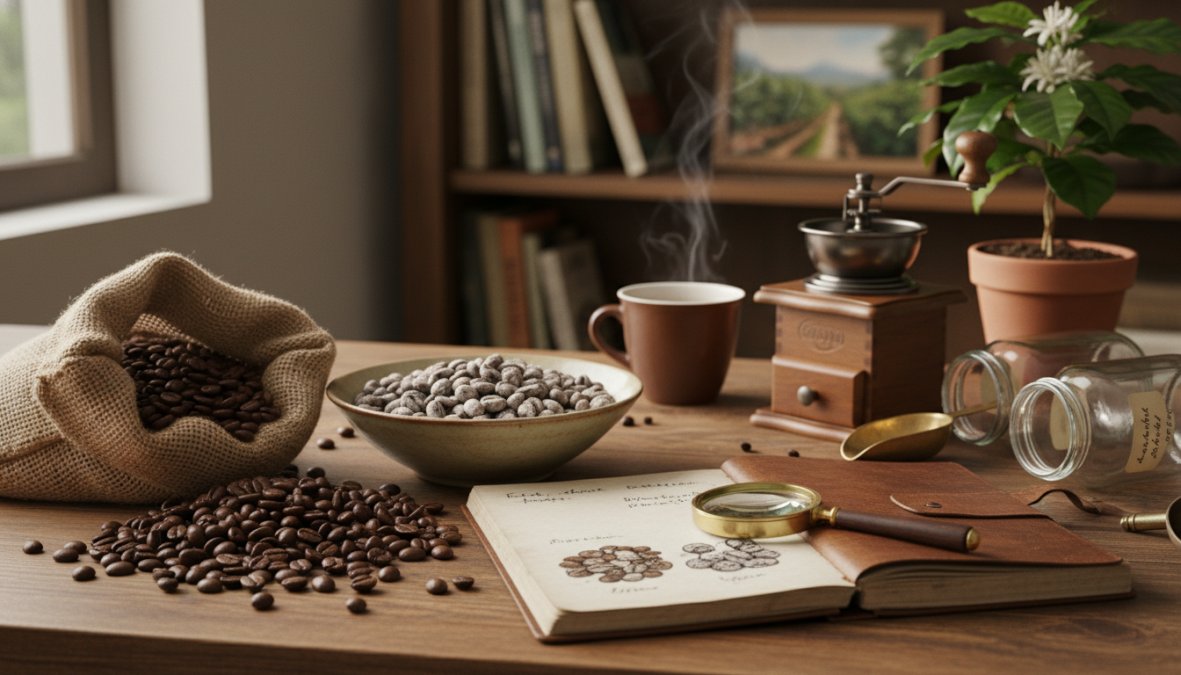
The bloom test is the fastest diagnostic: add twice the weight of your dose in hot water, wait 30 seconds, and watch. Vigorous bubbling means active degassing and a fresh bean. No activity at all means the CO2 is gone and you are likely past peak flavor.
Is Coffee Safe to Drink After Months? Shelf Life Explained
Coffee does not spoil in the way that raw meat or dairy does. Drinking coffee that is several months old will not make you sick. The question is purely one of flavor quality, and the honest answer is that old coffee tastes bad enough that most people stop drinking it long before it becomes a safety concern.
Roasted whole beans stored in an airtight container at room temperature remain safe to drink essentially indefinitely. The practical flavor shelf life is a different matter. Most specialty coffee professionals consider whole beans past their prime after 4 to 6 weeks post-roast, even with good storage. Ground coffee degrades much faster: within 15 to 30 minutes of grinding, a measurable portion of volatile aromatics have already escaped.
Vacuum-sealed or nitrogen-flushed commercial packaging can extend the shelf life of roasted beans to 6 to 12 months before opening, but the flavor at month 6 will not resemble the flavor at week 2. The marketing term "best by" on coffee packaging refers to flavor quality, not food safety.
One genuine concern with very old coffee: rancid oils. Coffee beans contain lipids that can oxidize into off-flavors that some people find mildly irritating to the stomach. This is more of a quality issue than a safety issue, but it is worth knowing.
How Long After Roasting Coffee Is Best: Quick-Reference Summary
The question of how long after roasting coffee is best comes down to four variables working together: roast level, brew method, bean density, and storage quality. Here is the consolidated guidance:
By roast level:
- Light roast: 7-14 days
- Medium roast: 5-10 days
- Dark roast: 2-5 days
By brew method:
- Espresso: add 3-5 days to the roast level baseline
- Pour over / drip: use the roast level baseline
- French press: subtract 1-2 days from the roast level baseline
Adjustments:
- High-altitude, dense beans: add 2-3 days
- Home-roasted beans (uneven profiles): add 2-3 days
- Beans stored in a vacuum canister: extend the peak window by up to 7 days
The universal rule: if your pour over produces no bloom and your espresso has flat crema, the coffee is past its peak. If your espresso tastes gassy and your pour over tastes sour, the beans need more rest.
The specialty coffee community, as documented by the Specialty Coffee Association's education resources, consistently identifies the 5-to-14-day post-roast window as the target zone for most brewing applications. That range holds up across origins, roast levels, and methods once you apply the adjustments above.
Getting the rest period right only works if the roast date is accurate and the beans were fresh when they shipped. That is the problem with most retail coffee: by the time it reaches the shelf, the optimal window has often already passed. Cuppari Coffee solves this by roasting only after an order is placed and shipping the same day, so every bag arrives with the full rest window ahead of it. With free shipping on all U.S. orders and sealed packaging that protects freshness from roaster to doorstep, you control the rest period from day one. Add to cart and start your rest timer with beans that are actually fresh.
Frequently Asked Questions
Why do you have to let coffee rest after roasting?
Immediately after roasting, coffee beans are saturated with carbon dioxide (CO2) produced during the roasting process. Brewing too soon means this CO2 escapes aggressively during extraction, creating uneven flavor and an overly acidic or grassy taste. Resting, also called degassing, allows CO2 to off-gas at a controlled rate so that water can interact evenly with the grounds, producing a balanced, lively flavor profile with better mouthfeel and aroma.
What happens if you brew coffee too soon after roasting?
Brewing coffee before it has properly degassed typically results in a cup with grassy notes, unpleasant acidity, and a hollow or thin mouthfeel. For espresso, excess CO2 disrupts crema formation and produces an inconsistent, channeled shot. For pour over or drip, the bloom stage becomes overly vigorous, pushing water away from grounds and causing under-extraction. Waiting the appropriate rest period, even just a few days, significantly improves solubility and overall flavor notes.
Does the roast level affect how long coffee needs to rest?
Yes, roast level is one of the most important variables when determining how long after roasting coffee is best. Light roasts are denser and release CO2 more slowly, often needing 7-14 days of rest before peak flavor. Medium roasts typically reach their best window between 5-10 days post-roast. Dark roasts degas faster due to their more porous structure and can be ready in as little as 2-5 days, though their shelf life and peak flavor window are also shorter.
How should you store coffee beans to maintain peak freshness?
To maintain freshness after roasting, store coffee beans in an airtight container away from light, heat, and moisture. Valve bags, like those used by specialty coffee roasters, allow CO2 to escape while blocking oxygen, making them ideal for the first week post-roast. For longer storage, vacuum canisters such as the Fellow Atmos actively remove oxygen to slow oxidation. Avoid the refrigerator, as moisture and odor absorption degrade the flavor profile quickly. Room temperature in a dark cupboard is best.
How long does coffee stay fresh after roasting?
Most specialty coffee is at its best between 5 and 21 days after the roast date, depending on roast level and brew method. After about 4 weeks, oxidation begins to noticeably flatten the flavor profile, reducing acidity and aroma. Coffee stored in an airtight container can remain drinkable for up to 3 months, though it will lack the lively, complex flavor notes of fresh beans. It is not unsafe to drink older coffee, it simply tastes increasingly stale and flat over time.
This article was written using GrandRanker