

Table of Contents
- How Long After Roasting to Brew Coffee: The Essential Timeline
- Understanding the Coffee Degassing Process
- Resting Times by Roast Level
- Brew Method Impact on Resting Requirements
- Peak Flavor Window for Coffee and How to Maximize It
- How to Store Roasted Coffee Beans for Longevity
- Putting It All Together: Your Brewing Timeline
- Conclusion
Last Updated: August 8, 2026
How Long After Roasting to Brew Coffee: The Essential Timeline
The moment your coffee beans finish roasting, a critical window begins. Freshly roasted beans aren't actually ready to brew immediately. The beans need time to release trapped gases and stabilize their flavor compounds. This guide walks you through exactly when to brew based on your roast level, brew method, and storage approach.
At Cuppari Coffee, we've seen firsthand how timing transforms the cup. Understanding the science behind this timing is the difference between a disappointing morning and one where every sip justifies your investment in premium beans.
Understanding the Coffee Degassing Process
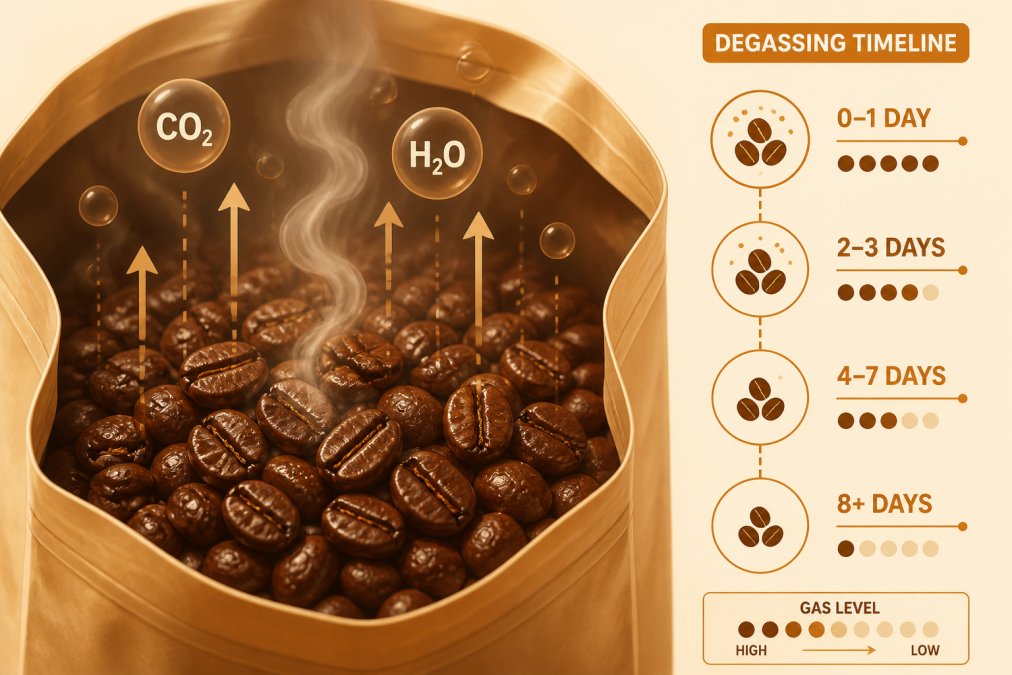
Degassing is the release of carbon dioxide and other volatile compounds from freshly roasted coffee beans. During roasting, heat forces CO2 into the cell structure of the bean. After roasting stops, the beans begin expelling this gas naturally over time. This process directly impacts how water extracts flavor compounds during brewing.
Why Degassing Matters for Flavor
When you brew coffee that's too fresh, excess CO2 interferes with extraction. The gas creates a barrier between hot water and the soluble compounds you want to extract: the acids, sugars, and aromatic molecules that define flavor. This is why super-fresh beans often taste sour, thin, or incomplete. Conversely, beans that have fully degassed allow water to contact the cell structure more efficiently, pulling out a fuller range of flavors.
The relationship between degassing and extraction is direct. More complete degassing equals more predictable extraction, which equals more balanced flavor. The volatile compounds being expelled include some of the very aromatics that make coffee smell incredible, but when present in excess during brewing, they throw off the balance of what ends up in your cup.
Visual Indicators That Degassing Is Complete
You don't need instruments to know when degassing has progressed. Watch for these signs:
- Surface appearance: Fresh beans look slightly oily or wet. As degassing completes, the surface becomes drier and more matte.
- Aroma intensity: The smell peaks around day 2-3, then gradually mellows. If the aroma is sharp and peppery, degassing is still active.
- Bag behavior: If your beans are in a bag with a one-way valve, you'll notice less gas escaping after day 3-4.
- Sound test: Freshly roasted beans crackle slightly when handled. This sound diminishes as degassing completes.
These visual and sensory cues help you gauge readiness without guesswork.
Resting Times by Roast Level
Not all roasts require the same rest period. Bean density, cell structure damage, and residual heat vary significantly by roast level, which changes how quickly degassing occurs.
Light Roasts: Shorter Rest, Maximum Acidity
Light roasts develop less, so the bean structure remains denser and degassing happens faster, often complete within 12-24 hours. Brewing too early (within 4-6 hours) can make the acidity sharp and unpleasant. Waiting 12-18 hours allows the acidity to integrate with the sweetness and body that's emerging. Many light roast enthusiasts prefer brewing between 18-36 hours after roasting.
Light roasts peak quickly and fade faster than darker roasts. Your window is roughly 2-3 weeks from roast date before staling becomes noticeable.
Medium Roasts: The Balanced Window
Medium roasts hit a sweet spot for most brewers. The roasting process goes deeper than light roasts, creating more cell structure damage and allowing faster degassing. Most medium roasts are ready to brew 24-48 hours after roasting.
This is the roast level where how long after roasting to brew coffee matters most for balance. Wait too little (under 12 hours), and the coffee tastes one-dimensional. Wait too long (past 4 weeks), and you're drinking stale beans. The 24-48 hour window is when medium roasts deliver the full range of their intended flavor: balanced acidity, developed body, and integrated sweetness.
Medium roasts maintain quality longer than light roasts, typically 4-5 weeks from roast date if stored properly.
Dark Roasts: Extended Rest for Body
Dark roasts are roasted longer, which means more cell structure breakdown and faster initial degassing. However, they benefit from a slightly longer rest: 48-72 hours. Brewing them too soon leads to over-extraction, and the cup tastes bitter or ashy. The extra 1-3 days allows the bean to stabilize its solubility and lets harsh volatile compounds dissipate. By day 3-4, dark roasts develop the full body and chocolate/caramel notes that define them.
Dark roasts have the longest shelf life, 6-8 weeks from roast date, because the extended roasting has already driven off many volatile compounds that cause staling.
Brew Method Impact on Resting Requirements
Your brewing equipment changes how sensitive the coffee is to degassing stage.
Espresso: Why It Needs Longer Rest
Espresso forces hot water through finely ground coffee under 9+ bars of pressure in 25-30 seconds. This extreme extraction method pulls out everything very quickly. With super-fresh espresso (under 12 hours), excess CO2 creates channeling: water finds paths of least resistance through the puck rather than extracting evenly. The shot tastes sour and thin.
This is why espresso professionals often wait 5-14 days after roasting before pulling shots. The sweet spot for espresso is typically 5-10 days post-roast. At this point, the beans have degassed enough to extract cleanly, but haven't yet begun the slow oxidation that degrades flavor.
Pour-Over and Drip: Flexibility Within the Window
Pour-over and drip methods are more forgiving. The slower contact time (2-4 minutes versus 25 seconds for espresso) allows water to extract gradually and consistently, even if CO2 is still present. You can brew pour-over coffee as early as 12 hours post-roast and get a drinkable cup.
The flavor improves noticeably between 24-48 hours. By day 2-3, the acidity is integrated, the body is present, and the origin flavors are clear. These methods maintain quality through about 4-5 weeks post-roast, so you have genuine flexibility in your brewing schedule.
French Press and Cold Brew: Different Extraction Demands
French press uses immersion extraction: the grounds steep in hot water for 4 minutes before plunging. You can brew French press coffee as early as 18-24 hours post-roast. The longer steeping allows full extraction regardless of CO2 levels.
Cold brew is the most forgiving method. The extraction happens over 12-24 hours at room temperature or in the refrigerator. You can use beans as fresh as 12 hours post-roast, and the cold brew will taste balanced. Cold brew also extends the usable window; beans remain flavorful for 6-8 weeks because the cold extraction process is gentle.
Peak Flavor Window for Coffee and How to Maximize It
The 3-to-30-Day Sweet Spot
Most coffee reaches peak flavor between day 3 and day 30 after roasting. This is when degassing is complete, oxidation hasn't progressed far, and all the roaster's intended flavors are fully expressed.
Light roasts peak around day 3-7. After day 14, they noticeably fade. Medium roasts peak around day 5-10 and remain excellent through day 21-28. Dark roasts peak around day 7-14 and maintain quality through day 30-35. These windows shift based on storage conditions.
To maximize this window, brew coffee within its peak range for your roast level. Cuppari Coffee's approach of roasting only after order placement becomes practical here: beans arrive at your door within 2-4 days of roasting, placing you right at the beginning of the peak window.
Signs Your Coffee Has Passed Its Peak
As beans age beyond their peak, oxidation accelerates. Here's what to notice:
- Flat aroma: Fresh coffee smells vibrant and complex. Stale coffee smells muted.
- Dull cup: The acidity disappears first, leaving the coffee tasting flat and heavy.
- Thin body: Oxidation breaks down the oils and compounds that create body.
- Bitter finish: As good flavor compounds oxidize, harsh compounds become more prominent.
Once you notice these signs, the beans are past their usable window. This typically happens 5-6 weeks post-roast with proper storage, or 2-3 weeks if stored poorly.
How to Store Roasted Coffee Beans for Longevity
Storage is where most home brewers lose quality. Coffee degasses for the first 1-2 weeks, but oxidation begins immediately. Your job is to slow oxidation while allowing necessary degassing.
Airtight Containers and One-Way Valves
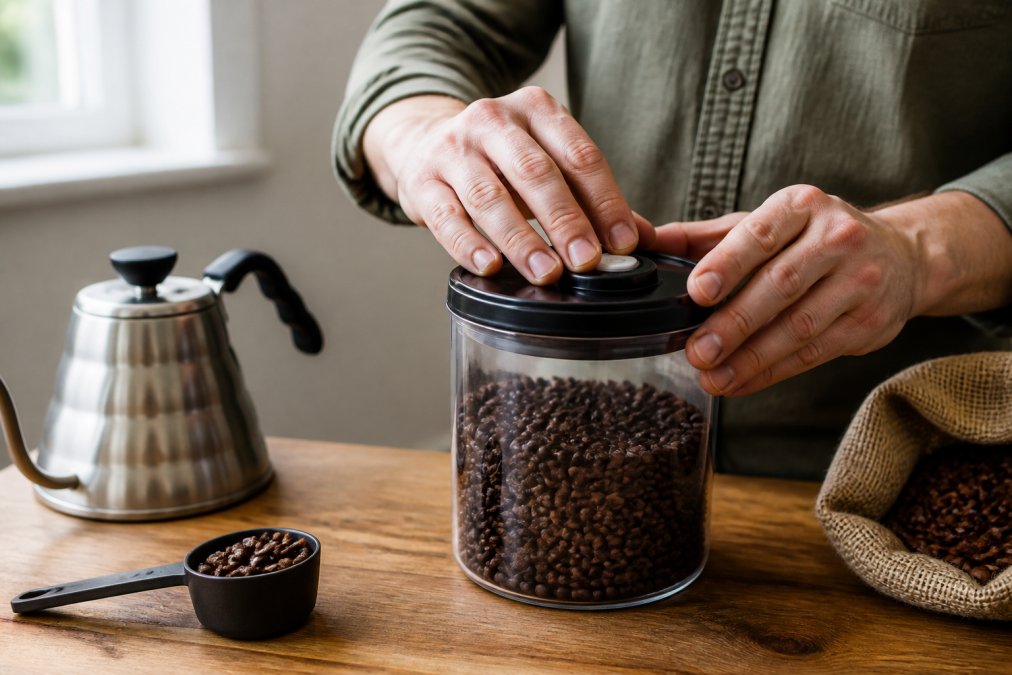
The best storage container is airtight and opaque. Glass jars with rubber seals, ceramic containers with tight lids, or metal tins all work. What matters is blocking oxygen and light. Oxygen accelerates oxidation exponentially.
One-way valves are specifically designed for coffee storage. These small plastic valves let CO2 escape while preventing oxygen from entering. Bags with one-way valves are ideal because they allow degassing to complete while keeping oxygen out. Transfer to an airtight container if your bag doesn't seal well. Fill the container as full as possible to minimize headspace. Store in a cool, dark place at room temperature (65-70°F).
Freezing as a Pause Button for Freshness
Freezing essentially stops oxidation. Coffee frozen in an airtight container maintains flavor for 3-4 months. Grind the beans first if you plan to freeze them, as grinding accelerates beneficial degassing. Place ground coffee in an airtight, freezer-safe container with minimal headspace and freeze immediately.
When you're ready to brew, remove only what you need and return the rest to the freezer immediately. Don't let the coffee thaw and refreeze repeatedly. The coffee will brew normally from the freezer without thawing.
This approach works especially well with Cuppari Coffee's roasting model. Order beans, let them degas for 2-3 days, then freeze the portion you won't brew in the next week. You've essentially extended your peak flavor window from 3-4 weeks to 3-4 months.
Putting It All Together: Your Brewing Timeline
Here's a practical framework for any coffee you receive:
Days 1-2 (Degassing Phase): The beans are still actively releasing CO2. Brewing is possible but suboptimal for most methods except cold brew.
Days 3-5 (Early Peak): Light roasts are ready now. Medium roasts are approaching their sweet spot. Dark roasts are becoming brewable.
Days 6-14 (Peak Window): All roast levels are in their intended flavor range. Brew with confidence.
Days 15-30 (Extended Window): Medium and dark roasts remain excellent. Light roasts are starting to fade.
Days 31+ (Staling Phase): Oxidation is accelerating. Coffee is still drinkable but noticeably flatter. Freeze what remains for later use.
For espresso specifically, add 2-3 days to all these timelines. For cold brew, subtract 1-2 days.
| Roast Level | Earliest Brew Time | Peak Window | Extended Window | Freezing Recommended |
|---|---|---|---|---|
| Light Roast | 12-18 hours | Days 3-7 | Days 8-14 | After day 7 |
| Medium Roast | 24-36 hours | Days 5-14 | Days 15-28 | After day 14 |
| Dark Roast | 48-72 hours | Days 7-21 | Days 22-35 | After day 21 |
| Espresso (any roast) | Add 5-7 days | Peak + 2-3 days | Peak + 7-10 days | After peak ends |
Understanding how long after roasting to brew coffee transforms how you approach your daily cup. The science is straightforward: degassing takes time, extraction improves as CO2 dissipates, and oxidation gradually degrades flavor. By matching your brew timing to your roast level and brew method, you're working with the coffee's natural chemistry instead of against it.
The challenge most home brewers face is getting beans fresh enough to matter. Beans that have sat in a warehouse or on a grocery shelf for weeks have already lost their peak window before you open the bag. This is where ordering from a roaster like Cuppari Coffee changes everything. Beans roasted and shipped the same day arrive at your door within the first few days of roasting, placing you right at the beginning of the peak flavor window.
Frequently Asked Questions
Why does coffee need to degas after roasting?
During roasting, heat causes chemical reactions that produce carbon dioxide gas trapped inside the bean's cell structure. This CO2 must escape before brewing, or it interferes with water extraction and creates a sour, unbalanced cup. The degassing process allows volatile compounds to stabilize, which improves flavor clarity and body. Brewing too soon traps CO2 in your cup, making the coffee taste harsh.
How long after roasting is coffee good for, and when is the peak flavor window?
Coffee reaches its peak flavor window 3 to 30 days after roasting. Freshly roasted beans (0-3 days) are still degassing and taste sour. After 30 days, oxidation begins breaking down the aromatics and acidity, dulling the flavor profile. For best results, brew within this window. If you receive freshly roasted coffee the day it's roasted, wait 2-3 days before your first cup to hit the sweet spot.
Does resting time change based on roast level?
Yes. Light roasts degas faster (2-4 days) because their lower bean density allows CO2 to escape quicker, preserving bright acidity. Medium roasts need 3-5 days for balanced extraction. Dark roasts require 5-7 days or longer because their denser cell structure traps more CO2. Espresso, regardless of roast, typically needs 7-10 days of rest to avoid channeling and sourness during high-pressure extraction.
What's the best way to store roasted coffee beans to keep them fresh longer?
Use an airtight container with a one-way valve that lets CO2 escape but blocks oxygen and moisture. Store in a cool, dark place away from heat and sunlight. Avoid the freezer for daily-use beans, as temperature swings cause condensation. However, you can freeze beans in a sealed bag for long-term storage (up to 3 months) if you plan to use them later, freezing pauses oxidation and staling.
This article was written using GrandRanker