

Table of Contents
- How Often to Clean Coffee Burrs: The Short Answer
- How to Clean a Burr Coffee Grinder in Six Safe Steps
- Building a Burr Grinder Cleaning Schedule Around Your Setup
- Signs Your Grinder Is Overdue for Cleaning
- Coffee Grinder Cleaning Tablets vs. Manual Cleaning
- When to Replace Coffee Grinder Burrs
- Post-Cleaning Checks and Calibration
- Frequently Asked Questions
Last Updated: October 20, 2026
How Often to Clean Coffee Burrs: The Short Answer
Clean your coffee burrs every 1 to 2 weeks if you grind daily, and once a month if you grind only a few times a week. That's the short version.
At Cuppari Coffee, we roast to order and ship the same day, so the beans that reach your burr grinder are genuinely fresh. Fresh beans carry more oils and more chaff than beans that have sat on a shelf.
Below, we'll show you exactly how often to clean coffee burrs, how to do it safely, and the signs that you've waited too long.
How Many Uses Per Day Changes Everything
Daily dose is the biggest lever on cleaning frequency. A grinder that runs once each morning builds up less residue than one that pulls shots for a household of four.
- One use per day: full cleaning every 2 weeks
- Two to three uses per day: full cleaning every 1 to 2 weeks
- Four or more uses per day: full cleaning once a week
- A few uses per week: full cleaning once a month
A quick brush-out of loose grounds should happen every day or two regardless of dose. The full teardown is the part that follows the schedule above.
How to Clean a Burr Coffee Grinder in Six Safe Steps
Cleaning a burr grinder safely means removing loose grounds first, then working through the burr chamber without water near the burrs. Here is the sequence we recommend.
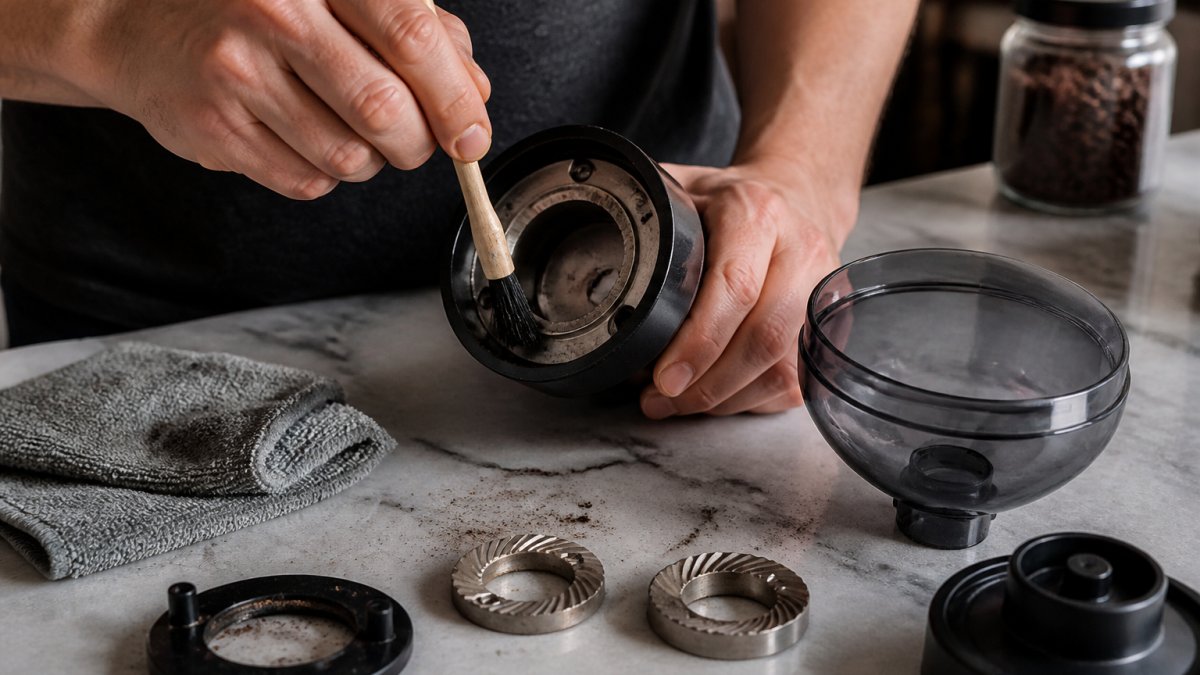
- Unplug the grinder. Never work on a powered machine.
- Empty the hopper. Pour leftover beans into a sealed container.
- Brush out loose grounds and chaff. Use a grinder brush to sweep the hopper, grind chamber, and spout.
- Remove the burrs. Follow your manual for burr removal and disassembly. Note the order so you can reassemble correctly.
- Clean the burrs and burr chamber. Brush both sides of each burr. Use a dry cloth on the chamber walls. Never run burrs under water.
- Reassemble and run a test grind. Grind a small handful of beans and discard it to clear any dust.
Common Mistakes That Damage Burrs
The biggest mistake is washing burrs with soap and water. Moisture rusts steel burrs and can warp ceramic ones. A dry brush and a wipe down are enough.
Other mistakes we see often:
- Grinding flavored or cleaning-tablet residue through burrs meant for coffee only
- Using a wet cloth inside the burr chamber
- Forcing burrs back in at the wrong setting, which chips the edges
- Skipping the brush-out for weeks and letting oils harden into a shell
Building a Burr Grinder Cleaning Schedule Around Your Setup
Your grinder design matters as much as your dose. Flat burrs and conical burrs collect residue differently, and steel versus ceramic burrs need different handling. Use the table below as a starting point, then adjust with the decision rules that follow.
| Grinder Type | Daily | Every 1-2 Weeks | Monthly |
|---|---|---|---|
| Hand grinder, conical steel burrs | Tap out loose grounds | Brush burrs and chamber | Full disassembly and brush |
| Electric flat-burr grinder | Brush spout and chute | Brush burr chamber | Full burr removal and clean |
| Electric conical-burr grinder | Empty hopper | Brush burrs in place | Full disassembly and clean |
| Ceramic burrs (any design) | Dry brush only | Brush burrs in place | Full clean, no water ever |
A Practical Frequency Calculator for Your Counter
Most advice gives broad intervals.
Step 1: Set your base interval by daily dose.
- One use per day: full cleaning every 2 weeks
- Two to three uses per day: full cleaning every 1 to 2 weeks
- Four or more uses per day: full cleaning once a week
- A few uses per week: full cleaning once a month
Step 2: Adjust for roast level. Dark roast and oily beans leave more residue on burrs than light roast.
Step 3: Adjust for hopper versus single-dose use. A hopper filled to the top keeps beans sitting against the burrs between sessions, and those beans release oils that coat the burr path.
Step 4: Adjust for burr material. Steel burrs tolerate dry brushing and occasional cleaning tablets.
Removable vs. Non-Removable Burrs
Not every grinder lets you take the burrs out. Removable burrs can be brushed on both sides and inspected for chips or wear. Non-removable burrs must be cleaned in place with a brush and a dry cloth, and you should never force a burr that the manual says to leave installed. For non-removable burrs, extend the daily brush-out and rely on cleaning tablets between full manual cleans. For removable burrs, follow the manual's removal order and note the reassembly sequence so you do not chip the edges when reinstalling.
Signs Your Grinder Is Overdue for Cleaning
Your grinder tells you when it needs attention. Watch for these objective signs, and treat two or more together as a prompt to clean before you change any other variable.
OutIn Fino Portable Electric Coffee Grinder →
- Grind consistency drops. The same setting suddenly produces a mix of fine and coarse particles.
- Grind retention rises. More grounds stay stuck in the chute than usual.
- Coffee flavor turns flat or bitter. Rancid oils from old residue carry into the cup.
- Brew quality suffers. Extraction yield shifts and shots run fast or slow without a recipe change.
- Visible buildup. You can see a dark film on the burrs or chamber walls.
- Stale or rancid odor. Open the hopper and smell the burr chamber. Fresh coffee smells like coffee; overdue burrs smell like old oil or cardboard.
- Chaff and dust collect in the chute. A dry brush pass should clear it; if it packs in, the grinder is overdue.
A Quick Checklist for Between Scheduled Cleanings
Use this checklist when you suspect buildup but are not due for a full clean:
- Smell the burr chamber with the hopper empty
- Brush the chute and spout into a sink or trash can
- Grind a small test dose and check for clumping or uneven particles
- Taste a cup brewed from the test dose and compare to your reference
- Note any change in grind setting needed to hit your usual recipe
If the checklist turns up odor, clumping, or a setting shift, move your next full clean forward rather than waiting for the calendar.
What Dirty Burrs Mimic
A dirty grinder mimics a grinder that needs new burrs. Before you spend money on replacement burrs, run a full manual clean, purge a small dose, and re-check grind consistency. If the problem persists after a clean and a recalibration, then consider burr wear. This order saves you from replacing burrs that only needed a brush and a dry cloth.
Coffee Grinder Cleaning Tablets vs. Manual Cleaning
Cleaning tablets are a fast option. You grind a dose of tablets through the machine, they absorb oils and scrub the burr path, then you grind a small amount of coffee and discard it. Tablets work well for weekly upkeep on electric grinders.
Manual cleaning with a brush and burr removal gets deeper. It reaches the burr chamber walls, the chute, and the space behind the burrs where tablets cannot go. We recommend manual cleaning as the backbone of your schedule and tablets as a supplement between full cleans.
Tablets clean the burr path. A brush and burr removal clean the whole grinder. Use both, but never let tablets replace a full manual clean.
When to Replace Coffee Grinder Burrs
Burrs wear out, and no cleaning schedule fixes a dull set. Most home grinders need new burrs after a few hundred pounds of coffee, though the exact life depends on burr material and roast level. Dark, oily beans wear burrs faster than light roasts.
Replace burrs when:
- Grind consistency stays uneven after a full clean
- You hear a change in pitch or feel more resistance while grinding
- The manufacturer's stated burr life has passed
- You notice heat building up during a normal grind
For a portable option, our OutIn Fino Portable Electric Coffee Grinder uses a rotating bean hopper that makes loading and cleaning quick, with 28 grind levels and stepless micro-adjustment so you can reset your setting after a clean without guesswork.
Post-Cleaning Checks and Calibration
After every full clean, recalibrate before you brew. Burr removal shifts the zero point slightly, so your old setting may not deliver the same grind.
Run these checks:
- Grind a small test dose and discard it
- Check grind consistency by eye or with a sieve
- Reset your dial to your reference setting and adjust from there
- Pull one shot or brew one cup and taste it
- Note the new setting in your log
A clean grinder with a fresh bag of beans is the simplest upgrade to your cup. Cuppari Coffee roasts every order after it's placed and ships the same day, with free shipping on all U.S. orders, so your burrs meet beans at their best.
Frequently Asked Questions
How do I know if my coffee grinder burrs are bad?
Bad burrs show up in the cup before they show up on the calendar. Grind consistency drops, so shots run fast or slow with no change to your recipe, and drip beds channel or stall. You may taste dull, bitter, or cardboard-like notes even with fresh beans. Visually, the cutting edges look rounded or shiny rather than sharp, and dark roast oils bake into the metal. If a full clean and recalibration does not fix the inconsistency, the burrs are likely worn and due for replacement.
What happens if you never clean your coffee grinder?
Old grounds and coffee oils build up in the burr chamber and hopper. Those oils turn rancid, and every fresh dose picks up stale, bitter flavor that no brew method can fix. Retention climbs, so the first shot or cup of the day is a mix of old and new coffee. Grind consistency also suffers as clogged burrs struggle to cut evenly. Left long enough, hardened residue and chaff can stress the motor and shorten the life of the grinder.
Are coffee grinder cleaning tablets safe for burr grinders?
Tablets are safe when the manufacturer lists them for your grinder model. They are made from food-safe, plant-based material that absorbs oils and carries residue out of the burr chamber. Run them through on a medium setting, then purge with a small dose of coffee beans you plan to discard. Skip tablets on hand grinders and on models whose manual warns against them, and never substitute rice, which is hard enough to chip burr edges.
How often should I change grinder burrs?
Most flat steel burrs are rated for roughly 500 to 1,000 pounds of coffee, and conical burrs often run longer. For a household grinding 1 to 2 pounds a month, that works out to several years of use. Heavy daily use at 2 pounds a week shortens the window considerably. Treat the rating as a guide and let taste and grind consistency decide: if a deep clean and recalibration do not restore even extraction, replace the burrs.
Keeping burrs clean is the difference between a cup that tastes like the roast and one that tastes like last month's oils. Cuppari Coffee makes that easier by roasting only after you order, so every bag arrives fresh enough to reward a clean grinder. Our beans ship the same day they're roasted, with free shipping on all U.S. orders. Add a bag to your cart and give your burrs something worth grinding.