

Table of Contents
- How to Brew Coffee for Camping Without Electricity: Your Complete Guide
- How to Boil Water for Coffee While Camping
- Best Manual Coffee Makers for Camping
- Cowboy Coffee Recipe: Step-by-Step Instructions
- Camping Coffee Grind Size and Coffee-to-Water Ratios
- Leave No Trace: Cleanup and Waste Management
- Instant Coffee vs. Ground Coffee: Weight and Efficiency
- Common Mistakes to Avoid When Brewing Camping Coffee
Last Updated: August 6, 2026
How to Brew Coffee for Camping Without Electricity: Your Complete Guide
Brewing coffee in the backcountry requires manual brewing methods, proper water heating, and adaptation to outdoor conditions. The best camping coffee comes down to three factors: water quality, brewing method, and bean freshness.
How to Boil Water for Coffee While Camping
Boiling water is the foundation of every off-grid coffee method. Without electricity, you'll rely on heat sources that work in wilderness settings: camp stoves, open fires, or portable heating devices.
Camp Stove Method
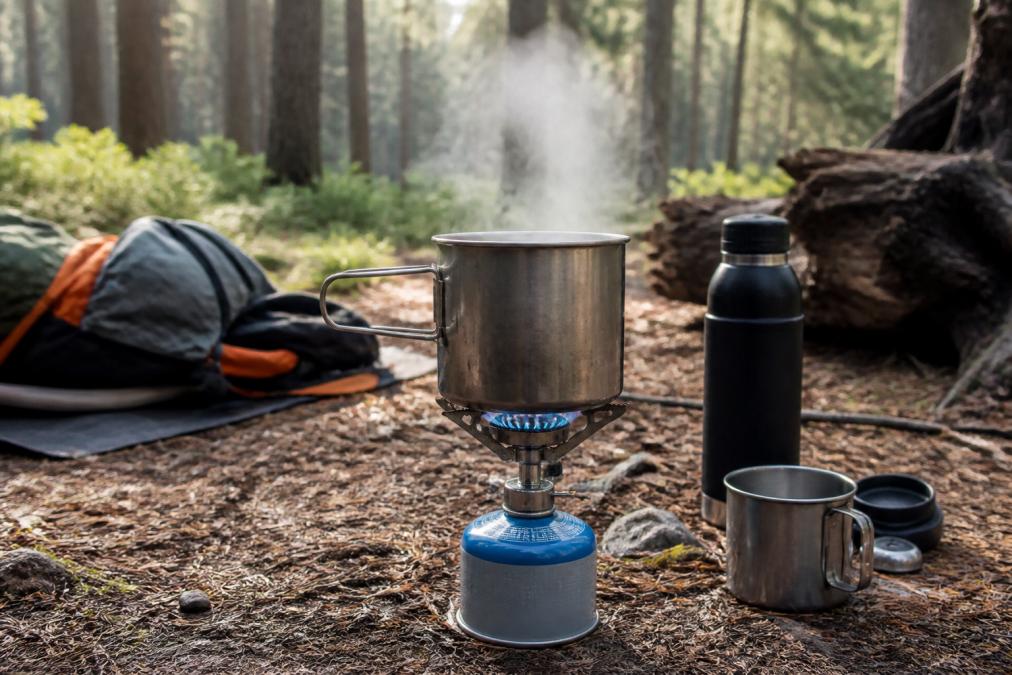
A camp stove is the most reliable way to heat water for coffee while camping. Lightweight, portable, and fuel-efficient, camp stoves give you precise control over temperature.
Set up your camp stove on level ground, away from tents and dry vegetation. Use a metal pot or camping kettle filled with water from your source. Light the stove according to manufacturer's instructions. Water boils at 212°F at sea level, though this drops at higher elevations, around 203°F at 5,000 feet and 194°F at 10,000 feet. Boiling takes 5-10 minutes depending on water volume and altitude. Once boiling, remove the pot carefully and let it cool slightly; water between 195-205°F is ideal for most camping coffee methods. A single fuel cartridge typically boils water 10-15 times, making them economical for multi-day trips.
Open Fire Heating
If you're car camping or at a site that allows open fires, heating water over a campfire is traditional and effective. Place the pot directly in hot coals or suspend it above the fire using a tripod or grill grate. Watch for rolling bubbles and steam, then remove using a heat-resistant glove or cloth. Open fire heating typically takes 10-15 minutes depending on flame intensity and water volume. The main drawback is consistency, fire conditions change as wood burns down, making it harder to achieve optimal brewing temperatures.
Best Manual Coffee Makers for Camping
Manual brewing methods don't require electricity, making them ideal for off-grid coffee. Each method produces different flavor profiles and requires different grind sizes and water temperatures.
Cowboy Coffee Method
Cowboy coffee is the simplest method: grounds steep directly in hot water, then settle at the bottom of the pot. No equipment beyond a pot and cup is required, making it the lightest option for backpacking.
Boil water in your pot. Remove from heat and add coarse grounds directly to the hot water, roughly one heaping tablespoon per cup. Let the grounds steep for 3-4 minutes, allowing full extraction. The grounds gradually settle to the bottom as they absorb water and become heavier. Carefully pour the brewed coffee into your cup, leaving the settled grounds behind. Cowboy coffee produces a full-bodied, strong cup because the grounds have extended contact with hot water, though you'll get some sediment in your cup.
Pour-Over Brewing
Pour-over uses gravity to pull hot water through grounds and a filter, producing a cleaner cup with less sediment than cowboy coffee. For camping, a collapsible pour-over cone works well with either paper or reusable metal mesh filters. Paper filters are lighter but require packing out waste; metal filters are reusable and eliminate Leave No Trace concerns.
Place the pour-over cone on top of your cup. Insert a filter and add medium-ground coffee. Slowly pour hot water (195-205°F) over the grounds in a circular motion. The entire pour takes 2-3 minutes. Pour-over produces a cleaner, brighter cup than cowboy coffee because the filter removes oils and fine sediment.
French Press for Camping
A French press is a manual immersion brewer that uses a metal mesh filter to separate grounds from liquid. Camping French presses are available in small, lightweight sizes, typically 12-20 ounces.
Add coarse grounds to the press, then pour hot water (195-205°F) over them. Let the coffee steep for 4 minutes. Press the plunger slowly downward, forcing the grounds to the bottom. The metal mesh filter traps most grounds while allowing oils and full flavor through. French press camping coffee is full-bodied and rich, with no waste since the filter is reusable.
AeroPress and Percolator Options
An AeroPress is a lightweight, durable hybrid brewing device that combines immersion and pressure, producing excellent coffee in 1-2 minutes with simple cleanup. A percolator is a classic camping brewer that cycles hot water through grounds repeatedly, producing strong, full-bodied coffee. Percolators work over any heat source and are durable and reliable, though heavier than other options.
Cowboy Coffee Recipe: Step-by-Step Instructions
Cowboy coffee is the most accessible method for camping without electricity.
Total Time: 10 minutes Difficulty: Beginner
What You'll Need:
- Metal pot or camping kettle
- Heat source (camp stove or fire)
- Water
- Coffee grounds (coarse grind)
- Cup
- Heat-resistant glove or cloth
Step 1: Boil Your Water [Time: 5-10 minutes] Fill your pot with water from your source. If you're concerned about water quality, filter or treat it before boiling. Heat over a camp stove or fire until you see rolling bubbles across the entire surface. At sea level, this occurs at 212°F. At higher elevations, water boils at lower temperatures; adjust your brewing time accordingly if you're above 5,000 feet.
Step 2: Remove From Heat and Add Grounds [Time: 1 minute] Carefully remove the pot from heat using a heat-resistant glove. Let it cool for 30 seconds; water that's too hot can scorch grounds. Add coarse-ground coffee directly to the hot water, using approximately one heaping tablespoon of grounds per 8-ounce cup. Stir briefly to ensure all grounds are wet.
Step 3: Steep the Coffee [Time: 3-4 minutes] Let the coffee steep undisturbed. At 3 minutes, you'll have a medium-strength cup; at 4 minutes, a stronger cup. Don't exceed 5 minutes or the coffee becomes over-extracted and bitter.
Step 4: Allow Grounds to Settle [Time: 1-2 minutes] The grounds gradually sink to the bottom as they become saturated. Wait until you see mostly clear liquid on top with settled grounds below.
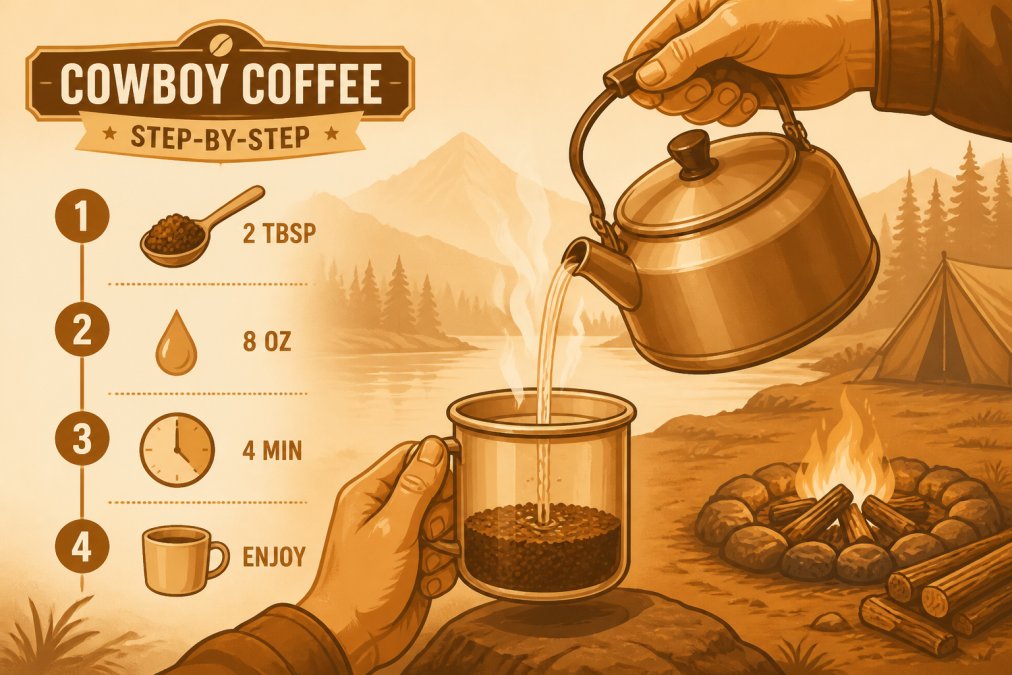
Step 5: Pour Carefully Into Your Cup [Time: 1 minute] Pour slowly and deliberately, tilting the pot so the liquid flows smoothly while grounds remain at the bottom. Pour until you reach the settled grounds layer, then stop.
Camping Coffee Grind Size and Coffee-to-Water Ratios
Grind size and coffee-to-water ratios directly affect extraction and flavor. Different brewing methods require different grinds because they control how long water contacts the grounds.
Grind Size for Different Brewing Methods
Coarse Grind (for cowboy coffee and French press): Coarse grounds resemble breadcrumbs. They steep in water for 3-4 minutes, giving water time to extract flavor without over-extracting. Coarse grounds also settle quickly, reducing sediment in your cup.
Medium Grind (for pour-over and AeroPress): Medium grounds are ideal for pour-over brewing, where water passes through in 2-3 minutes. They balance extraction speed with flavor development.
Fine Grind (for percolators): Fine grounds resemble sand and extract quickly because water contacts more surface area. Percolators cycle hot water repeatedly, so fine grounds prevent over-extraction.
Grind size matters because it controls extraction rate. Coarse grounds extract slowly; fine grounds extract quickly. If you use the wrong grind for your method, you'll either under-extract (weak, sour coffee) or over-extract (bitter, harsh coffee). Bring pre-ground coffee in the appropriate size for your brewing method.
Measuring Coffee and Water in the Backcountry
The standard ratio is 1:16 (coffee to water by weight), which translates roughly to 1 tablespoon of grounds per 8 ounces of water. For stronger coffee, use 1.5 tablespoons per 8 ounces. For weaker coffee, use 0.75 tablespoons per 8 ounces. At altitude, water boils at lower temperatures, reducing extraction efficiency. Compensate by using slightly more coffee (add 10-15% extra grounds) or extending steep time by 30 seconds.
| Brewing Method | Grind Size | Ratio | Steep/Brew Time |
|---|---|---|---|
| Cowboy Coffee | Coarse | 1 tbsp per 8 oz | 3-4 minutes |
| Pour-Over | Medium | 1 tbsp per 8 oz | 2-3 minutes |
| French Press | Coarse | 1 tbsp per 8 oz | 4 minutes |
| AeroPress | Medium-Fine | 1 tbsp per 8 oz | 1-2 minutes |
| Percolator | Fine | 1 tbsp per 8 oz | 5-10 minutes |
Leave No Trace: Cleanup and Waste Management
Camping coffee produces waste that must be managed responsibly. Leave No Trace (LNT) principles require you to pack out everything you pack in and minimize environmental impact.
Coffee Grounds Disposal: Never dump grounds directly on the ground or into water sources. Scatter them in small amounts across a wide area far from camp and water sources (at least 200 feet). Alternatively, pack out used grounds in a sealed bag, especially in heavily-used areas or sensitive ecosystems.
Filter Disposal: Paper filters must be packed out. Burn paper filters completely if you have a campfire, then pack out any remaining ash. Metal mesh filters are reusable and produce no waste.
Water Disposal: Cooled coffee and rinse water should be scattered at least 200 feet from camp and water sources.
Instant Coffee vs. Ground Coffee: Weight and Efficiency
When backpacking, every ounce matters. Instant coffee and ground coffee offer different tradeoffs in weight, convenience, and flavor.
Ground Coffee: Ground coffee requires brewing equipment and more water. A typical serving uses 7-8 grams of grounds and 8 ounces of water. Ground coffee produces superior flavor, more complex, nuanced, and satisfying. For a 3-day backpacking trip with one cup per day, you'd pack 21-24 grams of grounds (less than 1 ounce) plus brewing equipment.
Instant Coffee: Instant coffee is dehydrated, concentrated coffee that dissolves in hot water. A typical serving uses 1-2 teaspoons (2-4 grams) and 8 ounces of water. For the same 3-day trip, you'd pack 6-12 grams of instant coffee (less than 0.5 ounces). Instant coffee requires no brewing equipment, just a cup and hot water.
Instant coffee is significantly lighter than ground coffee, making it ideal for ultralight backpacking. However, the flavor is thinner and less complex. If weight is critical, instant coffee wins. If flavor matters more, ground coffee is superior.
Common Mistakes to Avoid When Brewing Camping Coffee
Brewing coffee in the field differs from home brewing. Avoid these common mistakes to improve your results.
Using Water That's Too Hot: Water over 210°F scalds grounds, extracting harsh, bitter flavors. Let boiled water cool for 30-60 seconds before adding grounds.
Using the Wrong Grind Size: Coarse grounds in pour-over under-extract, producing weak, sour coffee. Fine grounds in cowboy coffee remain suspended, creating sediment and bitterness. Match your grind to your brewing method.
Steeping Too Long: Cowboy coffee steeped for more than 5 minutes becomes over-extracted and bitter.
Not Settling Grounds Properly: Pouring too quickly in cowboy coffee stirs up settled grounds, filling your cup with sediment. Pour slowly and deliberately.
Ignoring Water Quality: Murky or questionable water produces murky coffee. Filter or treat water before boiling.
Packing Heavy Equipment: A full-size French press or percolator adds unnecessary weight on backpacking trips. Choose lightweight options: cowboy coffee (no equipment), pour-over (1-2 ounces), or AeroPress (3 ounces).
Not Accounting for Altitude: At high elevations, water boils cooler and extraction is slower. Use slightly more grounds or extend steep time by 30 seconds.
Brewing coffee for camping without electricity is a skill that improves with practice. Start with cowboy coffee, the simplest method, and experiment with other techniques as you gain confidence. Cuppari Coffee delivers premium, freshly-roasted beans that arrive at your doorstep ready for your next trip. Order your preferred grind size before you leave, and bring coffee that tastes as good in the backcountry as it does at home. Free shipping on all U.S. orders means you can stock up without added cost.
Frequently Asked Questions
What is the easiest way to brew coffee while camping?
Cowboy coffee is often the easiest method for camping because it requires minimal gear, just a pot, water, and grounds. Boil water in a camp pot, add coarse-ground coffee directly, let it settle for a few minutes, and pour carefully into your cup. Pour-over and instant coffee are also simple alternatives that require only a filter or cup and don't need electricity. Choose based on the gear you're comfortable carrying and your brewing time preference.
What is the best grind size for camping coffee?
Coarse-ground coffee works best for most camping methods because it settles faster and produces less sediment. For cowboy coffee and French press, use a coarse grind to prevent grounds from ending up in your cup. Medium-ground coffee suits pour-over methods and AeroPress. Avoid fine grinds for camping unless you're using an espresso maker, as they create excessive sediment and require more precise water temperature control in the field.
How do I know if my camping coffee is actually fresh?
Freshly roasted coffee beans, like those from Cuppari Coffee roasted the day you order, deliver noticeably better flavor and aroma than older beans. When you open a bag, look for a strong coffee aroma and vibrant color. Beans roasted within the past 1-2 weeks will produce a richer, more complex cup with better extraction. Older beans taste flat and bitter, especially in camping conditions where brewing precision is harder to control.
Can I make coffee while camping without a fire?
Yes. A portable camp stove is your best option for brewing without a fire. Many backpackers use lightweight butane or liquid fuel stoves to heat water reliably. Alternatively, instant coffee requires only hot water from any heat source, or you can use a thermos of pre-heated water from home. These methods work well for car camping or backpacking trips where campfires aren't available or permitted.
This article was written using GrandRanker