

Table of Contents
- Start With Taste: A Beginner's Decision Tree for Coffee Roast Profiles
- Light vs. Medium vs. Dark Roast Coffee: What Changes in the Cup
- Coffee Roast Profile Examples You Can Follow at Home
- How Bean Density, Processing, and Batch Size Affect Your Roast Curve
- The Right Roast Profile for Espresso vs. Pour-Over
- How Long to Rest Coffee After Roasting Before You Brew
- Troubleshooting Underdeveloped, Baked, Scorched, and Uneven Roasts
- Frequently Asked Questions
Last Updated: October 4, 2026
Start With Taste: A Beginner's Decision Tree for Coffee Roast Profiles
Choosing a coffee roast profile starts with one question: what do you want in the cup? A coffee roast profile is the plan a roaster follows to apply heat to green coffee over time, and it decides whether your beans taste bright and fruity or deep and smoky. At Cuppari Coffee, we roast every order after it's placed, so we think about roast level the same way you do: as a flavor decision first.
Here's the short version before the details.
- Like tea-like, fruity, floral cups? Go light.
- Want balance, cocoa, and caramel? Go medium.
- Crave bold, smoky, bittersweet depth? Go dark.
Most beginners pick a roast by brand or price. The better move is to pick by taste, then match it to how you brew.
Match the Roast to Your Brewing Method
Your brewing method narrows the choice fast. Pour-over and drip reward light and medium roasts, where delicate flavors can shine. Espresso and moka pots handle medium to dark roasts better, because pressure and short contact time need a bolder bean to cut through.
A simple rule we give customers:
- Pour-over, Chemex, drip: light to medium
- French press, cold brew: medium to dark
- Espresso, moka: medium to dark
If you brew several ways, medium is the safest middle ground. It works everywhere without tasting thin or ashy.
Light vs. Medium vs. Dark Roast Coffee: What Changes in the Cup
The roast level changes flavor more than the bean origin does for most drinkers. Light roasts stop earlier in the roast, keeping more of the bean's natural acidity and origin character. Dark roasts stay in longer, trading those bright notes for caramelized, smoky ones.
Here's how the three levels compare.
| Roast Level | Flavor Notes | Acidity | Body | Best For |
|---|---|---|---|---|
| Light | Fruity, floral, tea-like | High | Light | Pour-over, drip |
| Medium | Cocoa, caramel, balanced | Medium | Medium | Any method |
| Dark | Smoky, bittersweet, bold | Low | Full | Espresso, French press |
Acidity, Sweetness, Body, and Bitterness Across the Spectrum
Acidity drops as the roast gets darker. That bright, tangy quality in a light roast fades into a smoother, rounder cup by the medium stage. Sweetness peaks in the middle: too light and the sugars haven't developed, too dark and they've burned off into bitterness.
Body moves the other way. Light roasts feel thin and clean. Dark roasts feel heavy and syrupy. Bitterness climbs with roast level, which is why dark roasts pair well with milk and sugar. A medium roast sits in the sweet spot for most people, balancing all four traits.
Coffee Roast Profile Examples You Can Follow at Home
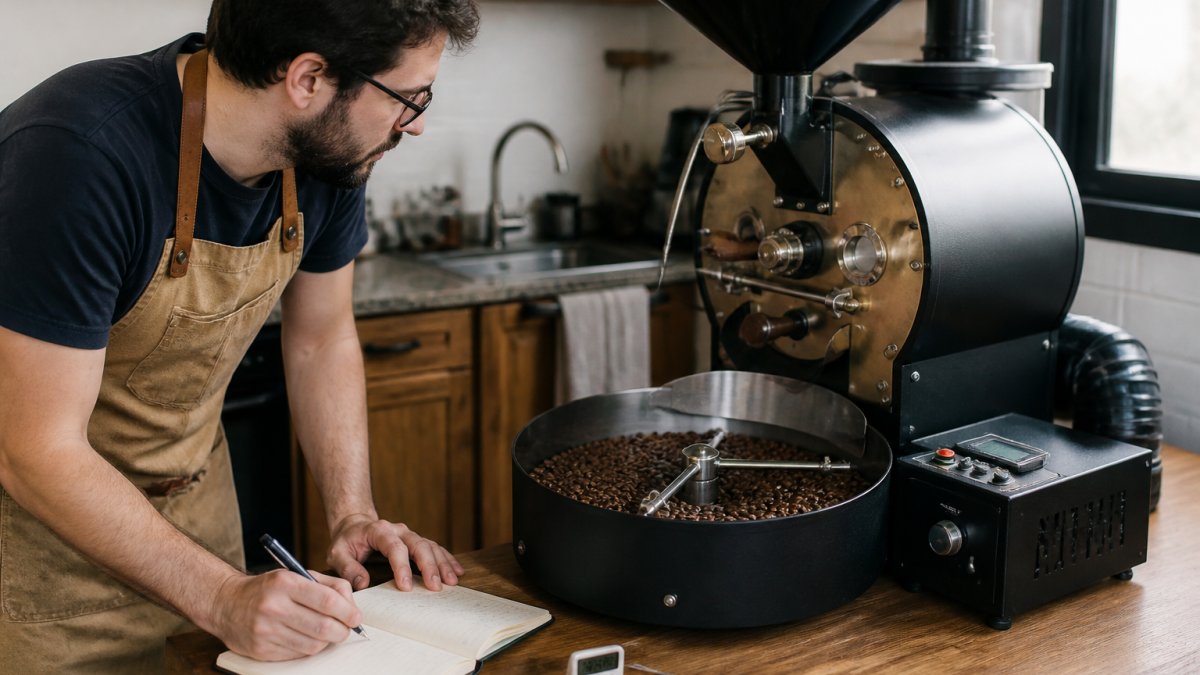
A starter profile gives you a repeatable plan instead of guesswork. Home roasting works best when you track time and temperature and stop at a clear checkpoint.
A Forgiving Starter Profile With Measurable Checkpoints
This profile is built to forgive small mistakes. Aim for these checkpoints:
- Drying stage: first 4-5 minutes, beans turn from green to yellow
- Browning stage: next 3-4 minutes, beans shift to tan then brown
- First crack: around 9-11 minutes, listen for a popping sound like popcorn
- Stop: 1-2 minutes after first crack for a medium roast
How Bean Density, Processing, and Batch Size Affect Your Roast Curve
Bean density, processing method, moisture, and batch size all shift how your roast behaves. Dense, high-grown beans need more heat early to push through the drying stage. Softer, lower-grown beans roast faster and scorch more easily.
Processing matters too. Natural-process beans often carry more sugar on the surface and brown quicker. Washed beans roast more predictably. Batch size changes everything: a small batch heats faster than a full drum, so a profile that works at 100 grams may stall at 250 grams. Keep batch size consistent so you can compare roasts fairly.
The Right Roast Profile for Espresso vs. Pour-Over
Espresso and pour-over pull flavor out of the same bean in very different ways, so the roast level that flatters one can flatten the other. Espresso forces water through a compact puck in roughly 25-30 seconds under about 9 bars of pressure. That short, pressurized contact rewards a bean with developed sugars and low acidity, which is why medium and medium-dark roasts dominate espresso. Pour-over runs 2-4 minutes of gentle, gravity-fed contact, which gives a light or medium roast room to express fruit, florals, and origin character that pressure would otherwise bury.
That difference shows up in the cup as a set of trade-offs:
| Brew Method | Contact Time | Roast Sweet Spot | Why |
|---|---|---|---|
| Pour-over, Chemex, drip | 2-4 min | Light to medium | Slow extraction teases out acidity and aromatics |
| French press, cold brew | 4 min to 18 hr | Medium to dark | Long immersion needs body and low acidity to stay balanced |
| Espresso, moka | 25-30 sec | Medium to medium-dark | Pressure needs developed sugars for crema and syrupy body |
A light roast on espresso is not impossible, but it is a beginner trap. Underdeveloped sugars plus fast pressure often produce a thin, sharply sour shot that no grind adjustment fully fixes. If you want to try it, expect to grind finer, pull longer (closer to 30 seconds), and accept a smaller yield, around a 1:1.5 ratio of coffee to liquid rather than the usual 1:2.
Comparing the Same Bean Across Brew Methods
If you drink both espresso and filter and do not want two separate roasts on the shelf, medium is the honest compromise. It carries enough developed sugar for crema and body while keeping enough acidity to stay interesting in a pour-over. Cuppari Coffee's Brazil Santos is a medium roast with smooth cocoa notes that suits espresso and drip alike, and our Ethiopia Natural leans lighter for pour-over fans who want fruit and caramel in the cup.
How Long to Rest Coffee After Roasting Before You Brew
Freshly roasted coffee is not ready coffee. During roasting, beans build up carbon dioxide inside their cell structure, and for the first few days after the roast that gas escapes steadily. When you brew too soon, the CO2 pushes water away from the grounds, so extraction stalls and the cup tastes flat, foamy, or oddly sharp. Resting lets the gas bleed off so water can do its job.
The right rest window depends on roast level, because darker roasts degas faster than light ones:
| Roast Level | Best Rest Window | Notes |
|---|---|---|
| Light | 5-10 days | Dense, less porous; holds gas longer |
| Medium | 4-7 days | The forgiving middle ground |
| Dark | 2-5 days | Porous and oily; peaks quickly, fades quickly |
| Espresso (any level) | Add 2-3 days | Pressure amplifies CO2 interference |
Espresso is the fussiest. Because the puck is under pressure, trapped CO2 creates channeling and gushers, so most espresso roasts need a few extra days beyond their filter counterpart. A common pattern is to rest espresso roasts 5-10 days and filter roasts 3-7 days.
How to Find Your Roast's Peak Without Guessing
This is also why roast date matters more than a "best by" date. A best-by date tells you nothing about how long the coffee has sat; a roast date lets you count days and brew inside the window. Store beans in an airtight container away from light and heat, and grind right before you brew so you are not adding stale grounds to a perfectly rested bean. Cuppari Coffee roasts and ships the same day so your coffee arrives with the full rest window still ahead of it.
Troubleshooting Underdeveloped, Baked, Scorched, and Uneven Roasts
Most home roasting problems trace back to heat and timing. Here's how to spot each fault and fix it.
| Problem | What It Tastes Like | Fix |
|---|---|---|
| Underdeveloped | Grassy, sour, thin | Roast longer past first crack |
| Baked | Flat, dull, cardboard | Raise heat earlier, avoid long slow roasts |
| Scorched | Burnt, ashy, harsh | Lower heat, stir or increase airflow |
| Uneven | Mixed sour and burnt | Reduce batch size, keep beans moving |
Frequently Asked Questions
What is a coffee roast profile?
A coffee roast profile is the record of how heat and time are applied to green coffee beans during roasting. It tracks temperature against time, marking key stages like drying, browning, and first crack. The profile determines the final roast degree and shapes the flavor profile, including acidity, sweetness, and body.
How do I choose a coffee roast profile as a beginner?
Start with your taste preference and brewing method. If you drink drip coffee and enjoy bright, fruit-forward cups, try a light or medium-light roast profile. For espresso or milk drinks, a medium to dark roast profile works better because it holds up to pressure and milk.
Should I choose a different roast profile for espresso and pour-over?
Yes. Espresso benefits from a roast profile for espresso that develops sugars fully and reduces acidity, often landing at medium to medium-dark. Pour-over highlights delicate origin characteristics, so a lighter roast profile preserves floral and fruit notes. If you brew both, a medium roast like Brazil Santos ($21.99) balances cocoa sweetness with enough body for either method.
How long should coffee rest after roasting before brewing?
Most coffee tastes best 3 to 7 days after roasting. Light roasts often need 5 to 10 days to settle, while dark roasts peak around 3 to 5 days. Espresso can rest 7 to 14 days for better crema and sweetness. If you buy freshly roasted beans, check the roast date and wait until the beans stop releasing intense carbon dioxide, which causes bubbling during brewing.
Getting a roast profile right takes practice, and most beginners burn a batch or two along the way. The easier path is to start with coffee roasted by people who do it every day. Cuppari Coffee roasts only after you order, ships the same day, and offers free shipping on all U.S. orders, so your beans arrive fresh instead of sitting on a shelf. Try our Best Sellers Sample Pack to find your favorite roast level, then add a full bag to your cart and brew a livelier cup.