

Table of Contents
- What Are Coffee Flavor Notes and Why They Matter
- Understanding the Coffee Flavor Wheel Explained
- Step-by-Step Guide: How to Identify Coffee Flavor Notes
- How to Do a Coffee Cupping at Home
- Common Coffee Flavor Profiles and What to Expect
- Troubleshooting: Why You Can't Taste the Flavor Notes
- Are Flavors Added to Coffee Beans?
- Conclusion: Start Tasting Coffee Like a Specialist
- Frequently Asked Questions
How to Identify Coffee Flavor Notes: A Tasting Guide
Last Updated: June 29, 2026
Learning how to identify coffee flavor notes transforms the way you experience your daily cup. Most coffee drinkers taste "coffee" and call it a day. But specialty coffee reveals something entirely different, citrus brightness, chocolate depth, nutty warmth, if you know how to look for it. Below, we'll show you exactly how to train your palate, avoid common mistakes, and taste coffee like someone who actually knows what they're doing.
When you understand how to identify coffee flavor notes, you're unlocking the story of where those beans came from, how they were roasted, and what makes them special. According to the Specialty Coffee Association's research on sensory evaluation, trained tasters identify between 100 and 150 distinct flavor compounds in coffee. That's not magic. That's method.
What Are Coffee Flavor Notes and Why They Matter
Coffee flavor notes are the specific taste descriptors that emerge when you brew and taste coffee. They're not added flavors, they're the natural result of how the beans were grown, processed, and roasted. When a bag says "notes of chocolate and berries," it's describing compounds that develop during roasting and become detectable on your palate.
The Difference Between Taste and Flavor in Coffee
Taste is what your taste buds detect: sweetness, bitterness, acidity, saltiness, and umami. Flavor is the combination of taste plus aroma plus texture. Your olfactory system contributes roughly 80% of what you perceive as flavor. This is why food tastes bland when you have a cold. Coffee tasting works the same way, the complexity people describe on specialty coffee bags comes almost entirely from aroma compounds, not from taste buds alone.
How Aroma Shapes Your Perception
Before you taste coffee, you smell it. When you inhale deeply from a freshly brewed cup, you're drawing volatile aromatic compounds into your nasal cavity. The moment you sip and swallow, those same compounds hit your olfactory system from the back of your throat (retronasal olfaction). This is why flavor develops as you drink. Your brain integrates the aroma with the taste and texture to create the complete flavor experience.
Understanding the Coffee Flavor Wheel Explained
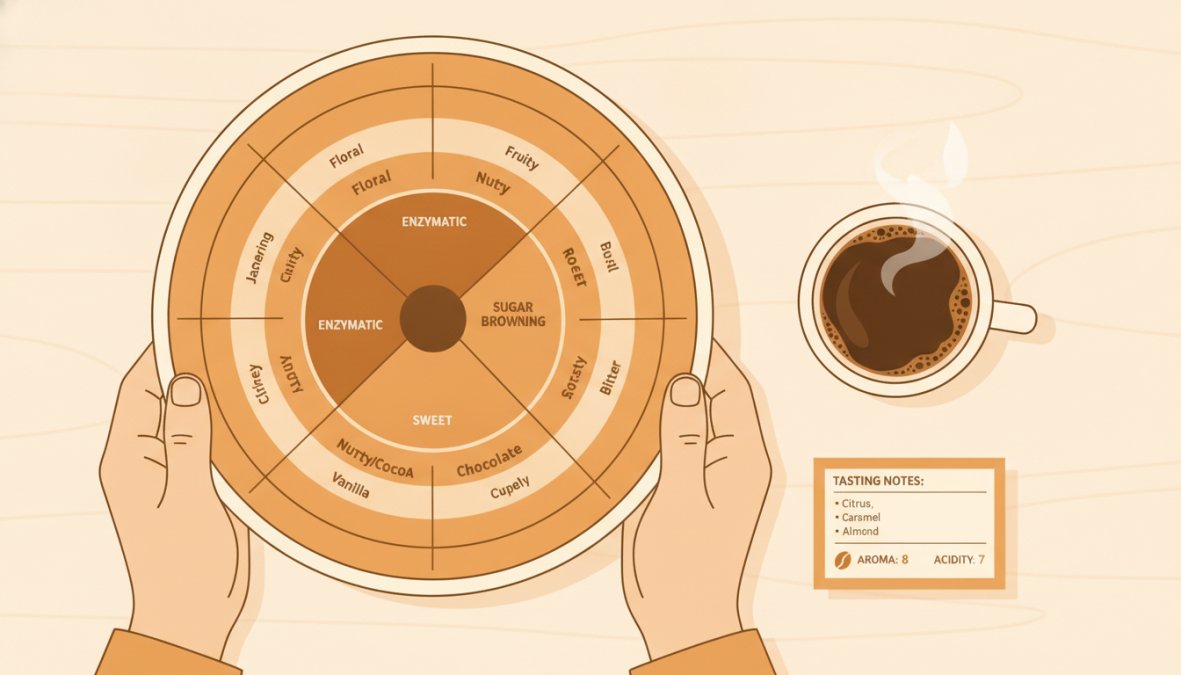
The coffee flavor wheel is a visual tool created by the Specialty Coffee Association to standardize flavor vocabulary. It organizes flavor descriptors into categories radiating outward from the center, moving from general to specific. At the center are broad categories like "fruity," "floral," and "nutty." Moving outward, each category branches into more specific notes.
The wheel serves one purpose: giving your brain a reference framework. Without it, you're trying to name flavors you've never consciously identified before. With it, you can point to "notes of blueberry" instead of fumbling to describe something vaguely sweet and slightly tart.
Reading the Wheel: From General to Specific
Start at the center of the flavor wheel and work outward. If you detect something fruity, move to the next ring and ask yourself: is it berry, citrus, or dried fruit? Keep narrowing until you land on a specific descriptor that matches what you're tasting. The wheel isn't a test. You won't identify every note listed. A single coffee might display 3-5 detectable flavor notes.
Common Flavor Categories: Chocolate, Nuts, and More
Chocolate notes appear frequently in coffee because roasting naturally develops cocoa-like compounds. Medium roasts often show chocolate sweetness; dark roasts lean toward bitter chocolate or cocoa powder. Nutty flavors (almond, hazelnut, walnut) emerge from roasting and often pair with chocolate. Fruity notes range from bright citrus (lemon, orange, grapefruit) to berries (blueberry, strawberry, raspberry) to dried fruit (raisin, fig, date). Citrus notes signal higher acidity and lighter roasts. Floral notes (jasmine, rose, hibiscus) and earthy notes (soil, wood, leather) appear less frequently but are unmistakable when present. Caramel and molasses represent the sweet side of roasting and are more common in medium and dark roasts.
Step-by-Step Guide: How to Identify Coffee Flavor Notes
The process of identifying coffee flavor notes follows a structured sequence. Professional cuppers use this method because it works.
Step 1: Assess the Aroma Before Tasting
Pour your coffee into a cup and wait 30 seconds for it to cool slightly. Bring the cup to your nose and inhale deeply. What do you smell? Don't overthink it. Your first instinct is often correct. Is it fruity, floral, earthy, spicy, or sweet? Write down your initial impression, then narrow it down further.
Step 2: Notice Acidity and Mouthfeel
Take a small sip and notice how the coffee feels in your mouth before you swallow. This is mouthfeel or body, the weight and texture of the liquid. Does it feel light and tea-like, medium and balanced, or heavy and syrupy? Acidity is the brightness or sharpness you feel on your palate. It's not sourness (which is a flaw). High acidity feels crisp and lively. Low acidity feels smooth and mellow.
Step 3: Identify Flavor Descriptors on Your Palate
Hold the coffee in your mouth for 2-3 seconds before swallowing to give your taste buds and olfactory system time to register the flavors. After swallowing, you'll often notice flavors more clearly because aromatic compounds travel retronasal to your olfactory bulb. What flavor comes to mind? Refer to the flavor wheel if you're stuck. Write down 2-3 descriptors.
Step 4: Evaluate Body, Balance, and Aftertaste
Body is the overall weight and texture of the coffee. Sweetness is how much natural sugar compounds you detect. Balance is whether the coffee feels harmonious or if one flavor dominates unpleasantly. Aftertaste is what lingers after you swallow, does it taste clean and pleasant, or does it leave a bitter or sour impression? A well-balanced coffee feels integrated, with acidity, sweetness, and body working together.
How to Do a Coffee Cupping at Home
Cupping is the professional method for evaluating coffee. It's structured, repeatable, and designed to eliminate variables so you can taste the coffee itself. You can do a simplified version at home with minimal equipment.
What You'll Need for a Home Cupping Session
You need coffee beans (freshly roasted, ideally within 2-4 weeks of roasting), a grinder, hot water (195-205°F), small cups or bowls, and a spoon. Freshness matters because stale beans lose aromatic compounds and flavor clarity. Grind your beans medium-fine, just coarser than espresso. Use a consistent ratio: roughly 1 tablespoon of ground coffee per 6 ounces of water.
The Cupping Process: A Structured Tasting Method
Pour hot water over the grounds and let them steep for 4 minutes. After 4 minutes, break the crust that forms on top by pushing the grounds down with your spoon. Smell the aroma as you do this. Let the coffee cool for a few minutes until you can taste it comfortably.
Slurp the coffee loudly, drawing air through it as you sip. This aerates the coffee and spreads it across your entire palate. Notice the aroma, taste, body, acidity, and aftertaste. Slurp multiple times from different spots in the cup, as flavor can vary slightly as the coffee cools.
| Step | Duration | What to Assess |
|---|---|---|
| Smell dry grounds | 30 seconds | Initial aroma impression |
| Pour hot water | Immediate | Aroma release as water hits grounds |
| Wait and smell | 4 minutes | Aroma development |
| Taste and slurp | 5-10 minutes | Flavor, body, acidity, balance |
| Cool and retaste | 10-15 minutes | Flavor changes as coffee cools |
Write down your observations for each coffee you cup. Over time, you'll notice patterns that help you recognize flavors more quickly.
Common Coffee Flavor Profiles and What to Expect
Different origins, processing methods, and roast profiles create distinct flavor signatures. Understanding these patterns helps you know what to expect before you taste, which primes your palate to notice those flavors.
How Origin and Terroir Influence Flavor
Terroir refers to the environmental factors that shape coffee flavor: altitude, climate, soil, rainfall. Ethiopian coffees often display floral and fruity notes. Kenyan coffees tend toward berry and citrus notes. Colombian coffees frequently show chocolate and nut notes. Higher altitude means slower ripening, which concentrates sugars and acids in the bean. This is why high-altitude coffees often taste brighter and more complex. Processing method also influences flavor. Washed coffees taste cleaner and brighter. Natural-processed coffees taste fruitier and sweeter.
Roast Profile's Impact on Flavor Development
Light roasts preserve origin flavors, you taste the terroir and processing method most clearly. They tend toward fruity, floral, and acidic notes. Medium roasts balance origin flavors with roasting flavors: chocolate, caramel, and nuttiness. Dark roasts emphasize roasting flavors, chocolate, cocoa, earth, spice, and minimize origin flavors. As beans heat during roasting, sugars caramelize, acids break down, and new flavor compounds develop. The roast profile you choose determines what flavors you'll be able to taste.
Troubleshooting: Why You Can't Taste the Flavor Notes
Many people follow the steps above and still don't taste the notes listed on the bag. This is normal. Your palate needs training. But several specific problems block flavor identification more often than others.
Common Mistakes in Flavor Identification
The biggest mistake is brewing wrong. If your coffee tastes bitter and harsh, the problem is usually over-extraction (brewing too long or with water that's too hot) or stale beans. Stale coffee loses aromatic compounds rapidly. Beans older than 4-6 weeks taste muted and flat. Another common mistake is tasting too quickly. Your palate needs time to adjust. The first sip often tastes generic. By the third or fourth sip, as your palate wakes up, you'll notice distinct flavors. Tasting at the wrong temperature also blocks flavor perception. Coffee tastes most complex when it's warm but not hot, around 160-180°F.
Training Your Sensory Memory for Better Recognition
Your sensory memory is a skill, not a gift. It improves with practice. Start by tasting side by side with a reference. If the bag says "notes of blueberry," taste actual blueberries while you drink the coffee. Your brain will link the flavor compound to the reference, and next time you taste blueberry in coffee, you'll recognize it immediately. Taste the same coffee multiple times over several days. Keep tasting notes. Over months, you'll notice your accuracy improving.
Comparative Tasting Exercises to Build Your Palate
Comparative tasting is the fastest way to train your palate. Brew two coffees side by side and taste them alternately. The contrast makes differences obvious. Start with coffees that are very different, a light roast and a dark roast, or two origins known for opposite flavor profiles. As your palate develops, compare coffees that are more similar.
Are Flavors Added to Coffee Beans?
No. Coffee flavor notes are not added to the beans. They're the natural result of the coffee plant's genetics, where it grows, how it's processed, and how it's roasted. The complexity on specialty coffee bags comes from hundreds of volatile compounds that develop during roasting.
Conclusion: Start Tasting Coffee Like a Specialist
Learning how to identify coffee flavor notes is entirely achievable. The process isn't complicated, it's just a method combined with practice. Most people fail not because they lack ability, but because they try to taste coffee that's stale, over-extracted, or poorly brewed. Start with fresh beans, brew correctly, and taste intentionally. Your palate will develop faster than you expect.
Frequently Asked Questions
What are coffee flavor notes and how do I identify them?
Coffee flavor notes are specific tastes and aromas you perceive when drinking coffee. To identify them, use your senses systematically: first smell the aroma, then notice the acidity and mouthfeel, then look for specific flavor descriptors like notes of chocolate, citrus, or berries on your palate. Using the coffee flavor wheel helps you narrow down descriptions from broad categories (fruit) to specific ones (citrus). Training your sensory perception through repeated tasting improves recognition over time.
How do I use the coffee tasting wheel explained to identify notes?
The coffee flavor wheel starts with broad categories at the center (like fruit or chocolate) and branches into specific descriptors at the edges. Begin by identifying which main category matches your perception, then move outward to more specific notes. For example, if you taste fruit, determine if it's citrus, berries, or stone fruit. This structured approach, used by the Specialty Coffee Association (SCA), trains your palate to recognize complexity and communicate flavors precisely.
Why can't I taste the flavor notes listed on my coffee bag?
Several factors affect flavor identification: brewing method and extraction impact taste, grind size affects how flavors develop, and your palate may need training to recognize subtle notes. Additionally, sensory memory plays a role, you taste better when you've recently experienced similar flavors. Common mistakes include not smelling the aroma first, drinking too quickly, or expecting flavors to taste like the actual fruit or chocolate rather than subtle hints. Comparative tasting exercises and repeated exposure strengthen your ability to detect these notes.
What's the difference between acidity and flavor notes in coffee?
Acidity refers to the brightness or tartness you feel on your tongue and palate, it's a tactile sensation that contributes to mouthfeel and overall balance. Flavor notes are the specific tastes you perceive, like notes of citrus, molasses, or berries. Both are essential to specialty coffee evaluation. A coffee might have high acidity (bright, lively sensation) with notes of citrus (the specific flavor descriptor). Understanding this distinction helps you describe coffee more accurately and appreciate how different elements create complexity.
The fastest way to develop your palate is to start with the freshest possible beans. Cuppari Coffee roasts beans only after your order is placed and ships the same day, guaranteeing maximum freshness and flavor clarity. With fresh beans, proper brewing, and intentional tasting, you'll recognize flavor notes within weeks, not months. Get started with Cuppari Coffee and experience the difference freshness makes in flavor perception.
This article was written using GrandRanker