

Table of Contents
- Why Proper Storage Is the Key to How to Store Coffee Beans Fresh
- Ideal Storage Conditions: Cool, Dark, and Dry
- Best Coffee Storage Containers: Materials, Seals, and One-Way Valves
- Freezing Coffee Beans: The Right Way to Do It
- How Long Do Coffee Beans Last? Shelf Life by Roast and Storage Method
- Signs of Stale Coffee Beans: How to Know When Freshness Is Gone
- How to Store Coffee Beans Fresh: Common Mistakes and Insider Tips
- Conclusion
Last Updated: May 24, 2026
Knowing how to store coffee beans fresh is the difference between a cup that sings and one that tastes like cardboard. This guide from Cuppari Coffee covers every variable that affects freshness, from container material to freezer protocols, so you can protect every bag you buy. Most guides stop at "keep it cool and dark." We go further. Below, you'll find specific container recommendations, a freezer thaw protocol most coffee drinkers have never heard of, and a breakdown of how roast level changes your storage strategy entirely.
Here's what most guides get wrong: they treat all coffee the same. A light roast fresh from the roaster behaves differently in storage than a dark roast that's been sitting on a retail shelf for three weeks. Getting that nuance right is where real freshness is preserved.
Why Proper Storage Is the Key to How to Store Coffee Beans Fresh
Coffee beans are one of the most chemically active foods you can store at home. The moment roasting ends, a slow but relentless degradation process begins.
Oxidation is the primary enemy. When coffee beans are exposed to oxygen, the aromatic compounds responsible for flavor and aroma break down rapidly. Carbon dioxide, which is naturally produced during roasting, initially protects the bean by pushing oxygen out. But once that CO2 dissipates, oxygen moves in and oil degradation accelerates.
The Four Enemies of Fresh Coffee: Oxygen, Moisture, Light, and Heat
The four main threats to coffee freshness work independently and in combination:
- Oxygen triggers oxidation, stripping flavor compounds and turning oils rancid
- Moisture causes beans to absorb ambient humidity; coffee is hygroscopic, meaning it actively pulls water from the surrounding air, which accelerates staling and can introduce mold
- Light degrades chlorogenic acids and aromatic compounds through photodegradation, which is why opaque containers matter
- Heat speeds up every chemical reaction, compressing a bean's shelf life from weeks to days
Understanding these four forces is the foundation of every storage decision you'll make. The best containers, locations, and protocols all exist to neutralize them.
Ideal Storage Conditions: Cool, Dark, and Dry
The optimal storage environment for whole bean coffee is a cool, dark, dry location with stable temperature, away from any heat source. A kitchen cabinet away from the stove or oven is ideal. A pantry shelf works even better.
But 'cool, dark, and dry' is the floor, not the ceiling. What most guides skip is that the ideal conditions are not identical for every bag of coffee you buy. Roast level changes the equation in ways that matter for daily storage decisions.
How Roast Level Changes Your Ideal Storage Environment
This is the angle almost no storage guide addresses, and it has real practical consequences.
Dark roasts develop a more porous cell structure during the longer, hotter roasting process. That porosity means they absorb ambient humidity faster and release CO2 more aggressively in the days after roasting. The surface oils that give dark roasts their characteristic sheen are also highly susceptible to oxidative rancidity. For dark roasts, temperature stability is the single most critical environmental variable. Even modest heat, a cabinet above a dishwasher, a shelf near a south-facing window, accelerates oil oxidation noticeably. Dark roasts stored at a consistent 65°F will outlast the same beans stored in a spot that swings between 65°F and 78°F during the day, even if the average temperature is the same. Consistency beats absolute coolness.
Light roasts are denser, less porous, and carry far less surface oil. Their primary freshness threat is not rancidity but the slow dissipation of volatile aromatic compounds, the floral, fruity, and acidic notes that define a well-sourced light roast. These compounds are sensitive to light exposure and humidity more than to moderate temperature swings. For light roasts, the opaque container and dry environment matter more than finding the coldest possible spot in your kitchen.
Medium roasts sit between the two. They benefit from the same stable-temperature principle as dark roasts but are somewhat more forgiving on both dimensions.
The practical takeaway: if you drink dark roasts, prioritize a location with the most stable temperature in your kitchen, even if it's not the absolute coolest. If you drink light roasts, prioritize darkness and low humidity above all else.
Why Temperature Fluctuation Is More Damaging Than Moderate Heat
Temperature fluctuations are particularly damaging regardless of roast level. Repeated warming and cooling causes beans to expand and contract, which accelerates the release of CO2 and speeds up flavor loss. Consistency matters more than absolute temperature. A steady 65-70°F is far better than a spot that swings between 60°F and 80°F depending on the time of day.
The worst locations in a typical kitchen, ranked by temperature instability:
- On top of the refrigerator, the compressor generates heat in cycles, creating constant temperature swings
- Next to or above the stove, obvious heat source, but also catches steam and cooking odors
- On a counter near a window, afternoon sun can raise surface temperature by 15-20°F in direct light
- Inside a cabinet directly above the dishwasher, steam and heat from drying cycles penetrate cabinet floors
- Near a toaster or electric kettle, small appliances generate more localized heat than most people realize
The best locations are interior cabinets on an exterior wall (naturally cooler), a dedicated pantry shelf away from appliances, or a lower cabinet away from the oven. The goal is thermal stability, not refrigeration.
Why Room Temperature Beats the Refrigerator Every Time
The refrigerator is one of the worst places to store coffee beans. Full stop.
Refrigerators are cold and humid. They also contain a rotating cast of odors from other foods. Because coffee is hygroscopic, beans stored in the fridge will absorb condensation every time you open and close the door, and they'll pick up the flavor of whatever else is in there. You'll end up with coffee that tastes vaguely of last night's leftovers.
Room temperature storage, in a proper airtight container, keeps beans stable for two to four weeks after the roast date without any of the condensation risk. According to the Specialty Coffee Association's guidance on coffee freshness, maintaining stable ambient conditions is one of the most impactful factors in preserving bean quality after roasting.
The refrigerator isn't a neutral option. It actively harms your coffee.
Best Coffee Storage Containers: Materials, Seals, and One-Way Valves
Choosing the right container is where most coffee drinkers underinvest. The container you use is the single most controllable variable in your storage setup.
A quality coffee storage container must do three things: block light, create an airtight seal, and, ideally, allow CO2 to escape without letting oxygen in.
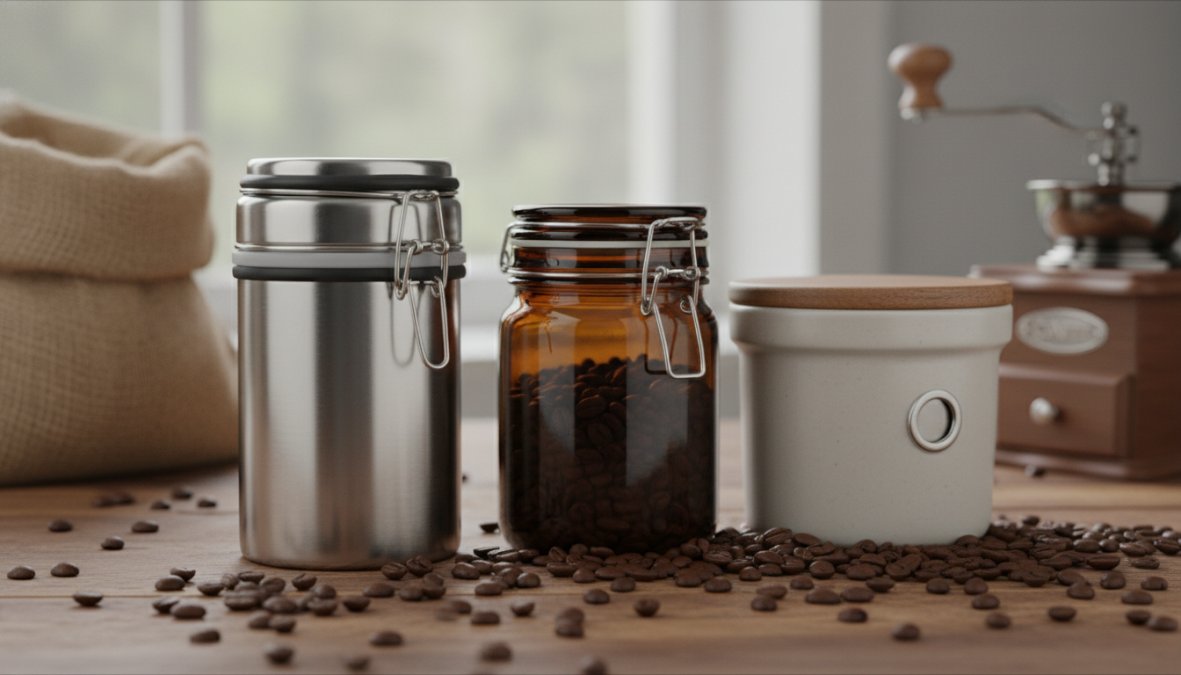
Container Material Analysis: Glass, Ceramic, Stainless Steel, and Plastic
Not all containers are equal. Here's a direct comparison of the four most common materials:
| Material | Light Blocking | Seal Quality | Odor Neutrality | Verdict |
|---|---|---|---|---|
| Glass (clear) | None | Good | Excellent | Poor choice without opaque wrap |
| Glass (opaque/tinted) | Good | Good | Excellent | Solid option |
| Ceramic | Excellent | Good-Excellent | Excellent | Top-tier for short-term |
| Stainless Steel | Excellent | Excellent | Excellent | Best overall material |
| Plastic | Poor-Good | Variable | Poor | Avoid for long-term storage |
Stainless steel vacuum canisters are the top recommendation for most home users. They block light completely, maintain a strong seal, and don't absorb or transfer odors. Ceramic canisters are a close second and look better on a counter. Glass containers are acceptable only if they're fully opaque or stored in a dark cabinet. Plastic is the weakest option: many plastics are gas-permeable and can leach odors into the beans over time.
Degassing and One-Way Valves: Why They Matter More Than You Think
Fresh roasted coffee releases carbon dioxide for days after roasting. This is called degassing, and it's actually a sign of quality. The problem is that CO2 buildup inside a sealed container can compromise the seal or, in extreme cases, cause packaging to balloon.
A one-way valve solves this elegantly. It allows CO2 to escape from the container while preventing oxygen from entering. This is why premium retail packaging for specialty coffee almost always includes a one-way valve built into the bag.
For home storage, look for canisters with a one-way valve or a pressure-release mechanism. These are especially important in the first week after roasting, when degassing is most active. If you're storing beans from Cuppari Coffee, which roasts and ships the same day the order is placed, your beans will arrive actively degassing. A valve-equipped container handles this without any intervention.
According to research on coffee packaging and freshness from the National Coffee Association, proper gas management during storage is a key factor in preserving the flavor profile of specialty-grade beans.
Freezing Coffee Beans: The Right Way to Do It
Freezing coffee beans is one of the most debated topics in the specialty coffee world. The conventional wisdom used to be: never freeze coffee. Current best practice is more nuanced. Freezing works well when done correctly and disastrously when done wrong.
The core issue is moisture and condensation. When you freeze beans and then expose them to room-temperature air, condensation forms on the surface of the beans. That moisture accelerates staling faster than if you'd never frozen them at all.
Short-Term vs. Long-Term Storage Protocols
The right freezing protocol depends entirely on your timeline.
Short-term storage (up to 2 weeks): Don't freeze. Room temperature in an airtight, opaque container is superior for beans you'll use within two weeks of the roast date. Freezing adds risk without meaningful benefit at this timescale.
Long-term storage (2 weeks to 3 months): Freezing is appropriate and effective. The key is portioning beans into single-use quantities before freezing so you never thaw more than you need.
Follow this protocol for long-term freezing:
- Divide beans into weekly or per-session portions immediately after receiving them
- Place each portion in a small, airtight freezer bag, pressing out as much air as possible before sealing
- Place all bags inside a larger airtight container or second freezer bag for double protection
- Label each bag with the roast date and portion size
- Store flat in the back of the freezer, away from the door where temperature fluctuates most
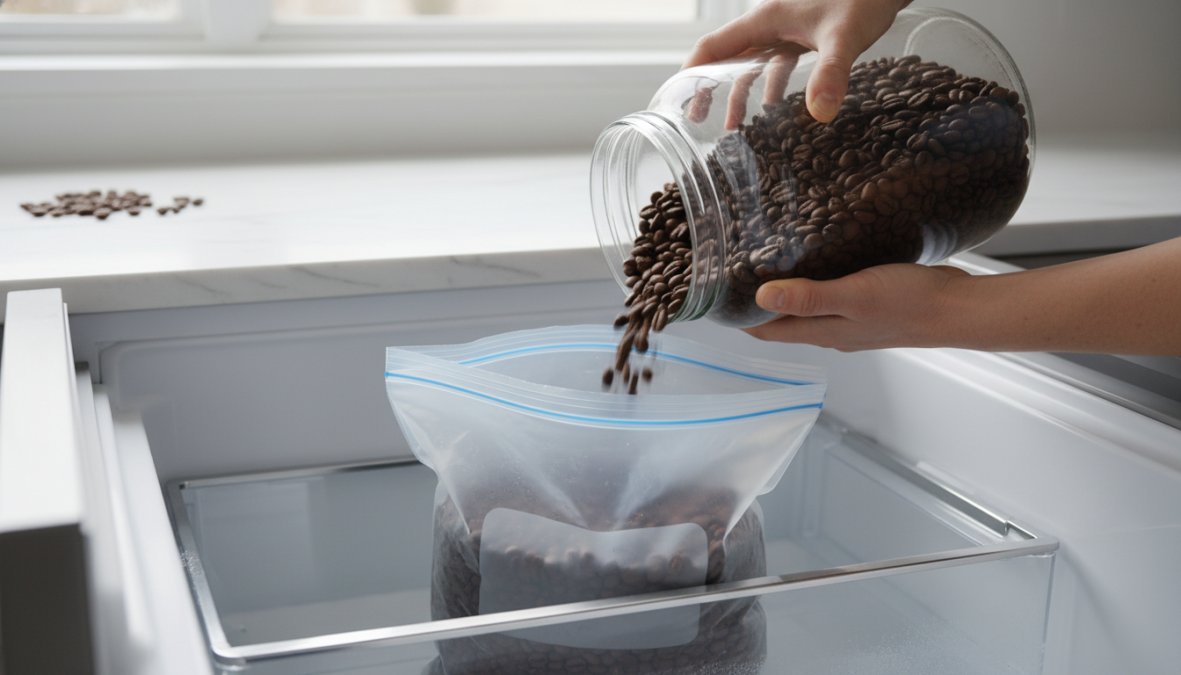
Freezer Thaw Protocol: How to Defrost Without Ruining Your Beans
This is the part nobody talks about, and it's where most people make the critical mistake.
Never open a frozen bag of coffee beans immediately after removing it from the freezer. The beans are colder than the ambient air, which means moisture from the air will condense on them the moment they're exposed.
The correct thaw protocol:
- Remove the sealed, unopened bag from the freezer
- Place it on the counter and allow it to come to room temperature completely, still sealed. This typically takes 30-45 minutes for a small portion
- Only open the bag once the beans feel close to room temperature to the touch
- Transfer to your grinder or storage container immediately and do not refreeze
This single protocol prevents the condensation damage that gives freezing a bad reputation. As documented in food science research on freeze-thaw cycles and moisture absorption, the rate of moisture uptake in porous food materials is highest immediately after removal from freezing temperatures when the surface is coldest.
How Long Do Coffee Beans Last? Shelf Life by Roast and Storage Method
How long coffee beans last depends on three variables: the roast level, the storage method, and how close to the roast date you start the clock. Whole bean coffee stored correctly outlasts pre-ground coffee by weeks.
| Storage Method | Whole Bean Shelf Life | Ground Coffee Shelf Life |
|---|---|---|
| Room temp, airtight container | 2-4 weeks (peak), 6-8 weeks (acceptable) | 1-2 weeks |
| Freezer (portioned correctly) | 2-3 months (peak quality) | 1 month |
| Original retail packaging | 1-2 weeks after opening | 3-5 days |
| No container (open air) | 3-5 days | 1-2 days |
How Roast Level Affects Storage Life and Flavor Degradation
This is the angle most guides skip entirely, and it changes your strategy significantly.
Dark roasts have more surface oil and a more porous structure than light roasts. That oil is flavorful when fresh but goes rancid quickly when exposed to oxygen. Dark roasts taste best within 7-14 days of roasting and degrade noticeably faster than lighter roasts in storage.
Light roasts are denser and have less surface oil. Their flavor compounds are more stable, and they maintain acceptable quality for 3-4 weeks post-roast when stored properly. They're also better candidates for longer-term freezer storage because their structure is less porous and absorbs less ambient moisture.
Medium roasts fall between the two. Plan for a 2-3 week peak window at room temperature.
The practical implication: if you're buying dark roasts, buy smaller quantities more frequently. If you prefer light roasts for pour-over or cold-brew, you have more flexibility to buy in larger batches and freeze portions.
Signs of Stale Coffee Beans: How to Know When Freshness Is Gone
Stale coffee beans announce themselves clearly if you know what to look for, but the signals are not the same for every roast level, and conflating them leads to either throwing out beans that are still good or brewing with beans that are well past their peak. Here is how to read the actual indicators, calibrated by roast.
The Bloom Test: The Fastest Daily Freshness Check
The single most reliable real-time freshness test requires no equipment beyond your brewer. When hot water contacts freshly roasted coffee grounds, dissolved CO2 escapes rapidly, causing the bed of grounds to swell and bubble. This is called the bloom, and it is a direct proxy for how much CO2, and therefore how much freshness, remains in the bean.
What a healthy bloom looks like: grounds rise visibly within the first 10-15 seconds of contact with water, continue bubbling for 30-45 seconds, and form a domed, slightly foamy surface before settling.
What a failing bloom looks like: grounds barely rise, the surface stays flat, and there is little to no visible CO2 release. The water absorbs immediately rather than sitting on top of a CO2 cushion.
No bloom does not mean undrinkable coffee. It means the CO2 is gone, and with it, a significant portion of the volatile aromatic compounds that define the cup's complexity. You can still brew it. You just won't get what you paid for.
How Staleness Looks Different by Roast Level
This is the nuance most guides miss entirely, and it changes how you diagnose your beans.
Dark roasts: The primary staleness signal is olfactory, not visual. Fresh dark roast beans have a rich, deeply aromatic smell, chocolatey, smoky, or nutty depending on the origin and roast profile. The surface oil on a fresh dark roast smells pleasant and slightly sweet. When that oil oxidizes, the smell shifts: it becomes sharp, faintly sour, or reminiscent of stale cooking oil. If you open your container and the first thing you notice is a flat or slightly acrid smell rather than an immediate hit of roasted aroma, the oils have turned. This can happen in as little as 7-10 days after roasting if the beans have been stored in suboptimal conditions.
Visually, heavily oily beans that have gone stale sometimes develop a slightly tacky or gummy surface texture rather than the clean, glossy sheen of fresh oil. This is a later-stage indicator, not an early warning.
Light roasts: Light roasts carry very little surface oil, so the visual and olfactory oil-rancidity signals don't apply in the same way. Staleness in light roasts shows up as aroma loss rather than aroma change. A fresh light roast smells bright, complex, and often fruity or floral. A stale light roast smells like... coffee. Generic, flat, undifferentiated. The complexity collapses before any unpleasant smell develops. If you can't identify any distinct aromatic notes when you open the bag, just a vague roasted smell, the volatile compounds have dissipated.
Light roasts also tend to look drier and dustier as they age, because they have less oil to maintain surface sheen.
Medium roasts: Expect a combination of both patterns. Watch for aroma flattening first, followed by any shift in the character of the surface oil smell if the roast is on the darker end of medium.
Full Staleness Indicator Checklist
Here are the key indicators to check across all roast levels:
- No bloom when brewing: CO2 is gone; freshness has significantly declined regardless of roast level
- Flat or absent aroma on opening: The volatile aromatic compounds have dissipated; most noticeable in light and medium roasts
- Sharp, sour, or rancid oil smell: Oxidized surface oil on dark roasts; the clearest sign beans are past usable quality
- Dusty or dull appearance: Beans that look matte and dry have lost moisture and oils; more visible on medium and dark roasts
- Tacky or gummy surface texture: Late-stage oxidation of surface oils on dark roasts; indicates significant degradation
- Flat, bitter, or hollow taste in the cup: Stale coffee loses its mid-palate complexity first; what remains is often just bitterness and a thin body
- No resistance when grinding: Fresh beans have a slight resistance and produce a clean snap when ground; stale beans grind more easily and produce a finer, dustier output at the same grinder setting
The Grinder Resistance Test
The grinder resistance test is an underused diagnostic that requires no special equipment. Fresh whole beans have a denser, more resilient cell structure. When you grind them, there is a slight but perceptible resistance, and the grinder produces a consistent, slightly coarse output with good particle separation.
Stale beans, particularly dark roasts that have lost moisture, grind with noticeably less resistance. The output tends to be finer and dustier at the same grinder setting, because the cell walls have become more brittle. If you notice your grinder seems to be running faster or producing finer grounds without any setting change, the beans have lost structural integrity. This is a later-stage indicator, but it is a reliable one for daily drinkers who use the same grinder and settings consistently.
Understanding these signals by roast level means you stop guessing and start diagnosing. A bag of light roast that smells flat after two weeks in a poor container is telling you something specific about your storage setup. A dark roast that smells sharp after ten days is telling you something different. Reading those signals correctly is what separates a home brewer who consistently gets great cups from one who wonders why their coffee never quite tastes as good as it did the first day.
How to Store Coffee Beans Fresh: Common Mistakes and Insider Tips
The most common storage mistakes aren't about the wrong container or the wrong temperature. They're about habits: buying too much at once, grinding too far in advance, and treating coffee like a pantry staple rather than a perishable.
Here's a quick checklist of the mistakes worth avoiding:
- Storing beans in the original paper bag after opening (paper is not airtight)
- Keeping the container next to the stove or on top of the refrigerator (both are heat sources)
- Grinding beans days in advance (ground coffee stales exponentially faster than whole beans)
- Refreezing beans after thawing (introduces moisture and destroys cell structure)
- Using a clear glass jar on a sunny counter (light degrades flavor compounds directly)
- Buying a 2-pound bag when you drink one cup a day (you'll never finish it fresh)
What most guides miss is the cumulative effect of small mistakes. One of these errors alone might cost you a day or two of freshness. Three of them together can cut your peak flavor window in half.
Buy Smaller, Fresher Batches and Grind Only What You Need
The single most impactful habit change for coffee freshness isn't a container upgrade. It's buying frequency.
Buying smaller batches more often keeps you consistently in the peak flavor window. A two-week supply of beans that you finish before they stale is infinitely better than a one-pound bag that sits open for six weeks. This is especially true for dark roasts, which have a narrower freshness window than light or medium roasts.
Grinding only what you need for each session is equally important. Grind size exposes an enormous surface area to oxygen. A whole bean might take weeks to go noticeably stale; the same bean ground and left in open air tastes flat within hours. Grind immediately before brewing, every time.
Cuppari Coffee roasts beans only after an order is placed and ships the same day, which means you're starting the freshness clock from the actual roast date rather than from whenever a bag was pulled off a retail shelf. That head start matters. Pair it with the storage protocols above, and you're preserving the best version of every roast you order.
For additional guidance on grind retention and its effect on flavor, the World Coffee Research variety catalog and quality resources offers detailed technical reading on how bean structure affects post-grind oxidation rates.
Keeping coffee fresh at home is a genuinely solvable problem, but it requires treating beans as the perishable they are rather than a shelf-stable pantry item. Cuppari Coffee addresses the freshness problem at the source by roasting only after an order is placed and shipping the same day, so your beans arrive at peak quality. Every order is sealed with no oxygen inside, giving your storage setup the best possible starting point. Add to cart and experience what genuinely fresh-roasted coffee tastes like before you even open the bag.
Frequently Asked Questions
Should coffee beans be stored in the fridge or freezer?
The refrigerator is generally a poor choice for storing coffee beans. It introduces humidity, condensation, and ambient moisture that accelerate stale flavors, and coffee is hygroscopic, it absorbs surrounding odors easily. The freezer is acceptable for long-term storage only if beans are vacuum-sealed in airtight, portioned bags. Once removed from the freezer, let beans reach room temperature before opening the bag to prevent condensation from forming on the beans.
What is the best container for storing coffee beans?
The best coffee storage containers are opaque, airtight, and made from non-porous materials. Ceramic and stainless steel canisters with airtight lids are top choices because they block sunlight, resist temperature fluctuations, and don't absorb odors. Containers with a one-way valve are ideal for freshly roasted whole beans because they allow carbon dioxide from degassing to escape without letting oxygen in, which significantly slows oxidation and preserves your flavor profile.
How long do coffee beans stay fresh?
Whole bean coffee stored in an airtight, opaque container at room temperature typically stays fresh for two to four weeks after the roast date. Pre-ground coffee loses freshness much faster, often within a week. Light roasts tend to have a longer shelf life than dark roasts because dark roasts have more exposed oils that degrade quickly. Vacuum-sealed beans kept in the freezer can last up to three months without significant flavor loss if thawed correctly.
Can you store coffee beans in the original bag?
Retail packaging varies widely in quality. Many bags from third-wave coffee roasters include a one-way degassing valve and resealable zippers, making them suitable for short-term storage, up to a week or two after opening. However, most retail packaging is not fully airtight once opened and offers limited protection against light and temperature fluctuations. For best results, transfer beans to a dedicated airtight, opaque container once you've opened the bag.
Does light and heat affect coffee bean freshness?
Yes, both are significant threats to freshness. Ultraviolet light accelerates oxidation and oil degradation, which dulls aroma and flattens the flavor profile. Heat, even moderate warmth near a stove or sunny windowsill, speeds up chemical reactions that cause staleness. This is why opaque containers stored away from heat sources are essential. Avoid countertop storage in direct sunlight, and never place your coffee container on top of or directly next to your coffee machine.
This article was written using GrandRanker