

Table of Contents
- Why Freshness Is the Most Important Factor in Your Cup
- How to Tell If Coffee Is Fresh: 7 Signs to Check Right Now
- The Coffee Bloom Test: What It Tells You About Freshness
- The Science Behind Staleness: Degassing and Oxidation Explained
- Coffee Shelf Life: How Long Does Coffee Actually Stay Fresh?
- How to Store Coffee Beans to Maximize Freshness
- Common Mistakes That Make Your Coffee Go Stale Faster
- How to Tell If Coffee Is Fresh When Buying Online or In-Store
- Conclusion
Last Updated: May 29, 2026
Knowing how to tell if coffee is fresh is the difference between a cup that genuinely excites you and one you drink out of obligation. At Cuppari Coffee, we roast every order on the day it ships, so freshness isn't an abstract concept for us, it's the entire product. Most guides on this topic stop at "smell it and check the date." That's a start, but it misses the deeper signals that separate truly fresh coffee from beans that are technically within their best-before date but already past their peak.
Below, we'll show you exactly how to read seven reliable signs of freshness, explain the science behind why coffee goes stale, and give you a practical storage checklist to protect every bag you buy.
But first, here's what most guides get wrong: the best-before date on a bag of coffee is nearly useless on its own. Freshness is about time since roasting, not time before an arbitrary expiry stamp.
Why Freshness Is the Most Important Factor in Your Cup
Coffee freshness is the single biggest variable in flavor quality that most home brewers underestimate. Roasted coffee is a chemically active material. The moment roasting ends, a race against oxidation and degassing begins, and both processes directly erode the aroma, acidity, body, and sweetness that define a great cup.
Fresh coffee delivers a flavor profile that stale coffee simply cannot replicate. The volatile aromatic compounds responsible for floral, fruity, and chocolatey notes are among the first casualties of oxidation. A bag that smells vibrant and complex at the roastery can taste flat and papery within two to three weeks of improper storage, even if it hasn't reached its best-before date.
The roasting process itself drives this urgency. During roasting, coffee beans absorb enormous amounts of carbon dioxide. That CO2 begins escaping immediately after roast, a process called degassing. For the first few days post-roast, degassing is so intense that brewing too early actually produces under-extracted, gassy cups. The sweet spot for most whole bean coffee sits between 5 and 21 days after roast, depending on the origin and roast level.
Understanding this timeline reframes how you shop. A bag with a roast date three months ago isn't fresh, regardless of what the packaging says. A bag roasted last week and stored correctly is.
How to Tell If Coffee Is Fresh: 7 Signs to Check Right Now
The most reliable way to assess coffee freshness combines sensory checks with date verification and a simple brewing test. No single indicator tells the whole story, but together, these seven signs give you a complete picture in under two minutes.
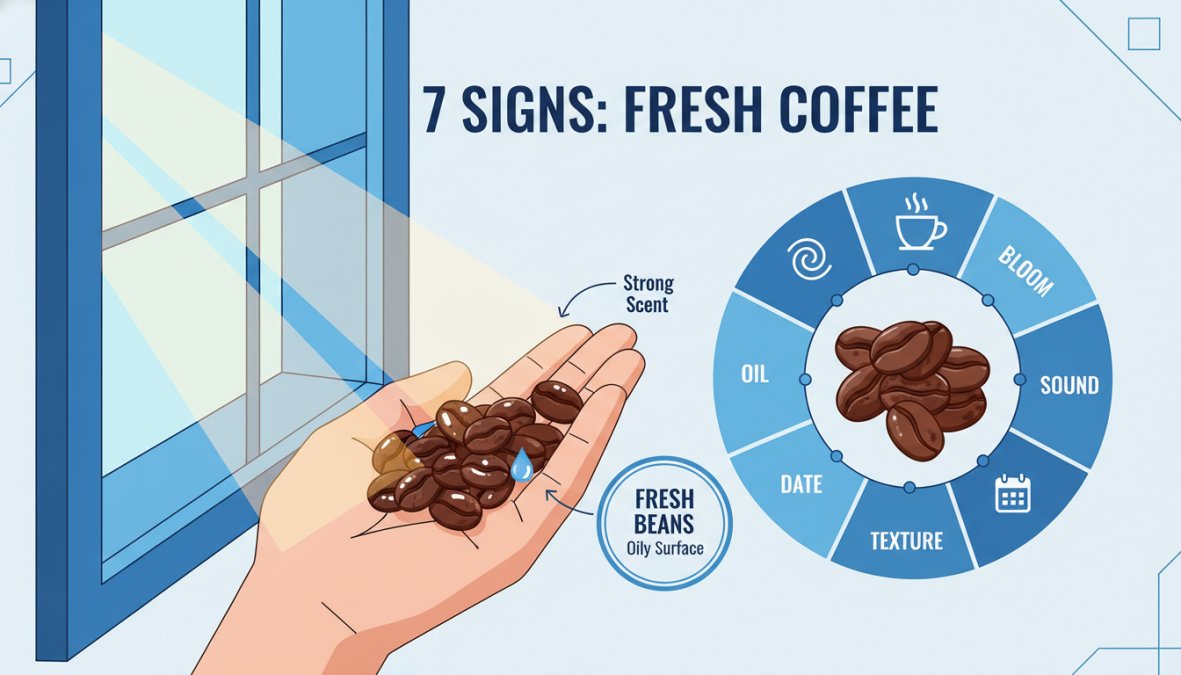
1. Check the Roast Date (Not Just the Best-Before Date)
The roast date is the most important piece of information on any bag of specialty coffee. A best-before date tells you when the manufacturer considers the product unacceptable, a very low bar. The roast date tells you when the clock actually started.
For whole bean coffee, look for a roast date within the last 2 to 4 weeks. For espresso specifically, many roasters recommend waiting at least 7 to 10 days post-roast before brewing, because freshly roasted espresso beans produce excessive crema and uneven extraction. For pourover and filter methods, 5 to 14 days post-roast is often the sweet spot.
If a bag carries no roast date at all, that's a significant red flag. Mass-market coffee frequently omits this information because the roast date would reveal that the product is months old before it even reaches the shelf. Specialty coffee roasters print the roast date prominently because it's a selling point, not something to hide.
2. Smell the Beans, Aroma Is Your Best Indicator
Fresh coffee has an aroma that hits you immediately and distinctly. Open a bag of recently roasted whole beans and the smell should be complex, present, and specific to its origin: fruity, nutty, chocolatey, floral, or spiced, depending on the single-origin or blend profile.
Stale coffee smells muted, generic, or faintly like cardboard. Sometimes it carries a faint rancid note, similar to old cooking oil. That's oxidation at work on the coffee's natural oils.
The aroma test is particularly useful for pre-ground coffee, where the surface area exposed to oxygen is dramatically higher. If ground coffee smells flat within days of opening, the beans were likely stale before grinding or stored incorrectly after.
3. Look for an Oily Shine or a Matte Finish
The surface of coffee beans tells you something useful, though this sign requires context to interpret correctly. Dark roasts naturally produce oily beans because the roasting process breaks down the bean's cell structure and forces oils to the surface. A slight oily sheen on a dark roast is normal and expected.
The problem is excessive oiliness combined with a stale smell, which indicates the oils have begun to oxidize and go rancid. On the other end, a completely matte, dusty finish on a dark roast that should be oily can indicate the beans have dried out significantly, often a sign of age.
Light and medium roasts should generally look dry with a matte finish. If a light roast looks oily, it was likely over-roasted or has been sitting long enough for residual oils to migrate to the surface under warm storage conditions.
4. Visual Identification: Fresh Grounds vs. Stale Grounds
Most guides skip this one entirely. Fresh grounds look and behave differently from stale grounds in ways you can see with your eyes before brewing.
Fresh grounds are slightly clumpy. This is the CO2 still present in the beans causing the grounds to stick together lightly. When you tap fresh grounds, they compact with some resistance. Stale grounds are powdery and loose, falling apart immediately with no cohesion.
Color is another visual marker. Fresh medium-roast grounds have a rich, warm brown tone. Stale grounds of the same roast level often appear slightly grayer or more uniform, lacking the variation in color that reflects the bean's internal structure.
| Characteristic | Fresh Grounds | Stale Grounds |
|---|---|---|
| Texture | Slightly clumpy, some cohesion | Powdery, loose, no clumping |
| Color | Rich, varied brown tones | Flat gray-brown, uniform |
| Smell | Strong, complex, origin-specific | Faint, generic, papery |
| Behavior when tamped | Compacts with resistance | Compacts too easily |
The Coffee Bloom Test: What It Tells You About Freshness
The bloom test is the most definitive freshness check available to any home brewer, and it requires nothing more than your normal brewing setup. Coffee bloom is the rapid release of CO2 that occurs when hot water first contacts freshly roasted coffee grounds.
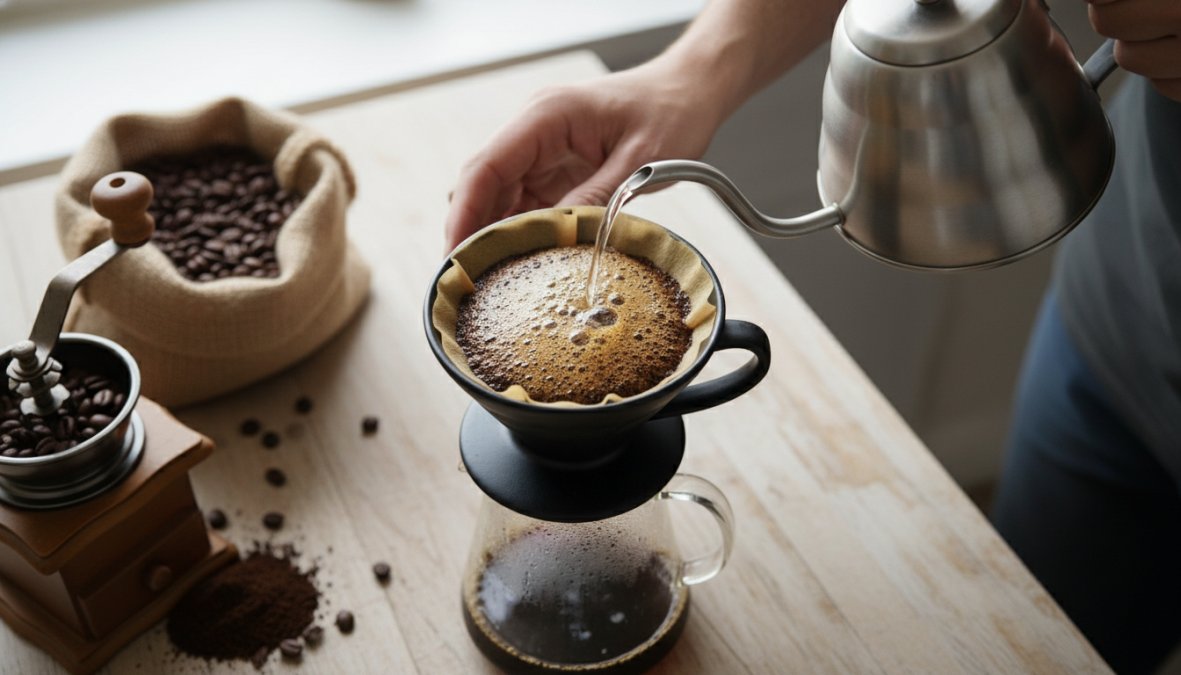
To perform the bloom test: pour a small amount of hot water (roughly twice the weight of your coffee dose) over your grounds and wait 30 to 45 seconds. Fresh coffee will visibly dome and bubble, sometimes quite aggressively. The grounds will swell and rise as CO2 escapes.
Stale coffee produces little to no bloom. The grounds may absorb the water and darken, but there will be no visible gassing, no doming, and no bubbling. This is a clear sign that the CO2 has already escaped during storage, meaning the coffee is well past its freshness window.
The bloom test works for pourover, French press, and AeroPress. For espresso, the equivalent signal is crema, the golden-brown foam that forms on a properly pulled shot. Fresh espresso beans produce thick, persistent crema. Stale beans produce thin, pale crema that dissipates within seconds.
The Science Behind Staleness: Degassing and Oxidation Explained
Understanding why coffee goes stale makes every other freshness check more intuitive. There are two distinct processes at work, degassing and oxidation, and they operate on different timelines, affect different flavor compounds, and respond differently to storage conditions. Most guides treat them as interchangeable. They are not.
What Is Degassing and Why Does It Matter?
Degassing is the gradual release of carbon dioxide from roasted coffee beans over time. During roasting, the Maillard reaction and caramelization generate large volumes of CO2 that become trapped within the bean's porous cellular structure. The moment roasting ends, that gas begins escaping, a process that continues for days to weeks depending on roast level, bean density, and ambient temperature.
The degassing curve is not linear. It is steep and aggressive in the first 24 to 72 hours post-roast, then flattens into a slower, sustained release over the following one to three weeks. Dark roasts degas faster than light roasts because the extended roasting time breaks down more of the bean's cell walls, creating larger pores and less resistance to gas escape. A dark roast may complete most of its degassing within 5 to 7 days; a dense, lightly roasted Ethiopian natural process bean may still be releasing meaningful CO2 at day 14.
This matters for two reasons that pull in opposite directions:
Too much CO2 is a problem. In the first few days post-roast, CO2 escaping from the grounds during brewing creates a physical barrier between water and coffee solids. Water channels around the gas rather than saturating the grounds evenly, producing uneven extraction, sour, thin, and underdeveloped. This is why specialty roasters recommend a rest period before brewing, typically 5 to 10 days for filter methods and 10 to 14 days for espresso.
Too little CO2 is also a problem. Once the CO2 is largely gone, the bean has lost its primary internal defense against oxygen infiltration. The same pores that released CO2 now allow oxygen in. At this point, the clock on oxidation accelerates sharply.
The bloom you see when hot water hits fresh grounds is direct visual evidence of active degassing. A vigorous bloom means CO2 is still present, which means the bean's aromatic compounds are still largely intact. No bloom means the CO2 is gone, and so is much of the flavor.
The Specific Compounds Oxidation Destroys (and When)
Oxidation is the second and ultimately more damaging process. Oxygen reacts with the aromatic compounds, oils, and acids in roasted coffee, breaking them down into simpler, less flavorful molecules. But not all flavor compounds degrade at the same rate, and understanding the sequence explains why stale coffee tastes the way it does.
Volatile aromatic compounds go first. The fruity esters, floral aldehydes, and bright organic acids responsible for the top notes in a light roast, the blueberry in a natural Ethiopian, the jasmine in a washed Yirgacheffe, are highly volatile and oxidize rapidly. These are the first casualties of improper storage. A bag that smells extraordinary at the roastery can lose these top notes within 10 to 14 days of opening if stored in a standard airtight jar.
Lipid oxidation follows. Coffee's natural oils, primarily triglycerides and diterpenes like cafestol and kahweol, oxidize more slowly but produce the most unpleasant result when they do: a rancid, stale-fat note that resembles old cooking oil. This is the flavor most people associate with supermarket coffee that has been sitting on a shelf for months. On dark roasts, where oils are already present on the bean surface, this process begins faster because the oils have greater exposure to oxygen.
Chlorogenic acids degrade last but matter most for bitterness. As these acids break down through oxidation and hydrolysis, they produce compounds that contribute to a harsh, hollow bitterness, not the pleasant, clean bitterness of a well-extracted espresso, but a flat, lingering, unpleasant aftertaste. This is why very stale coffee doesn't just taste flat; it often tastes actively bad.
Oxidation accelerates with four environmental factors: heat, light, moisture, and surface area. This is why pre-ground coffee goes stale so much faster than whole beans, grinding increases the surface area exposed to oxygen by a factor of several hundred, compressing a two-to-three-week degradation timeline into hours.
How Degassing and Oxidation Interact by Brew Method
This is the part most guides skip entirely. The practical consequences of degassing and oxidation are not the same across brewing methods, and knowing the difference changes how you assess freshness for your specific setup.
Espresso is the most sensitive method to both processes. The 9-bar extraction pressure and 25-to-30-second contact time amplify every quality in the bean, positive and negative. Beans that are too fresh (under 7 days post-roast) produce excessive, unstable crema from CO2 overload and extract unevenly. Beans that are too stale produce thin, pale crema that dissipates in seconds, flat flavor, and a harsh bitter finish. The espresso freshness window is the narrowest of any brew method: roughly 10 to 21 days post-roast for most single-origin espresso, and up to 28 days for blends with higher robusta content, which degas more slowly.
Pourover and filter methods are more forgiving on the early end (you can brew at 5 to 7 days post-roast without the extraction problems espresso faces) but still show clear degradation from oxidation after 3 to 4 weeks. The bloom test is most visible and most diagnostic with pourover, making it the best brew method for freshness assessment.
Cold brew is the most forgiving method for mildly stale beans. The long extraction window (12 to 24 hours) and cold water temperature extract flavor compounds through a different mechanism, slow diffusion rather than pressure or turbulence, and the resulting concentrate tends to mask the flatness associated with beans that are 3 to 6 weeks post-roast. The volatile top notes that oxidation destroys first are also less prominent in cold brew's flavor profile to begin with. That said, fresh beans still produce a noticeably brighter, more complex cold brew concentrate with cleaner sweetness. Starting with fresh coffee is always the better choice; cold brew simply penalizes staleness less severely than espresso does.
Coffee Shelf Life: How Long Does Coffee Actually Stay Fresh?
Coffee shelf life varies significantly based on roast level, grind state, and storage conditions. The numbers below assume reasonable storage in a sealed, opaque container away from heat and light.
| Coffee Type | Peak Freshness | Acceptable Range | Beyond This |
|---|---|---|---|
| Whole bean (light/medium roast) | 7-21 days post-roast | Up to 4 weeks | Noticeable flavor loss |
| Whole bean (dark roast) | 5-14 days post-roast | Up to 3 weeks | Oil oxidation accelerates |
| Pre-ground coffee | 15-30 min after grinding | Up to 1 week sealed | Significant degradation |
| Coffee pods (sealed) | Per manufacturer date | Sealed = extended shelf life | Varies by seal integrity |
Freshness Windows for Espresso vs. Cold Brew
Espresso and cold brew have different freshness requirements, and conflating them leads to suboptimal results.
Espresso is the most sensitive brewing method for freshness. The high pressure and short extraction time amplify both the best and worst qualities of the bean. Fresh espresso beans (7 to 21 days post-roast) produce thick crema, complex flavor, and balanced acidity. Stale beans produce thin crema, flat flavor, and a harsh, bitter finish. Espresso also benefits from a slightly longer rest period post-roast compared to filter methods, typically 10 to 14 days for optimal extraction.
Cold brew is more forgiving. The long extraction time (12 to 24 hours) and cold water temperature extract flavor compounds differently, and the resulting concentrate tends to mask some of the flatness associated with mildly stale beans. Many cold brew producers use coffee that's 3 to 6 weeks post-roast without significant quality loss. That said, fresh beans still produce a noticeably brighter, more complex cold brew concentrate. Starting with fresh coffee is always the better choice.
How to Store Coffee Beans to Maximize Freshness
Proper storage is where most home brewers lose freshness they didn't need to lose. The enemies are oxygen, light, heat, and moisture, and your storage solution needs to address all four simultaneously. Most guides give you a list of rules. This section gives you the reasoning behind each rule and a direct comparison of the storage containers that actually matter, so you can make the right call for your specific situation.
The Four Enemies of Fresh Coffee (and How Each Damages Flavor)
Before choosing a container, it helps to understand what you're defending against:
- Oxygen triggers oxidation of aromatic compounds and oils. Even brief exposure during a container opening introduces enough oxygen to measurably accelerate staling. This is the primary enemy.
- Light, particularly UV light, catalyzes oxidation reactions in coffee's lipids and aromatic compounds. Clear glass jars on a kitchen counter are one of the most common and most damaging storage choices home brewers make.
- Heat accelerates every chemical reaction involved in staling. Storing coffee near a stovetop, oven, or in a cabinet above a dishwasher can cut the effective freshness window by half.
- Moisture causes hydrolysis of coffee's acids and promotes microbial activity. It also causes ground coffee to clump and lose its grind consistency. The refrigerator introduces moisture risk through condensation every time a cold container meets warm air.
Vacuum-Sealed Containers vs. One-Way Valve Bags: A Real Comparison
This is the storage question most guides avoid answering specifically. Both formats are marketed as the best solution. They are not interchangeable, and the right choice depends on where your coffee is in its post-roast timeline.
One-way valve bags are the industry standard for freshly roasted coffee, and the reason is chemistry, not marketing. Fresh coffee off-gasses CO2 aggressively, particularly in the first 3 to 7 days post-roast. A fully airtight container would bulge, potentially fail, and trap CO2 at concentrations that can actually accelerate certain staling reactions. The one-way valve solves this by allowing CO2 to escape outward while preventing oxygen from entering inward. The valve is a pressure-differential mechanism: internal pressure from degassing keeps the valve open just enough to release gas, but atmospheric pressure keeps it closed against oxygen infiltration when the bean is not actively off-gassing.
This is why most quality roasters, including the approach Cuppari Coffee uses, ship in one-way valve bags rather than vacuum-sealed pouches. The valve is doing active work during the most critical phase of the bean's post-roast life.
Vacuum-sealed containers (the kind with a hand pump or electric pump that actively removes air) are better suited for coffee that has already completed most of its degassing, generally after day 7 to 10 post-roast. At that point, the bean is no longer producing meaningful CO2, so the valve's function is no longer needed. What matters now is minimizing residual oxygen, and a vacuum container does this more completely than a one-way valve bag, which still contains some oxygen in the headspace.
The practical implication: if you buy freshly roasted coffee and want to maximize its window, keep it in the original one-way valve bag for the first week, then transfer to a vacuum container if you won't finish it within another week. If you buy coffee that's already 10 or more days post-roast, a vacuum container is the better immediate choice.
| Storage Format | Best For | Limitation | Freshness Impact |
|---|---|---|---|
| One-way valve bag (original) | Days 1-14 post-roast | Headspace oxygen still present | Best for active degassing phase |
| Vacuum-sealed container | Days 7-28 post-roast | Not suitable for very fresh beans (CO2 breaks seal) | Best for slowing oxidation after degassing |
| Standard airtight jar (opaque) | Short-term (under 1 week) | Oxygen trapped at fill; no degassing relief | Acceptable if used quickly |
| Clear glass jar | Never recommended | Light exposure accelerates oxidation | Actively harmful |
| Refrigerator (whole beans) | Not recommended for daily use | Condensation, moisture, odor absorption | Net negative for most home brewers |
| Freezer (single-use portions, sealed) | Long-term storage only | Must be airtight; never refreeze | Effective if done correctly |
The Freezer Question: When It Helps and When It Hurts
Freezing coffee is one of the most debated topics in home brewing, and the answer is more nuanced than most guides admit.
Freezing works, but only under specific conditions. The key requirement is that the coffee must be portioned into single-use, airtight bags or containers before freezing, and each portion must be used in a single session without refreezing. When done this way, freezing effectively pauses the oxidation clock. Whole beans frozen within the first two weeks post-roast and stored in a sealed, airtight container can retain most of their flavor profile for several months.
Freezing fails, and actively damages coffee, when the same bag is repeatedly frozen and thawed. Each thaw cycle introduces condensation as the cold beans meet warm air. That moisture penetrates the bean's porous structure, accelerates hydrolysis of acids, and causes physical damage to the cell walls that affects grind consistency and extraction. The result is coffee that tastes simultaneously stale and muddy.
The practical rule: if you buy more coffee than you can drink in two weeks, portion it into weekly amounts before it arrives, freeze the portions you won't use immediately in sealed bags, and thaw each portion at room temperature, still sealed, for several hours before opening.
The Practical Storage Rules
- Store in an opaque, airtight container away from direct light at all times
- Keep at room temperature, away from the stovetop, oven, or any appliance that generates heat
- Do not refrigerate whole beans for daily use, temperature fluctuation and moisture exposure accelerate staling faster than the cool temperature helps
- Grind immediately before brewing, pre-ground coffee stored even in a sealed container loses measurable flavor within hours, not days
- Buy in quantities you'll consume within two to three weeks of the roast date
- Keep coffee in its original one-way valve bag if it was packaged that way, transferring beans to a standard jar exposes them to a burst of oxygen during transfer and removes the degassing mechanism the bag was designed to provide
Common Mistakes That Make Your Coffee Go Stale Faster
A common mistake is buying more coffee than you can drink in two weeks. It feels economical. It isn't. The flavor loss from stale coffee is a worse outcome than paying slightly more for smaller, fresher quantities.
Other frequent errors:
- Storing on the counter in a clear glass jar. Light accelerates oxidation. A beautiful display jar is a freshness-destroying choice.
- Freezing and thawing repeatedly. Freezing whole beans in a single-use portion can work if done correctly. Repeatedly freezing and thawing the same bag introduces moisture and causes cell structure damage.
- Grinding coffee in advance. Pre-grinding and storing grounds, even in a sealed container, dramatically shortens the freshness window. Grind to order.
- Ignoring the roast date when buying online. Many online retailers sell coffee with roast dates weeks or months in the past. Always check before purchasing.
What most guides miss is the compounding effect of multiple small mistakes. A bag roasted three weeks ago, stored in a clear jar near the stove, and ground two days in advance will taste dramatically worse than its roast date alone would suggest.
How to Tell If Coffee Is Fresh When Buying Online or In-Store
The challenge of buying coffee is that you often can't smell or bloom-test it before purchase. This makes the roast date your primary tool, and it's worth being deliberate about.
For in-store purchases: look for the roast date on the bag, not just the best-before date. If no roast date is printed, that's a signal to move on. Specialty coffee shops and roasters almost universally print roast dates. Supermarket coffee frequently does not.
For online purchases: filter your search toward roasters who roast to order. This model guarantees the coffee ships within days of roasting rather than sitting in a warehouse. According to the National Coffee Association's consumer research on freshness preferences, freshness is consistently ranked among the top three purchasing factors by specialty coffee consumers, yet most retail coffee is roasted weeks before it reaches the buyer.
Cuppari Coffee addresses this directly: every order is roasted only after it's placed and shipped the same day, eliminating the warehouse lag that makes most online coffee purchases a freshness gamble. For anyone serious about getting genuinely fresh beans delivered, this roast-to-order model is the most reliable approach available.
A practical freshness checklist for buying coffee:
- Roast date is visible and within the last 14 days
- Bag has a one-way valve
- Roaster uses a roast-to-order or small-batch model
- No best-before date as the only freshness indicator
- Single-origin or named blend (indicates traceability and quality focus)
- Opaque packaging (protects from light during shipping)
For cupping and tasting purposes, the Specialty Coffee Association's cupping protocols also recommend evaluating coffee within a specific post-roast window, reinforcing that freshness is a professional standard, not just a consumer preference.
Stale coffee is one of the most common and most avoidable quality problems in home brewing. The seven signs covered here, from roast date to bloom behavior to visual ground texture, give you a complete diagnostic toolkit. Cuppari Coffee was built around the conviction that genuinely fresh coffee changes the experience entirely, which is why every order is roasted and shipped the same day, with one-way valve packaging to protect freshness in transit. If you want coffee that passes every test on this list before you even open the bag, add to cart and taste the difference a real roast date makes.
Frequently Asked Questions
How can you tell if coffee beans have gone bad?
You can tell if coffee beans have gone bad by checking several things: the roast date (beans older than 4-6 weeks past roast are likely stale), the smell (stale beans smell flat, musty, or like cardboard instead of rich and aromatic), the surface (very oily and wet-looking beans may be over-aged), and the bloom test (pour hot water over grounds, little to no bubbling means the carbon dioxide has escaped and the coffee is no longer fresh).
What is the bloom test for coffee freshness?
The coffee bloom test involves pouring a small amount of hot water over your grounds and watching for a reaction. Fresh coffee releases carbon dioxide gas trapped during the roasting process, causing the grounds to bubble and swell, this is the bloom. A vigorous bloom indicates your beans are fresh and full of CO2. Weak or no bloom is a clear sign the coffee is stale and has already off-gassed, which typically results in a flat, underwhelming flavor in the cup.
How long does coffee stay fresh after roasting?
Whole bean coffee is generally at its best between 4 and 21 days after the roast date, once initial degassing has settled. After about 4-6 weeks, flavor degradation becomes noticeable. Pre-ground coffee has a much shorter freshness window, often just 15-30 minutes after grinding before oxidation begins to dull the flavor. Proper storage in an airtight container away from light, heat, and moisture can extend shelf life, but nothing replaces a fresh roast date.
How should you store coffee beans to keep them fresh?
Store coffee beans in an airtight container with a one-way valve, which allows CO2 to escape without letting oxygen in. Keep the container in a cool, dark place, a pantry or cabinet works well. Avoid the refrigerator or freezer for daily-use coffee, as repeated temperature changes introduce moisture. Never store beans near a stove, window, or in clear containers. For best results, buy whole bean coffee in small batches and grind only what you need right before brewing.
Can you drink coffee that is past its expiration date?
Yes, coffee past its best-before date is generally safe to drink, it won't make you sick. However, the flavor profile will be noticeably dull. You'll likely lose the brightness, acidity, sweetness, and clarity that make specialty coffee enjoyable. The aroma fades, the body becomes flat, and any single-origin notes disappear. The best-before date is a quality indicator, not a safety deadline. That said, if coffee smells musty or rancid rather than just flat, it's better to discard it.
Does coffee smell different when it is stale?
Yes, stale coffee smells noticeably different from fresh coffee. Fresh beans or grounds have a rich, complex aroma with distinct notes depending on the roast and origin. Stale coffee loses this vibrancy and begins to smell flat, papery, or even slightly musty. In some cases, older pre-ground coffee can take on a faint cardboard-like scent. If you open your bag and don't immediately notice a strong, pleasant aroma, that's a reliable sign your coffee is past its freshness window.
This article was written using GrandRanker