

Table of Contents
- The Science Behind Temperature and Extraction
- Why Temperature Matters More Than You Think
- Effect of Water Temperature on Coffee Extraction
- Coffee Brewing Temperature Chart for Different Methods
- How to Measure Water Temperature for Coffee
- Water Quality and Mineralization: An Often-Overlooked Factor
- Common Temperature Mistakes and Troubleshooting
- Sustainability and Reusable Filters: Temperature Considerations
- Achieving Barista-Quality Results at Home with Proper Temperature
- Frequently Asked Questions
Ideal Water Temperature for Brewing Coffee at Home
Last Updated: June 30, 2026
When it comes to brewing exceptional coffee at home, water temperature is one of the most critical variables you control. The difference between 195°F and 205°F can mean the gap between a sour, under-extracted cup and one that tastes bitter and over-stewed. This guide walks you through exactly what temperature works best for your brewing method, why it matters, and how to measure it consistently.
The Science Behind Temperature and Extraction
Water temperature controls how quickly coffee compounds dissolve. Higher temperatures extract faster and more completely; lower temperatures extract slowly, leaving desirable flavors behind.
The ideal range for most brewing methods falls between 195°F and 205°F. This temperature range dissolves the compounds that create sweetness, acidity, and complexity while leaving behind the bitter compounds that over-extraction produces. Below 195°F, you miss out on flavor. Above 205°F, you're pulling out harsh, astringent notes.
Temperature also affects how water moves through the coffee bed. Hotter water flows faster; cooler water moves slower, increasing contact time. This interaction determines your final extraction level, the percentage of coffee solids that end up in your cup.
Why Temperature Matters More Than You Think
Temperature is the PRIMARY lever that controls extraction, and extraction determines whether your coffee tastes good or tastes like regret. Consider what happens when you ignore temperature: you buy fresh beans, grind them with a burr grinder, measure your coffee-to-water ratio precisely, then use water that's cooled to 180°F. All that care gets undermined by one overlooked detail.
Temperature works like a master control that speeds up or slows down the entire extraction process uniformly. The effect becomes obvious when you taste it. A cup brewed at 190°F tastes thin and sharp; the same beans at 205°F taste flat and dull. At 200°F, you get both brightness and body.
Effect of Water Temperature on Coffee Extraction
Temperature directly influences which compounds dissolve and when. Coffee contains hundreds of flavor compounds that dissolve at different rates. The first compounds to dissolve are the acids and sugars, the bright, sweet flavors you want. Next come the oils and complex flavors. Finally come the bitter tannins and burnt compounds you don't want.
The window where you have the good stuff without the bad stuff is narrow, typically representing about 18-22% extraction. Most specialty coffee professionals target 19-20%. Temperature controls how fast you move through this window. Higher temperatures move you through it faster; lower temperatures move you through it slower.
Underextraction vs. Overextraction
Underextraction happens when water is too cool or contact time is too short. The coffee tastes sour, thin, and sharp. You get brightness without body; the acidity feels harsh rather than pleasant.
Overextraction happens when water is too hot or contact time is too long. The coffee tastes bitter, dry, and flat. Body is heavy but flavor is muted. The finish is unpleasant.
If your coffee tastes sour, increase water temperature by 2-3 degrees. If it tastes bitter, decrease temperature by 2-3 degrees. Make one change at a time and brew the same beans three times before deciding if the adjustment worked.
How Temperature Influences Tasting Notes and Bitterness
Tasting notes, the flavors you see on specialty coffee bags like "chocolate," "berry," or "caramel", emerge at specific extraction levels. A single-origin Ethiopian coffee might taste bright and floral at 198°F but earthy and muted at 208°F. The beans haven't changed; the extraction level has. A small amount of bitterness adds complexity and depth, but too much makes coffee undrinkable. The difference is usually 3-5 degrees of water temperature.
Coffee Brewing Temperature Chart for Different Methods
| Brewing Method | Ideal Temperature | Brew Time | Key Consideration |
|---|---|---|---|
| Pour-Over (V60, Chemex, Kalita Wave) | 195-205°F | 3-4 minutes | Temperature drops during brew; start hot |
| French Press | 200-205°F | 4 minutes | Immersion method; hotter water needed |
| AeroPress | 175-205°F | 1-3 minutes | Versatile; cooler temps for lighter roasts |
| Espresso | 195-205°F | 25-30 seconds | Pressure compensates; precise temp critical |
| Turkish Coffee | 195-205°F | 2-3 minutes | Heat gradually; watch for foam |
| Moka Pot | 195-205°F | 5-10 minutes | Steam-driven; monitor closely |
Pour-Over Brewing (Hario V60, Chemex, Kalita Wave)
Pour-over methods work best with water between 195°F and 205°F, with 200°F as the sweet spot. Start your water at 202°F. By the time you finish pouring and the last water drains through the coffee bed, the temperature has dropped several degrees. This cooling actually helps you, you get initial fast extraction from hot water, then slower extraction as it cools, which helps develop balanced flavor.
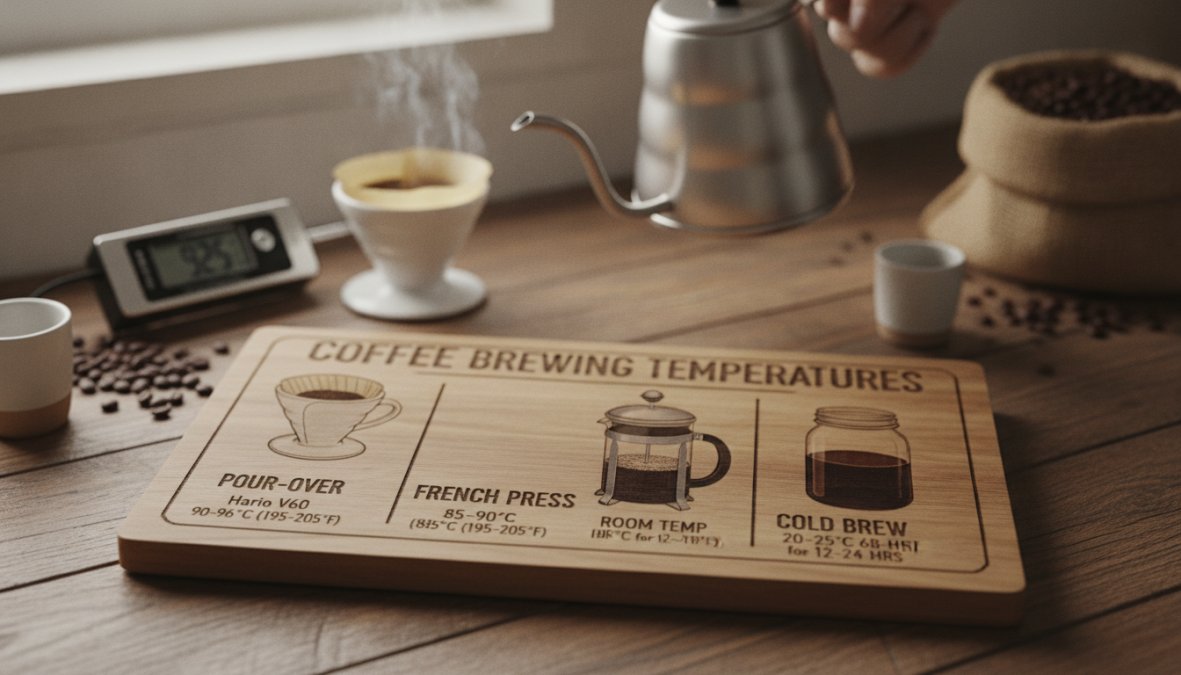
Chemex brewing requires slightly hotter water because its thick paper filters slow water flow, reducing contact time. Use 203-205°F for Chemex to ensure full extraction before the brew finishes.
French Press and Immersion Brewing
French press and other immersion methods work best with water between 200°F and 205°F. Use 202°F as your target. Immersion methods keep the coffee in contact with water the entire time, so you control extraction primarily through steep time. Hotter water means you need to reduce steep time; cooler water means you need to increase it.
A French press with 200°F water and a 4-minute steep hits the right extraction zone for most coffees. If you use 205°F water, reduce steep time to 3.5 minutes. If you use 195°F water, increase to 4.5 minutes.
How to Measure Water Temperature for Coffee
Using a Digital Thermometer
A basic digital instant-read thermometer costs $10-20 and gives you accuracy within 1-2 degrees. Insert the thermometer into your water after heating but before brewing. Wait 10 seconds for the reading to stabilize. This is ideal if you're serious about dialing in your coffee.
Gooseneck Kettle with Built-In Temperature Control
A gooseneck kettle with a built-in thermometer and temperature control costs $40-100 but eliminates guesswork entirely. You set the desired temperature, the kettle heats to that temperature, and maintains it until you pour. This ensures consistency across every brew.
Low-Tech Methods: The Wait-and-Feel Approach
Boil water, then wait 30 seconds before pouring. This gets you close to 200°F for most kettles and stoves. For more precision, use the hand test: hold your hand 6 inches above the water surface. If you can hold it there comfortably for 10 seconds, the water is roughly 200°F. This method isn't precise but is surprisingly consistent once you practice it.
Water Quality and Mineralization: An Often-Overlooked Factor
Water quality affects extraction as much as temperature does. The mineral content in your water, calcium, magnesium, and other dissolved solids, changes how extraction happens. Soft water (low mineral content) extracts quickly and can taste thin. Hard water (high mineral content) extracts slowly and can taste flat. The ideal water for coffee has moderate mineral content: around 150 parts per million (ppm) of total dissolved solids.
Minerals affect how quickly water heats and cools. Hard water with high mineral content heats more slowly than soft water. This means if you're using hard tap water, you might need to heat it 2-3 degrees hotter to reach your target brewing temperature.
For brewing coffee, filtered water is usually better than tap water because it removes chlorine and other off-flavors. Distilled water is too soft and extracts too quickly. The best approach is filtered water that retains some mineral content.
Common Temperature Mistakes and Troubleshooting
What Happens if Your Water Is Too Hot
Water above 205°F over-extracts quickly. Your coffee tastes bitter, dry, and flat. The body is heavy but the flavor is muted. Over-extraction happens fastest with fine grinds and longer brew times.
The fix is simple: reduce water temperature by 2-3 degrees. If that doesn't work, reduce brew time by 30 seconds. Make one change at a time so you can identify which variable was the problem.
What Happens if Your Water Is Too Cool
Water below 195°F under-extracts. Your coffee tastes sour, thin, and sharp. You get brightness without body; the acidity feels harsh rather than pleasant. Under-extraction is common with pour-overs because water cools as it flows through the grounds.
The fix is to increase water temperature by 2-3 degrees. If your water is already at 205°F and you're still getting sour coffee, your brew time is too long. Speed up your pour or use a coarser grind to reduce contact time.
Maintaining Thermal Stability During the Brew
Temperature drop during brewing is inevitable, but you can minimize it. Use a gooseneck kettle, which lets you pour water slowly and steadily, maintaining contact with hot water throughout the brew. For immersion methods like French press, preheat your vessel with hot water before adding grounds. This reduces heat loss to the equipment itself.
Sustainability and Reusable Filters: Temperature Considerations
Reusable filters affect how water flows through coffee and how heat is retained. Metal mesh filters allow more oils to pass through than paper filters and allow water to flow faster, reducing contact time. You might need slightly hotter water when using metal mesh, about 1-2 degrees hotter than you'd use with paper.
Paper filters slow water flow, increasing contact time. Because paper slows flow, you can use slightly cooler water, about 1-2 degrees cooler than metal mesh. Reusable cloth filters sit between metal and paper in terms of flow rate and heat retention.
Achieving Barista-Quality Results at Home with Proper Temperature
Barista-quality coffee at home requires three things working together: the right temperature, the right grind consistency, and the right coffee-to-water ratio. Temperature is the foundation.
Pairing Temperature with Grind Consistency and Coffee-to-Water Ratio
Temperature, grind size, and coffee-to-water ratio all affect extraction and interact with each other. If you're using a fine grind (which extracts quickly), you need cooler water to avoid over-extraction. If you're using a coarse grind (which extracts slowly), you need hotter water to reach proper extraction.
The standard starting point is 1:16 coffee-to-water ratio (1 gram coffee to 16 grams water), medium grind, and 200°F water. This works for most brewing methods. From here, adjust one variable at a time based on how your coffee tastes.
The Bloom Phase and Temperature Control
The bloom phase, the first 30-45 seconds of brewing when you wet the grounds without pouring all your water, is crucial for even extraction. Hotter water (205°F) creates a more vigorous bloom, helping grounds expand and open up for better water penetration. Cooler water (195°F) creates a gentler bloom.
For most coffees, a 30-second bloom is ideal. Pour just enough water to wet all the grounds, about 2-3 times the weight of the coffee. Let it sit for 30 seconds, then continue pouring.
Getting the ideal water temperature for brewing coffee at home is the single most important step toward better coffee. The difference between a great cup and a mediocre one often comes down to whether you started with water at 200°F or 190°F. Start with 200°F as your baseline, taste your results, and adjust by 1-2 degrees based on whether your coffee tastes sour or bitter. Within three brews, you'll find your sweet spot.
Frequently Asked Questions
What is the ideal water temperature for brewing coffee at home?
The ideal water temperature for brewing coffee at home is between 195-205°F (90-96°C) for most brewing methods. This range optimizes extraction without scorching the coffee grounds. Lighter roasts benefit from slightly higher temperatures (200-205°F), while darker roasts perform better at lower temperatures (195-200°F). Freshly roasted coffee from sources like Cuppari Coffee brews best when temperature is precisely controlled, as fresher beans release flavors more efficiently.
What happens if coffee water is too hot or too cold?
Water that's too hot (above 205°F) causes overextraction, resulting in bitter, burnt-tasting coffee with harsh notes. Water that's too cold (below 195°F) leads to underextraction, producing sour, weak, and thin coffee with muted tasting notes. The coffee bed requires proper heat to dissolve soluble compounds effectively. Using a digital scale and gooseneck kettle helps maintain consistent temperature, ensuring neither extreme occurs and your brew achieves balanced flavor.
How does water temperature affect coffee extraction and bitterness?
Water temperature directly controls the rate of extraction, how quickly hot water dissolves flavor compounds from the coffee grounds. Higher temperatures speed up extraction, while lower temperatures slow it down. Overextraction at excessive temperatures extracts too many bitter compounds, while underextraction at low temperatures leaves desirable flavors behind. The effect of water temperature on coffee extraction is why precision matters: hitting 195-205°F ensures you pull the right balance of acids, sugars, and oils for a smooth, flavorful cup.
How do I measure water temperature for coffee without a thermometer?
While a digital thermometer is most accurate, you can estimate temperature by waiting after boiling: let water cool for 30 seconds for 195°F, 45 seconds for 190°F, or 60 seconds for 185°F. A gooseneck kettle with built-in temperature display removes guesswork. For manual brewing methods like pour-over, investing in a simple digital thermometer ensures consistency. Precise measurement pairs with grind consistency and coffee-to-water ratio to achieve barista-quality results at home.
This article was written using GrandRanker