

Table of Contents
- Is a Burr Grinder Worth It for Home Brewing? The Direct Answer
- Burr vs. Blade Grinders: The Core Differences
- Burr vs. Blade Grinder Taste Test: What the Evidence Shows
- Benefits of Consistent Grind Size for Extraction
- Best Burr Grinder for Beginners: Budget-Friendly Options
- Maintenance and Long-Term Cost of Ownership
- Conical vs. Flat Burrs: Which Delivers Better Results?
- Heat Friction and Aroma Preservation in Grinding
Last Updated: June 20, 2026
Asking whether a burr grinder is worth it for home brewing is one of the most common questions serious coffee drinkers face. The short answer: yes. For most home brewers, the difference is immediate and noticeable. Grinding quality is the single variable that separates a mediocre cup from an exceptional one.
Quick Picks:
- Best Overall: Baratza Encore ESP - ideal for espresso and filter versatility
- Best for Filter Coffee: fellow Ode Brew Grinder Gen 2 - exceptional grind consistency for pour-over
- Best Budget Manual: Timemore Chestnut C3 - outstanding value at entry-level price
Is a Burr Grinder Worth It for Home Brewing? The Direct Answer
A burr grinder is worth it because it produces uniform particle size distribution, which directly controls how evenly water extracts flavor compounds from coffee grounds. Blade grinders chop beans randomly, creating a chaotic mix of fine dust and coarse chunks that brew unevenly. The result is a cup that tastes simultaneously bitter and sour.
Uniform grind size means predictable, repeatable extraction. Every brew tastes the way you intended. Pre-ground coffee loses volatile aromatic compounds within minutes of grinding, compromising flavor regardless of bean quality. For daily home brewers, a burr grinder delivers the most return on investment.
Burr vs. Blade Grinders: The Core Differences
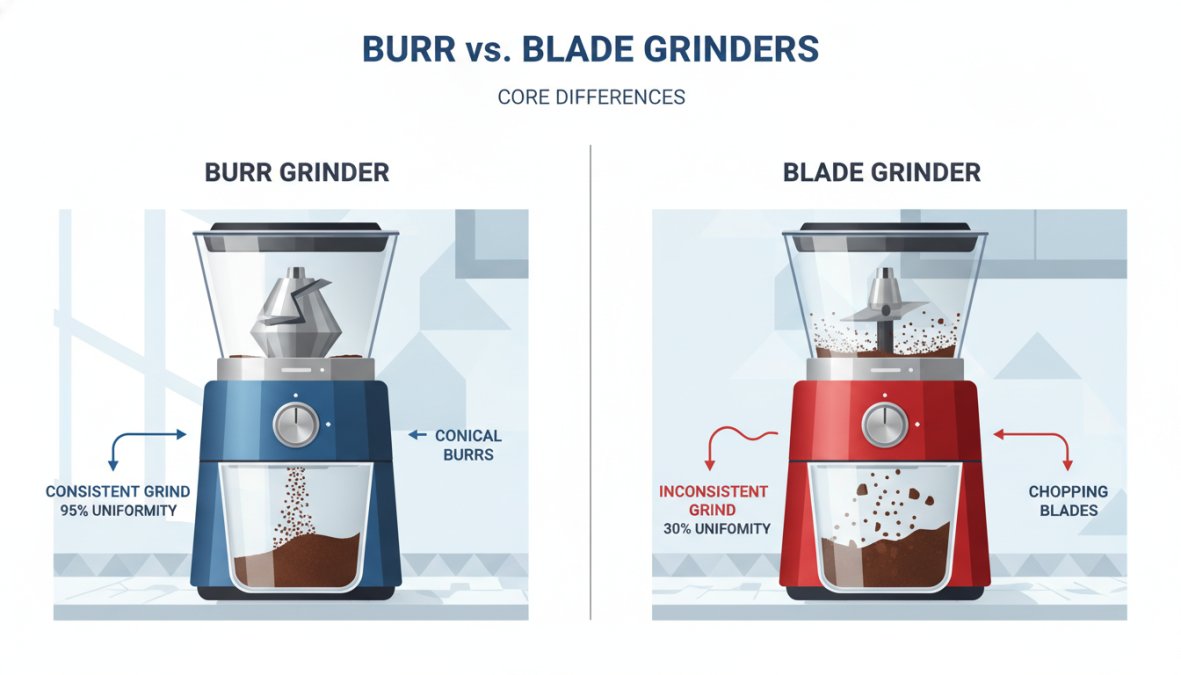
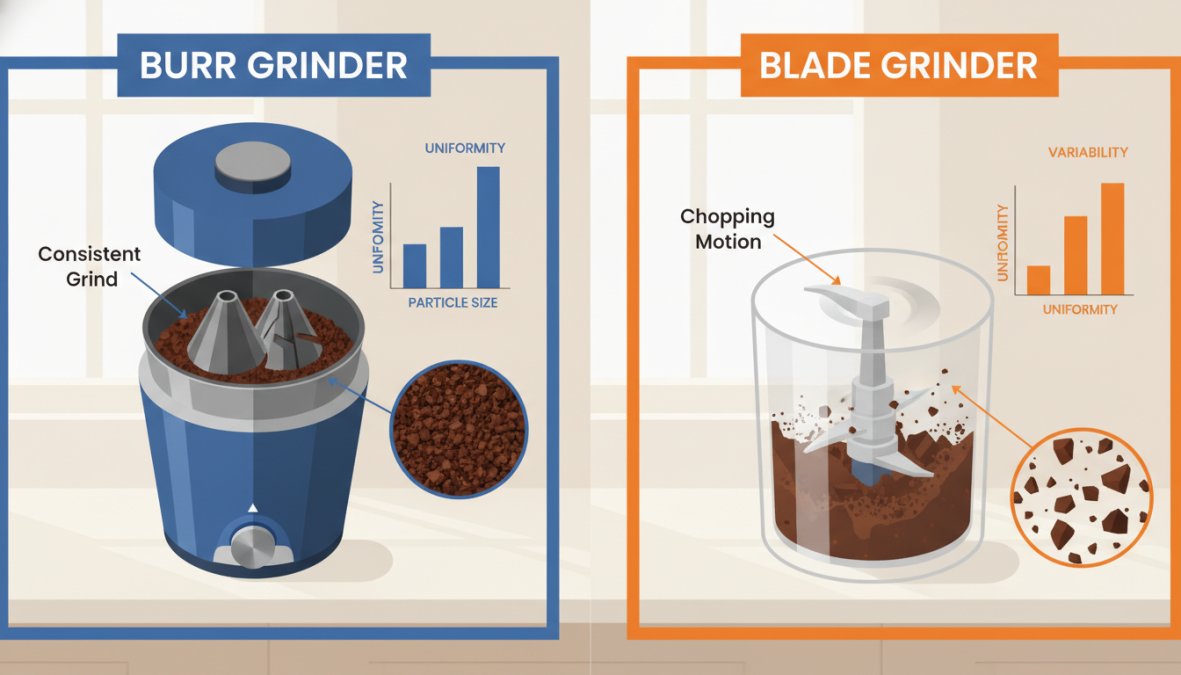
A burr grinder uses two abrasive surfaces, either conical or flat, that crush beans between them at a controlled distance. A blade grinder uses a spinning metal blade that chops beans randomly, like a food processor.
The core difference is control. Burr grinders let you set the distance between grinding surfaces, determining particle size. Blade grinders offer no such control: grind time is the only variable, and it's a poor proxy for consistency.
How Burr Grinders Achieve Uniform Particle Size
Burr grinders force coffee beans through a fixed gap between two burr surfaces. The gap width determines the grind setting: narrow for espresso, wider for French press. Because every bean passes through the same gap, resulting grounds cluster tightly around a target particle size.
This tight distribution makes extraction predictable. Water flows through uniform particles at a consistent rate, contacting each particle for roughly the same duration, producing balanced extraction. Stepped grinders offer discrete settings (typically 40-60 positions), making them easy to use and repeat. For most home brewers, this covers every brewing method comfortably.
Why Blade Grinders Struggle with Consistency
Blade grinders produce unpredictable particle size distribution because the blade strikes beans at random angles. Some become fine powder; others remain as large chunks. A single batch might contain particles ranging from espresso-fine dust to near-whole beans.
This inconsistency makes dialing in any brewing method nearly impossible. Additionally, blade grinders spin at high RPM, generating significant heat through friction that accelerates the loss of aromatic compounds.
Burr vs. Blade Grinder Taste Test: What the Evidence Shows
Blind taste comparisons consistently show that cups brewed from burr-ground coffee score higher on flavor clarity, sweetness, and overall balance. Blade-ground coffee tends toward a muddled, harsh flavor profile: fines over-extract and contribute bitterness, while coarse chunks under-extract and contribute sourness.
According to the Specialty Coffee Association's brewing research, extraction yield is the primary driver of perceived coffee quality. Burr grinders make it far easier to hit the target extraction range consistently, typically between 18 and 22 percent of the coffee's soluble mass.
The benefits become most apparent with high-quality single-origin coffee. Distinctive flavor notes, fruity acidity, chocolate depth, floral aromatics, only emerge when extraction is even. A blade grinder masks these characteristics behind bitterness and imbalance.
Benefits of Consistent Grind Size for Extraction
Consistent grind size is the foundation of controlled extraction. When all particles are the same size, water extracts from each one at the same rate, producing a balanced cup.
How Particle Size Distribution Affects Brewing
A narrow particle size distribution, where most particles cluster tightly around the target size, is what burr grinders produce. This produces predictable flow rates in pour-over, consistent steeping in French press, and stable pressure profiling in espresso. Wide distributions cause channeling in espresso, uneven steeping in French press, and erratic flow in pour-over.
Grind retention also matters. Coffee grounds left inside the grinder from a previous session have already begun losing aroma. When those retained grounds mix with fresh grounds, they dilute the flavor profile.
Grind Consistency Across Pour-Over, Espresso, and French Press
Different brewing methods require different grind sizes:
- Pour-over: Medium-fine grind. Particle uniformity controls flow rate and contact time.
- Espresso: Fine grind with very tight distribution. Even small variations cause significant pressure changes and extraction imbalance.
- French press: Coarse grind. Uniformity prevents fine particles from slipping through the mesh filter.
A quality burr grinder handles all three methods by simply changing the grind setting. A blade grinder cannot reliably hit any of these targets.
Best Burr Grinder for Beginners: Budget-Friendly Options
The best burr grinder for beginners covers your primary brewing method, offers enough grind settings to dial in your recipe, and costs proportionally to how often you brew.
Entry-Level Electric Burr Grinders
Baratza Encore ESP - $199.95
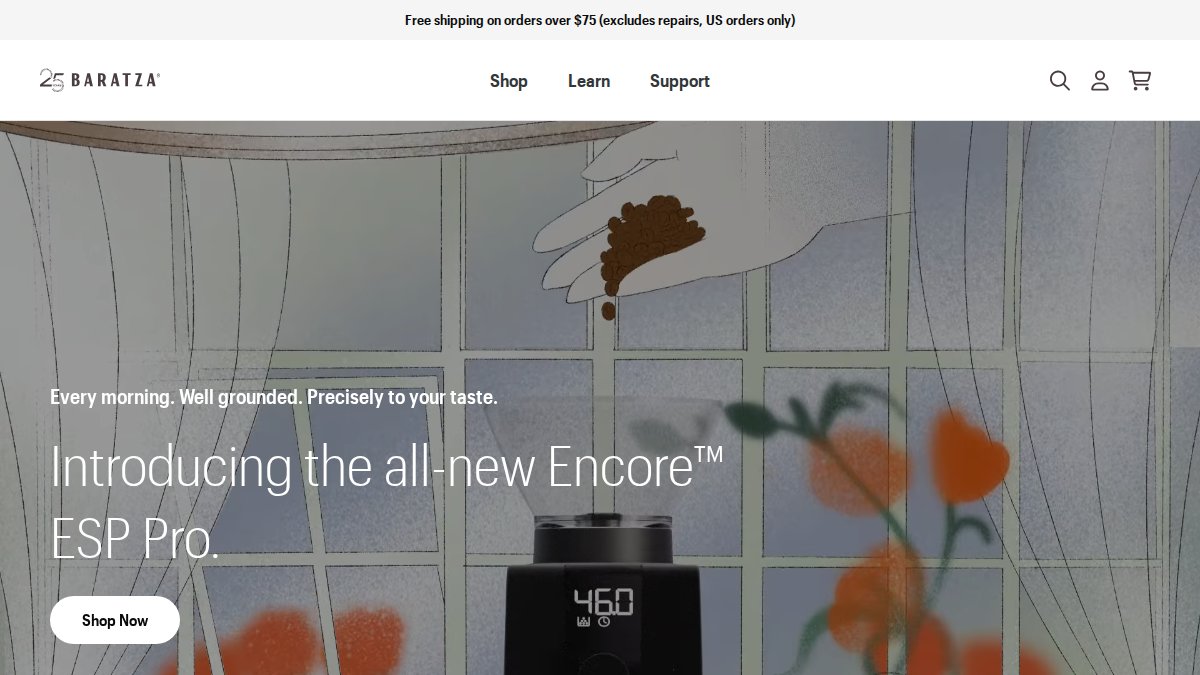
The Baratza Encore ESP is the most versatile entry-level electric burr grinder. It uses an M2 conical burr set with 40 micro-adjustment settings, including a dedicated espresso range, and ships with adapters for direct portafilter grinding. This is the grinder to buy if you want one machine that handles both espresso and filter coffee.
What most reviews miss is its repairability. Baratza sells individual replacement parts directly to consumers, meaning a grinder under $200 can last a decade with basic maintenance.
Pros: Exceptional versatility, repairable, wide parts availability Cons: Audible during operation, plastic exterior
Breville Smart Grinder Pro - $199.95
The Breville Smart Grinder Pro prioritizes convenience. Sixty grind settings, Dosing IQ technology for precise adjustments, and a large LCD display make this the most user-friendly entry-level option. If you want to set a dose, press a button, and walk away, this is the machine for that workflow.

Pros: Highly programmable, intuitive interface, covers all brew methods Cons: Higher retention, primarily plastic build
| Grinder | Price | Burr Type | Settings | Best For |
|---|---|---|---|---|
| Baratza Encore ESP | $199.95 | Conical (M2) | 40 | Espresso + filter versatility |
| Breville Smart Grinder Pro | $199.95 | Conical | 60 | Automated dosing convenience |
| Timemore Chestnut C3 | $79.00 | Conical (S2C) | Stepless | Budget, travel, manual brewing |
| fellow Ode Gen 2 | $345.00 | Flat (64mm) | 31 | Filter and pour-over clarity |
Manual Burr Grinders: Affordable and Portable
Timemore Chestnut C3 - $79.00
The Timemore Chestnut C3 is the most compelling argument for manual grinding at entry level. Its patented S2C stainless steel conical burrs produce grind quality that competes with electric grinders costing two to three times more. The all-metal aluminum alloy body eliminates wobble that plagues cheaper manual grinders.
Manual grinding takes effort and time, roughly 60-90 seconds for 20 grams. For a single cup each morning, that's manageable. For multiple cups, it becomes tedious.
Pros: Outstanding grind quality for the price, durable all-metal construction, portable Cons: Physical effort required, small 25g capacity
Maintenance and Long-Term Cost of Ownership
Maintenance is where the real cost of ownership hides. A burr grinder requires periodic cleaning to perform at its best. Coffee oils accumulate on burr surfaces and inside the grinding chamber, turning rancid over time and contaminating fresh coffee.
Durability and Longevity of Burr Grinders
The durability of a burr grinder depends primarily on burr quality and motor strength. Conical burrs, particularly steel burrs like those in the Baratza Encore ESP and Timemore Chestnut C3, maintain sharpness through years of regular use. Flat burrs also hold up well but may require replacement after several years of heavy use.
According to Baratza's official parts and repair documentation, many of their grinder models have been in continuous service for over a decade with basic part replacements. The key variable is motor quality. Cheaper motors may wear out after three to five years of daily use.
The long-term cost calculation favors quality burr grinders over repeated blade grinder replacements.
Cleaning Cycles and Retention: Hidden Costs
A cleaning cycle for most home burr grinders involves removing the hopper, brushing out the grinding chamber, and occasionally running a grinder cleaning tablet through the burr set. This takes about five minutes and should happen every two to four weeks for daily users.
Grind retention refers to coffee grounds that remain inside the grinder after grinding. High-retention grinders waste coffee and mix stale grounds from previous sessions into fresh batches. The fellow Ode Gen 2 addresses this with its single-dose hopper design and grinds knocker, which physically dislodges retained grounds after each use.
Conical vs. Flat Burrs: Which Delivers Better Results?
Conical burrs use a cone-shaped inner burr rotating inside a ring-shaped outer burr. Flat burrs use two parallel disc-shaped burrs facing each other.
Conical burrs tend to produce a slightly bimodal particle size distribution, often described as adding body and texture to the cup, particularly noticeable in espresso. They also generate less heat friction because they typically operate at lower RPM.
Flat burrs, like the 64mm professional-grade set in the fellow Ode Gen 2, produce a more uniform distribution. This translates to exceptional flavor clarity in filter coffee and pour-over, where individual flavor notes are easier to distinguish.
For home brewing, both burr types produce dramatically better results than blade grinders. The choice between them matters most at the higher end of the market, where you're optimizing for specific flavor characteristics. According to the Specialty Coffee Association's grinder performance guidelines, both burr geometries can achieve excellent extraction when properly calibrated.
Heat Friction and Aroma Preservation in Grinding
Heat generated during grinding is a genuine threat to coffee aroma. When a motor spins burrs at high RPM, friction between the burr surfaces and coffee beans generates heat that accelerates the evaporation of volatile aromatic compounds.
Grinding speed matters. Slower grinding generates less heat. This is one reason high-end commercial grinders use large, slow-spinning burrs. The fellow Ode Gen 2's 64mm flat burrs operate at lower RPM than smaller-burred competitors, helping preserve aroma.
For home brewers, the practical solution is simple: grind only what you need immediately before brewing. Grinding in advance and storing grounds causes more aroma loss than the heat generated during grinding itself. Fresh grinding, even with a modest burr grinder, outperforms pre-ground coffee stored for days.
Manual grinders like the Timemore Chestnut C3 sidestep the heat problem almost entirely. The slow, hand-powered grinding speed generates negligible friction heat. For coffee enthusiasts who prioritize aroma preservation, a quality manual grinder is a legitimate choice.
Upgrading one variable at a time makes it hard to know what's actually improving the cup. Grinder quality is the highest-use upgrade available, but it only delivers its full benefit when paired with freshly roasted coffee. Start with fresh beans and proper grinding to taste the real difference.
Frequently Asked Questions
What is the main difference between a burr grinder and a blade grinder?
Burr grinders use two rotating burrs to crush coffee beans to uniform particle size, while blade grinders use spinning blades that chop beans inconsistently. Burr grinders produce consistent grind size for better extraction yield, whereas blade grinders create uneven grounds that lead to over- and under-extraction in your brewing method.
Does a burr grinder really make coffee taste better?
Yes, burr grinders improve flavor profile by producing uniform particle size distribution. Consistent grind size ensures even extraction during brewing, reducing bitter over-extracted particles and sour under-extracted grounds. This is especially noticeable in pour-over and espresso brewing, where extraction yield directly impacts taste quality.
What are the benefits of consistent grind size for home brewing?
Consistent grind size ensures predictable extraction, which means better flavor clarity and aroma preservation. With uniform particle size distribution, water contacts coffee grounds evenly, preventing channeling in pour-overs and improving crema stability in espresso. This consistency allows you to dial in your brewing parameters precisely and replicate great coffee every time.
How long do burr grinders last, and is the investment worth it?
Quality burr grinders typically last 5-10+ years with proper maintenance and cleaning cycles. While entry-level models cost $80-$200 and premium options reach $345+, the investment pays dividends through superior grind consistency and durability. Manual burr grinders offer exceptional value, lasting decades with minimal maintenance, making them excellent for budget-conscious coffee enthusiasts.
Do I need a burr grinder for French press or just for espresso?
While espresso benefits most from burr grinder precision, French press also gains from consistent grind size. Burr grinders help achieve the coarse, uniform particle size French press requires, preventing sediment and improving flavor extraction. Even for pour-over and drip coffee, burr grinders deliver noticeably better results than blade grinders across all brewing methods.
This article was written using GrandRanker