

Table of Contents
- The Real Question: Is Specialty Tea Worth the Extra Cost?
- The Specialty Tea Value Proposition: What You're Actually Paying For
- Loose Leaf Tea vs Tea Bags: The Brewing Efficiency Factor
- How to Identify High Quality Tea: A Practical Checklist
- Health Benefits of White Tea vs Green Tea (and Other Varieties)
- Storage and Shelf-Life Economics: Protecting Your Investment
- Verdict: Who Should Buy Specialty Tea and Who Should Skip It
- Frequently Asked Questions
Last Updated: October 3, 2026
The Real Question: Is Specialty Tea Worth the Extra Cost?
Here is the part most guides skip: the price on the tin is not the real cost. The real cost is cost per cup, and that number changes everything once you factor in re-steeping.
We will also cover the storage and shelf-life math that nobody puts on the label, plus a blind taste test you can run at your own kitchen table in under an hour.
The Specialty Tea Value Proposition: What You're Actually Paying For
Specialty tea costs more because the leaf itself is handled differently at every stage, from the garden to the tin. The premium is not marketing fluff; it reflects real labor, real selection, and real scarcity.
When you buy a bag of commodity tea, you are buying whatever the machine harvested on a given day, chopped and blended for consistency. When you buy specialty tea, you are paying for someone to pick specific leaves at a specific time, process them with care, and sort out the stems and dust. That work has a price.
Harvest Timing and Grade
Harvest timing is the biggest driver of both flavor and cost. The first flush, the earliest pick of the season, usually carries the most delicate aromatics and the highest price. Later flushes yield more leaf but a flatter cup.
Grade works the same way. Whole leaves and buds command more than broken pieces, which command more than fannings and dust. A single-origin tea from one garden and one harvest tastes different than a blend, and it costs more because the supply is limited to that one place and time.
Processing Methods and Labor Costs
Processing is where labor costs climb fast. Oxidation levels determine whether a tea lands as green, oolong, or black, and each style needs a different touch. Hand-rolling, pan-firing, and shade-growing all take skilled hands and time.
A cultivar grown for a specific flavor profile, like the shade-grown leaves behind good matcha, costs more to produce than a high-yield field variety. That is the value chain in plain terms: more care at each step, more cost at the register.
Loose Leaf Tea vs Tea Bags: The Brewing Efficiency Factor
Loose leaf tea beats tea bags on brewing efficiency because whole leaves expose more surface area to water and hold their flavor across multiple infusions. A tea bag is designed for one fast, convenient cup. Loose leaf is designed for several.
This is the angle most comparisons miss. The question is not just which tastes better; it is which gives you more usable cups per dollar.
There is a practical catch: loose leaf needs a gaiwan, a basket infuser, or a teapot, and it needs you to pay attention to brewing parameters like time and temperature. Bags forgive neglect. Loose leaf rewards attention.
Cost Per Cup and Re-Steeping Economics
Cost per cup is where loose leaf wins, and it is simple math. If a tin of loose leaf costs more upfront but yields three or four good infusions per serving, the per-cup price drops below a single-use bag over the life of the tin.
Re-steeping is the whole game. A whole-leaf tea that re-steeps three times effectively divides its cost by three or more. A bag that only works once cannot compete on that basis, no matter how cheap the box was. This is why a higher sticker price on loose leaf often translates to a lower real cost.
| Factor | Loose Leaf Tea | Standard Tea Bags |
|---|---|---|
| Leaf size | Whole leaf and buds | Fannings and dust |
| Re-steeping | 2-4 good infusions | Usually 1 |
| Cost per cup | Drops with each re-steep | Fixed per bag |
| Brewing effort | Needs infuser and timing | Drop and go |
| Flavor across cups | Holds up | Fades fast |
How to Identify High Quality Tea: A Practical Checklist
You can judge tea quality without any lab equipment, using your eyes, nose, and a plain white saucer. The markers are consistent once you know what to look for.
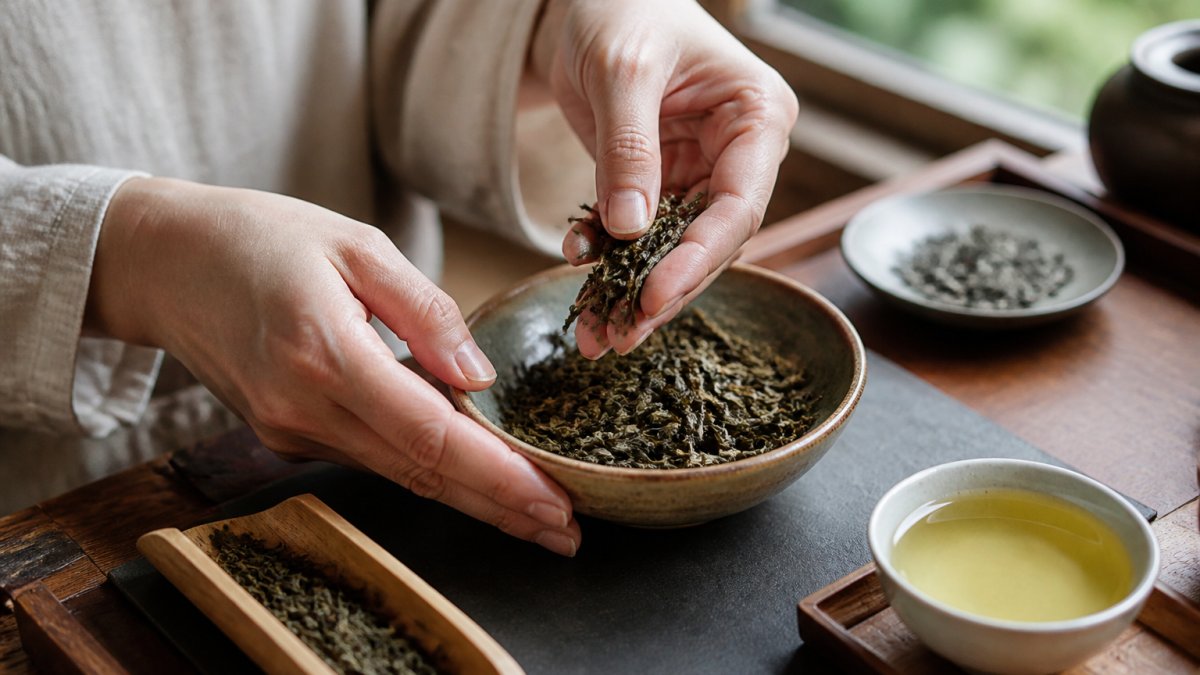
Start with the dry leaf. Whole, unbroken leaves with a uniform color suggest careful handling. A pile of dust and stems suggests the opposite.
- Look at leaf shape. Whole leaves and visible buds are a good sign; lots of broken bits are not.
- Check color consistency. Even color across the batch points to careful processing.
- Smell the dry leaf. It should smell fresh and specific, not dusty or flat.
- Brew and inspect the wet leaf. Good leaves unfurl into full, pliable pieces.
- Taste for aftertaste. Quality tea leaves a clean, lingering finish rather than a dry, bitter one.
Pay attention to tannins and astringency. Some is expected, especially in black tea, but a harsh, mouth-drying bite usually signals over-brewing or low-grade leaf.
Blind Taste Test Methodology for Your Own Kitchen
A blind taste test is the fastest way to settle the question for yourself, and it takes about 30 minutes. The method is simple: brew two teas you want to compare, hide which is which, and taste them side by side without knowing the labels.
Here is how to run it fairly:
- Brew both teas to the same strength using the same water and the same steep time.
- Pour each into an identical unmarked cup and label them only A and B on the bottom.
- Have someone else set the cups in front of you so you do not know which is which.
- Taste both, note the aroma, flavor profile, body, and finish for each.
- Reveal the labels only after you have written down your notes.
Do this with a specialty loose leaf and a bagged version of the same style. Most people are surprised by how much of the difference is texture and finish rather than raw strength. The test also keeps you honest: if you cannot taste a difference you care about, you have your answer on whether the upgrade is worth it for you.
Health Benefits of White Tea vs Green Tea (and Other Varieties)
White tea and green tea differ mainly in processing, and that difference shapes both flavor and what ends up in your cup.
Because white tea skips the rolling and firing steps, it tends to have a lighter, sweeter, more delicate flavor profile.
What about the rest of the shelf? Oolong sits between green and black on the oxidation scale, black tea is fully oxidized, and blends like masala chai build on a black base with spices.
A word of caution: tea is not medicine, and no cup replaces medical advice. If you are managing a health condition or watching caffeine, talk to a healthcare provider about what fits your routine.
Storage and Shelf-Life Economics: Protecting Your Investment
Storage is where a lot of tea money quietly goes to waste. If you pay a premium for fresh leaf and then leave the tin open on a sunny shelf, you lose the very thing you paid for.
The economics are straightforward: better storage extends the usable life of the leaf, which lowers your real cost per cup. Three enemies do the damage, and they are light, air, and moisture.
- Airtight: oxygen fades aroma and flavor over time.
- Dark: light breaks down the compounds that make tea taste fresh.
- Cool and dry: heat and humidity speed up staleness.
- Away from odors: tea absorbs nearby smells, so keep it away from spices and coffee.
For a tea you drink daily, a small tin you refill is better than a large bag you open again and again. Every time you open a container, fresh air and moisture get in.
Verdict: Who Should Buy Specialty Tea and Who Should Skip It
Specialty tea is worth the extra cost if you brew loose leaf, re-steep your leaves, and store them well. Under those conditions, the higher sticker price turns into a lower cost per cup and a noticeably better drink. If you want a fast single cup with no fuss and no gear, bags still make sense, and there is no shame in that.
Here is how we would call it:
- Buy specialty if you drink tea daily, enjoy the ritual, and will use an infuser or gaiwan.
- Buy specialty if you want to explore single-origin and first flush teas and taste the difference.
- Skip it if you want one quick cup with zero attention and never re-steep.
- Skip it if you will not store the leaf properly, because you will waste the premium.
For readers who want to try the upgrade without overthinking it, our own lineup keeps things simple. The English Breakfast is a sturdy blend of African and Indian tea that stands up to milk and sugar, and the Earl Grey pairs Ceylon black tea with bergamot oil and cornflowers for a classic cup. If you prefer something greener, the Moroccan Mint blends green tea with fresh mint and works hot or iced, while the Matcha is built for traditional preparation.
The real challenge with specialty tea is not the price; it is finding leaf fresh enough to justify it. Stale tea from any shelf tastes like a waste of money, which is exactly the trap that makes people give up on loose leaf.
Frequently Asked Questions
What are the best specialty tea brands?
Quality varies by brand, but the best specialty tea brands share a few traits: they disclose harvest dates and origin, sell whole-leaf tea rather than dust or fannings, and offer clear brewing guidance. Look for brands that name the garden or region, state the grade (such as OP or FTGFOP), and provide a harvest window. Cuppari Coffee, for example, lists specific ingredients and brewing parameters for each tea, which helps you judge freshness and expected flavor before buying.
Is loose leaf tea really more expensive than tea bags?
The upfront price per container is higher for loose leaf, but the cost per cup often ends up lower. A 2.5g serving of loose leaf tea can be re-steeped two to three times, while a standard tea bag is typically used once. When you divide the total cost by the number of cups, loose leaf frequently matches or beats premium bagged tea. The key is factoring in re-steeping, not just the sticker price.
How can I tell if a specialty tea is actually high quality?
Start with your senses. High-quality dry leaves should look uniform, smell fresh, and feel dry but not brittle. After brewing, the liquor should be clear rather than cloudy, and the aroma should be layered, not flat. Check the packaging for a harvest date and origin. If the label only says 'black tea' with no region or grade, it is likely a commodity blend. Also, whole leaves unfurl fully during steeping; broken pieces or dust settle quickly.
Does specialty tea have more health benefits than regular tea?
The health benefits of white tea vs green tea and other varieties depend more on the leaf quality and processing than on the price tag. Whole-leaf teas generally retain more of the leaf's natural compounds because they undergo less crushing. However, the difference between a high-end green tea and a standard one is not a guarantee of dramatically higher health benefits. What matters is consistent brewing and choosing teas you enjoy drinking regularly.
How should I store specialty tea to keep it fresh?
Store tea in an airtight container away from light, heat, and strong odors. Oxygen and moisture are the main enemies; they dull aroma and turn leaves stale. For daily drinking, keep a small amount in a tin and store the rest in a cool cupboard. If you buy in bulk, consider a vacuum-sealed bag or a container with a tight seal. Proper storage preserves the flavor profile and extends the shelf life, which protects the value of the extra cost.