

Table of Contents
- Light Roast vs Dark Roast: A Flavor Comparison Table
- What Is Light Roast Coffee?
- What Is Dark Roast Coffee?
- The Roasting Process: How Heat Shapes Flavor
- Caffeine Content in Light vs Dark Roast
- Brewing Methods for Different Roast Profiles
- How to Choose the Best Coffee Roast for Your Taste
- Frequently Asked Questions
Last Updated: September 25, 2026
Light Roast vs Dark Roast: A Flavor Comparison Table
Comparing light roast vs dark roast flavor profiles comes down to one idea: the roast level decides how much of the bean's origin character survives the roaster. At Cuppari Coffee, we roast every order after it's placed, so we think about this difference daily. Light roasts stay bright, fruity, and tea-like. Dark roasts turn bold, smoky, and chocolatey. Neither is better.
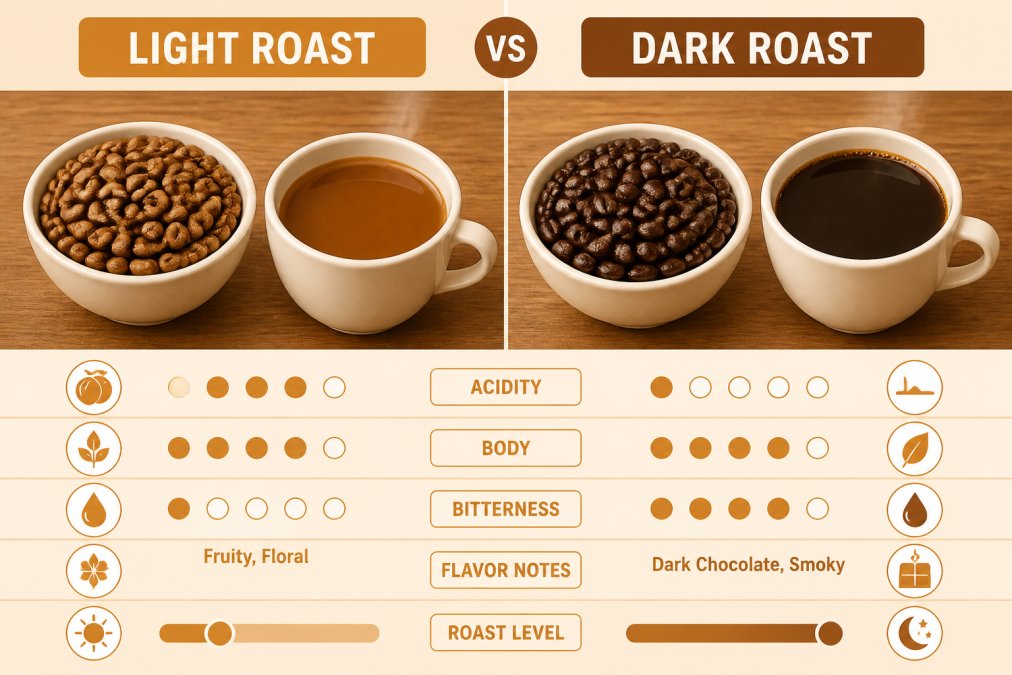
| Factor | Light Roast | Dark Roast |
|---|---|---|
| Flavor focus | Origin, fruit, floral | Roast, smoke, caramel |
| Acidity | High, bright | Low, mellow |
| Body | Light to medium | Full and syrupy |
| Bitterness | Low | Moderate to high |
| Surface oils | Dry | Oily and shiny |
| Best brew method | Pour-over, drip | Espresso, French press |
What Is Light Roast Coffee?
Light roast coffee is coffee pulled from the roaster shortly after first crack, the moment beans pop and expand as internal moisture escapes. Roasters stop the process early to preserve the bean's natural sugars and acids.
Flavor Notes and Acidity in Light Roasts
Expect bright, floral, and fruity notes with a clean, tea-like body. Acidity runs high, which reads as juiciness rather than sourness when the coffee is brewed well.
What Is Dark Roast Coffee?
Dark roast coffee is coffee roasted past second crack, when sugars caramelize heavily and oils migrate to the bean's surface. The longer roast time builds body and bittersweet depth while muting the bean's original acidity.
Body, Bitterness, and Smoky Notes in Dark Roasts
The flavor profile shifts toward smoky, chocolatey, and caramelized sweetness with a heavy, syrupy mouthfeel. Bitterness increases, but well-roasted dark coffee stays smooth rather than harsh.
The Roasting Process: How Heat Shapes Flavor
Roast degree is a function of time and temperature, and two chemical reactions do most of the work. But the reactions that separate a light roast from a dark roast are more specific than the generic "Maillard and caramelization" story most guides stop at.
First Crack, Second Crack, and the Temperature Ladder
Green coffee enters the roaster at roughly 350-400°F of drum temperature and drops in moisture content from about 10-12% to 1-2% by the end of the roast. The audible milestones roasters use to mark progress are:
- First crack, around 385-400°F bean temperature. Moisture and carbon dioxide escape, the bean expands 50-100% in volume, and the roast becomes drinkable. Light roasts are dropped here or shortly after.
- Second crack, around 435-450°F bean temperature. Cell walls fracture, oils migrate to the surface, and sugars carbonize. Dark roasts are dropped during or just past this stage.
What Actually Changes Inside the Bean
Chlorogenic acid, the polyphenol behind much of coffee's perceived brightness and a large share of its antioxidant activity, degrades steadily as roast time and temperature climb (pubmed.ncbi.nlm.nih.gov). A light roast retains substantially more chlorogenic acid than a dark roast; by the time a bean reaches French roast territory, a large fraction of the original chlorogenic acid has broken down into quinic and caffeic acid.
Why Bean Density and Origin Matter
Caffeine Content in Light vs Dark Roast
Here's the myth worth retiring: dark roast does not contain more caffeine than light roast. By weight, the opposite is closer to true.
Brewing Methods for Different Roast Profiles
Matching roast to brew method is where most drinkers leave flavor on the table. The right pairing makes each roast taste like its best self, and the wrong pairing can make a great bean taste thin, sour, or muddy. Here's how to dial in each method for the roast you're brewing.
Pour-Over and Drip, Built for Light Roasts
Paper filters trap oils and sediment, which highlights acidity and flavor clarity. This is the format that lets a light roast's origin character come through most clearly.
- Water temperature: 200-205°F. Light roasts are dense and need heat to extract fully. Water below 195°F is the most common cause of sour, thin light roast.
- Grind: Medium-fine for pour-over, medium for drip.
- Ratio: Start at 1:16 coffee to water by weight (about 1 gram of coffee per 16 grams of water).
- Why it works: The paper filter removes the oils that would otherwise mute the fruit and floral notes, so the cup reads clean and tea-like.
Espresso, Built for Dark Roasts
Pressure and a short contact time suit bold, low-acid beans. Dark roasts also produce more crema because their surface oils and CO2 content are higher.
- Dose: A traditional double shot uses 18-20 grams of coffee in and 36-40 grams of espresso out, in 25-30 seconds.
- Grind: Fine, adjusted shot by shot.
- Why it works: Dark roasts extract quickly, so the short contact time prevents the harsh, ashy notes that over-extraction produces. Light roasts can be pulled as espresso, but they usually need a finer grind, longer ratio, and higher brew temperature to avoid sourness.
French Press, Favors Dark Roasts
The metal mesh keeps oils and fine particles in the cup, amplifying body and mouthfeel.
- Grind: Coarse, roughly the texture of sea salt.
- Ratio: 1:12 to 1:15, depending on how heavy you want the cup.
- Steep time: 4 minutes, then press slowly.
- Why it works: The oils that a paper filter would remove stay in the cup, which is exactly what a dark roast's syrupy body needs. A light roast in a French press can taste muddled, the sediment pushes body forward while the acidity stays high, and the two fight each other.
Cold Brew, Works With Both, for Different Reasons
Cold water extracts fewer of the bitter compounds and more of the sweet ones, so the same bean tastes smoother and less acidic than it would hot-brewed.
- Ratio: 1:5 for concentrate, 1:15 for ready-to-drink.
- Time: 12-18 hours in the refrigerator.
- Light roasts stay bright and fruity, almost like iced tea.
- Dark roasts turn smooth and chocolatey, with the smoky edge softened.
Moka Pot, Best With Medium and Dark Roasts
The stovetop pressure and high heat produce a concentrated, intense cup. Medium and dark roasts hold up to that intensity; light roasts often taste sharp and underdeveloped.
- Grind: Fine, but slightly coarser than espresso.
- Heat: Low and slow. High heat scorches the coffee and produces a metallic, burnt taste.
- Fill line: Fill the basket level and do not tamp, the moka pot needs room for the coffee to expand.
A Quick Pairing Cheat Sheet
| Roast | Best Methods | Avoid |
|---|---|---|
| Light | Pour-over, drip, cold brew | French press, moka pot |
| Medium | Drip, pour-over, moka pot, espresso | , (most versatile) |
| Dark | Espresso, French press, moka pot, cold brew | Pour-over (oils get filtered out) |
How to Choose the Best Coffee Roast for Your Taste
Start with the flavors you already enjoy, then work backward to a roast level.
- Like tea, citrus, or berries? Choose light roast.
- Prefer cocoa, toasted nuts, or caramel? Choose medium and dark roasts.
- Drink your coffee with milk or sugar? Dark roasts hold their flavor better against additions.
- Drink it black? Light and medium roasts show more nuance.
- Want low bitterness? Go lighter, not darker.
Frequently Asked Questions
What tastes better, light roast or dark roast?
Neither is objectively better. Light roasts highlight bright, fruity, floral notes and higher acidity. Dark roasts deliver bold, smoky, chocolatey flavors with low acidity and a heavier body. Your preference depends on whether you enjoy brightness and complexity or depth and richness. Trying both side by side is the fastest way to decide.
Does light roast coffee have more caffeine than dark roast?
By weight, light roast beans are slightly denser, so a scoop of light roast may contain marginally more caffeine. However, when measured by volume, the difference is negligible. Dark roast beans lose more mass during roasting, so you may use slightly more beans per cup. The caffeine difference between light and dark roast is far smaller than most people assume.
Which roast level is best for pour-over brewing?
Light and medium roasts work best for pour-over. Their brighter acidity and nuanced flavors shine through the paper filter. Dark roasts can taste flat or overly bitter in pour-over because the filter traps some of the oils that give dark roasts their body. If you prefer dark roast, try a French press or espresso instead.
How does the roasting process affect the acidity of coffee beans?
During roasting, organic acids break down as bean temperature rises. Light roasts retain more chlorogenic and citric acids, giving them a bright, tangy quality. Dark roasts lose most of these acids through prolonged heat exposure, resulting in lower acidity and a smoother, sometimes smoky cup. The Maillard reaction and caramelization also create new flavor compounds at each roast level.
Choosing between light and dark roast comes down to matching the cup to your taste, not chasing a universal winner. Cuppari Coffee roasts every order only after it's placed and ships the same day, so the flavors described here reach you intact. Start with the Ethiopia Natural for bright, fruity complexity, or the French Roast for a bold, smoky cup, and let your brew method do the rest. Add to cart and taste the difference freshness makes.