

Table of Contents
- What Sustainable Coffee Farming Practices Actually Change on the Farm
- The Benefits of Shade-Grown Coffee for Farmers and Flavor
- Fair Trade Coffee Certification Standards and What They Require
- Regenerative Agriculture in Coffee Production: Beyond Organic Certification
- Water-Efficient Irrigation and Post-Harvest Processing Methods
- Climate-Resilient Coffee Varieties and Economic Resilience for Growers
- How to Identify Coffee Grown With Sustainable Farming Practices
- Frequently Asked Questions
Last Updated: September 16, 2026
What Sustainable Coffee Farming Practices Actually Change on the Farm
Sustainable coffee farming practices are growing methods that protect soil, water, biodiversity, and farmer livelihoods while still producing a commercial crop. At Cuppari Coffee, we buy from growers who treat their land as a long-term asset rather than a single-season resource, and the difference shows up in the cup. This guide breaks down what those practices look like in the field, from shade canopies to water-efficient processing.
The Benefits of Shade-Grown Coffee for Farmers and Flavor
Shade-grown coffee is cultivated beneath a canopy of taller trees rather than in open sun. The canopy lowers soil temperature, slows erosion, and creates habitat for birds and insects that keep pests in check. For farmers, that means less reliance on chemical inputs and more resilience when rainfall turns unpredictable.
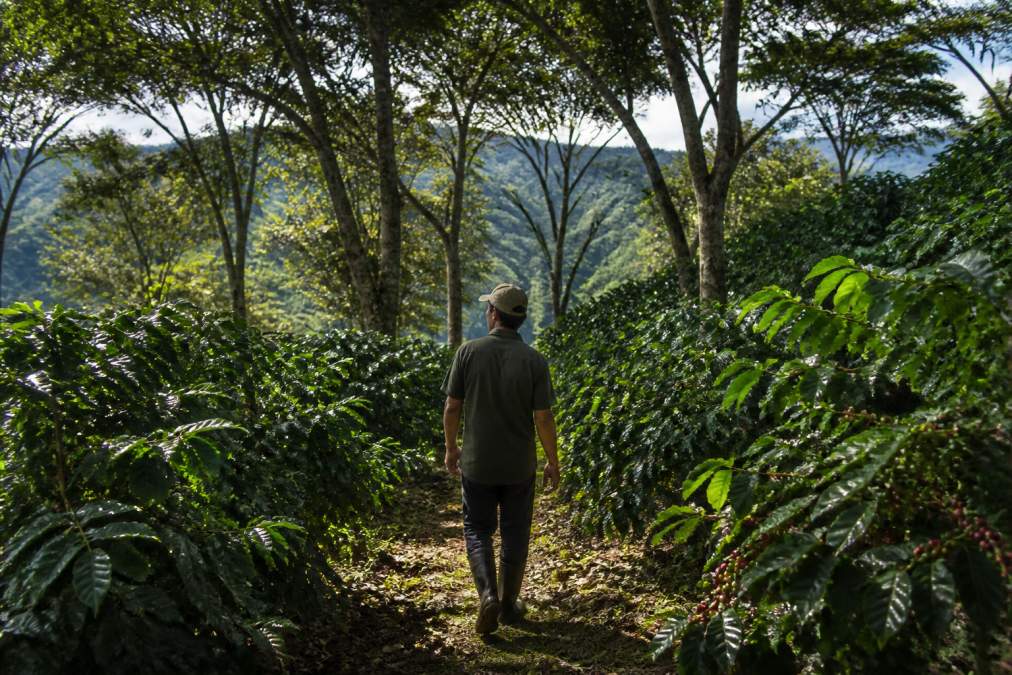
How Canopy Cover Protects Soil and Wildlife
Tree roots hold topsoil in place during heavy rain, which matters because coffee grows on slopes where erosion strips fertility fast. Leaf litter breaks down into organic matter, feeding the soil without synthetic fertilizer. The same canopy shelters migratory birds that eat the coffee berry borer, a pest that damages cherries and cuts yield.
Flavor Differences Between Shade-Grown and Sun-Grown Beans
Shade slows cherry maturation. That longer ripening period lets sugars develop more fully, which many roasters describe as greater sweetness and complexity in the cup. Sun-grown coffee ripens faster and can taste flatter, though it produces higher volume per hectare. The trade-off is real: shade costs yield and rewards quality.
Fair Trade Coffee Certification Standards and What They Require
Fair trade coffee certification standards set minimum prices, require a social premium paid on top of the market rate, and prohibit the worst forms of child labor. Certification also mandates democratic cooperatives, so smallholder farmers negotiate collectively instead of selling into whatever price a buyer offers.
Price Floors, Premiums, and Social Equity for Smallholder Farmers
The mechanism is straightforward. When the market price drops below the floor, buyers still pay the floor. On top of that, a fixed premium goes to the cooperative for community projects like schools, clinics, or processing equipment. This is where social equity becomes concrete: a farmer who can plan next season's inputs is a farmer who stays in coffee.
Regenerative Agriculture in Coffee Production: Beyond Organic Certification
Regenerative agriculture in coffee production goes further than organic certification. Organic rules tell you what a farmer cannot apply. Regenerative practice asks what the farm actively gives back to the soil, and how it builds fertility season over season.
Cover Crops, Composting, and Agroforestry Systems
The toolkit is practical rather than exotic:
- Cover crops between rows fix nitrogen and suppress weeds, reducing herbicide use.
- Composting turns pulp and husks from processing into fertilizer instead of waste.
- Agroforestry stacks timber, fruit, and coffee trees on the same land, diversifying income.
- Mulching retains moisture and feeds soil biology through the dry season.
A common mistake is treating these as separate projects. They work as a system, and the payoff compounds over several harvests rather than one.
Water-Efficient Irrigation and Post-Harvest Processing Methods
Water is where coffee farming earns or loses its environmental reputation, and the numbers are stark. Traditional fully washed processing can consume roughly 10 to 20 liters of water per kilogram of green coffee in some operations, while eco-pulping and mechanical demucilaging can cut that to under 1 liter per kilogram. That gap is the single biggest lever a wet mill controls, and it is where most sustainability guides stop short.
Irrigation: Delivering Water to the Root Zone, Not the Field
On the irrigation side, the goal is to match application to plant uptake. Drip lines deliver water directly to the root zone instead of spraying entire fields, which typically cuts evaporative loss compared with overhead sprinklers. Mulch on the soil surface reduces evaporation further and feeds soil biology through the dry season. Rainwater harvesting captures runoff during the wet season for use during dry spells, which matters most for farms that lack a reliable dry-season source.
Post-Harvest Processing: Where the Water Is Actually Spent
The wet mill is the water-intensive stage, and the method chosen determines the footprint:
- Fully washed: Depulping, fermentation, and channel washing can use the most water of any method. The fermentation step alone can run 12 to 24 hours depending on temperature.
- Eco-pulping (mechanical demucilaging): Removes mucilage with mechanical friction and a small amount of water, often reducing consumption by 80 percent or more versus traditional washing.
- Honey processing: Leaves some mucilage on the parchment and dries it there, eliminating the washing channel entirely.
- Natural (dry) processing: Skips water altogether; cherries dry whole on raised beds or patios.
Waste-Water Treatment: The Part Most Guides Skip
Wet-mill effluent is high in organic load and, if released untreated, depletes oxygen in local streams. Practical treatment options include:
- Settling tanks and lagoons that let solids separate before water is reused or released.
- Anaerobic digesters that break down organic matter and can capture biogas for cooking or drying.
- Recycling wash water back through the pulper for subsequent lots, which cuts total draw.
- Composting pulp and mucilage rather than dumping them, turning a waste stream into fertilizer for the farm.
Climate-Resilient Coffee Varieties and Economic Resilience for Growers
Coffee rust and rising temperatures have pushed growers toward varieties bred for resistance and heat tolerance, but the choice of cultivar is also a financial decision that plays out over years. This is the part most sustainability guides skip: which varieties actually resist disease, what they cost to plant, and how long before the investment pays back.
The Resistance Mechanisms Behind the Names
- Castillo and Colombia: Developed for resistance to coffee leaf rust (Hemileia vastatrix), these lines carry multiple resistance genes and are widely planted in Colombia. They yield well but can be susceptible to new rust races over time, which is why breeding programs keep rotating genetics.
- Caturra and Catuai: Traditional dwarf cultivars with good cup quality but limited rust resistance; many farms still grow them for flavor and replant with resistant stock only when disease pressure forces it.
- F1 hybrids (e.g., Centroamericano, H3, Mundo Maya): First-generation hybrids between genetically distant parents. They tend to show hybrid vigor, higher yield, stronger rust resistance, and better cup quality than many older lines, but seed is more expensive and not always open-pollinated, so farmers cannot save seed the same way.
- Geisha and other specialty lines: Valued for cup quality rather than rust resistance; usually grown at higher altitudes where disease pressure is lower.
A common pattern is that a farm plants a resistant variety after a rust outbreak, then discovers the cup profile differs from its traditional lots. That is why many growers keep a mix: resistant workhorses for volume and heirloom varieties for specialty premiums.
The Economics of Replanting
Replanting is a multi-year investment. A new coffee tree typically takes three to four years to reach commercial production, and during that window the farm has costs but little coffee income. Growers often stagger replanting in blocks so that only part of the farm is out of production at once.
The cost-benefit picture depends on several variables:
- Nursery and seedling cost: F1 hybrids and certified resistant stock cost more per plant than farm-saved seed.
- Yield recovery: Resistant varieties can restore yields that rust had cut, sometimes within two to three harvests of maturity.
- Price premium: Specialty buyers may pay more for certain varieties, which can shorten the payback period.
- Risk reduction: A farm that loses a harvest to rust loses far more than the cost of replanting, which is why many agronomists frame resistant varieties as insurance rather than an upgrade.
Diversifying Beyond Variety
Resilience is not only agronomic; it is economic. A farm that depends on one buyer and one variety has no margin for a bad year. Diversifying varieties, adding shade trees with marketable fruit, and selling into multiple channels spreads risk. That economic resilience is what keeps a farm viable when a single harvest fails.
How to Identify Coffee Grown With Sustainable Farming Practices
Identifying coffee grown with sustainable farming practices comes down to traceability. You want to see the grower, the region, the altitude, and the processing method on the label. That level of detail is hard to fake and easy to verify.
Here is what to look for at a glance:
| Signal on the Label | What It Tells You | Why It Matters |
|---|---|---|
| Named grower and region | Traceable supply chain | Confirms farm-level sourcing |
| Altitude range listed | Slower cherry maturation | Often linked to higher quality |
| Processing method stated | Water use and drying method | Reveals post-harvest sustainability |
| Single origin designation | No blending across sources | Easier to verify practices |
| Variety named | Climate-resilient plant stock | Signals long-term farm planning |
Frequently Asked Questions
What are the core pillars of sustainable coffee farming?
Sustainable coffee farming rests on several interconnected pillars: soil health through composting and mulching, water conservation via drip irrigation and rainwater harvesting, biodiversity protection through shade-grown and agroforestry systems, fair labor practices backed by fair trade coffee certification standards, and economic resilience for smallholder farmers. These pillars work together. A farm that protects soil and water while paying workers fairly can sustain production through climate shifts, pests like coffee rust, and market volatility. Together they form a system that supports both the environment and the people growing the coffee.
What is the difference between organic and shade-grown coffee?
Organic certification focuses on what is not used: synthetic pesticides, herbicides, and fertilizers. Shade-grown refers to how coffee is cultivated, under a canopy of trees that provides habitat for birds and insects, reduces soil erosion, and moderates temperature. A coffee can be organic but grown in full sun, or shade-grown but not certified organic. The strongest environmental outcomes come when both practices overlap. When you see a bag labeled with both, you are getting coffee produced with fewer chemicals and more biodiversity. Cuppari Coffee's Ethiopia Natural, for example, comes from smallholder farmers using traditional shade methods.
How do sustainable farming practices impact coffee flavor profiles?
Growing conditions directly shape what ends up in your cup. Shade-grown coffee tends to ripen more slowly, which allows sugars to develop and produces more complex acidity and sweetness. Regenerative practices that build soil fertility can improve nutrient uptake, leading to cleaner, more vibrant flavors. Processing methods matter too: fully washed coffees like Cuppari Coffee's Colombia, which is dried in solar dryers, tend to have clarity and bright acidity, while natural-process coffees like the Ethiopia Natural bring fruity, caramel notes from drying on raised beds. Sustainable farming and careful processing together produce a noticeably better cup.
How can consumers identify truly sustainable coffee brands?
Check whether the roaster names the farm, region, and processing method. Transparency about supply chain and traceability signals a genuine commitment. Single-origin coffees from named growers, like Cuppari Coffee's Brazil Santos from Fazenda Santa Barbara or Costa Rica from micro farms in Alajuela, give you a direct line to the source. Roasters who share these details are more likely to have real relationships with the farms they buy from.