

Table of Contents
- Where to Buy a Diverse Coffee Selection: Quick Comparison
- How We Evaluated Each Source for Coffee Variety
-
The Best Places to Buy a Diverse Coffee Selection Ranked
- 1. Cuppari Coffee, Best for Roast-to-Order Freshness Across All Styles
- 2. Trade Coffee, Best Marketplace for Maximum Roaster Variety
- 3. Atlas Coffee Club, Best for Single-Origin Global Exploration
- 4. Bean Box, Best Curated Experience for Beginners
- 5. MistoBox, Best for Personalized Human-Guided Discovery
- 6. Onyx Coffee Lab, Best for Transparency and Micro-Lot Access
- 7. Counter Culture Coffee, Best for Ethical Sourcing and Sustainability
- Choosing a Specialty Coffee Subscription That Matches Your Taste
- How Coffee Tasting Flights Help You Discover Your Flavor Profile
- Environmental Impact: Packaging, Shipping, and Ethical Sourcing
- Which Option Is Right for You? A Decision Framework
- Conclusion
Last Updated: May 11, 2026
Where to Buy a Diverse Coffee Selection: Quick Comparison
Knowing where to buy diverse coffee selection options has never mattered more. The specialty coffee market has expanded dramatically, with dozens of roasters, subscription services, and direct-trade importers competing for your attention. This guide from Cuppari Coffee cuts through the noise by ranking the best sources across every category, from roast-to-order freshness to global single-origin exploration. Below, we'll show you exactly how each option stacks up, what most comparison guides miss about subscription management, and which choice fits your brewing setup and budget.
Here's what most reviews get wrong: they treat "variety" as a single dimension. A diverse coffee selection actually spans four axes: origin diversity, processing method diversity, roast profile diversity, and format diversity (whole bean, pre-ground, pods). The best sources score well across all four. The worst score well on one and ignore the rest.
| Source | Best For | Starting Price | Roast-to-Order | Free US Shipping |
|---|---|---|---|---|
| Cuppari Coffee | All-around freshness + variety | Visit site | Yes | Yes |
| Trade Coffee | Maximum roaster variety | $16.99/bag | Varies by roaster | No |
| Atlas Coffee Club | Global single-origin | $9/shipment | No | No |
| Bean Box | Beginner curation | $20/shipment | No | No |
| MistoBox | Human-guided discovery | $20/shipment | Varies | No |
| Onyx Coffee Lab | Micro-lot transparency | Varies | Yes | No |
| Counter Culture | Ethical sourcing | Varies | Yes | No |
How We Evaluated Each Source for Coffee Variety
Every option on this list was evaluated against five criteria, weighted by what actually affects cup quality and long-term satisfaction.
1. Origin and roast diversity: Does the service offer single-origin, blends, flavored options, and different roast levels? A true diverse coffee selection covers light through dark, washed through natural-processed, and multiple growing regions.
2. Freshness protocols: Roast date transparency matters more than most people realize. According to Specialty Coffee Association's freshness guidelines, coffee is best consumed within two to four weeks of the roast date. Services that ship pre-roasted inventory sitting in a warehouse fail this test.
3. Subscription flexibility: Can you change grind size, shipping frequency, and coffee type without calling customer service? Cancellation friction is a real problem in this industry.
4. Format compatibility: Whole bean, pre-ground, and pod options matter depending on your brewing equipment. Not every service covers all three.
5. Value for money: Price per ounce, shipping costs, and whether the quality justifies the premium.
A common mistake buyers make is choosing a service based on brand recognition alone. Bigger names do not automatically mean fresher beans or better variety.
The Best Places to Buy a Diverse Coffee Selection Ranked
The seven options below represent the strongest performers across the criteria above. Each has a genuine strength and a real limitation worth knowing before you commit.
 roasted whole beans scattered across the surface under warm natural light](https://cdn.grandranker.com/articles/where-to-buy-a-diverse-coffee-selection-in-2026-content-1-1778486796.jpg)
1. Cuppari Coffee, Best for Roast-to-Order Freshness Across All Styles
Cuppari Coffee earns the top spot because it solves the problem every other service struggles with: delivering a genuinely diverse coffee selection without sacrificing freshness. Every order is roasted only after it is placed and shipped the same day. You are never receiving beans that have been sitting in a fulfillment center.
The selection covers single-origin coffees, blends, flavored varieties, and coffee pods, plus a range of teas. That breadth is rare. Most roasters specialize in one category and treat the others as afterthoughts. The pod format uses sealed capsules with no oxygen inside, which preserves flavor in a way that standard packaging cannot match. The improved filter design in those capsules also absorbs more grounds, producing a cleaner, livelier cup.
Free shipping on all U.S. orders removes one of the most common hidden costs in the coffee subscription world.
Pros:
- Roast-to-order with same-day shipping
- Full format range: whole bean, pods, and teas
- Free US shipping with no minimum order
- Sealed, oxygen-free capsules for maximum freshness
Cons:
- International shipping timelines vary
2. Trade Coffee, Best Marketplace for Maximum Roaster Variety
No single roaster can match what Trade Coffee offers in raw numbers. The platform connects buyers with over 50 specialty roasters across the United States, giving access to more than 450 unique coffees. A personalized coffee quiz matches your flavor profile to specific roasters and origins, which is genuinely useful when the catalog is this large.
Subscriptions start at $16.99 per bag, and you can also purchase individual bags à la carte. The Classic vs. Premium subscription tiers give flexibility on quality level and budget.
The honest limitation: shipping consistency depends entirely on which roaster fulfills your order. Some ship same-day. Others take longer. If freshness is your top priority, the variable roast-to-ship timeline is a real concern.
Pros: Unmatched roaster variety, highly personalized recommendations Cons: Shipping timelines vary by roaster; no unified freshness standard
3. Atlas Coffee Club, Best for Single-Origin Global Exploration
Picture this: every month, a new country. Atlas Coffee Club rotates through coffee-producing nations on a monthly schedule, pairing each shipment with postcards, origin stories, and brewing tips. It is the closest thing to a world coffee tour without leaving your kitchen.
Entry-level pricing starts at $9 per shipment, making this one of the most affordable ways to explore single-origin coffees from regions like Ethiopia, Colombia, Yemen, and beyond. Roast levels and grind types are customizable, and K-Cup and Nespresso-compatible pod options are available.
The trade-off is real: you get one origin per month. If you want to compare a Kenyan AA against an Ethiopian Yirgacheffe in the same week, Atlas is not the right fit. It rewards patience and curiosity, not comparison shopping.
Pros: Excellent cultural and educational experience, very affordable Cons: One origin per shipment limits side-by-side tasting
4. Bean Box, Best Curated Experience for Beginners
What separates Bean Box from the rest of this list is the editorial hand behind every shipment. This Seattle-based service curates small-batch, specialty-grade coffee from top independent roasters, and every box includes tasting notes and brewing tips. You are not just receiving coffee; you are receiving context.
Subscriptions start at $20 per shipment, and bag sizes run about 10% larger than many competitors. For someone new to specialty coffee, that combination of quality beans and built-in education is genuinely valuable.
The limitation is control. You cannot choose specific coffees for each shipment. The curation team decides. That is great if you trust their judgment and want to be surprised. It is frustrating if you already know you prefer naturally processed Ethiopian coffees and want to stay in that lane.
Pros: Strong educational materials, high-quality small-batch beans Cons: Limited ability to select specific coffees per shipment
5. MistoBox, Best for Personalized Human-Guided Discovery
MistoBox takes personalization further than most by pairing each subscriber with a personal coffee curator. You answer questions about your taste preferences, and a human curator builds your queue from a catalog spanning hundreds of coffees across 50+ roasters. The "Brew Queue" system lets you manage upcoming shipments with more granularity than most subscription models allow.
Pricing starts at $20 per shipment, with tiered options based on coffee rarity.
Here's the honest caveat: the breadth of options can produce choice overload. Some subscribers report feeling overwhelmed by the volume of recommendations. If you prefer a more edited, narrower selection, MistoBox's strength becomes its weakness.
Pros: High personalization, wide roaster network, flexible queue management Cons: Overwhelming for users who prefer a curated, limited selection
6. Onyx Coffee Lab, Best for Transparency and Micro-Lot Access
Onyx Coffee Lab is for the coffee nerd who wants to know everything: the origin, the price paid to the farmer, the processing method, the roast profile, and the recommended brew parameters. This level of transparency is rare even among third-wave coffee roasters.
The Roaster's Choice subscription delivers constant variety, including access to rare and experimental processing lots that never appear in mainstream catalogs. Detailed filter and espresso brew guides come with each coffee, which is useful if you are dialing in a new origin on an espresso machine or a Chemex.
Pricing varies by coffee and reflects the premium quality. This is not the right entry point for casual drinkers. For serious enthusiasts, it is one of the best direct-trade options available anywhere.
Pros: Industry-leading transparency, award-winning roast profiles, micro-lot access Cons: Premium pricing; not suited for everyday casual drinking budgets
7. Counter Culture Coffee, Best for Ethical Sourcing and Sustainability
Counter Culture has been doing direct trade before it was a marketing term. The roaster's commitment to sustainability shows up in transparent labeling that includes altitude, variety, and processing method, and in a sourcing model that prioritizes long-term farmer relationships over spot-market purchasing.
The Blend Box subscription delivers variety across their core offerings, while the single-origin subscription rotates seasonally. Roast quality is consistent in a way that marketplace-style services cannot guarantee, because Counter Culture controls the entire process from sourcing to roasting.
The limitation is scope. You are limited to Counter Culture's own roasts. If you want to sample 20 different roasters, this is not the right platform. If you want one roaster you can trust completely, it is hard to beat.
Pros: Strong sustainability commitment, highly consistent roast quality Cons: No external roaster partners; limited variety compared to marketplaces
Choosing a Specialty Coffee Subscription That Matches Your Taste
A specialty coffee subscription is a recurring delivery service that sends freshly roasted, high-quality coffee beans directly to subscribers, typically sourced from specific origins and roasted in small batches. Choosing the right one depends on more than flavor preference.
Grind Size, Whole Bean vs. Pre-Ground, and Brewing Compatibility
Your brewing equipment determines which format you need, and not every service offers all three. Whole bean coffee stays fresh longer and gives you control over grind size, which matters enormously for espresso versus pour-over versus French press. Pre-ground is convenient but goes stale faster. Pod formats, like those available from Cuppari Coffee, offer the most convenience with the least waste when the capsules are properly sealed.
As noted in the SCA's brewing standards documentation, grind consistency is one of the primary variables affecting extraction quality. A service that only ships pre-ground at a medium grind is incompatible with espresso machines and coarse-grind methods like cold brew.
Check these specifics before subscribing:
- Does the service offer whole bean as a default?
- Can you specify grind size (coarse, medium, fine, espresso)?
- Are pod options available if you use a capsule machine?
- Can you change your grind preference between orders?
Shipping Frequency, Cancellation Policies, and Customer Service
This is the part most subscription reviews skip entirely. Shipping frequency affects freshness. If you order a two-week supply but receive it every four weeks, you are either over-caffeinating or drinking stale coffee. Most services offer weekly, bi-weekly, and monthly options. Choose based on your actual consumption rate, not what sounds convenient.
Cancellation policies vary widely. Some services allow instant cancellation through a dashboard. Others require email requests with multi-day response times. According to consumer subscription research from the Harvard Business Review, friction in the cancellation process is one of the top drivers of negative brand perception. Before subscribing, test the customer service channel with a simple question. Response time and tone tell you a lot about what happens when something goes wrong.
How Coffee Tasting Flights Help You Discover Your Flavor Profile
Coffee tasting flights are structured samplings of multiple coffees side by side, designed to help drinkers identify their preferences across variables like acidity, body, sweetness, and flavor profile. They are the fastest way to calibrate your palate without committing to full bags of coffee you may not enjoy.
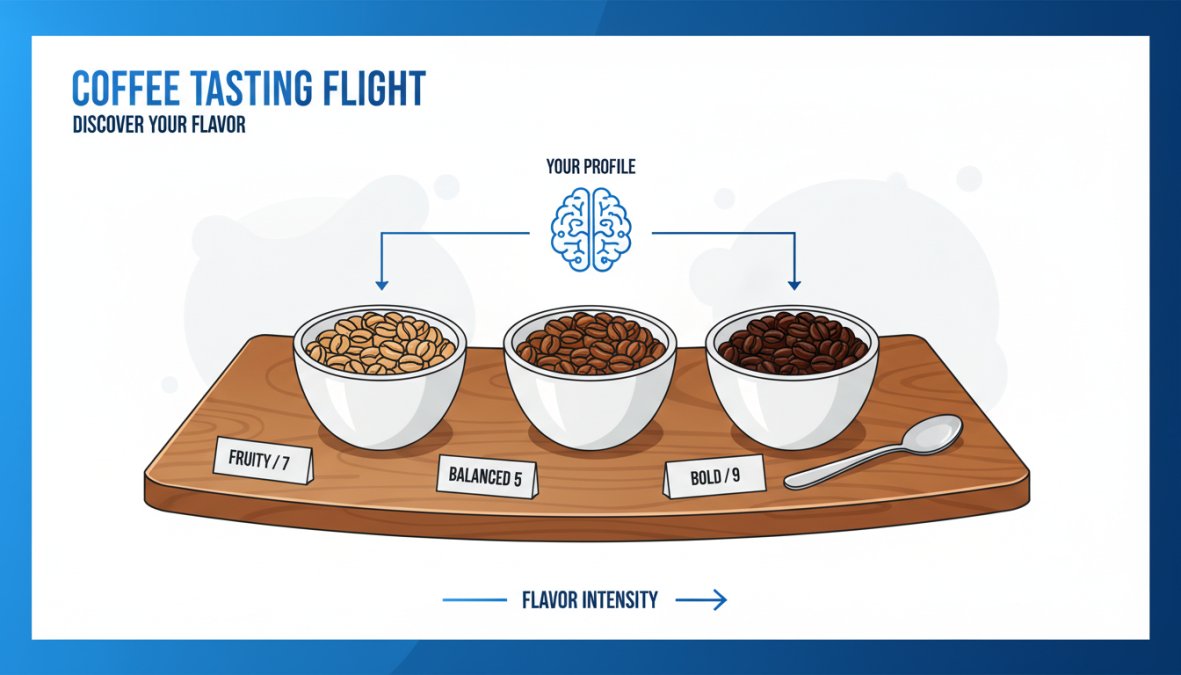
The practical value of a tasting flight is that it removes guesswork from future purchases. After tasting a washed Ethiopian alongside a natural-processed Brazilian and a honey-processed Colombian, most people discover their preferences are more specific than "I like medium roast." They like bright acidity and floral notes, or they prefer low acidity and chocolate-forward body. That specificity makes every future purchase more accurate.
Several services on this list support tasting-flight-style discovery. Bean Box explicitly designs its shipments around this concept. Atlas Coffee Club builds geographic variety into every subscription cycle. For services that do not offer formal flights, you can replicate the experience by ordering two or three single-origin coffees simultaneously and brewing them back to back on the same morning using the same method.
A few practical notes on running your own blind tasting at home:
- Use the same brewing method and water temperature for each coffee
- Taste in order from lightest to darkest roast
- Note acidity (brightness on the sides of your tongue), body (weight and texture), and finish (how long the flavor lingers)
- Write down your impressions before looking at the tasting notes on the bag
The goal is not to become a coffee sommelier. The goal is to stop buying coffee you do not enjoy.
Environmental Impact: Packaging, Shipping, and Ethical Sourcing
The environmental cost of coffee delivery is a real consideration, and it is one most buyers underweight. Shipping frequency, packaging materials, and sourcing practices all contribute to the overall footprint of a coffee subscription.
Direct trade and ethical sourcing are not interchangeable terms. Direct trade means the roaster purchases directly from the farm, typically at a price above commodity market rates. Ethical sourcing is a broader term that can include direct trade but also encompasses fair labor practices, environmental farming standards, and community investment. Counter Culture and Onyx Coffee Lab both publish sourcing transparency reports that detail the price paid per lot, which is the most verifiable form of accountability in this space.
On packaging: single-use pods are often criticized for environmental impact, but sealed capsules that preserve freshness and reduce waste from spoiled coffee present a more nuanced picture. The lifecycle analysis framework from the Rainforest Alliance suggests that food waste reduction and sustainable sourcing often offset packaging concerns when evaluated across the full supply chain.
Practical steps for reducing your subscription's environmental footprint:
- Choose longer shipping intervals (monthly vs. weekly) to reduce per-unit shipping emissions
- Prioritize roasters with published direct-trade or sustainability reports
- Select services that use recyclable or compostable packaging where available
Which Option Is Right for You? A Decision Framework
The right choice depends on three variables: how you brew, how often you drink, and what you value most in a coffee experience.
Use this framework to narrow your decision:
If freshness is your top priority: Choose Cuppari Coffee. Roast-to-order with same-day shipping is the strongest freshness guarantee available, and the diverse selection means you are not sacrificing variety for freshness.
If you want to explore as many roasters as possible: Trade Coffee's 450+ coffee catalog is unmatched for sheer variety. Accept that roast-date consistency will vary.
If you are new to specialty coffee: Bean Box provides the educational scaffolding that makes the learning curve enjoyable rather than intimidating.
If you want a world tour of single-origin coffees: Atlas Coffee Club at $9 per shipment is the most affordable way to systematically explore global origins.
If you want human-guided personalization: MistoBox's curator model is the closest thing to having a knowledgeable friend pick your coffee.
If transparency and micro-lot access matter most: Onyx Coffee Lab is the most technically rigorous option on this list.
If sustainability is non-negotiable: Counter Culture's sourcing model and consistency make it the strongest ethical choice.
One more consideration most guides ignore: start with a one-time purchase before committing to a subscription. Almost every service on this list allows it. Buy a single bag, assess the roast date on arrival, evaluate the packaging, and taste the coffee before you lock in a recurring order.
Finding the right place to buy a diverse coffee selection comes down to matching your priorities, whether that is freshness, variety, education, or sustainability, with a service that genuinely delivers on them. Cuppari Coffee stands out for buyers who refuse to choose between variety and freshness: every order is roasted after it is placed, shipped the same day, and covers single-origin, blends, flavored coffees, and sealed pods with free US shipping. Add to cart and experience the difference that roast-to-order freshness makes in your daily cup.
Frequently Asked Questions
What is the best way to discover new coffee varieties online?
The most effective approach to finding a diverse coffee selection is to use a marketplace or curated subscription service. Platforms like Trade Coffee connect you with 50+ specialty roasters and 450+ unique coffees, while services like Atlas Coffee Club rotate single-origin beans from a different country each month. Starting with a personalized quiz or a coffee tasting flight lets you map your flavor profile before committing to a full subscription, saving money and reducing guesswork.
How do I choose a specialty coffee subscription for diverse beans?
When choosing a specialty coffee subscription for variety, consider four factors: roaster breadth (does it feature one roaster or many?), customization options like grind size and roast level, shipping frequency flexibility, and the roast date printed on each bag. Services that roast to order, like Cuppari Coffee, which roasts and ships the same day, deliver measurably fresher beans. Also check cancellation policies before subscribing, as some services require advance notice to pause or cancel.
Is single-origin or blended coffee better for exploring variety?
Both serve different purposes when building a diverse coffee selection. Single-origin coffees highlight the unique terroir, acidity, and tasting notes of a specific region or micro-lot, making them ideal for learning how origin affects flavor. Blends, by contrast, offer a roaster's intentional balance of body, sweetness, and consistency. For true variety, alternate between the two, many subscriptions like Counter Culture Coffee offer separate single-origin and blend subscription tracks so you can explore both styles.
What should I look for when buying specialty coffee online to ensure freshness?
Always check the roast date, not the expiration date. Freshly roasted coffee is generally best consumed within two to four weeks of the roast date. Look for roasters that use roast-to-order models, meaning beans are roasted only after you place your order. Cuppari Coffee, for example, roasts and ships every order the same day. Also look for sealed, oxygen-free packaging, which significantly extends peak flavor compared to standard bags.
Are online coffee marketplaces better than buying from a single roaster for variety?
Online marketplaces offer unmatched coffee variety by aggregating dozens of roasters in one place, making them ideal if discovering new flavor profiles is your main goal. However, single-roaster services often deliver more consistent freshness, tighter quality control, and better value for money per bag. The best approach depends on your priority: if variety is paramount, choose a marketplace or multi-roaster subscription; if freshness and a curated selection matter more, a dedicated roaster like Cuppari Coffee is the stronger choice.
This article was written using GrandRanker