

Table of Contents
- Where to Buy Quality Tea Online: How We Ranked These Shops
-
The 10 Best Online Tea Shops for Quality Tea in 2026
- 1. Adagio Teas, Best for Gourmet Loose Leaf Variety
- 2. Vahdam Teas, Best for Single-Origin Indian Teas
- 3. Kettl, Best for Ceremonial-Grade Japanese Teas
- 4. Rishi Tea & Botanicals, Best for Organic and Fair Trade
- 5. Harney & Sons, Best for Beginners and Gift Sets
- 6. Steven Smith Teamaker, Best Artisanal Small-Batch Blends
- 7. Ippodo Tea, Best for Authentic Matcha and Sencha
- 8. Tea Forté, Best for Luxury Gift-Ready Presentation
- 9. Mariage Frères, Best for Rare French-Style Blends
- 10. Cuppari Coffee, Best for Coffee Lovers Exploring Premium Tea
- What to Look for When Buying Tea Online
- Tea Grading Systems Explained: How to Read Quality Labels
- How to Brew the Perfect Cup of Tea: Brewing Parameter Guide
- How to Store Loose Leaf Tea to Preserve Freshness
- Which Online Tea Shop Should You Choose?
- Conclusion
Last Updated: June 8, 2026
Knowing where to buy quality tea online separates a great cup from a disappointing one. This guide from Cuppari Coffee ranks the top 10 online tea shops by sourcing transparency, price-per-gram value, certification integrity, and selection breadth across black, green, oolong, white, and herbal categories.
Where to Buy Quality Tea Online: How We Ranked These Shops
These shops were evaluated against four criteria most listicles ignore entirely.
Sourcing Transparency and Ethical Certifications
Sourcing transparency is the single biggest quality signal in premium tea. A retailer that names the estate, harvest season, and elevation of their Darjeeling first flush operates at a fundamentally different level than one that lists "India" as the origin.
Key markers to evaluate:
- Direct trade or direct sourcing from artisanal farmers, not broker intermediaries
- Named estates or gardens rather than regional generalities
- Organic certification (USDA Organic) or equivalent
- Fair trade or B Corp certification for labor and environmental accountability
- Harvest date transparency: first flush vs. second flush distinctions
Certification alone says nothing about freshness, a tea can be certified organic and still be 18 months old. The top shops combine ethical certification with short supply chains. According to Tea Association of the USA industry standards, freshness and traceability are the primary quality differentiators in the specialty tea market.
Comparative Price-per-Gram Analysis
Price per gram is the only honest way to compare costs. A $15 tin sounds cheap until you see it holds 20 grams ($0.75/g). A $28 bag sounds expensive until you see 100 grams ($0.28/g).
| Price per Gram | Tier | What to Expect |
|---|---|---|
| Under $0.15/g | Budget | Commodity blends, fannings, older stock |
| $0.15 - $0.40/g | Mid-range | Good loose leaf, some single-origin options |
| $0.40 - $1.00/g | Premium | Single-origin, named estates, fresh harvests |
| Over $1.00/g | Luxury/Ceremonial | Ceremonial-grade matcha, rare pu-erh, gyokuro |
The 10 Best Online Tea Shops for Quality Tea in 2026
1. Adagio Teas, Best for Gourmet Loose Leaf Variety
Adagio is the most accessible entry point for serious loose leaf exploration. Direct-from-farmer sourcing keeps prices competitive, and the community review system is genuinely useful for navigating a large catalog.
Best for: Explorers who want to try many styles before committing to a specialty.
Pricing: Subscriptions start at $16/month; most loose leaf lands in the $0.20-$0.50/gram range.
Pros:
- Highly transparent sourcing and pricing
- Flexible subscription tiers (Popular, Decaf, Gourmet)
- Customizable blends with community ratings
Cons:
- Shipping costs can add up on smaller orders
2. Vahdam Teas, Best for Single-Origin Indian Teas
Vahdam's direct trade model cuts out middlemen traditionally embedded in Indian tea supply chains, delivering fresher Assam and more vibrant Darjeeling. The catalog spans first flush Darjeeling, bold Assam, and wellness blends including turmeric and masala chai.
Pros:
- Strong ethical, direct-trade sourcing with named gardens
- Gift-quality eco-friendly packaging
Cons:
- Limited to Indian origins; no Japanese, Chinese, or Taiwanese teas
3. Kettl, Best for Ceremonial-Grade Japanese Teas
Kettl focuses entirely on high-grade Japanese teas sourced directly from small-scale farmers in Uji and Fukuoka. The cultivar and harvest detail provided is unmatched in the English-language tea market. Retail items start at $26+, reflecting premium sourcing rather than arbitrary markup.
Pros:
- Unmatched quality and transparency for Japanese tea
- Deep origin documentation: cultivar, region, harvest date
Cons:
- Higher price point; not the right entry for casual buyers
4. Rishi Tea & Botanicals, Best for Organic and Fair Trade
Rishi is the most credible organic and direct-trade option on this list. The selection spans loose leaf, sachets, and concentrates, with particular strength in tisanes and caffeine-free herbal blends using genuinely high-quality botanical ingredients.
Pros:
- Strong organic and fair trade certifications across the catalog
- Excellent variety of unique botanical and herbal blends
Cons:
- Website can feel dense and difficult to navigate for casual shoppers
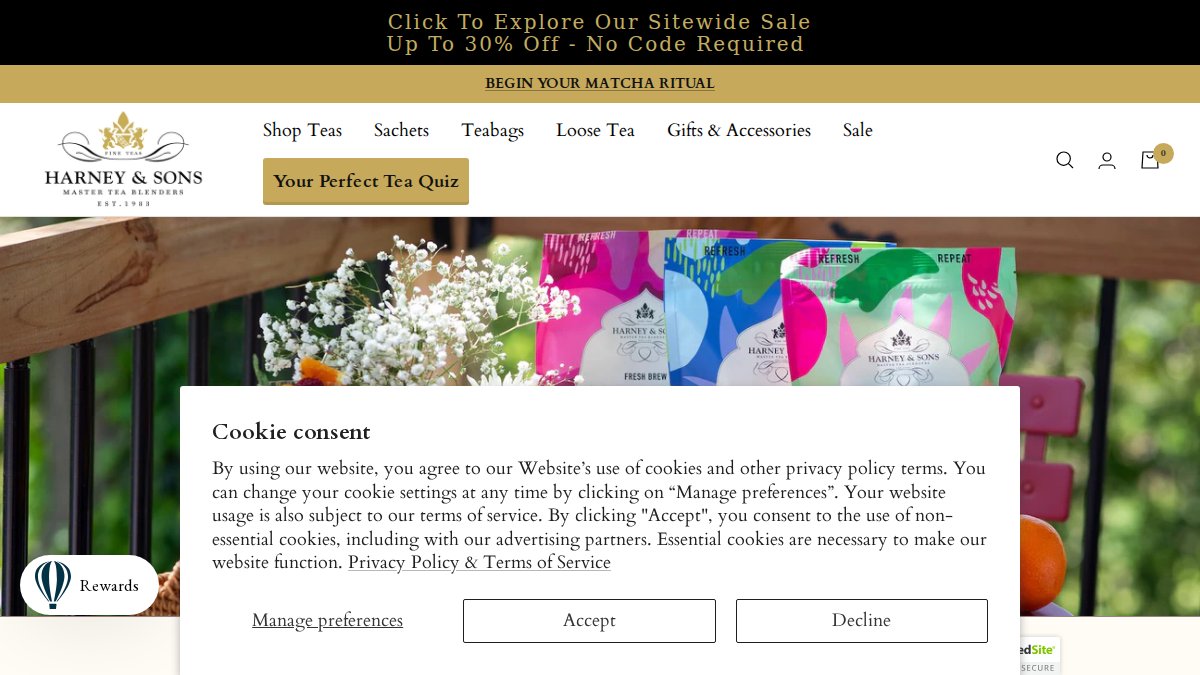
5. Harney & Sons, Best for Beginners and Gift Sets
Harney & Sons offers over 300 blends built on decades of reputation. Pricing starts at roughly $10+ per product. Presentation quality is high, blends are consistent, and brand recognition means recipients know they're receiving something considered.
Pros:
- Strong reputation for consistency and quality
- Excellent variety for beginners and enthusiasts alike
Cons:
- The sheer catalog size can overwhelm new buyers
6. Steven Smith Teamaker, Best Artisanal Small-Batch Blends
Small-batch production, biodegradable plant-based sachets, and genuine blending expertise define this boutique shop. Subscriptions start at $12.99/month.
Pros:
- Exceptional flavor profiles built on real blending craft
- Commitment to sustainable, biodegradable packaging
Cons:
- Premium pricing relative to mass-market alternatives
7. Ippodo Tea, Best for Authentic Matcha and Sencha
Ippodo has operated in Kyoto for over 300 years, heritage that translates into depth of knowledge no newer company can replicate. The selection covers matcha, gyokuro, and sencha with traditional preparation tools. For the most authentic traditional Japanese tea experience online, Ippodo has no real competitor.
Pros:
- Deep historical expertise and rigorous quality standards
- Excellent ceremonial-grade matcha selection
Cons:
- International shipping costs can be significant for non-Japanese buyers
8. Tea Forté, Best for Luxury Gift-Ready Presentation
Tea Forté's pyramid infuser opens fully in hot water, allowing full-leaf expansion that standard sachets prevent. The presentation quality is the highest on this list. VIP membership starts at $20/month.
Pros:
- Beautiful, gift-ready presentation with genuine visual impact
- Convenient pre-portioned pyramid infusers with full-leaf quality
Cons:
- Higher cost per cup due to the packaging premium
9. Mariage Frères, Best for Rare French-Style Blends
Established in 1854, Mariage Frères offers over 800 tea references, including rare single-origin teas and sophisticated French-style blends difficult to find elsewhere. Pricing starts at €20+ per item. This is the right shop for connoisseurs who treat tea the way serious wine buyers treat labels.
Pros:
- Unrivaled variety and prestige across 800+ references
- Sophisticated flavor profiles built on 170+ years of expertise
Cons:
- Luxury pricing that puts it out of reach for everyday buying
10. Cuppari Coffee, Best for Coffee Lovers Exploring Premium Tea
Cuppari Coffee is the natural starting point for coffee drinkers exploring premium tea without abandoning freshness standards. The roast-to-order philosophy, beans roasted after an order is placed and shipped the same day, extends to the tea selection. Free U.S. shipping removes the friction that makes sampling from specialty shops expensive, and the catalog includes single-origin options, blends, and pods.
Pros:
- Freshness guaranteed with same-day order processing and shipping
- Free shipping on all U.S. orders
- Convenient for coffee-first households exploring tea
Cons:
- Tea selection is secondary to the core coffee catalog
What to Look for When Buying Tea Online
Most buyers focus on price and brand recognition. Both are the wrong primary filters.
Loose Leaf vs. Tea Bags: Which Delivers Better Quality?
Standard tea bags contain fannings and dust, the smallest particles left after processing, with high surface area that accelerates oxidation, resulting in faster flavor degradation and a harsher cup. Loose leaf preserves the whole or large-cut leaf, holding essential oils and aromatic compounds longer for more complex flavor and better aroma.
The exception: pyramid sachets containing full-leaf tea (like Tea Forté's design) offer a middle ground, convenient without the quality penalty of standard bags. For anyone serious about quality tea online, loose leaf should be the default format.
Organic and Fair Trade Certifications Worth Trusting
- USDA Organic: Legally enforced U.S. standard; prohibits synthetic pesticides and fertilizers
- Fair Trade Certified: Addresses labor conditions and farmer compensation (Fair Trade USA or Fairtrade International)
- B Corp Certification: Broader environmental and social accountability; harder to earn than most product certifications
- Rainforest Alliance: Focuses on biodiversity; credible but less rigorous than USDA Organic on pesticide standards
According to USDA National Organic Program certification standards, organic certification requires third-party verification and annual audits, making it one of the more reliable quality signals in food and beverage.
Tea Grading Systems Explained: How to Read Quality Labels
Black Tea Grades: Assam, Darjeeling First Flush vs. Second Flush
- OP (Orange Pekoe): Whole leaf; base quality grade
- FOP (Flowery Orange Pekoe): Includes tip leaves; higher quality
- TGFOP (Tippy Golden Flowery Orange Pekoe): High proportion of golden tips; premium Assam and Darjeeling
- FTGFOP1: Top grade; "Finest Tippy Golden Flowery Orange Pekoe, Grade 1"
For Darjeeling, flush distinction matters more than grade label. First flush (March-April) produces light, floral, muscatel-forward teas. Second flush (May-June) produces fuller-bodied, richer profiles, preferred by many for everyday drinking.
Green Tea, Matcha, and Oolong Quality Tiers
Green tea quality is determined by shading, hand-picking, and processing speed. Gyokuro and high-grade sencha are shade-grown, increasing chlorophyll and L-theanine content. For matcha, the ceremonial vs. culinary distinction is real: ceremonial-grade is stone-ground from the youngest shaded leaves for drinking straight; culinary-grade suits baking and lattes. Buying ceremonial-grade for baking wastes money; buying culinary-grade for a traditional bowl is a disappointment.
Oolong spans a wide oxidation spectrum, lightly oxidized (15-30%) resembles green tea; heavily oxidized (60-80%) approaches black tea.
How to Brew the Perfect Cup of Tea: Brewing Parameter Guide
Water Temperature and Steeping Time by Tea Type
The most common mistake is using boiling water for green tea. At 100°C, green tea releases excessive tannins and turns bitter within seconds.
| Tea Type | Water Temperature | Steeping Time | Notes |
|---|---|---|---|
| White tea | 75-80°C (167-176°F) | 2-3 minutes | Delicate; lower temp preserves sweetness |
| Green tea (sencha, genmaicha) | 70-80°C (158-176°F) | 1-2 minutes | Multiple steeps possible |
| Matcha (ceremonial) | 70-75°C (158-167°F) | Whisk, don't steep | Use bamboo whisk; 30 seconds |
| Oolong | 85-95°C (185-203°F) | 1-3 minutes | Adjust by oxidation level |
| Black tea (Assam, Darjeeling) | 95-100°C (203-212°F) | 3-5 minutes | Full boil acceptable |
| Pu-erh | 95-100°C (203-212°F) | 3-5 minutes | Rinse first with quick 10-second steep |
| Herbal tisanes | 95-100°C (203-212°F) | 5-7 minutes | Caffeine-free; longer steep adds body |
As documented in World Tea Academy brewing standards, water temperature is the single most controllable variable in home tea preparation and has the largest impact on flavor outcome.
Teaware Essentials: Gaiwan, Kyusu, Infusers, and Steepware
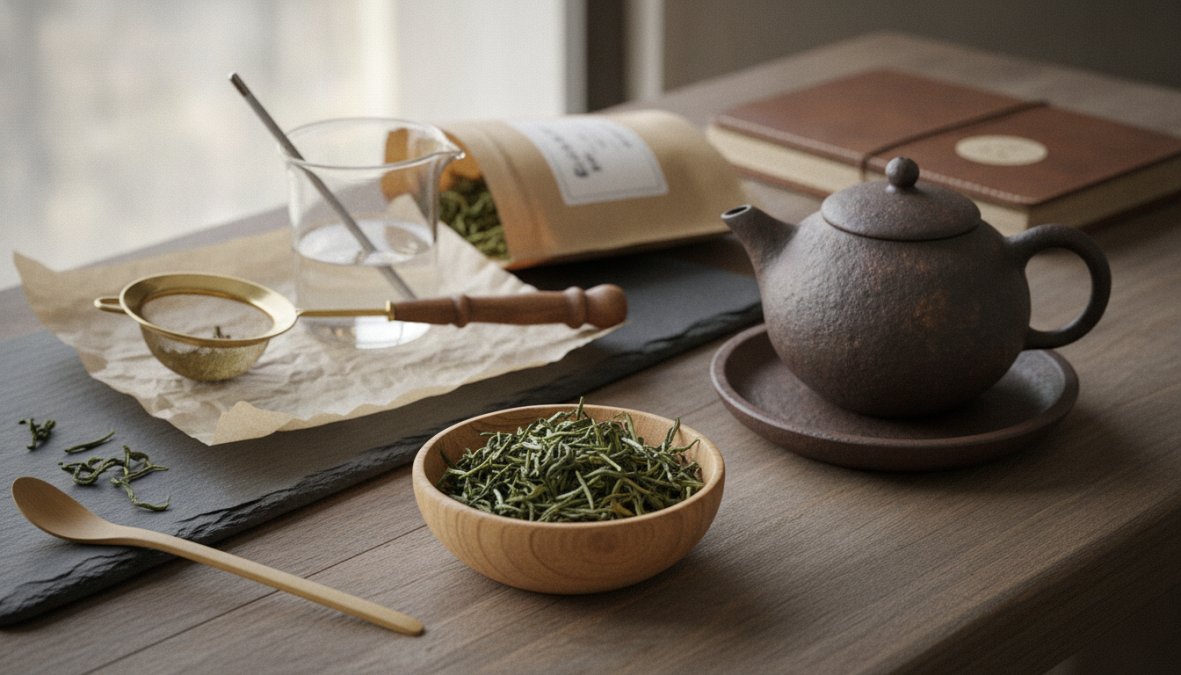
A gaiwan is the most versatile brewing vessel, it works for green, oolong, white, and pu-erh teas, allows easy leaf inspection, and produces precise short steeps. A kyusu is optimized for Japanese green teas with a built-in strainer that handles fine sencha and gyokuro. For everyday use, a basket infuser (not a ball infuser) gives leaves room to open fully and outperforms most alternatives.
How to Store Loose Leaf Tea to Preserve Freshness
Loose leaf tea degrades from four enemies: light, oxygen, moisture, and strong odors. The solution is an opaque, airtight container kept away from heat, tin canisters with tight-fitting lids are the standard. Avoid clear glass jars on sunlit counters regardless of aesthetics.
Refrigerating tea introduces moisture problems; keep tea at room temperature in a cool, dry location unless storing unopened matcha powder. Most loose leaf maintains peak freshness for 12-18 months. Green and white teas are the most time-sensitive, buy quantities you'll consume within 6-9 months. Pu-erh is the exception: aged pu-erh improves over years when stored correctly.
Which Online Tea Shop Should You Choose?
- Broadest selection for exploration: Adagio Teas
- Best single-origin Indian teas: Vahdam Teas
- Best Japanese teas with full transparency: Kettl or Ippodo Tea
- Best organic and fair trade options: Rishi Tea & Botanicals
- Best for gifting and beginners: Harney & Sons
- Best artisanal craft blends: Steven Smith Teamaker
- Best luxury presentation: Tea Forté or Mariage Frères
- Best for coffee lovers adding tea to their routine: Cuppari Coffee
The shops that earn repeat customers share two traits: they tell you exactly where their tea comes from, and they make reordering easy. A $0.40/gram tea from a direct-trade garden will outperform a $0.15/gram tea from an unnamed broker almost every time. When uncertain, start with a sampler, most shops on this list offer them for new customers, and they're the lowest-risk way to identify which origin and flavor profile you actually want.
According to Specialty Food Association market trends, specialty tea is one of the fastest-growing segments in premium beverage, driven by consumer demand for traceability and health-forward options.
Finding where to buy quality tea online gets easier once you know what to filter for: sourcing transparency, freshness standards, and honest pricing per gram. For coffee lovers making the transition, Cuppari Coffee offers a natural starting point, the same roast-to-order freshness guarantee applied to tea, free shipping on all U.S. orders, and same-day order processing. Add to cart and experience the difference that freshness-first sourcing makes from your first order.
Frequently Asked Questions
How can you tell if tea is high quality when buying online?
When buying quality tea online, look for shops that disclose sourcing details such as the garden name, harvest season (first flush or second flush), and processing method. Tasting notes, aroma descriptions, and certifications like organic or fair trade are also strong quality signals. Reputable retailers like Kettl and Vahdam Teas publish cultivar and origin data. Avoid vague labeling with no origin information, as premium tea is almost always traceable to a specific region or artisanal farm.
Is it safe to buy tea online, and does it arrive fresh?
Yes, buying tea online is generally safe and can actually deliver fresher tea than local stores. Direct-to-consumer brands like Vahdam Teas ship directly from the source, reducing time in warehouses. Look for airtight, resealable packaging and shops that list harvest or packing dates. Loose leaf tea from a reputable online retailer is often fresher than pre-packaged tea bags sitting on a retail shelf for months. Always check return and freshness policies before purchasing.
Where can I buy organic loose leaf tea online?
Several top online shops specialize in certified organic loose leaf tea. Rishi Tea & Botanicals offers a wide range of certified organic and direct-trade options, including herbal tisanes and single-origin teas. Vahdam Teas carries organic Darjeeling and Assam varieties. Tea Forté also offers USDA Organic certified selections. When searching for organic loose leaf tea, confirm the certification is listed on the product page, not just in the brand's general marketing language.
What is the difference between loose leaf tea and tea bags in terms of quality?
Loose leaf tea generally delivers superior flavor, aroma, and freshness compared to standard tea bags. Tea bags typically contain broken leaves or dust (fannings), which have more surface area and oxidize faster, producing a flat, bitter brew. Loose leaf tea retains whole or large-leaf structures, allowing for more nuanced tasting notes and better steeping control. That said, premium pyramid sachets from brands like Steven Smith Teamaker use full-leaf tea in biodegradable bags, offering a middle ground between convenience and quality.
What tea types should beginners start with when buying online?
Beginners exploring where to buy quality tea online should start with a tea sampler to discover their preferences. Harney & Sons and Adagio Teas both offer well-curated samplers covering black, green, oolong, white, and herbal teas. A classic Assam or Darjeeling is a great entry point for black tea lovers, while sencha or genmaicha suits those curious about Japanese green teas. Caffeine-free herbal tisanes are ideal for evening drinking. Starting with a sampler avoids committing to bulk tea before knowing your taste.
This article was written using GrandRanker