

Table of Contents
- Why Coffee Tastes Bitter After Brewing: Understanding Over-Extraction
- Coffee Grind Size for Bitterness: The First Control Point
- Coffee Water Temperature for Brewing: Finding the Sweet Spot
- Brew Time and Steeping: Why Minutes Matter
- Coffee Bean Freshness and Roast Profile: Start with Quality
- Equipment Cleanliness and Maintenance: Hidden Culprits
- How to Fix Bitter Coffee: 7 Actionable Steps
- Common Mistakes That Make Coffee Taste Bitter
Last Updated: July 29, 2026
Why Coffee Tastes Bitter After Brewing: Understanding Over-Extraction
When hot water contacts coffee grounds for too long, it pulls out excessive bitter compounds, a process called over-extraction that transforms smooth, balanced coffee into something harsh. At Cuppari Coffee, we've helped countless enthusiasts fix this common problem. Once you understand the mechanics behind bitterness, fixing it becomes straightforward.
Most assume bitterness means poor-quality beans. In reality, the brewing method is usually the culprit. A single variable, grind size, water temperature, brew time, or equipment cleanliness, can shift your coffee from exceptional to undrinkable. This guide walks you through each variable and shows you exactly how to diagnose and fix bitter coffee.
How Over-Extraction Creates Bitter Flavors
Over-extraction happens when water dissolves too many soluble compounds from coffee grounds. Coffee contains thousands of organic compounds with different solubility rates. Desirable ones, sugars, acids, and aromatic compounds, dissolve first. But if water stays in contact too long, it pulls out bitter phenolic compounds and astringent tannins that create harsh, dry mouthfeel.
Think of extraction like steeping tea. Steep for 30 seconds and you get balanced flavor. Leave it for five minutes and it tastes bitter. Coffee works the same way: under-extraction tastes sour and thin, optimal extraction tastes balanced and complex, and over-extraction tastes harsh and bitter.
Bitter vs. Sour: Which Problem Do You Have?
Before adjusting brewing variables, identify whether your problem is bitterness or sourness. These opposite problems require opposite solutions.
Bitterness tastes harsh, dry, and astringent. Your mouth feels drying after swallowing. Bitterness signals over-extraction, too much contact time between water and grounds.
Sourness tastes acidic and tangy, like lemon or vinegar. It hits your palate immediately and feels sharp. Sourness signals under-extraction, not enough contact time to dissolve the full flavor profile.
The distinction matters because fixes are opposite. Sour coffee needs longer brew time, hotter water, or finer grounds. Bitter coffee needs shorter brew time, cooler water, or coarser grounds.
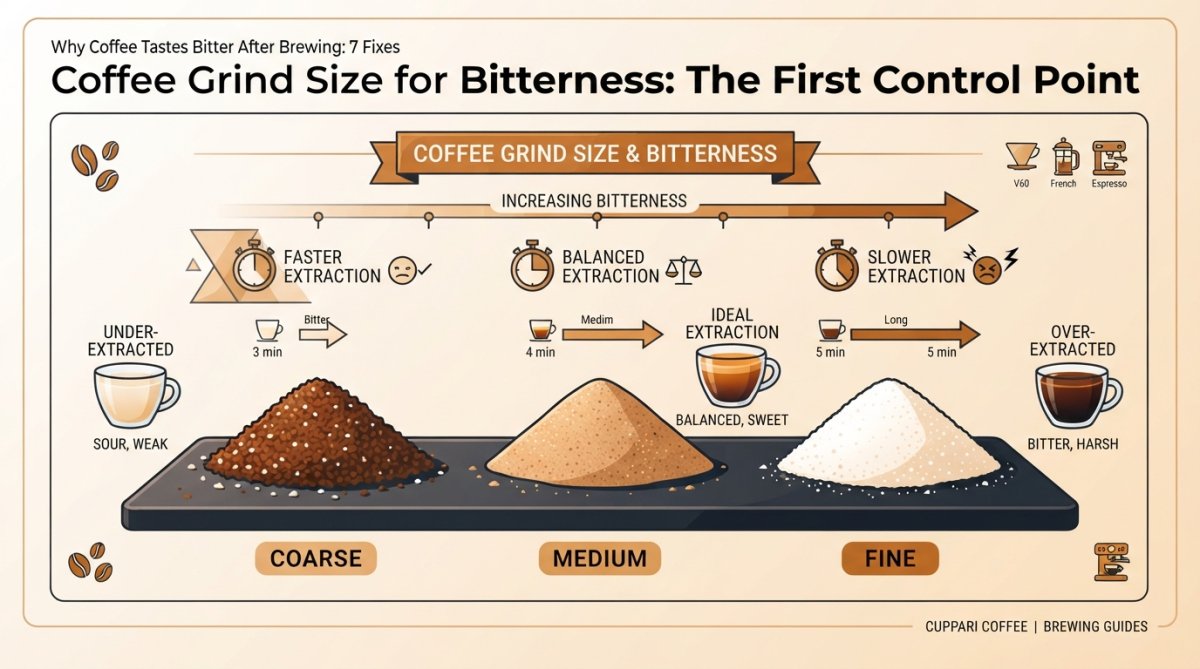
Coffee Grind Size for Bitterness: The First Control Point
Grind size controls how quickly water extracts compounds from grounds. Finer grounds expose more surface area to water, speeding up extraction. Coarser grounds slow extraction by reducing surface area. This single variable often makes the difference between excellent coffee and undrinkable bitterness.
Fine vs. Coarse Grounds and Surface Area
When you grind coffee finer, you create more total surface area for water to contact. A fine espresso grind might have 100 times more surface area than a coarse French press grind of the same bean.
More surface area means faster extraction. Using a fine grind with a brewing method designed for coarse grounds causes over-extraction within seconds. This is why espresso machines use very fine grounds but short brew times, the intense pressure and fine particles extract quickly, but short contact time prevents over-extraction.
For drip coffee makers, medium grounds work best. Pour-over methods often use medium-fine grounds because slower water flow compensates for increased surface area. French press requires coarse grounds because the long steeping time (4 minutes) would over-extract with anything finer.
Burr Grinders vs. Blade Grinders: Consistency Matters
A burr grinder produces uniform particle sizes. A blade grinder chops randomly, creating a mix of fine powder and large chunks. This inconsistency causes uneven extraction, fine particles over-extract while coarse particles under-extract simultaneously.
If you're using a blade grinder, switching to a burr grinder often solves bitterness complaints immediately, even without changing anything else.
Coffee Water Temperature for Brewing: Finding the Sweet Spot
Water temperature directly controls extraction rate. The ideal temperature range for most brewing methods is 195-205°F (90-96°C). This range extracts the full flavor profile without pulling excessive bitter compounds.
Temperature Range and Extraction Rate
Water at 212°F (boiling) extracts so aggressively that even short brew time produces bitter coffee. Let boiling water cool for 30 seconds before brewing. This drops temperature to the optimal range.
Water below 195°F extracts so slowly that you need significantly longer brew times to get balanced flavor. Most coffee makers heat water to approximately 200°F, which sits in the ideal range. If you're using a pour-over method, use a thermometer to verify your water temperature.
Water Chemistry: TDS and Mineral Content
Water chemistry affects extraction more than most brewers realize. Total dissolved solids (TDS) in your water influence how readily compounds dissolve from coffee grounds. Soft water (low mineral content) extracts slowly. Hard water (high mineral content) extracts quickly.
The ideal water for coffee brewing contains 50-150 parts per million (ppm) of dissolved minerals. Most municipal tap water falls in this range. If you have exceptionally hard or soft water, consider using filtered water for brewing.
Brew Time and Steeping: Why Minutes Matter
Contact time between water and grounds determines extraction completeness. Longer contact time extracts more compounds. The optimal contact time varies by brewing method.
Contact Time for Different Brewing Methods
French press requires 4 minutes of steeping. Reducing this to 3 minutes produces under-extracted, sour coffee. Extending to 5 minutes produces over-extracted, bitter coffee.
Pour-over methods typically take 2.5-4 minutes depending on grind size and water flow rate. Drip coffee makers vary widely, some brew in 5 minutes, others in 10 minutes. If brew time consistently exceeds 6 minutes, the machine may have a design flaw that over-extracts. Espresso uses extremely short contact time, 25-30 seconds, because high pressure forces water through grounds rapidly.
If your coffee tastes bitter, reduce brew time by 15-30 seconds and taste the difference. This single adjustment often fixes bitterness without requiring equipment changes.
Coffee Bean Freshness and Roast Profile: Start with Quality
Bean quality and freshness matter more than most variables. Stale coffee tastes flat and bitter no matter how perfectly you brew it. Dark roasts taste inherently more bitter than light roasts because the roasting process creates bitter compounds through caramelization.
Degassing and Peak Flavor Window
Coffee beans release carbon dioxide (CO2) after roasting. This degassing process peaks within 24-48 hours after roasting. After 2-3 weeks, flavor quality declines. After 4 weeks, beans taste noticeably stale.
Cuppari Coffee roasts beans only after your order is placed and ships the same day, ensuring your coffee arrives during the peak flavor window. Grocery store beans may have been roasted weeks earlier, forcing you to over-extract just to get balanced flavor from stale beans.
Dark Roast vs. Light Roast Bitterness
Dark roasts naturally taste more bitter than light roasts. This isn't a flaw, it's roasting chemistry. If you consistently experience bitterness, try switching to a light or medium roast. Single-origin beans often taste different than blends. If your current beans taste persistently bitter, trying a different origin or roast level might solve the problem more effectively than adjusting brew variables.
Equipment Cleanliness and Maintenance: Hidden Culprits
Dirty equipment produces bitter coffee even with perfect brewing technique. Oil buildup from previous brews creates rancid flavors that contaminate fresh coffee.
Oil Buildup and Rancid Flavors
Coffee oils are hydrophobic and don't dissolve in water. Over time, oils accumulate on your brewing equipment's interior surfaces. When you brew fresh coffee, water contacts these rancid oils and picks up stale, bitter flavors.
This happens in French press filters, pour-over baskets, espresso machine group heads, and automatic drip coffee maker brew baskets. Disassemble your equipment weekly and wash all parts that contact coffee or water with hot water and dish soap. For stubborn buildup, soak parts in hot water for 15 minutes before scrubbing. For espresso machines and automatic drip makers, run a cleaning cycle with specialized coffee machine cleaner monthly.
How to Fix Bitter Coffee: 7 Actionable Steps
Here's how to apply this knowledge systematically to fix your bitter coffee.
Step 1: Coarsen Your Grind
Start here because grind size is the easiest variable to adjust. If you're using a burr grinder, move the dial one setting coarser. Coarser grounds slow extraction by reducing surface area. Brew your next pot and taste it.
Step 2: Lower Water Temperature
If coarser grounds didn't fix the bitterness, your water is probably too hot. Use a thermometer to measure your water temperature. If it's above 205°F, let it cool for 30-60 seconds after boiling before brewing.
Step 3: Reduce Brew Time
Shorter contact time extracts fewer bitter compounds. Reduce your brew time by 15-30 seconds. For French press, reduce from 4 minutes to 3.5 minutes. For drip coffee, interrupt the brew at 7 minutes instead of 8.
Step 4: Adjust Coffee-to-Water Ratio
Use less coffee relative to water. If you've been using 1 ounce of coffee per 16 ounces of water, try 0.9 ounces per 16 ounces. Measure your coffee by weight if possible for precision.
Step 5: Use Fresher Beans
If you've adjusted grind size, temperature, brew time, and ratio without success, your beans might be stale. Buy fresh beans roasted within the past week. Look for a roast date on the bag.
Cuppari Coffee guarantees freshness by roasting only after your order is placed and shipping the same day, ensuring your beans arrive during the peak flavor window.
Step 6: Clean Your Equipment Thoroughly
Disassemble every part of your brewing equipment that contacts coffee or water. Wash with hot water and dish soap. For automatic machines, run a cleaning cycle with coffee machine cleaner. This removes rancid oil buildup that causes persistent bitterness.
Step 7: Test Your Water Quality
If all six previous steps haven't fixed the bitterness, your water chemistry might be the issue. Buy an inexpensive water hardness test kit. If your water is extremely hard (above 200 ppm), use filtered water for brewing.
| Step | Variable | Adjustment | Time Required |
|---|---|---|---|
| 1 | Grind size | Move to coarser setting | 1 minute |
| 2 | Water temperature | Cool to 195-205°F | 1 minute |
| 3 | Brew time | Reduce by 15-30 seconds | 1 minute |
| 4 | Coffee-to-water ratio | Reduce coffee amount slightly | 2 minutes |
| 5 | Bean freshness | Purchase beans roasted this week | 0 minutes |
| 6 | Equipment cleanliness | Deep clean all parts | 20-30 minutes |
| 7 | Water chemistry | Test hardness or use filtered water | 10 minutes |
Common Mistakes That Make Coffee Taste Bitter
Mistake 1: Using boiling water directly. Boiling water (212°F) extracts too aggressively. Let water cool 30 seconds after boiling.
Mistake 2: Grinding too fine. Fine grounds extract quickly. Match your grind size to your brewing method.
Mistake 3: Brewing too long. French press shouldn't steep longer than 4 minutes. Drip coffee shouldn't take longer than 6-7 minutes.
Mistake 4: Ignoring equipment cleanliness. Oil buildup creates rancid flavors. Clean your equipment weekly.
Mistake 5: Assuming all bitterness means over-extraction. Sometimes bitter taste comes from dark roasts, stale beans, or water chemistry. Adjust one variable at a time.
Mistake 6: Using pre-ground coffee older than two weeks. Ground coffee loses flavor rapidly. Buy smaller quantities more frequently.
Mistake 7: Blaming the beans when the problem is technique. Master the brewing fundamentals first. Perfect technique with average beans beats poor technique with premium beans.
Bitter coffee frustrates even experienced drinkers, but the fix is systematic. By working through these seven variables, grind size, water temperature, brew time, ratio, bean freshness, equipment cleanliness, and water quality, you'll identify the exact cause of your bitterness. Cuppari Coffee's freshly roasted beans eliminate one variable entirely, arriving at peak flavor within days of roasting. Combined with proper brewing technique, fresh beans transform your daily cup from harsh and unpleasant to smooth and balanced. Start with step one today and taste the difference within your next brew.
Frequently Asked Questions
What causes coffee to taste bitter after brewing?
Bitter coffee is typically caused by over-extraction, when hot water pulls too many organic compounds and dissolved solids from the grounds. This happens when grind size is too fine, water temperature is too high, brew time is too long, or the coffee-to-water ratio is off. Over-extraction creates harsh, astringent flavors that mask the coffee's natural flavor profile. Stale beans and dirty equipment can also contribute to bitterness.
How does grind size affect bitter coffee taste?
Grind size directly controls the surface area of coffee grounds exposed to water. Finer grinds have more surface area, increasing extraction rate and the risk of over-extraction. Coarser grinds reduce surface area, slowing extraction. If your coffee tastes bitter, try using a coarser grind, this is often the easiest fix. Using a burr grinder instead of a blade grinder also ensures consistent particle size, preventing some grounds from over-extracting while others under-extract.
What water temperature should I use to avoid bitter coffee?
Ideal brewing temperature is typically 195-205°F for most methods. Water above 205°F extracts too quickly and aggressively, pulling excessive bitter compounds. Water below 195°F may under-extract, creating sour or weak coffee. Additionally, water chemistry matters, high total dissolved solids (TDS) or mineral content can intensify bitterness. If your tap water is hard, consider filtered or distilled water to improve flavor balance and reduce harsh aftertaste.
Is bitter coffee the same as sour coffee, and how do I tell the difference?
No. Bitter coffee tastes harsh, dry, and astringent, a lingering unpleasant aftertaste from over-extraction. Sour coffee tastes acidic and tangy, usually from under-extraction or using beans that are too light-roasted or stale. To distinguish: bitter coffee often feels drying on your palate; sour coffee feels sharp on your tongue. Fixing bitter coffee requires longer steeping time or hotter water; fixing sour coffee requires shorter brew time or cooler water. Fresh, quality beans help eliminate both issues.
This article was written using GrandRanker