

Table of Contents
- Why Fresh Coffee Tastes Better: Oxidation and Aromatic Compounds
- The Coffee Degassing Process: Why Carbon Dioxide Matters
- The 'Too Fresh' Paradox: Why Freshly Roasted Isn't Always Ready
- Best Time to Drink Coffee After Roasting for Peak Flavor
- Why Pre-Ground Coffee Loses Flavor Faster Than Whole Beans
- Signs of Stale Coffee Beans You Should Never Ignore
- How to Store Coffee Beans for Maximum Freshness
- Why Fresh Coffee Tastes Better: Putting It All Together
Last Updated: May 30, 2026
Ask any coffee drinker why does fresh coffee taste better than the bag sitting in the back of the cabinet, and they'll say "it just does." But the real answer runs deeper than intuition. At Cuppari Coffee, we roast every order to fulfillment and ship the same day precisely because the chemistry of freshness is not a marketing claim. It is measurable, traceable, and surprisingly fragile. Below, we'll walk through the exact science behind what makes a fresh cup vibrant and what quietly destroys it.
The core argument here is worth stating plainly: freshness is not one thing. It's the intersection of degassing, oxidation, volatile oil preservation, and grind surface area. Most guides treat these as separate tips. They're actually a single interconnected system, and understanding how they connect changes how you buy, store, and brew.
Why Fresh Coffee Tastes Better: Oxidation and Aromatic Compounds
Fresh coffee tastes better primarily because its aromatic compounds and volatile oils remain intact. Once those compounds begin to degrade, the flavor profile shifts from vibrant and balanced to flat, bitter, and one-dimensional.
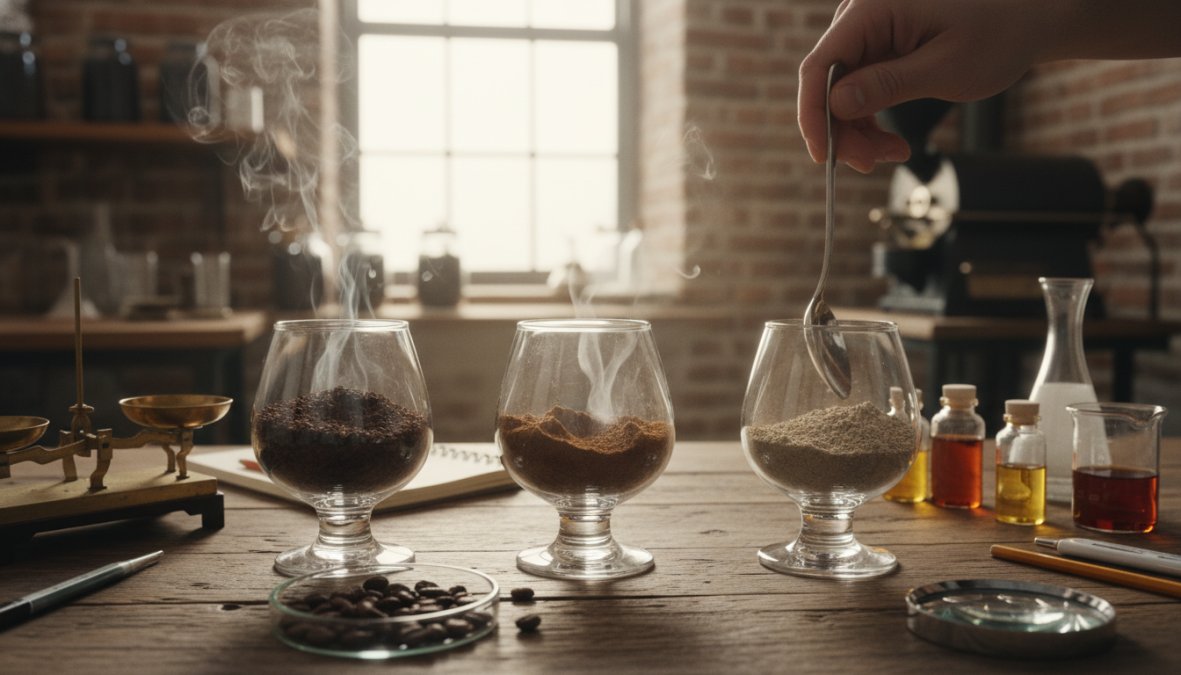
Coffee beans contain hundreds of volatile aromatic compounds formed during the roasting process. These compounds, including aldehydes, ketones, and furans, are responsible for the sweetness, acidity, and complexity you notice in a well-made cup. The problem is that they are inherently unstable. Oxygen exposure triggers oxidation reactions that break these compounds down rapidly, and the degradation begins the moment roasted beans are exposed to open air.
The Role of Volatile Oils and Amino Acids in Flavor
The natural oils on and within coffee beans carry a significant portion of the flavor you taste. These volatile oils are produced during roasting when heat transforms raw lipids into aromatic compounds. Alongside oils, amino acids and sugars undergo the Maillard reaction during roasting, creating the layered complexity that distinguishes specialty coffee from commodity coffee.
Here's what most guides miss: it's not just the oils themselves that matter, it's their rate of evaporation and oxidation. At room temperature, volatile compounds begin escaping from the bean surface almost immediately after roasting. Grinding accelerates this dramatically because it shatters the bean's protective structure and exposes interior oils to air. The sweetness and brightness you associate with good coffee are the first casualties.
How Oxygen Exposure Destroys Your Coffee's Flavor Profile
Oxidation is the primary enemy of fresh coffee. When oxygen molecules interact with the aromatic compounds in roasted beans, they break chemical bonds that hold flavor together. The result is stale coffee: dull, papery, and often unpleasantly bitter.
A common mistake is assuming that sealed packaging solves the problem entirely. Standard packaging without a one-way valve allows oxygen to accumulate inside the bag as beans off-gas carbon dioxide. Proper airtight storage with degassing valves, or better yet, consuming beans within the optimal freshness window, is the more reliable solution. According to research published by the Specialty Coffee Association, oxidation is the single largest contributor to post-roast flavor loss in whole bean coffee.
The Coffee Degassing Process: Why Carbon Dioxide Matters
Degassing is the process by which freshly roasted coffee beans release carbon dioxide gas trapped inside the bean structure during roasting. This process is central to understanding why does fresh coffee taste better when given the right amount of rest, and why brewing too soon after roasting can actually undermine extraction quality.
What Happens Inside the Bean After Roasting
During roasting, the Maillard reaction and caramelization produce significant volumes of carbon dioxide as byproducts. This CO2 becomes trapped within the bean's cellular structure. After roasting, the gas begins escaping gradually, a process that can continue for several days to weeks depending on roast level, bean origin, and storage conditions.
The carbon dioxide serves a protective function in the short term: it displaces oxygen inside the bean and within sealed packaging, slowing oxidation. This is why freshly roasted beans actually benefit from a short rest period before brewing. Brewing with beans that are still heavily off-gassing causes CO2 to interfere with water's ability to extract flavor compounds evenly, resulting in under-extracted, sour, or uneven cups. As documented in food chemistry research on coffee degassing, the rate of CO2 release is highest in the first 24-48 hours post-roast and slows significantly over the following week.
The 'Too Fresh' Paradox: Why Freshly Roasted Isn't Always Ready
This is the section most coffee guides quietly skip, because it complicates the 'fresher is always better' marketing message. The truth is more interesting: coffee roasted within the last 24 to 48 hours can produce a cup that tastes gassy, metallic, or sour, not because anything went wrong, but because the chemistry inside the bean hasn't finished its post-roast transformation.
Understanding why requires going one level deeper than 'CO2 is escaping.'
The Chemistry Behind the Gassy, Metallic Cup
During roasting, the Maillard reaction and pyrolysis generate carbon dioxide at a rate far faster than the bean's cellular structure can release it. CO2 becomes trapped under pressure inside the bean's porous matrix. In the hours immediately after roasting, that pressure is at its highest, and when hot brew water contacts the grounds, the sudden release of CO2 does two things that damage flavor.
First, the rapid outgassing physically disrupts extraction. Water molecules are trying to dissolve soluble flavor compounds from the ground surface, but CO2 bubbling out of the same surface creates a barrier, essentially pushing water away from the grounds before full dissolution can occur. The result is uneven, channeled extraction that tastes simultaneously sour (under-extracted acids) and hollow (missing the sweetness and body that require more contact time).
Second, and less commonly discussed: dissolved CO2 in brew water forms carbonic acid (H₂CO₃), a weak acid that adds a sharp, almost metallic edge to the cup. At normal CO2 levels in a well-rested bean, this effect is negligible. In a bean roasted within the past day, the CO2 concentration is high enough that carbonic acid becomes a perceptible flavor contributor, the 'gassy' or 'mineral-sharp' note that experienced tasters describe when brewing too-fresh coffee.
Why Espresso and Pour-Over Have Completely Different Rest Requirements
Not all brewing methods are equally disrupted by excess CO2, and this is where most guides treat the paradox as a single rule when it's actually method-specific.
Espresso (recommended rest: 7-14 days post-roast)
Espresso is the most CO2-sensitive method because it uses 9 bars of pressure to force water through a compacted puck of finely ground coffee. When beans are too fresh, the CO2 still trapped in the grounds expands under that pressure, creating micro-channels through the puck, a phenomenon baristas call channeling. Water follows the path of least resistance through those channels rather than extracting evenly across the entire puck. The result is a shot that runs fast, appears blonde too early, and tastes thin and sour regardless of how carefully the dose and tamp were dialed in. Many specialty roasters recommend a minimum 7-day rest for espresso, with the sweet spot between days 10 and 21 for most medium roasts. Darker roasts degas faster and can be ready slightly sooner; lighter roasts degas more slowly and may benefit from resting closer to 14 days before pulling a clean shot.
Pour-Over and Filter (recommended rest: 4-8 days post-roast)
Filter methods are more forgiving because there is no pressurized puck to channel. The bloom phase, the initial 30-to-45-second pre-infusion where hot water saturates the grounds, actually serves as a controlled degassing step. Excess CO2 escapes during the bloom before the main pour begins, which means filter brewing self-corrects for moderate over-freshness in a way espresso cannot. That said, beans roasted within 48 hours still produce a noticeably uneven bloom and a cup with that carbonic sharpness. A 4-to-8-day rest is sufficient for most filter applications, with lighter, more delicate roasts benefiting from the longer end of that range.
Cold Brew (recommended rest: 3-5 days post-roast)
Cold brew is the most forgiving method for fresh beans. Because no heat is involved, CO2 release during brewing is minimal, and the 12-to-24-hour steep time compensates for extraction inconsistencies. The carbonic acid effect is also absent at cold temperatures. Beans as fresh as 3 days post-roast can produce acceptable cold brew, though flavor complexity still improves with a short rest.
French Press (recommended rest: 5-10 days post-roast)
French press sits between filter and espresso in sensitivity. The coarser grind means less surface area releasing CO2 simultaneously, but the full-immersion method means any carbonic sharpness stays in the cup rather than draining away. A 5-to-10-day rest produces the rich, oil-forward body French press is known for without the gassy edge.
The Practical Rest Window by Method
| Brew Method | Minimum Rest | Optimal Window | Why |
|---|---|---|---|
| Espresso | 7 days | Days 10-21 | High pressure amplifies channeling from excess CO2 |
| Pour-Over / Filter | 4 days | Days 5-14 | Bloom phase offsets moderate CO2; lighter roasts need more time |
| French Press | 5 days | Days 6-16 | Full immersion retains carbonic sharpness if too fresh |
| Cold Brew | 3 days | Days 3-10 | No heat = minimal CO2 activation; most forgiving method |
| AeroPress | 4 days | Days 5-14 | Similar to filter; short brew time slightly reduces CO2 impact |
The narrow window between 'too fresh to brew cleanly' and 'too old to taste vibrant' is real, and it's different for every method. Knowing which side of that window your beans are on, and adjusting your method or waiting accordingly, is one of the highest-leverage habits in home brewing.
Best Time to Drink Coffee After Roasting for Peak Flavor
The best time to drink coffee after roasting is between 5 and 21 days post-roast for filter methods, and 7 to 14 days for espresso. This window balances sufficient degassing with minimal oxidation, producing the most vibrant and balanced cup possible.
Roast Date vs. Best-By Date: What the Label Really Tells You
Many coffee bags display a best-by date rather than a roast date. This distinction matters enormously. A best-by date tells you when the roaster believes the coffee will fall below acceptable quality. A roast date tells you when the beans were actually roasted, giving you the information needed to calculate where you are in the optimal freshness window.
A bag with a roast date of 60 days ago and a best-by date of 90 days from now is not the same as a bag roasted last week. Both might technically be "within date," but the flavor difference is significant. Roasters who print roast dates are signaling confidence in their product's freshness. Roasters who only print best-by dates are often obscuring the age of their beans.
The practical checklist for reading coffee labels:
- Roast date present: Calculate days since roasting. Aim to brew between days 5-21.
- Only best-by date: Subtract the typical shelf life (often 6-12 months) to estimate roast date.
- No date at all: Treat the beans as potentially stale and adjust expectations accordingly.
Why Pre-Ground Coffee Loses Flavor Faster Than Whole Beans
Pre-ground coffee loses flavor faster than whole beans because grinding dramatically increases the surface area exposed to oxygen, accelerating both oxidation and the escape of volatile aromatic compounds. This is not a minor difference. Ground coffee can become noticeably stale within 15-30 minutes of grinding.
Surface Area, Grind Size, and the Speed of Flavor Loss
The relationship between grind size and flavor loss is direct: finer grinds have more surface area and therefore lose aromatic compounds faster. A coarse grind for French press has less exposed surface than a fine espresso grind, which means it retains flavor slightly longer after grinding. But both degrade far faster than whole beans.
Grind consistency also affects extraction quality beyond freshness. Inconsistent grind particles, often called "fines," extract at different rates than larger particles, producing a cup with both over-extracted bitterness and under-extracted sourness simultaneously. A quality burr grinder produces uniform particle sizes that extract evenly, which is why grind consistency is as important as grind freshness.
The practical recommendation is straightforward: grind immediately before brewing, every time. Pre-grinding even 30 minutes in advance is enough to notice flavor loss in a well-dialed espresso. For drip coffee, the difference is subtler but still present.
| Grind Timing | Flavor Retention | Recommended For |
|---|---|---|
| Ground fresh, brew immediately | Highest | All brew methods |
| Ground 30 min before brewing | Moderate | Filter coffee only |
| Ground 1-2 hours before | Noticeable loss | Not recommended |
| Pre-ground (days old) | Significant loss | Avoid if possible |
Signs of Stale Coffee Beans You Should Never Ignore
Stale coffee announces itself clearly if you know what to look for. The most reliable signs of stale coffee beans include a flat or absent aroma, an oily or waxy surface on beans that should be dry, and a dull, papery taste with no sweetness or brightness in the cup.
Fresh beans have a distinct, complex smell when you open the bag. Stale beans smell faint, musty, or like cardboard. This is the volatile aromatic compounds having already evaporated or oxidized. If you can't smell the coffee through the bag before opening, that's a warning sign.
The bloom test is another reliable indicator. When you pour hot water over fresh grounds, you should see vigorous bubbling and expansion as CO2 escapes. Little to no bloom means the CO2 has already off-gassed, which typically indicates older beans. A flat bloom doesn't automatically mean bad coffee, but combined with a weak aroma, it's a strong signal that the shelf life has been exceeded.
How to Store Coffee Beans for Maximum Freshness
Storage advice for coffee is one of the most repeated and least precise topics in the category. Most guides say 'airtight container, away from light and heat' and stop there. That's correct but incomplete. The real question is: which container, at what temperature, for how long, and what does the science actually say about the trade-offs?
This section provides a definitive breakdown, including the freezing debate that most guides handle carelessly.
The Four Enemies of Fresh Coffee (and How Storage Addresses Each)
Effective storage is not about one variable. It's about simultaneously managing four degradation pathways:
- Oxygen, Triggers oxidation of aromatic compounds and volatile oils. The primary driver of staleness.
- Moisture, Accelerates hydrolysis of flavor compounds and promotes mold growth at high humidity. Even moderate humidity speeds staling.
- Light, UV and visible light catalyze photo-oxidation, breaking down chlorogenic acids and other flavor-active compounds. Clear glass jars on a sunny counter are particularly damaging.
- Heat, Elevates the rate of nearly every chemical degradation reaction. Each 10°C (18°F) increase in storage temperature roughly doubles the rate of oxidation reactions, a principle known as the Q10 temperature coefficient in food science.
Every storage decision you make is a trade-off between how well it controls these four variables.
Container Comparison: What Actually Works
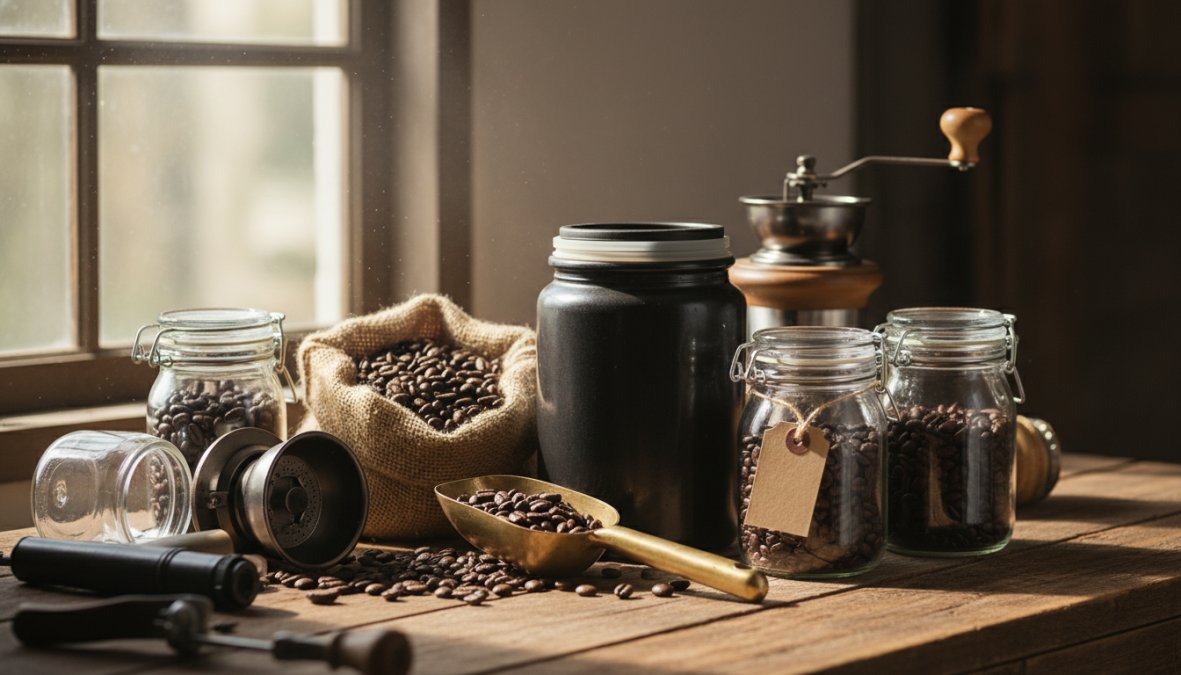
One-way valve bags (degassing bags) The valve allows CO2 to escape while preventing oxygen from entering. This is the correct container for beans in the first 7-10 days post-roast, when CO2 output is highest. Leaving freshly roasted beans in a fully sealed airtight container during this period causes CO2 to build up pressure and can compromise the seal over time. Most specialty roasters ship in valve bags for this reason. Keep the bag rolled tightly and clipped between uses.
Opaque airtight canisters After the initial degassing period, a fully sealed opaque canister is preferable to a valve bag because it eliminates oxygen ingress entirely. Ceramic and stainless steel canisters with silicone-sealed lids perform well. Avoid clear glass unless it's stored in a completely dark cabinet, the convenience of seeing your beans is not worth the photo-oxidation risk.
Vacuum-seal canisters Vacuum canisters that allow you to pump out residual air offer a meaningful upgrade over standard airtight containers for beans you won't use within a week. By reducing the partial pressure of oxygen inside the container, they slow oxidation measurably. The trade-off is cost and the need to re-vacuum after each opening.
Original bag without resealing Leaving beans in an open or loosely folded bag is the fastest path to stale coffee. Even a valve bag left open loses its protective function within hours. Always roll and clip, or transfer to a dedicated canister.
| Container Type | Oxygen Control | CO2 Management | Best For |
|---|---|---|---|
| One-way valve bag | Good | Excellent | Days 1-10 post-roast |
| Opaque airtight canister | Excellent | Poor (seals CO2 in) | Days 7-21 post-roast |
| Vacuum-seal canister | Best | Good | Extended room-temp storage |
| Clear glass jar | Poor (light exposure) | Poor | Not recommended |
| Original bag, open | None | None | Never |
Room Temperature vs. Freezing: The Definitive Trade-Off
This is the most contested storage debate in coffee, and the answer depends on one variable most guides ignore: how you freeze.
Room temperature storage is appropriate for beans you will consume within 2-3 weeks of the roast date. At typical indoor temperatures (18-22°C / 65-72°F), whole beans in an airtight opaque container retain peak flavor through approximately day 21 post-roast, with gradual but noticeable decline from day 21 to day 45, and significant staleness beyond 60 days.
Refrigeration is not recommended for daily-use beans. Refrigerators operate at high relative humidity, and coffee is hygroscopic, it readily absorbs moisture and odors from surrounding foods. The temperature differential between the cold refrigerator and your warm kitchen also causes condensation on beans each time you remove the container, introducing moisture directly to the bean surface. Refrigeration slows oxidation slightly but introduces moisture and odor absorption problems that typically outweigh the benefit.
Freezing, done correctly, is the best long-term storage method available. The key word is correctly. The common mistake is treating a bag of coffee like a bag of frozen peas, opening it repeatedly, taking out a scoop, and returning it to the freezer. Each freeze-thaw cycle causes condensation, and repeated moisture exposure degrades flavor faster than room-temperature storage would.
The correct freezing protocol:
- Portion before freezing. Divide beans into single-use portions (typically 50-100g depending on your daily consumption) immediately after the bag arrives.
- Vacuum-seal each portion. A vacuum sealer removes the oxygen that would otherwise cause freezer oxidation. If you don't have a vacuum sealer, press out as much air as possible from a zip-lock freezer bag before sealing.
- Freeze in a single layer initially, then consolidate once frozen solid to prevent clumping.
- Thaw at room temperature, sealed, before opening. Allow the sealed portion to reach room temperature (approximately 30-45 minutes) before opening. This prevents condensation from forming on the beans themselves.
- Never refreeze. Once a portion is thawed and opened, treat it as room-temperature beans and use within 1-2 weeks.
When executed this way, freezing can extend the usable life of specialty coffee from 3-4 weeks to 3-6 months with minimal flavor degradation. This is particularly useful for single-origin or limited-release coffees you want to preserve at peak quality.
Shelf-Life Reference by Storage Method
| Storage Method | Container | Approximate Peak Flavor Window |
|---|---|---|
| Room temperature | Opaque airtight canister | Days 5-21 post-roast |
| Room temperature | Valve bag, resealed | Days 5-18 post-roast |
| Room temperature | Open bag | Days 3-7 post-roast |
| Refrigerator | Any | Not recommended |
| Freezer (portioned, vacuum-sealed) | Vacuum bag | Up to 3-6 months post-roast |
| Freezer (bulk, zip-lock) | Zip-lock bag | Up to 4-6 weeks post-roast |
Storage checklist for maximum freshness:
- Keep beans in the original valve bag for the first 7-10 days post-roast
- Transfer to an opaque airtight canister after initial degassing period
- Store at room temperature, away from stoves, windows, and direct sunlight
- Never store in the refrigerator
- If buying in bulk, portion and vacuum-seal before freezing; thaw sealed portions at room temperature
- Buy quantities you'll use within 2-3 weeks of the roast date whenever possible
- Grind only what you need immediately before brewing
Why Fresh Coffee Tastes Better: Putting It All Together
The question of why does fresh coffee taste better resolves to a single underlying truth: coffee is a perishable product with a narrow window of peak performance. Every step from roast date to your cup either preserves or destroys the volatile oils, aromatic compounds, and CO2 balance that make great coffee possible.
The throughline across every section of this guide is that freshness is active, not passive. It requires knowing your roast date, grinding at the right time, storing correctly, and matching your brewing method to your beans' current state. Beans that are too fresh off the roast produce gassy, uneven cups. Beans that are too old produce flat, oxidized ones. The sweet spot is real, and it's achievable with straightforward habits.
What most guides get wrong is treating freshness as binary: either fresh or stale. The reality is a spectrum. Understanding where your beans sit on that spectrum, and adjusting your brewing accordingly, is what separates a good cup from a great one. For a deeper look at the chemistry involved, food science research on coffee flavor chemistry provides a thorough breakdown of how roasting and storage affect compound stability.
The challenge most coffee drinkers face is not knowing their beans' roast date or having no reliable way to guarantee freshness at purchase. Cuppari Coffee addresses this directly by roasting every order only after it's placed and shipping the same day, so beans arrive within their optimal freshness window. Every order comes sealed to protect against oxygen exposure, and the improved filter design in Cuppari's coffee capsules absorbs more grounds for a consistently lively cup. Add to cart and experience the difference that genuine freshness makes.
Frequently Asked Questions
How long does coffee stay fresh after roasting?
Whole coffee beans are generally at their best between 5 and 30 days after the roast date, depending on the roast level and storage method. Light roasts tend to stay vibrant a bit longer than dark roasts. Once ground, coffee loses freshness significantly faster, often within 15 to 30 minutes of grinding. Storing beans in an airtight container away from heat, light, and moisture helps extend shelf life and preserve their balanced flavor profile.
Does grinding coffee beans immediately before brewing really make a difference?
Yes, grinding immediately before brewing makes a noticeable difference in cup quality. When you grind coffee, you dramatically increase the surface area exposed to oxygen, accelerating oxidation and the loss of aromatic compounds. Pre-ground coffee can go stale within minutes to hours. Using a grinder right before brewing, whether for drip coffee or espresso, preserves volatile oils, sweetness, and acidity, resulting in a far more vibrant and flavorful extraction.
What are the signs of stale coffee beans?
Stale coffee beans show several telltale signs: a flat or musty aroma instead of a rich, complex smell; an oily or dry surface inconsistent with the roast level; a dull, bitter, or cardboard-like taste with little sweetness or acidity; and no bloom when hot water is added during brewing (indicating minimal carbon dioxide remains). If your beans lack that fresh roasted aroma when you open the bag, they have likely lost much of their flavor through oxidation.
How should you store coffee beans to keep them fresh?
Store whole coffee beans in an airtight container, ideally one with a one-way valve, in a cool, dark place like a pantry or cabinet. Avoid the refrigerator, which introduces moisture and odors. Keep beans away from direct sunlight, heat sources, and humidity. Buy in smaller quantities aligned with your consumption rate, and always check the roast date rather than a best-by date. Grinding only what you need immediately before brewing further protects freshness and shelf stability.
Why does coffee brewed from freshly roasted beans taste more vibrant?
Freshly roasted coffee beans retain high concentrations of volatile aromatic compounds, natural sugars, amino acids, and carbon dioxide, all of which contribute to a cup's complexity, sweetness, and acidity. As beans age, oxygen exposure breaks down these compounds through oxidation, flattening the flavor profile and producing stale, bitter notes. Fresh coffee also produces a stronger bloom during brewing, indicating active degassing that improves extraction and delivers a more balanced, lively cup.
This article was written using GrandRanker