

Table of Contents
- Why Freshly Roasted Coffee Tastes Better: The Chemical Truth
- Understanding the Coffee Degassing Process
- Peak Flavor Window for Coffee: When Taste Is at Its Best
- Oxidation and Lipid Degradation: Why Stale Coffee Tastes Flat
- Signs of Stale Coffee Beans: How to Spot Them
- How to Store Coffee to Maintain Freshness
- Brew Method Matters: Freshness Requirements Vary
- Conclusion
Last Updated: August 7, 2026
Why Freshly Roasted Coffee Tastes Better: The Chemical Truth
When coffee is roasted, heat drives out moisture, develops flavor compounds, and creates the complex taste profile you expect. But the moment cooling begins, a clock starts ticking. Freshly roasted coffee tastes better because of volatile compounds, oxidation rates, and the active degassing process that defines peak flavor in the days immediately following the roast.
At Cuppari Coffee, we've built our entire operation around this principle. By roasting beans only after an order is placed and shipping the same day, we ensure that the coffee arriving at your door is still in its flavor prime. Understanding what happens to coffee after roasting explains why freshness is the primary factor determining whether your morning cup tastes vibrant or flat.
Understanding the Coffee Degassing Process
Degassing is the release of carbon dioxide that was trapped inside coffee beans during roasting. For the first 24 to 48 hours after roasting, beans actively expel CO2 through tiny pores in their cell structure. This process is essential to flavor development.
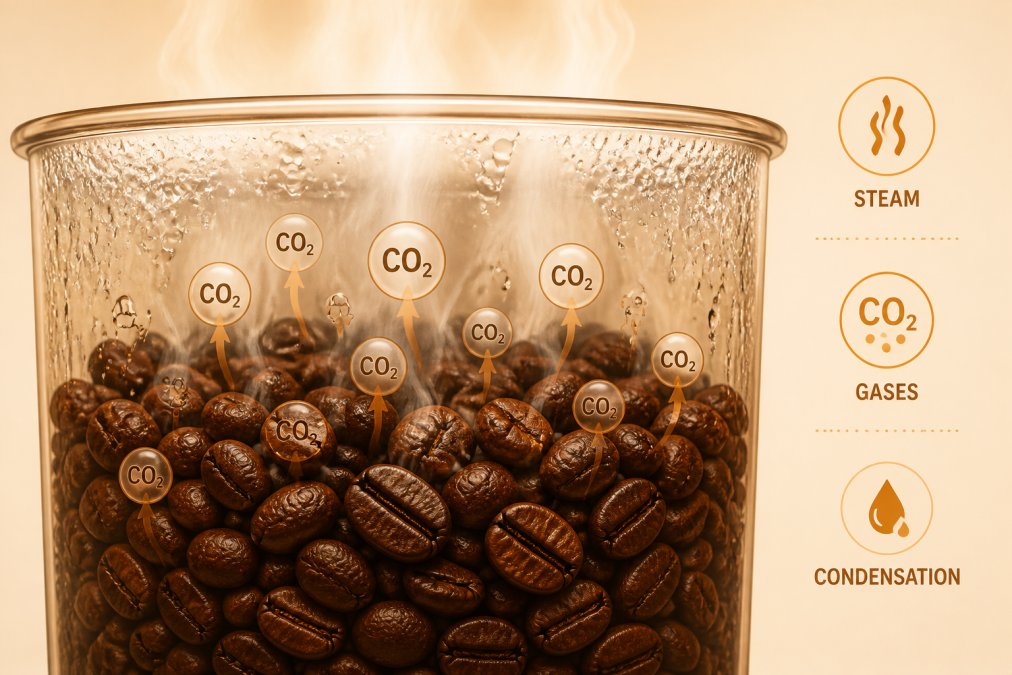
During roasting, heat causes water inside the bean to turn to steam, and chemical reactions create CO2 as a byproduct. Once roasting stops and the bean cools, it begins releasing that trapped carbon dioxide. This degassing affects everything about how the coffee tastes and brews.
CO2 directly influences extraction during brewing. When you pour hot water over coffee grounds, CO2 in the bean creates pressure that affects how water penetrates the grounds and how flavors dissolve into your cup. Fresh beans with abundant CO2 create a more vigorous bloom, that initial foaming when water first contacts the grounds. As CO2 escapes over time, the bloom becomes less pronounced, signaling reduced CO2 content and typically resulting in under-extraction.
How Carbon Dioxide Affects Flavor
A strong bloom when you brew indicates the beans still contain meaningful CO2 and are likely within their peak flavor window. A flat, minimal bloom suggests the beans have lost most of their gas and are past their prime.
The Role of Volatile Aromatics
Beyond CO2, roasted coffee contains hundreds of volatile aromatic compounds that create the smell and taste you experience. These compounds are fragile and begin escaping the moment roasting stops. Unlike CO2, which escapes over days in a predictable pattern, these aromatics escape continuously and irreversibly. Each day that passes, more of these compounds are lost to the air.
The sealed environment matters enormously. Coffee stored in an airtight container or in sealed capsules with a one-way valve loses aromatics much more slowly than coffee exposed to air. The one-way valve allows CO2 to escape without letting oxygen in, a critical design feature that extends the freshness window.
Peak Flavor Window for Coffee: When Taste Is at Its Best
The peak flavor window for freshly roasted coffee typically spans 5 to 30 days after roasting, with the sweet spot falling between days 7 and 14 for most brewing methods. This window represents the period when CO2 levels have stabilized enough for proper extraction, but volatile aromatics haven't yet degraded significantly.
The Resting Period After Roasting
The first 24 to 48 hours after roasting is not ideal for brewing. During this period, CO2 is escaping so rapidly that it interferes with water's ability to extract flavors evenly. Waiting 3 to 5 days allows enough CO2 to escape that brewing becomes more controllable, while enough remains to support proper extraction. A bean roasted a week ago and brewed today will likely taste better than the same bean roasted yesterday and brewed today.
How Long Fresh Coffee Stays at Peak Quality
After the 5 to 30-day window closes, the coffee degrades gradually. By day 45 to 60, most coffees have lost enough volatile aromatics and CO2 that the difference becomes noticeable. The acidity flattens, the body thins, and the flavor notes become muted.
Storage method dramatically affects this timeline. Coffee in a sealed bag with a one-way valve maintains quality much longer than coffee in an open container. A bag stored in a cool, dark cupboard will stay fresher longer than one sitting on a counter near a window.
Because Cuppari Coffee beans are roasted and shipped the same day, they arrive at your home while still in the early part of their peak window. You have weeks to enjoy the coffee at its best, rather than days.
Oxidation and Lipid Degradation: Why Stale Coffee Tastes Flat
Once the active degassing phase ends, oxidation takes over. Oxygen in the air reacts with the oils and organic compounds in the coffee bean, breaking them down into simpler, less flavorful molecules. Coffee beans contain lipids that carry much of the flavor. As they break down, the coffee loses body, complexity, and the subtle notes that distinguish one origin from another.
The rate of oxidation depends on surface area exposure. Whole beans oxidize more slowly than ground coffee because grinding dramatically increases the surface area exposed to oxygen. This is why whole beans stay fresher longer and why grinding immediately before brewing is a best practice.
Oxidation also affects the oils that create crema in espresso. Fresh beans produce a thick, persistent crema layer. As oxidation progresses, crema becomes thinner and disappears faster, correlating with taste changes.
Signs of Stale Coffee Beans: How to Spot Them
Stale coffee announces itself through multiple signals. Learning to recognize these signs helps you understand whether beans are past their peak.
Visual and Physical Indicators
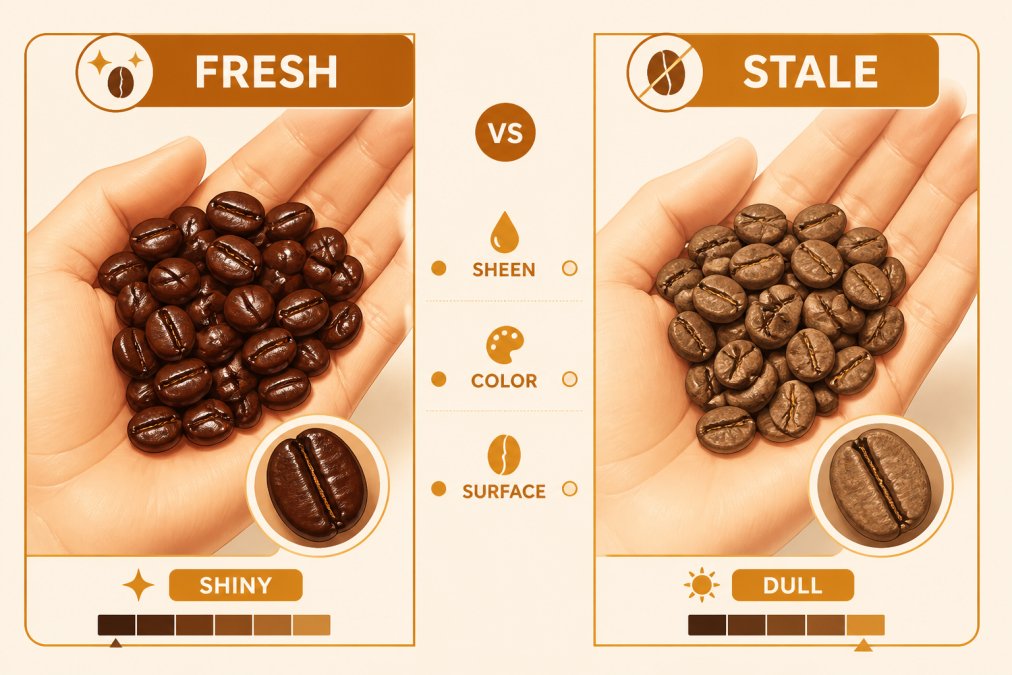
The most obvious visual change is loss of sheen. Fresh, recently roasted beans have a subtle shine on their surface from the oils that have migrated outward during roasting. As oxidation progresses, these oils break down and the surface becomes duller and more matte.
The aroma test is one of the most reliable checks. Open a bag of fresh beans and the smell should be intense and complex. Sniff the same beans a month later and the aroma will be noticeably muted. If you open a bag and smell nothing remarkable, the volatile aromatics have largely evaporated.
Sensory Differences You Can Taste
Fresh coffee tastes bright, complex, and clean. The flavor notes are distinct, and the body feels full. Stale coffee tastes flat and one-dimensional. The acidity becomes either sharp and unpleasant or disappears entirely. The body thins out.
The bloom during brewing is another sensory indicator. Fresh beans create a vigorous bloom that lasts 10 to 15 seconds. Stale beans produce a weak bloom that flattens quickly. If you're not seeing much bloom action, the beans have likely lost most of their CO2 and are past their peak.
How to Store Coffee to Maintain Freshness
Storage conditions determine how quickly coffee degrades after roasting. The four enemies of coffee freshness are oxygen, light, heat, and humidity. An airtight container is the minimum standard. A sealed bag with a one-way valve is even better, allowing CO2 to escape without letting oxygen in.
Location matters as much as container. Store coffee in a cool, dark place, ideally a cupboard or pantry away from direct sunlight. Heat accelerates all degradation processes. A kitchen counter near a window or above a stove is the worst possible location.
Humidity is often overlooked but significant. High humidity can cause beans to absorb moisture, affecting grinding consistency. Dry storage is preferable.
The practical approach: buy coffee in quantities you'll use within 2 to 4 weeks. Store it in an airtight container in a cool, dark location. Grind immediately before brewing.
Brew Method Matters: Freshness Requirements Vary
Different brewing methods extract flavor at different rates, which means they have different freshness requirements.
Espresso is the most demanding. The rapid extraction means CO2 content matters enormously. Espresso is best brewed with beans that are 7 to 14 days post-roast.
Pour-over and drip methods are more forgiving. These slower extraction methods work well with beans that are 5 to 30 days post-roast.
French press is the most forgiving. The immersion method steeps grounds in hot water for 4 minutes, allowing extended contact time. Beans that are 10 to 45 days post-roast can still produce a good cup.
Cold brew uses time instead of heat. Grounds steep in cold water for 12 to 24 hours, meaning even older beans can produce a smooth, flavorful concentrate.
If you're an espresso drinker, freshness is critical to your results. If you prefer French press or cold brew, you have more flexibility. But across all methods, beans within their peak window will outperform older beans.
Conclusion
Freshly roasted coffee tastes better because of degassing, volatile aromatics, and the active flavor development that happens in the days immediately following roasting. Coffee peaks between days 7 and 14 post-roast and declines gradually after that as oxidation and aromatic loss take their toll.
Most coffee reaches consumers already past its peak. Beans sit in warehouses, travel through distribution networks, and wait on store shelves.
Cuppari Coffee solves this by roasting beans only after your order arrives and shipping the same day. Your coffee arrives while still in its peak flavor window, with full CO2 content, intact volatile aromatics, and the complexity the roaster intended. Paired with free shipping on all U.S. orders, this means you get premium, freshly roasted coffee delivered to your door at peak freshness. Start with Cuppari Coffee and taste the difference that freshness makes.
| Timeframe | CO₂ Level | Volatile Aromatics | Oxidation Stage | Best For |
|---|---|---|---|---|
| Days 1-3 | Very High | Peak | Minimal | Resting (not ideal for brewing) |
| Days 5-14 | High | Excellent | Minimal | Peak flavor window for most methods |
| Days 15-30 | Moderate | Good | Slight | Still excellent, especially for immersion methods |
| Days 30-45 | Low | Declining | Moderate | Acceptable, but noticeably less vibrant |
| Days 45+ | Very Low | Significantly Reduced | Advanced | Flat, one-dimensional taste |
Sources:
The chemistry of coffee degassing and flavor development is well-documented in specialty coffee literature and research. According to the Specialty Coffee Association's research on post-roast degassing, the first 24-48 hours after roasting are critical to CO₂ release patterns, and the 5-30 day window aligns with industry standards for peak flavor across multiple brewing methods.
Research from the Journal of Agricultural and Food Chemistry on coffee volatile compounds confirms that aromatic compounds begin degrading immediately after roasting and that oxidation of lipids directly correlates with sensory perception of flavor complexity and body.
For guidance on optimal storage methods, the National Coffee Association's consumer guide to coffee freshness provides recommendations consistent with the storage principles outlined here, emphasizing airtight containers, cool temperatures, and protection from light and humidity.
Frequently Asked Questions
How long should you wait to drink freshly roasted coffee?
Most coffee reaches peak flavor 3-7 days after roasting, once the coffee degassing process has released excess carbon dioxide. Brewing immediately after roasting can result in an overly bitter or harsh taste due to over-extraction. However, you don't need to wait a full week, many specialty roasters recommend starting to enjoy the coffee after 3 days. The exact timing depends on your brew method and personal preference, but this window is when you'll experience the best balance of acidity, body, and flavor notes.
Can you tell if coffee beans are fresh by looking at them?
Yes, there are several visual indicators of freshness. Fresh beans have a glossy, uniform appearance with rich color depth, while stale beans look dull and faded. Check the roast date on the packaging, this is the most reliable indicator. Fresh beans should have been roasted within the past 2-4 weeks. You can also smell the beans: fresh coffee has a strong, vibrant aroma, while stale coffee smells muted or flat. Avoid beans with visible discoloration, cracks, or a chalky appearance, as these signs suggest age or improper storage.
Why does stale coffee taste sour or flat?
Stale coffee tastes sour or flat because oxidation breaks down the lipids and volatile aromatics that create complex flavor notes. As oxygen exposure increases over time, the oils in the beans become rancid, destroying the delicate balance of acidity and body that make fresh coffee taste vibrant. Additionally, carbon dioxide continues to escape, which affects extraction consistency during brewing. The result is a cup that tastes one-dimensional, either too acidic (sour) or completely lacking in flavor (flat), rather than the balanced, nuanced profile of freshly roasted beans.
Does the brewing method affect how fresh coffee needs to be?
Yes, different brewing methods have different freshness requirements. Espresso demands the freshest beans possible, ideally 5-14 days post-roast, because the high pressure and short extraction time amplify any stale flavors. Pour-over and drip coffee can tolerate slightly older beans, typically up to 3-4 weeks, because the longer brew time allows for better extraction of remaining flavor compounds. French press, which uses immersion brewing, also works well with beans in the 2-4 week range. Grind size and water temperature also matter: finer grinds and hotter water extract faster, so they perform better with fresher beans.
This article was written using GrandRanker