

Table of Contents
- Why Freshness Makes a Coffee Subscription Worth It
- Coffee Subscription vs Grocery Store Coffee: What Changes in the Cup
- Convenience, Customization, and Doorstep Delivery
- Best Practices for Storing Coffee Beans at Home
- Is a Coffee Subscription Worth It for Your Budget?
- How to Pick a Coffee Subscription That Matches Your Setup
- Frequently Asked Questions
Last Updated: September 30, 2026
Why Freshness Makes a Coffee Subscription Worth It
The single biggest benefit of joining a coffee subscription box is freshness you can verify. Coffee reaches peak flavor roughly 3 to 7 days after roasting, then fades. Supermarket bags often sit for months before you open them, while a roast-to-order service ships within days of the roast date.
This guide from Cuppari Coffee breaks down what actually changes in your cup, what a subscription costs you over a year, and how to pick a plan that fits your brewing setup. Below, we cover the practical questions most buyers ask before they commit.
Freshly roasted beans hold volatile oils that carry aroma. Those oils start degrading the moment the beans leave the roaster, which is why coffee freshness and storage guidance from the National Coffee Association stresses buying from roasters who stamp a roast date, not a "best by" date.
Coffee Subscription vs Grocery Store Coffee: What Changes in the Cup
Grocery store coffee is built for shelf life. Subscription coffee is built for flavor. That difference shows up in roast dates, packaging, and how the beans taste once brewed.
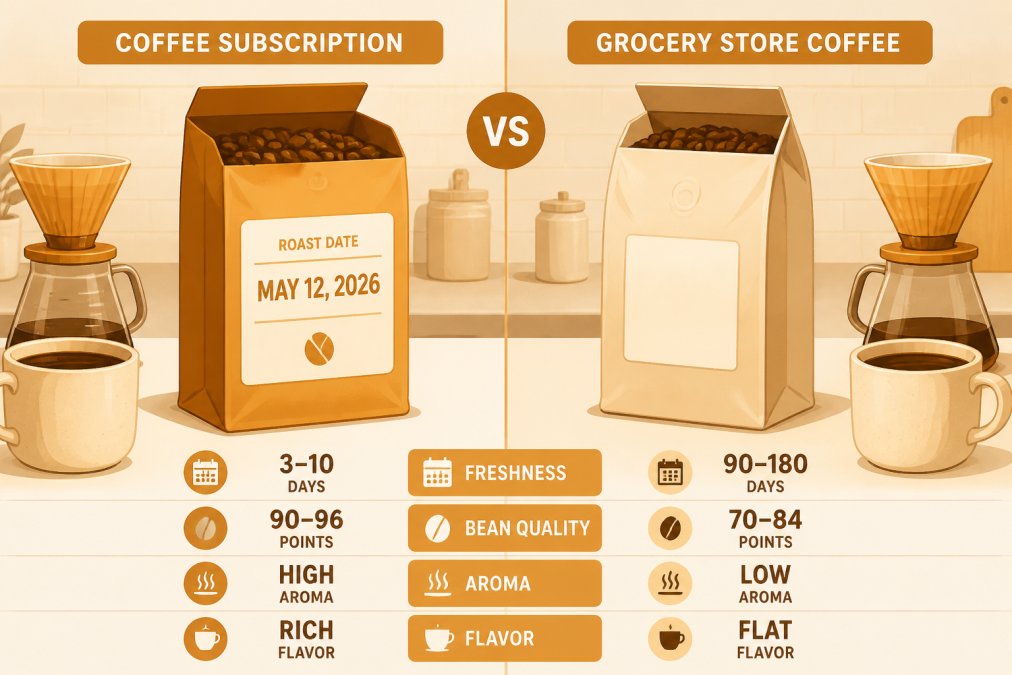
A coffee subscription model works differently from retail distribution.
Roast Dates and Shelf Time
Roast dates are the clearest signal of quality. A bag with a printed roast date lets you track exactly how fresh your coffee is. Most grocery brands print only a best-by date, which can sit a year out.
| Factor | Grocery Store Coffee | Coffee Subscription |
|---|---|---|
| Roast date on label | Rarely printed | Usually stamped |
| Time from roast to you | Weeks to months | Days |
| Selection | Fixed, mass-market blends | Rotating origins and roasts |
| Customization | None | Grind, frequency, roast level |
Convenience, Customization, and Doorstep Delivery
Doorstep delivery removes the errand entirely. You set a delivery frequency, choose your grind size, and coffee shows up on schedule. Flexible scheduling means you can skip, pause, or change plans without losing your account.
Best Practices for Storing Coffee Beans at Home
Storing coffee beans well is simple: keep them away from air, light, heat, and moisture. A subscription only delivers fresh beans if you protect them once they arrive.
Follow these storage rules:
- Keep beans in an opaque, airtight container
- Store at room temperature, away from the stove and oven
- Skip the fridge, and never freeze and refreeze
- Buy whole bean and grind right before brewing
- Use beans within 2 to 4 weeks of the roast date
- Keep the original bag's valve if you transfer to a canister
Is a Coffee Subscription Worth It for Your Budget?
A coffee subscription is worth it when your cost per cup stays close to what you already pay and the quality improves. The honest version of that math has three variables: how much you drink, how much you currently waste, and how much of your coffee spend is café coffee rather than home-brewed.
The Per-Cup Math, Step by Step
You don't need a spreadsheet, but you do need four numbers:
- Your monthly coffee spend. Add grocery bags, café stops, and any office or kiosk coffee. Most people underestimate this by a wide margin.
- Your daily cup count. This sets how many ounces of beans you actually go through.
- Your current waste. Estimate how much of each bag you pour out or leave sitting past its prime. Even a rough guess is more accurate than assuming zero.
- Your subscription's cost per ounce. Divide the bag price by the bag weight. This is the only fair comparison against grocery, because bag sizes differ.
Where the Discounts Actually Help
Subscription pricing rarely beats mass-market grocery on sticker price per ounce. What narrows the gap is everything bundled around it:
- Free shipping thresholds. Shipping is the hidden cost that kills the math on small orders. A service that ships free removes it entirely.
- Loyalty or subscriber pricing. Many roasters price subscriptions below their one-off bag price, which is the discount that actually compounds.
- Sample packs as a trial. A small multi-pack lets you test before committing to a recurring charge, so you're not paying full price to discover you don't like the roast profile.
- Fewer café runs. The behavioral savings matter more than the line-item savings. If a subscription keeps you brewing at home, the café spend drops on its own.
How to Test the Value for Yourself
Run a one-month test before committing to a long plan.
- Track your current monthly coffee spend, including café stops.
- Order a small sample instead of a full bag.
- Brew the same way you normally do and compare.
- Calculate your cost per cup from the subscription.
- Decide whether the taste difference justifies the price.
How to Pick a Coffee Subscription That Matches Your Setup
Match the subscription to how you brew, not the other way around. Grind size, roast level, and delivery frequency should all fit your routine, and the brewer you use determines more of that than most guides admit.
Match the Bean to the Brewer
Each brewing method extracts differently, and that changes which roasts and origins work best:
- Pour-over (V60, Chemex, Kalita): These reward clarity and acidity. Light to medium roasts with distinct origin character, washed Ethiopian, Kenyan, or a bright Colombian, show their tasting notes best here. A medium-fine grind and a slow, controlled pour let the fruit and floral notes come through.
- French press: Full immersion and a metal mesh filter let more oils and sediment through, which mutes delicate acidity. Medium to medium-dark roasts with body, Brazilian, Sumatran, or a chocolatey blend, hold up better than a delicate light roast.
- Drip machine: Forgiving but flat. Medium roasts with balanced sweetness work best, because the machine's consistent temperature and timing don't flatter extremes. A dark roast can turn bitter; a very light roast can taste weak.
- Espresso: High pressure and short contact time demand a finer grind and a roast that can stand up to it. Medium-dark to dark roasts with lower acidity pull sweeter, more balanced shots and hold their own in milk drinks. Very light roasts are possible but demand more dialing-in.
- Cold brew: Long, cold extraction favors darker roasts and blends with chocolate and nut notes, since the slow steep pulls sweetness without the acidity that light roasts carry.
Set Grind, Roast, and Frequency to Your Routine
Consider these factors before you subscribe:
- Grind size: match it to your brewer, or buy whole bean. If you're unsure, whole bean is the safer default.
- Roast level: light to medium for pour-over, medium for drip, medium-dark to dark for espresso and cold brew.
- Delivery frequency: every 2 weeks if you drink daily, monthly if you drink less. Smaller, more frequent deliveries keep every cup fresh.
- Bag size: smaller bags keep every cup fresh and reduce the stale tail.
- Cancellation ease: confirm you can pause or cancel without a fee.
Cuppari Coffee lists grower, region, altitude, and process for each single origin, so you can trace exactly where your coffee came from. The Colombia ($21.99) carries dried orange, berry, and chocolate notes, while the Ethiopia Natural ($21.99) leans fruity and caramel. Both ship fresh, roasted after you order.
Frequently Asked Questions
Are coffee subscription boxes worth it for casual drinkers?
For casual drinkers, the math works out when you value freshness over volume. A daily drip drinker using roughly 60 grams per day goes through a 12-oz bag in about a week, which fits the 3-7 day window when freshly roasted coffee tastes best. If you drink less, choose a longer delivery frequency or a sample pack like Cuppari's Best Sellers Sample Pack at $24.99, which lets you try six 2-oz coffees before committing to a full-size bag.
How does a coffee subscription ensure fresher beans than grocery stores?
Roast-to-order is the difference. Cuppari Coffee roasts beans only after an order is placed and ships the same day, so the roast date on your bag is days old, not months. Grocery store coffee typically sits in a warehouse and on a shelf before you buy it, so shelf time eats into the window when beans still taste lively. A subscription shortens that gap to a few days and keeps every delivery on the same schedule.
Can I customize my coffee subscription based on roast preference?
Yes, and it is one of the main reasons people stay subscribed. You can set delivery frequency, pause or skip a shipment. If you prefer medium roasts, Cuppari's single origins like Colombia, Costa Rica, and Guatemala all sit at a medium roast with distinct tasting notes, from dried orange and berry to sweet apple and honey. Trying a sample pack first is the fastest way to find your match.
Do coffee subscriptions save money compared to buying individual bags?
Not always on sticker price, but often on cost per good cup. Cuppari's single-origin bags run $21.99, and every U.S. order ships free, which removes a shipping line item that many online orders add. Subscribers also tend to waste less because deliveries arrive on a schedule that matches their drinking pace. If you currently pour out stale beans every few weeks, the subscription can cost less than replacing coffee you never finish.
Picking a coffee subscription comes down to one question: do you want coffee that tastes like it was roasted for you, or coffee that sat on a shelf? At Cuppari Coffee, every order is roasted only after it's placed and shipped the same day, with free shipping on all U.S. orders. Start with a sample pack, find your favorite origin, and get freshly roasted coffee delivered to your doorstep.