

Last Updated: November 9, 2026
Quick Summary
Rinse your pour over dripper with hot water after every brew, deep clean it weekly with mild dish soap, and descale monthly with a one-part-vinegar-to-two-parts-warm-water soak for 20 to 30 minutes. Always disassemble the dripper first and rinse thoroughly so no soap or vinegar residue reaches your next cup.
- Leaving wet grounds in the dripper overnight is the fastest way to grow residue.
- Skip abrasive scrubbers because scratches give residue a place to hide.
- Limit vinegar soaks on plastic drippers to 30 minutes and never overnight.
- Never mix vinegar with bleach because the combination releases dangerous chlorine gas.
- Never bend stainless mesh filters, since the damage is permanent and creates drip channels.
Table of Contents
- Why a Clean Pour Over Dripper Changes How Your Coffee Tastes
- Daily Rinse vs. Deep Clean: What Your Dripper Needs Each Day
- Materials You Need to Clean a Pour Over Dripper
- Step-by-Step: How to Clean Your Pour Over Dripper
- How to Clean Your Pour Over Dripper With Vinegar
- How to Clean a Stainless-Steel Pour Over Filter
- How Often to Clean a Pour-Over Dripper
- Troubleshooting Clogged Filters and Water Quality Issues
- Frequently Asked Questions
Why a Clean Pour Over Dripper Changes How Your Coffee Tastes
A dirty pour over dripper ruins good coffee faster than bad beans do.
Fresh beans deserve a clean brewer. A five-minute cleaning routine protects both. Below, you'll find how to clean common dripper materials, how often to do it, and how to fix a clogged filter.
Here's what most guides get wrong: they treat cleaning as one chore. It isn't. Daily rinsing and deep cleaning solve two different problems, and skipping either one shows up in the cup.
Daily Rinse vs. Deep Clean: What Your Dripper Needs Each Day
Daily maintenance is a quick rinse with hot water after each brew.
The daily rinse handles fresh grounds and loose residue.
The deep clean tackles what water alone cannot. Coffee oils bond to ceramic and stainless steel mesh, and over time they clog the flow.
A simple rule:
- After every brew: hot water rinse and air dry
- Once a week: deep clean with dish soap or vinegar
- Once a month: descaling soak for mineral buildup
Watch out: leaving wet grounds in the dripper overnight is the fastest way to grow residue in the nooks and crannies.
Materials You Need to Clean a Pour Over Dripper
You likely own everything required. Gather these before you start:
- Soft sponge or bottle brush
- Mild dish soap
- White vinegar for descaling
- Warm water
- A clean towel or drying rack
Skip abrasive scrubbers. Steel wool and rough pads scratch glass, ceramic, and stainless steel mesh, and scratches give residue a place to hide. A Barista Towel Set (2-Pack) is a useful drying option, with one side that absorbs and one that polishes gently.
For non-toxic cleaning, dish soap and vinegar cover nearly every situation. You rarely need anything stronger.
Step-by-Step: How to Clean Your Pour Over Dripper
Start with a full disassembly. Separate the dripper, filter, carafe, and any silicone or rubber parts. Cleaning each piece on its own is the only way to reach the nooks and crannies where residue settles.
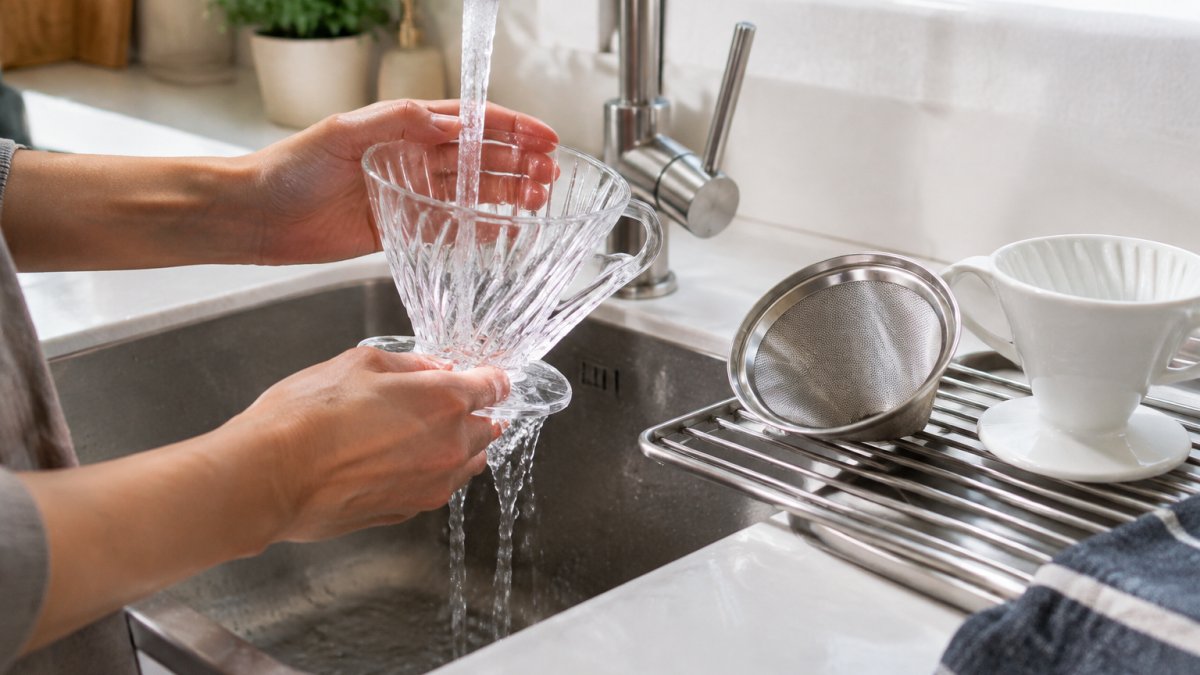
Follow these steps:
- Rinse every part under warm water to loosen loose grounds.
- Add a drop of dish soap to a soft sponge and wipe all surfaces.
- Scrub the filter mesh gently in the direction of the perforations.
- Rinse thoroughly until no soap remains.
- Air dry on a rack, or towel dry with a microfiber cloth.
Soap residue alters flavor, so the rinse cycle matters as much as the wash. If you use a reusable stainless filter, our Pour Over Coffee Maker with Filter - 500ml/17oz has a dual-layer 304 stainless steel filter.
Cleaning Glass and Ceramic Drippers
Glass and ceramic are the easiest materials to keep clean. Both handle hot water and mild soap without damage.
For a glass brewer, check the Hario V60 "Simply" Glass Pour Over Kit. For ceramic, the Kalita Style 102 Ceramic Coffee Dripper - Brown is an option to consider.
Avoid sudden temperature changes. Pouring boiling water into a cold glass dripper can crack it.
Cleaning Plastic Drippers
Plastic holds onto coffee oils longer than glass or ceramic. It also scratches easily, and those scratches trap residue. Use only soft sponges and mild soap.
Skip vinegar soaks longer than 30 minutes on plastic, since acid can dull the surface over time. Rinse with hot water daily and deep clean weekly to keep plastic brewing clean.
How to Clean Your Pour Over Dripper With Vinegar
Vinegar is a common choice for descaling and cutting coffee oils, but it is not a universal cleaner. White distilled vinegar contains acetic acid, and that acid reacts differently with each dripper material.
Start with the standard dilution: one part white distilled vinegar to two parts warm water. Soak the fully disassembled dripper for 20 to 30 minutes. After soaking, scrub gently with a soft brush, paying attention to the filter mesh and the base.
When you clean your pour over dripper with vinegar, timing matters. According to the USDA's food safety guidance on cleaning and sanitizing, rinsing after any cleaning solution is essential to avoid residue.
Material-Specific Vinegar Safety
Vinegar is not suitable for every material. Check the guidance for each part before soaking it.
- Borosilicate glass: Fully vinegar-safe. Glass has no pores and a non-reactive surface.
- Glazed ceramic: Vinegar-safe on the glaze, but check for crazing (fine hairline cracks in the glaze). Acid can seep into crazed glaze and weaken the bond over repeated soaks. If you see crazing, switch to a dish-soap deep clean and skip the vinegar.
- Unglazed or porous ceramic: Avoid vinegar soaks. The porous body absorbs acid, and the residue is nearly impossible to rinse out. It will leach into subsequent brews. Use a soft brush and mild soap only.
- Plastic (polypropylene and similar): Limit vinegar soaks to 30 minutes. Acid can dull the surface over time, and dulled plastic scratches more easily, which gives coffee oils a place to hide. Never soak plastic overnight.
- Stainless steel mesh: Short vinegar soaks are safe and effective for mineral scale. Avoid prolonged soaks beyond about an hour, and never combine vinegar with bleach or chlorine cleaners, which can corrode stainless steel.
Watch out: never mix vinegar with bleach or a bleach-based cleaner. The combination releases chlorine gas, which is dangerous in a kitchen. Rinse and dry the dripper completely before using any second cleaning agent.
Neutralizing and Rinsing
Soap residue and vinegar residue both alter flavor. After the vinegar soak, wash the parts with a drop of mild dish soap, then rinse under warm running water for at least 15 seconds per part.
If hard water leaves white scale, a vinegar soak once a month keeps the flow rate steady and the brew quality high. If you notice scale returning within two weeks, your water is likely very hard, and a filtered-water routine will reduce how often you need to descale.
How to Clean a Stainless-Steel Pour Over Filter
Stainless steel mesh needs careful handling. The fine perforations trap coffee oils, and a clogged filter slows the flow and muddies extraction. Rinse the filter under hot water right after brewing, before grounds dry.
Once a week, soak the filter in warm water with a drop of dish soap for 10 minutes. Use a soft brush to lift oils from the mesh, then rinse until the water runs clear. For deeper cleaning, a short vinegar soak dissolves mineral buildup without harming the steel.
Our Stainless Steel Coffee Filters use a dual-layer design, with laser-cut precision outside and ultra-fine mesh inside, so a gentle brush reaches the oils without bending the mesh.
How Often to Clean a Pour-Over Dripper
Rinse after every brew, deep clean once a week, and descale once a month. That schedule keeps most drippers in top shape. Heavy daily use may call for a deep clean twice a week.
Here's a quick reference:
| Task | Frequency | Time | What It Removes |
|---|---|---|---|
| Hot water rinse | After every brew | Under 1 minute | Loose grounds, fresh residue |
| Soap wash | Weekly | 5 minutes | Coffee oils, surface film |
| Vinegar soak | Monthly | 20-30 minutes | Mineral scale, deep oils |
| Full descale | Every 1-2 months | 30 minutes | Hard water buildup |
If you also grind your own beans, our guide on how often to clean coffee burrs pairs well with this schedule. Clean equipment at every stage keeps the whole brew fresh.
Time required for each pour-over dripper cleaning task
Troubleshooting Clogged Filters and Water Quality Issues
A slow drip points to a clogged filter or mineral buildup, but 'clogged' covers several different failures. Diagnose before you soak, because the wrong fix can bend a mesh filter or leave oils in place.
Diagnosing a Stalled Brew
Run through this sequence before reaching for vinegar:
- Check the grind first. A bed of fine grounds or too much agitation can stall any dripper. If the brew stalls only with certain beans or grind settings, the filter is probably fine.
- Look at the filter against a light. Hold the stainless mesh up to a window or lamp. Uniform pinpricks of light mean the perforations are open. Dark or uneven patches mean oils or scale are blocking the mesh.
- Feel the surface. A tacky, oily film on the mesh is coffee oil. A chalky, rough texture is mineral scale. The two need different treatments.
- Check the dripper's exit hole and ridges. On cone drippers, residue builds in the spiral ridges and around the single exit hole. A clear mesh with a blocked exit hole will still stall.
Unclogging Micro-Perforations in Metal Filters
For oil-clogged mesh, soak the filter in warm water with a drop of dish soap for 10 minutes, then brush gently in the direction of the perforations with a soft brush. Rinse until the water runs clear.
For scale-clogged mesh, use the one-part-vinegar-to-two-parts-water soak for 20 to 30 minutes, then brush and rinse. If water still pools after both treatments, the perforations are blocked deeper than a surface soak reaches.
Watch out: never bend, flex, or press the mesh to force out grounds. A bent filter creates drip channels that ruin even extraction, and the damage is permanent.
Water Quality and Scale Buildup
Water quality plays a bigger role than most brewers realize. Hard water leaves calcium and magnesium scale that narrows the flow and dulls flavor, and that scale bonds to coffee oils to form a stubborn film that neither soap nor vinegar removes alone. According to the EPA's guidance on drinking water quality, knowing your local water helps you adjust brewing and cleaning.
Visual Inspection Checklist
Use this quick guide to identify what you are looking at:
- White chalky film: mineral scale, descale with vinegar
- Dark oily sheen: coffee oils, deep clean with soap
- Rough, tacky texture on mesh: scale and oil combined, alternate soap and vinegar soaks
- Slow drip despite a clean filter: clogged micro-perforations or a blocked exit hole
- Cloudy glass: soap residue, rinse longer
- Hairline cracks in ceramic glaze: stop vinegar soaks and switch to mild soap
Frequently Asked Questions
Can I use vinegar to clean my pour over dripper?
Yes. White vinegar is effective for dissolving mineral buildup and coffee oils from glass, ceramic, and stainless steel pour over drippers. Mix one part white vinegar with two parts hot water and soak the dripper for 20 to 30 minutes. Rinse thoroughly with hot water afterward to remove any vinegar taste. Avoid vinegar on aluminum components, as the acid can pit the metal. For daily cleaning, plain dish soap and hot water are enough; save vinegar soaks for weekly deep cleans.
How often should you clean your pour-over dripper?
Rinse your pour over dripper with hot water after every brew to remove loose grounds and oils. Do a deeper clean with dish soap and a soft brush at least once a week if you brew daily. If you notice a bitter taste, slow flow rate, or visible residue in the drip channels, clean it immediately. Stainless steel mesh filters benefit from a vinegar soak every two to four weeks to clear micro-perforations that trap oils and fine particles.
How do you unclog a stainless-steel pour-over filter?
A clogged stainless steel mesh filter usually has coffee oils and fine particles trapped in the micro-perforations. Soak the filter in a solution of hot water and white vinegar for 30 minutes, then scrub gently with a soft brush. For stubborn clogs, add a pinch of baking soda to the soak to lift residue. Rinse under high-pressure hot water and check the flow by running water through the filter. Repeat if water still pools on the surface.
Can you put a pour-over dripper in the dishwasher?
It depends on the material. Glass and ceramic drippers are usually dishwasher-safe on a top rack, but check the manufacturer's instructions first. Plastic drippers may warp with high heat, so hand washing is safer. Stainless steel mesh filters should be hand washed to protect the mesh from bending and to avoid trapping oils in the perforations. Hand washing with dish soap and a soft brush extends the life of any pour over dripper and keeps brew quality consistent.
