
Table of Contents
- Why Ethical Coffee Sourcing Labels Matter More Than Ever
- Fair Trade vs Direct Trade Coffee: What's the Real Difference?
- The Best Ethical Coffee Certifications to Look For
- How to Verify Coffee Supply Chain Transparency
- Reading Coffee Bags Like a Detective: 6 Things to Check
- Greenwashing Red Flags: When Ethical Coffee Sourcing Claims Fall Apart
- The Economics of a Cup: Where Your Money Actually Goes
- Frequently Asked Questions
Last Updated: September 24, 2026
Why Ethical Coffee Sourcing Labels Matter More Than Ever
Grocery aisles are full of bags stamped with birds, trees, and smiling farmers, symbols meant to help you identify ethical coffee sourcing labels at a glance. But not every stamp means what you think.
The Problem With Taking Labels at Face Value
A logo is a claim, not proof. Anyone can print a leaf on a bag.
- Some logos require annual third-party audits
- Some are self-declared by the company itself
- Some certify farming methods, not pay
- Some certify pay, not farming methods
Fair Trade vs Direct Trade Coffee: What's the Real Difference?
Fair trade and direct trade are two systems for getting money to farmers. Fair trade sets a minimum price and adds a premium through a certified cooperative. Direct trade skips the certification body and builds a contract between roaster and farm.
The Best Ethical Coffee Certifications to Look For
The strongest certifications combine third-party verification with published standards you can look up. Here's what each verifies, what it doesn't, and how to confirm it's active.
Third-Party Certifications That Carry Weight
Fairtrade International sets a minimum price for green coffee plus a premium paid to the cooperative, checked by independent auditors on a recurring cycle. It verifies price floor and premium payment, but not farming methods like shade or pesticide use.
How to Confirm a Certification Is Actually Active
A certification is a contract with an expiration date, and brands sometimes keep printing a badge after it lapses, a common form of accidental greenwashing. Most major certifiers maintain a public searchable directory:
- Go to the certifier's official site, not the roaster's site.
- Find the "find a certified product" or "certified companies" search tool.
- Search the roaster or brand name exactly as printed on the bag.
- Check the status field, active, suspended, or expired, and the date range.
- If the brand is not listed, treat the badge as unverified until the roaster can explain.
Certifications That Sound Better Than They Are
Some labels are company-created: a roaster writes its own standards, audits itself, and prints a badge. That's not fraud, but it isn't independent verification either. Watch for phrases like "sustainably sourced," "ethically grown," "farm-direct," or "beyond fair trade" with no certifying body named. If you can't find who audits it, assume nobody does.
A Quick Comparison of What Each Certification Covers
| Certification | Verifies Price/Income | Verifies Farming Practices | Verifies Labor Conditions | Public Searchable Database |
|---|---|---|---|---|
| Fairtrade International | Yes (floor + premium) | Limited | Yes | Yes |
| Rainforest Alliance | No | Yes | Yes | Yes |
| USDA Organic | No | Yes (inputs) | No | Yes |
| Bird-Friendly | No | Yes (shade/habitat) | No | Yes |
No single row covers everything. The strongest bags stack two or more, and the strongest roasters say which certification applies to which coffee rather than stamping every bag with the same logo.
How to Verify Coffee Supply Chain Transparency
Verification means following the beans from farm to bag using something other than the label. Supply chain transparency is publishing who grew the coffee, where, and for how much. A transparent roaster names the farm or cooperative, region, altitude, and often the price paid, detail that's hard to fake, and you can follow the paper trail yourself.
Reading a Lot Code or Batch Number
Many specialty roasters print a lot code, batch number, or harvest ID on the bag, a short alphanumeric string like PE-24-018 or LOT 0426, that tracks a specific green coffee purchase. How to use it:
- Copy the code exactly as printed, including any letters or dashes.
- Go to the roaster's website and look for a "traceability," "our coffees," "harvest reports," or "transparency report" page.
- Search the code, or match it against the listed harvest year and farm name.
- Cross-check the farm name against the region and altitude on the bag, they should agree.
- If the code leads nowhere, email the roaster and ask which farm and harvest the code corresponds to.
Using QR Codes on the Bag
QR codes are now the most common traceability tool on specialty coffee bags. Scanning one typically lands you on one of a few page types:
- A farm profile with grower name, region, altitude, and varietal
- A harvest report with processing method and harvest dates
- A price transparency page showing what was paid per pound at farm gate
- A generic brand homepage with no traceability data at all
Searching Certifier Databases
If the bag carries a certification logo, the certifier's own database is the fastest independent check. Search the roaster's legal business name, not just the brand name on the bag, they're sometimes different. Look for:
- The roaster appears as a certified handler, trader, or brand owner
- The certification status is active, not expired or suspended
- The product category matches coffee (some certifiers certify multiple product lines)
Emailing the Roaster: What to Ask
Direct email is the most underrated verification tool, and roasters who publish farm data usually answer within a day or two. Questions that separate real transparency from marketing:
- Which farm or cooperative grew this specific lot?
- What region and altitude was it grown at?
- What harvest year is this coffee from?
- What price was paid at farm gate, or what premium above commodity price?
- Which certification applies to this specific coffee, and is it current?
Cross-Checking the Harvest Year
One detail that catches almost everyone: the roast date and harvest date are not the same thing. A bag can be roasted last week from coffee harvested two years ago. Green coffee holds for a while, but freshness and quality drop, and an old harvest often signals commodity-priced coffee rather than a fresh-crop contract. Look for a harvest year on the bag or product page.
Reading Coffee Bags Like a Detective: 6 Things to Check
Start with the fine print, not the front of the bag. The back panel and small text under the logo tell you more than any badge.
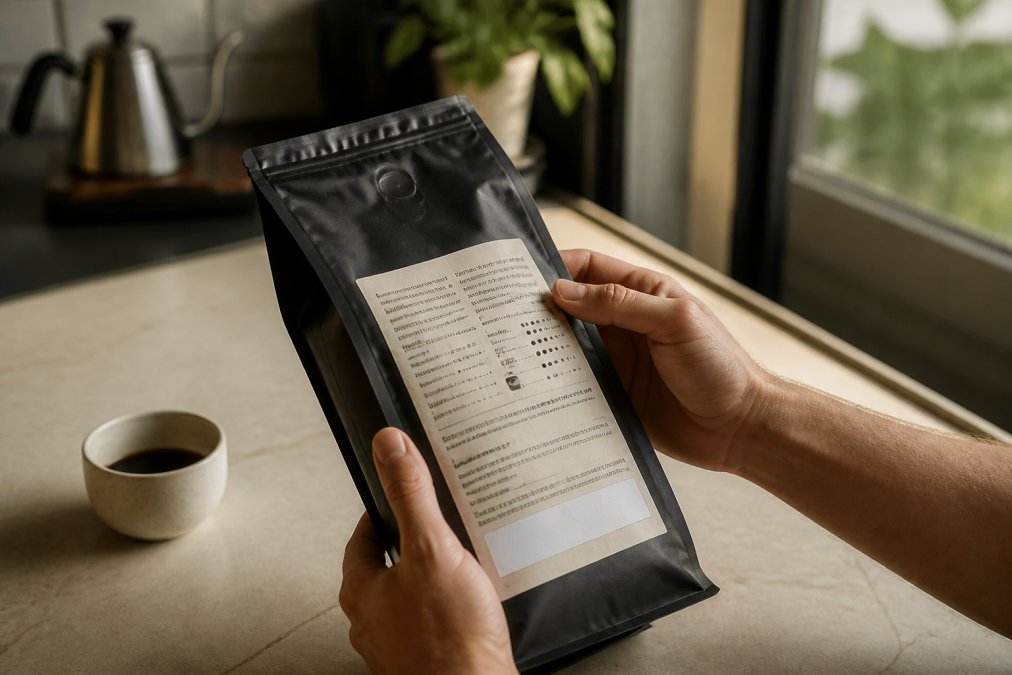
Here's what to look for, in order:
- Certifier name and logo. A real certification names the body that audits it.
- Farm or cooperative name. "Single origin" alone means nothing. A named farm means something.
- Region and altitude. Specific regions like Piura or Medellin signal real sourcing.
- Process method. Washed, natural, or honey tells you how the cherry was handled.
- Harvest year. Current crop beats an old one every time.
- Price transparency. Some roasters publish what they paid per pound.
Greenwashing Red Flags: When Ethical Coffee Sourcing Claims Fall Apart
Greenwashing is when a company markets itself as ethical without the practices to back it up. It's common in coffee because the supply chain is long and hard to check.
Watch for these signals:
- Vague words like "natural" or "responsibly sourced" with no certifier
- A logo that appears nowhere except that company's bags
- No farm names anywhere on the packaging or website
- Claims about "supporting farmers" with no price or program details
- Certification logos used after the certification lapsed
The Economics of a Cup: Where Your Money Actually Goes
Most of what you pay for coffee never reaches the farm. A rough breakdown shows why the label matters so much:
| Cost Component | Share of Retail Price |
|---|---|
| Farm-gate coffee price | Smallest slice |
| Shipping and import | Moderate |
| Roasting and packaging | Moderate |
| Retail and marketing | Largest slice |
Frequently Asked Questions
What is the difference between Fair Trade and Direct Trade coffee?
Fair Trade uses third-party certification to set minimum prices and standards for cooperatives. Direct Trade skips the certifier and builds relationships straight between roasters and farmers. Fair Trade guarantees a floor price; Direct Trade often pays more but relies on roaster honesty. Neither is automatically better. Look for specific farm names, prices paid, and long-term commitments on the bag.
How can I verify if a coffee brand is actually ethical?
Start by checking whether the bag names the farm, cooperative, or region. Then look for a third-party certification logo like Fair Trade, Rainforest Alliance, or Bird Friendly. Visit the roaster's website and see if they publish farm-gate prices or impact reports. If a brand makes vague claims like 'sustainably sourced' without specifics, treat that as a warning sign.
What should I look for on a coffee bag to ensure ethical coffee sourcing?
Check for four things: a named origin (farm or cooperative, not just a country), at least one recognized third-party certification, a harvest or roast date, and a stated price premium or living wage commitment. Bags that list all four are rare but reliable. Bags with only a country name and a generic 'ethically sourced' claim give you nothing verifiable.
Do organic labels imply ethical labor practices in coffee?
No. Organic certification covers growing practices like pesticide use and soil health. It says nothing about wages, working conditions, or how much farmers are paid. A coffee can be certified organic and still pay poverty wages. If labor ethics matter to you, look for a separate social certification alongside the organic seal.