

Table of Contents
- The Enemies of Coffee Freshness: Heat, Light, Moisture, and Air
- How Long Does Coffee Stay Fresh?
- Best Coffee Storage Containers for Long-Term Preservation
- Freezing Coffee Beans for Long Term Storage: Step-by-Step
- Vacuum Sealing, Oxygen Absorbers, and Mylar Bags for Bulk Storage
- How Roast Level and Brewing Method Affect Storage
- Common Coffee Storage Myths and Mistakes to Avoid
- Frequently Asked Questions
Last Updated: September 14, 2026
The Enemies of Coffee Freshness: Heat, Light, Moisture, and Air
Knowing how to store roasted coffee beans long term begins the moment they leave the roaster, because quality starts dropping right away. The four primary threats are heat, light, moisture, and oxygen, and understanding how each one degrades beans is the foundation of any long-term storage plan.
Oxygen drives oxidation, the chemical reaction that strips volatile compounds from roasted beans and replaces bright acidity with stale, cardboard-like notes. Heat accelerates that reaction. Light breaks down the oils that carry aroma. Moisture introduces condensation and, eventually, mold.
Oxidation is the chemical degradation of coffee's volatile compounds through contact with oxygen, producing stale and flat flavors over time.
This is why the packaging your beans arrive in matters as much as where you put them afterward. At Cuppari Coffee, beans are roasted only after an order is placed and shipped the same day, so the clock on freshness starts when the bag reaches your kitchen, not weeks earlier on a warehouse shelf.
How Long Does Coffee Stay Fresh?
Whole bean coffee stays at peak flavor for roughly two to four weeks after the roast date when stored in an airtight, opaque container at room temperature. Ground coffee peaks within days, since grinding exposes far more surface area to oxygen.
After that window, beans do not become unsafe, but the flavor profile flattens. The Specialty Coffee Association's guidance on freshness notes that degassing, the release of carbon dioxide after roasting, continues for days and is part of why freshly roasted coffee behaves differently in brewing.
Shelf life depends on storage method:
| Storage Method | Typical Peak Freshness | Best For |
|---|---|---|
| Original valve bag, pantry | 2-4 weeks | Daily drinkers |
| Airtight opaque canister | 3-4 weeks | Small batches |
| Freezer, sealed portions | 2-3 months | Long-term storage |
| Vacuum sealed + frozen | 6-12 months | Bulk buying |
Roast date, not a printed "best by" date, is the number that matters. A bag with no roast date tells you nothing about how long those beans have been degassing.
Best Coffee Storage Containers for Long-Term Preservation
The best container for storing roasted coffee beans long term is an opaque, airtight vessel that blocks light and limits oxygen exposure. That much is standard advice. What most guides skip is why each property matters and how the container interacts with the bean's ongoing chemistry.
Roasted beans are not inert. For the first several days after roasting they release carbon dioxide in a process called degassing, and that gas has to go somewhere. In a fully sealed jar with no valve, the CO2 builds pressure, and every time you open the lid you release a burst of the aromatic compounds you were trying to keep. In a valve bag, the CO2 escapes through a one-way membrane while outside air cannot get back in. That is the entire reason roasters ship in valve bags, and it is why the original packaging often outperforms a decorative jar.
Opaque vs. Clear Containers
Light is the most underrated threat to stored coffee. Ultraviolet and visible light break down the oils that carry aroma, and the degradation is cumulative. A clear glass jar on a sunny counter can noticeably flatten a roast within a week, even if the lid seals perfectly.
Opaque containers, whether ceramic, stainless steel, or a dark-tinted canister, remove that variable entirely. If you want to see your beans, keep a small clear jar for the portion you will finish in a few days and store the rest in something opaque. The trade-off is real: clear containers are convenient and photogenic, but they are the wrong choice for anything you plan to keep past a week.
The Role of the One-Way Valve Bag
A one-way valve bag is a packaging design that releases carbon dioxide from degassing beans while preventing outside air from entering. The valve is a small membrane, usually a thin disc or a channel, that opens under the slight positive pressure of CO2 inside the bag and closes when pressure equalizes.
The practical implication is that the original roaster bag, folded and clipped, is often a better storage vessel than a jar you open twice a day. Every time you open a jar, you exchange the CO2-rich headspace for oxygen-rich room air, and the beans start oxidizing again. A valve bag left sealed does not have that problem.
Container Materials Compared
- Stainless steel: Fully opaque, airtight with a gasket lid, and does not hold odors. The best all-around choice for pantry storage, though it is heavier and more expensive than glass.
- Ceramic: Opaque and attractive, but check the seal. Many ceramic canisters use a loose lid that is not truly airtight, which defeats the purpose.
- Glass: Excellent seal and no flavor transfer, but transparent. Only suitable for short-term storage or if kept in a dark cabinet.
- Plastic: Lightweight and cheap, but many plastics are slightly permeable to oxygen over time and can absorb and release odors. Fine for a week, not for months.
A Note on Sustainability
Reusable stainless and ceramic canisters cut packaging waste compared with single-use vacuum bags, and they last for years. If you do use vacuum bags or Mylar, reuse them for pantry portions before retiring them, and check whether your local recycling program accepts the film. The most sustainable container is the one you already own and will keep using.
Freezing Coffee Beans for Long Term Storage: Step-by-Step
Freezing is the only home method that meaningfully extends roasted coffee past the one-month mark, and it works because cold temperatures slow the oxidation and volatile-loss reactions that heat accelerates. The catch is moisture: a freezer is a dry, circulating environment, and any air left in the package will pull water out of the beans and deposit ice crystals on their surface. That is freezer burn, and it shows up in the cup as flat, papery, and slightly musty notes.
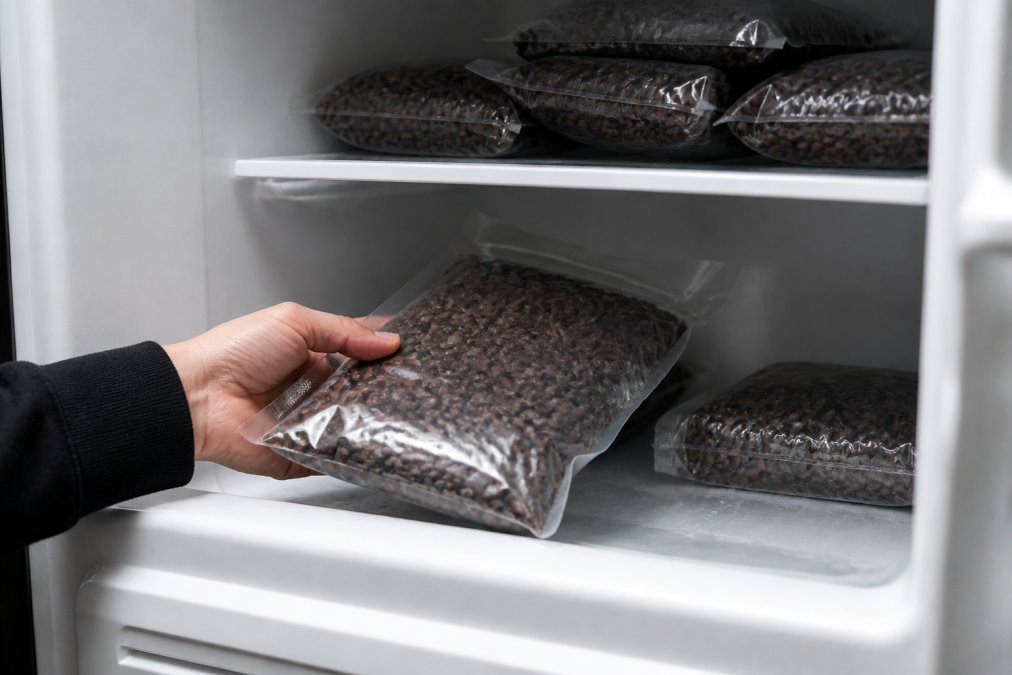
The fix is to eliminate headspace air before the beans ever see the cold. Here is the protocol most careful home storers settle on:
- Portion before you freeze. Divide beans into amounts you will finish in one to two weeks of brewing. A 12-ounce bag split into three 4-ounce portions means you thaw only what you will drink, and the rest stays sealed.
- Match the package to the portion. A vacuum-sealed bag, a Mylar barrier bag with the air pressed out, or a small mason jar filled nearly to the rim all work. The goal is minimal headspace, because headspace air is what condenses.
- Label with the roast date, not the freeze date. You need to know how old the beans were when they went in, since a bean frozen at day 20 starts its frozen life already past peak.
- Place portions in the coldest, most stable part of the freezer. That is usually the back of a bottom shelf or the floor of a chest freezer, away from the door and away from the auto-defrost fan. Door shelves swing through the widest temperature range every time the freezer cycles.
- Keep the freezer temperature steady. Most home freezers run near 0°F, and a swing of even a few degrees causes repeated sublimation and refreezing on the bean surface (foodsafety.gov). A full freezer holds temperature better than an empty one, so freeze alongside other food rather than in a bare compartment.
Thawing and Defrosting Coffee Beans Properly
The thaw is where most people ruin otherwise well-frozen beans. The rule is simple: do not open the package until the beans have reached room temperature.
Here is the mechanism. Cold air holds very little water vapor. When you pull a sealed bag from the freezer and crack it open while the beans are still at 0°F, warm kitchen air rushes in and immediately cools against the bean surfaces. That air cannot hold its moisture at that temperature, so the water condenses directly onto the beans. You get a thin film of surface moisture, and over a few minutes it soaks into the porous bean structure. The result is a bean that brews unevenly and tastes muted.
The same physics explains why you should never refreeze thawed beans. Each freeze-thaw cycle adds another condensation event, and the damage compounds.
A workable thaw routine:
- Leave the sealed portion on the counter for two to four hours, or overnight in the refrigerator if you want a slower ramp, then bring it fully to room temperature before opening.
- Once open, use the portion within about a week. It is now on the same clock as any pantry-stored bean.
- Do not thaw in a microwave or under warm water. Rapid warming is exactly the condition that drives condensation.
How Roast Level Changes the Freezing Calculus
Not all beans freeze equally well, and roast level is the variable most guides ignore. Darker roasts spend longer in the roaster, which drives more of the bean's internal oils to the surface. Those surface oils oxidize faster than oils still locked inside the cell structure, and they are also the first thing freezer air attacks. A dark, oily roast that would peak at two weeks on the counter may hold only six to eight weeks in the freezer before the surface oils turn.
Lighter roasts, with their oils still largely internal, tolerate freezing noticeably better and can hold quality for two to three months when sealed and thawed correctly. If you are buying in bulk to freeze, a medium or light roast is the safer long-term bet, and a dark roast is better bought in smaller quantities you will finish fresh.
Freeze in portions, seal out the air, thaw sealed and fully, and expect dark roasts to fade faster than light ones even in the freezer.
Vacuum Sealing, Oxygen Absorbers, and Mylar Bags for Bulk Storage
Vacuum sealing removes the air that drives oxidation, and it is the most effective home method for bulk storage. Pair it with an oxygen absorber inside a Mylar bag and you create a near-zero-oxygen environment that holds quality for months.
The USDA's food storage guidance outlines how oxygen absorbers and barrier bags limit spoilage in dry goods, and the same principle applies to coffee. Mylar blocks light and moisture; the absorber handles residual oxygen; the vacuum seal handles the rest.
For bulk buyers, this combination is worth the setup cost. Portion first, seal second, freeze third.
How Roast Level and Brewing Method Affect Storage
Roast level changes how fast beans degrade. Darker roasts have more oil on the surface from longer roasting, and that oil migrates and oxidizes faster than the oils locked inside a lighter roast. This means dark roasts have a shorter peak window, so store them accordingly.
Brewing method matters too. Espresso pulls flavors from a fine grind under pressure, so it exposes staleness quickly. A dark, oily bean destined for espresso should be used sooner than the same bean brewed as drip.
- Espresso: use within 2-3 weeks of roast
- Pour-over and drip: 3-4 weeks
- Cold brew: more forgiving, since cold extraction masks some staleness
If you are coming from grocery-store beans with no roast date, expect a noticeable difference in how quickly a fresh roast peaks and fades.
Common Coffee Storage Myths and Mistakes to Avoid
The biggest storage mistake is the refrigerator. Cold storage in a fridge exposes beans to moisture and odors from other food, and every open-and-close cycle creates condensation. The freezer, sealed properly, is a different story.
Other myths worth discarding:
- "Freezing ruins coffee." False, if beans are sealed and thawed correctly.
- "Airtight is enough." Airtight helps, but light and heat still degrade beans.
- "Grinding ahead saves time." Pre-ground coffee stales in days, not weeks.
Store whole beans, keep them sealed and dark, and buy in quantities you will actually finish. Cuppari Coffee roasts to order and ships the same day, so a Bali Blue or Colombia single origin arrives with its freshness window fully intact.
Knowing how to store roasted coffee beans long term comes down to controlling four variables: heat, light, moisture, and air. Get those right and a fresh roast stays vibrant for months instead of days.
Cuppari Coffee makes that easier by roasting only after you order and shipping the same day, so you start with beans at their peak. With free shipping on all U.S. orders and a diverse selection of single origins, blends, flavored, and convenient coffee pods, you can buy in quantities that match your storage setup. Add a bag to your cart and taste what freshly roasted actually means.
Frequently Asked Questions
Is coffee roasted 4 months ago still good?
Coffee roasted four months ago has lost most of its volatile compounds and aroma, but it is not unsafe to drink. If stored in an airtight, opaque container away from heat and moisture, it may still be drinkable, though the flavor will taste flat. For better results, freeze beans within a week of the roast date and use them within two to three months for the best flavor profile.
Is it better to store coffee beans in the freezer or pantry?
For long-term storage, the freezer is better because cold temperatures slow oxidation and preserve volatile compounds. The pantry works for short-term use, ideally within two to four weeks. If you freeze coffee beans for long term storage, portion them into airtight bags so you only thaw what you need. Refreezing thawed beans exposes them to moisture and degrades quality.
What is the best container for long-term coffee storage?
An opaque, airtight container with a one-way valve is the best choice for pantry storage. For extended periods, vacuum-sealed bags or Mylar bags with oxygen absorbers protect against air exposure and light degradation. Avoid clear containers that let light through, and never store beans in the original bag unless it is resealable and has a valve. Glass jars work if kept in a dark cabinet.
Can you vacuum seal roasted coffee beans for long-term storage?
Yes, vacuum sealing removes air exposure and slows oxidation, making it one of the most effective methods for long-term coffee preservation. After roasting, beans release carbon dioxide for several days, so wait 3 to 5 days before vacuum sealing to avoid trapping gas. Portion beans into single-use bags, vacuum seal, and freeze for up to three months without significant flavor loss.