

Table of Contents
- Craft Coffee Roasters vs Grocery Store Beans: The Core Differences
- Why Coffee Roast Date Importance Matters More Than You Think
- Quality Control and Batch Consistency
- Recognizing Signs of Stale Coffee Beans
- How to Store Coffee Beans for Maximum Freshness
- Price, Convenience, and Real Value
- Making Your Choice: Craft Roasters or Grocery Store
- Frequently Asked Questions
Last Updated: October 1, 2026
Craft Coffee Roasters vs Grocery Store Beans: The Core Differences
Craft coffee roasters and grocery store beans differ fundamentally in freshness, quality control, and supply chain transparency, differences that show up in your cup every morning.
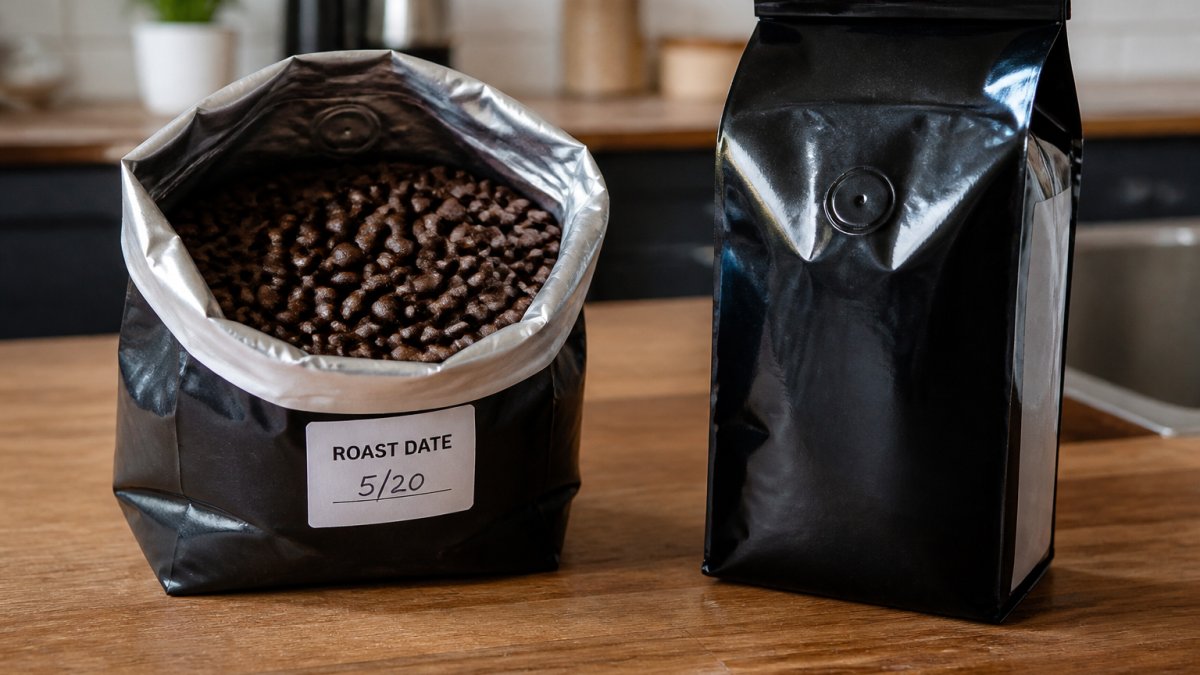
Grocery store coffee sits on shelves for weeks or months; craft coffee roasters roast to order. At Cuppari Coffee, beans are roasted after order placement and shipped the same day, arriving at peak freshness within days of roasting rather than months after, a measurable difference in taste and brew quality.
Why Coffee Roast Date Importance Matters More Than You Think
Roast date is the single most important indicator of coffee quality. Flavor peaks between 3-7 days after roasting, then declines as beans oxidize and lose aromatic compounds.
Grocery store coffee rarely lists roast dates, or lists dates 3-6 months old. By brewing time, beans have lost complexity and brightness, delivering a flattened, stale version of the original.
Craft roasters highlight roast dates as a competitive advantage. With Cuppari Coffee, you know exactly how old your beans are, whether they're in their flavor sweet spot or past prime.
Fresher beans have better degassing properties, affecting water flow during brewing. Older beans have released most CO2, leading to uneven extraction and a thinner cup.
Quality Control and Batch Consistency
Quality control operates at two levels: technical consistency (batch uniformity) and supply chain transparency (bean origin and conditions). Craft roasters excel at both; grocery store coffee typically fails at both.
Technical batch consistency: Craft roasters roast in smaller batches (5-50 lbs) with tight control over temperature, timing, and roast profile. If you buy the same single-origin coffee twice, it should taste nearly identical because the roasting process is controlled.
Grocery store coffee comes from massive commercial operations (1000+ lb batches). Volume, not precision, is the priority. Beans from multiple origins are blended and roasted to a standardized dark profile that masks defects and extends shelf life. Bag-to-bag taste variation reflects batch inconsistency from prioritizing scale over control.
| Aspect | Craft Roasters | Grocery Store Coffee |
|---|---|---|
| Batch Size | Small (5-50 lbs) | Large (1000+ lbs) |
| Roast Date Transparency | Clearly marked | Often omitted or very old |
| Quality Control Testing | Cupping and density testing | Minimal testing |
| Flavor Profile Consistency | High | Variable |
| Roast Profile | Origin-specific | Standardized |
| Supply Chain Transparency | Direct grower relationships | Opaque commodity sourcing |
Supply chain transparency and ethical sourcing: Most grocery store coffee flows through commodity brokers where specific bean origins are obscured. Labels show "Colombian" or "Brazilian," but the farm, cooperative, or region remains unknown, making it impossible to verify fair wages, safe conditions, or environmental practices.
Craft roasters source directly from farms or cooperatives with long-term relationships, knowing the farmer's name, altitude, processing method, and harvest wages.
Fair trade and certification: Fair Trade certification guarantees minimum prices to farmers ($1.40/lb for conventional, higher for organic). Grocery store coffee sometimes carries certifications, but costs are often absorbed by reducing farmer payments elsewhere.
Environmental impact: Large-scale commodity farming uses monoculture, depleting soil and destroying habitat. Specialty farms supplying craft roasters often use shade-grown methods (coffee under native tree canopy), preserving biodiversity and improving soil health. Shade-grown craft coffee has a measurably lower carbon footprint than commodity monoculture coffee.
Carbon footprint of the supply chain: Grocery store coffee travels through multiple intermediaries (exporter → broker → importer → distributor → retailer), each adding transportation. Craft roasters often source directly and ship to consumers, reducing total distance. Some offset shipping carbon or use carbon-neutral methods, resulting in lower total carbon footprint than grocery store coffee.
The quality control advantage: Buying from a craft roaster gives you fresher, consistent coffee plus visibility into origin, grower, and conditions. You can verify fair wages and environmental stewardship. Grocery store coffee offers no such visibility; lowest prices often reflect lowest farmer wages and least environmental care.
Recognizing Signs of Stale Coffee Beans
Fresh beans have vibrant, bright, complex aromas (fruity or floral depending on origin). Stale beans smell flat, dull, and cardboard-like.
Fresh whole beans have a slightly oily sheen and rich color; stale beans look dull and brittle. Cracking open a fresh bean reveals aromatic interior; stale beans smell like nothing.
Stale coffee brews with weak extraction, water passes through too quickly since beans have lost CO2, resulting in thin, watery, sour or flat coffee. Fresh beans create fuller body and balanced flavor through even extraction.
Fresh coffee has clarity with identifiable flavor notes (chocolate, fruit, floral). Stale coffee tastes muted, one-dimensional, sometimes bitter or papery. If coffee tastes like something's missing, staleness is likely the culprit.
How to Store Coffee Beans for Maximum Freshness
Craft beans need less aggressive storage because they arrive fresher; grocery store coffee's pre-existing staleness makes storage less impactful on the final cup.
Coffee's enemies are air, light, heat, and moisture, each accelerates oxidation. Storage windows differ dramatically based on roast date.
Craft roaster beans (roasted within 1-2 weeks): Use airtight, opaque containers at room temperature (65-70°F). One-way valve bags allow residual CO2 to escape without letting oxygen back in. Once opened, transfer to airtight container within 2-3 days. Whole beans remain in flavor sweet spot for 2-3 weeks post-roast, drinkable for 4-6 weeks.
Grocery store coffee (typically 3-6 months old at purchase): Most CO2 has already escaped and oxidation is underway. Storage slows further degradation but cannot recover lost flavor. A perfectly stored grocery store bag tastes noticeably flatter than a 2-week-old craft roaster bag in a regular cabinet.
Temperature stability is critical. Room temperature (around 65-70°F) is ideal. The freezer is counterintuitive: temperature fluctuations when you remove beans and return them cause condensation inside the bag, which accelerates oxidation. Some roasters recommend freezing only if you're storing beans for months without opening, in vacuum-sealed bags, but for regular weekly use, room temperature storage outperforms freezer storage.
Humidity matters significantly. Coffee is hygroscopic, it absorbs moisture from air. High humidity (above 60%) speeds oxidation. Store beans in a dry environment, away from the kitchen sink, dishwasher, or any moisture source. A kitchen cabinet or pantry is ideal; open shelving near a window is not.
Grind timing is non-negotiable. Pre-ground coffee has roughly 10 times the surface area of whole beans.
Price, Convenience, and Real Value
Craft coffee typically costs $18-24 per pound. Grocery store coffee costs $8-12 per pound. On the surface, craft roasters are twice as expensive.
National Coffee Association research on consumer preferences
Making Your Choice: Craft Roasters or Grocery Store
The decision comes down to three factors: freshness priority, flavor sensitivity, and convenience tolerance.
Choose craft roasters if:
- You brew coffee daily and care about flavor quality
- You're willing to order ahead or subscribe
- You want to know exactly how old your beans are
- You enjoy trying different single-origin coffees and flavor profiles
- You're curious about the supply chain and where your coffee comes from
Choose grocery store coffee if:
- Coffee is functional caffeine, not a sensory experience
- You need immediate availability without ordering ahead
- You don't notice or care about the flavor difference between fresh and stale
- Your budget is tight and every dollar counts
- You prefer simplicity and minimal planning
Specialty Coffee Association standards for coffee quality
Frequently Asked Questions
How long do grocery store coffee beans stay fresh?
Grocery store beans typically remain at peak freshness for 2-4 weeks from the roast date, though the date is often unmarked or months old by purchase. After that window, oxidation accelerates and flavor degrades noticeably. Sealed bags with one-way valves slow this process, but once opened, use them within 1-2 weeks. Craft roasters ship beans roasted the same day, giving you the full freshness window.
Does roasting date really affect coffee flavor?
Yes, significantly. Fresh beans release complex flavor notes and aroma during the first 7-14 days post-roast, a critical window called the degassing phase. Beans older than 3-4 weeks lose acidity, body, and nuanced flavor profiles. Grocery store beans often sit weeks or months before you purchase them, meaning you miss the peak sensory experience. This is why coffee roast date importance is central to quality, it directly determines what's in your cup.
What makes craft coffee roasters different from grocery store brands?
Craft roasters focus on specialty grade beans with documented supply chain transparency, often featuring single origin lots from specific farms or regions. They roast in smaller batches for quality control and ship immediately after roasting. Grocery store coffee typically uses commercial grade commodity beans blended for consistency, roasted weeks or months prior, and stored in warehouses.
Is it cheaper to buy coffee from a roaster or the grocery store?
Grocery store coffee costs less per pound upfront, often $8-14 for a bag. Craft roasters like Cuppari Coffee charge $21.99 per bag, but you're paying for guaranteed freshness (roasted same-day), supply chain transparency, and superior flavor. When you factor in waste from stale beans, the cost difference narrows. Plus, Cuppari offers free shipping on all U.S. orders, eliminating additional costs. Most home brewers find the improved taste and freshness worth the premium.
How can I tell if coffee beans are stale?
Signs of stale coffee beans include: flat or muted aroma when you open the bag, dull appearance (fresh beans have a slight sheen), lack of crema when brewed, thin or watery body in your cup, and absence of the bright, complex flavor notes you expect. Stale beans also don't produce the satisfying 'snap' when you bite one. If the bag has no roast date or the date is more than 4-6 weeks old, freshness is already compromised. Fresh craft-roasted beans show vibrant aroma and bold flavor immediately.