

Last Updated: November 5, 2026
Quick Summary
Choose a coffee scale by starting with your brew method, not the spec sheet: pour-over needs a fast readout and timer, espresso needs 0.1-gram resolution and a small platform, and batch brewing needs basic accuracy and capacity. Then check accuracy and repeatability at home, confirm response speed during the pour, and measure your gear's clearance and footprint before buying.
- Resolution is the smallest displayed increment; accuracy is how close that display is to true weight.
- Test repeatability by weighing a known item five times and watching for variation.
- A 60-second auto-off default can shut an entry-level scale down mid-brew.
- Measure clearance under your espresso machine's drip tray before buying any scale.
- Capacity should cover your largest vessel plus water, not a typical dose.
Table of Contents
- Start With Your Brew Method, Not the Spec Sheet
- Coffee Scale Accuracy and Resolution: Why 0.1 Grams Isn't the Whole Story
- Response Speed and Real-Time Readings During the Pour
- Finding the Best Espresso Scale for Fast, Repeatable Shots
- What a Budget Coffee Scale Can and Cannot Do
- Is a Coffee Scale With Timer Worth It for Your Setup?
- Capacity, Platform Size, and Fitting Your Brewing Equipment
- Pair Your New Scale With Freshly Roasted Beans From Cuppari Coffee
- Frequently Asked Questions
Start With Your Brew Method, Not the Spec Sheet
Most people buy a coffee scale backwards. They find a well-reviewed model, then try to make their brewing fit it.
Here is the better path: pick the scale based on how you brew.
The core tension is simple. The Specialty Coffee Association's brewing standards treat consistent measurement as a baseline for repeatable results, not a luxury add-on.
So before you read a single spec, answer one question: what are you brewing most often?
- Pour-over and filter: you need a fast, responsive readout and a timer
- Espresso: you need 0.1-gram resolution, a small platform, and fast response
- Batch brewing or French press: basic accuracy and a decent capacity are enough
If you are still assembling your pour-over setup, our guide to pour over coffee equipment covers the full kit before you commit to a scale.
Coffee Scale Accuracy and Resolution: Why 0.1 Grams Isn't the Whole Story
Resolution is the smallest increment a scale displays. Accuracy is how close that display is to the true weight.
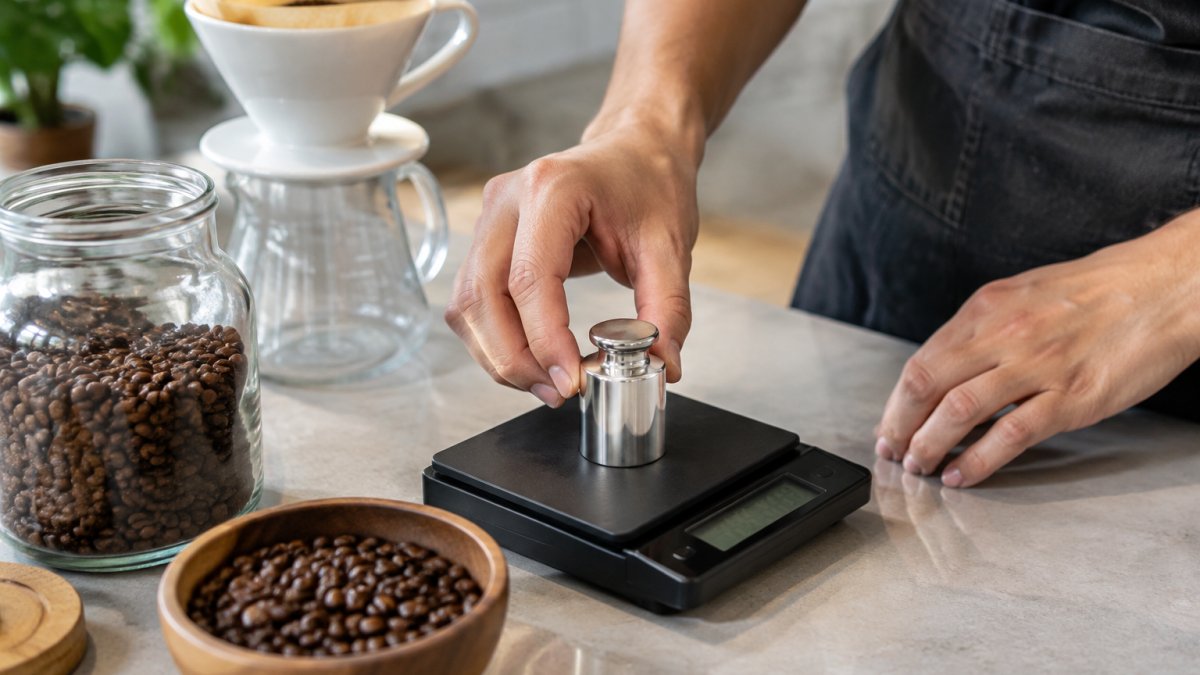
A scale can show 0.1-gram steps and still be off by a full gram. Resolution sells the product. Accuracy makes the coffee.
For espresso, 0.1-gram resolution matters because a small dose change shifts extraction. For pour-over, a 1-gram step is usually fine, since you are dosing larger amounts.
How to Test a Scale's Accuracy at Home
You do not need a lab. You need a known weight and a little patience.
- Find a calibration weight, or use a sealed coin or item with a documented weight
- Place it on the scale and note the reading
- Repeat five times and watch for variation
- Add a second known weight and check the reading again
- Tare, re-tare, and confirm the scale returns to zero
If the same weight reads differently each time, the scale lacks repeatability. That is a bigger problem than a small fixed offset.
A common mistake is testing once and calling it done. Repeatability is what makes your brew consistent day to day.
If you are chasing precision, pair the scale with a grinder that can deliver a consistent grind. Our roundup of the best coffee grinders for fresh beans explains how grind consistency and weighing work together.
Response Speed and Real-Time Readings During the Pour
A slow scale ruins a good pour. You add water, the number lags, and you overshoot your target weight before the display catches up.
Responsiveness matters most during the pour itself. You want real-time readings that update as the water hits the bed, so you can stop exactly on target.
Look for a scale that updates quickly under a changing load, not just when sitting still.
Watch out: a scale with a long auto-off timer can shut down mid-brew.
Finding the Best Espresso Scale for Fast, Repeatable Shots
For espresso, the best espresso scale is small, fast, and readable to 0.1 grams.
Espresso brewing leaves little margin. A shot pulls in roughly the time it takes to read this paragraph, so the scale must keep up.
What most reviews miss is platform size. A scale that fits your pour-over setup may be too wide to sit under an espresso machine.
Dialing in shots also depends on the beans. Our guide to the best coffee beans for espresso helps you pick beans suited to repeatable shots, so your new scale has something consistent to measure.
What a Budget Coffee Scale Can and Cannot Do
A budget coffee scale can handle the basics well. It will weigh your dose, tare your cup, and give you a usable timer. For filter coffee and casual brewing, that is often enough. Budget scales come in different tiers, and each tier buys a different set of capabilities.
Good: The Essential Tier
At the entry level, expect a scale that displays in 1-gram increments, tares reliably, and includes a basic count-up timer. Capacity is usually around 1 to 3 kilograms, which is plenty for a dripper or French press.
Watch out: Some entry-level scales default to a 60-second auto-off. That is shorter than a typical pour-over, so confirm the shutoff window can be extended or disabled before you buy.
Better: The Precision Tier
Moving up one step typically gets you 0.1-gram resolution, a faster load cell, and a timer that runs long enough for a full brew. This is the tier where espresso becomes practical: a 0.1-gram display lets you see a single bean's worth of change in the dose, and faster response means the readout tracks the shot instead of trailing it.
Best: The Feature Tier
At the top, you pay for flow-rate feedback, auto-tare and auto-start on first drop, app connectivity, and build quality that survives daily cafe-style use. These features are genuinely useful if you are dialing in espresso shots and want to compare flow curves, or if you brew the same recipe repeatedly and want the scale to handle timing automatically. They are unnecessary if you brew one pour-over a day and already own a phone timer.
How to Decide
Ask two questions. First, do you brew espresso more than once a week? If yes, the precision tier is your floor, 0.1-gram resolution and fast response are not luxuries at that dose size. Second, do you already time your brews and track recipes? If yes, the feature tier may earn its cost. If you never time anything, buy the essential tier and spend the difference on fresh beans.
Budget scales come in tiers, and each tier buys a different set of capabilities.
| Tier | What you get | Main compromise |
|---|---|---|
| Good: Essential | 1-gram increments, reliable tare, basic count-up timer | Readings may lag a second or more |
| Good: Essential | Capacity usually around 1 to 3 kilograms | Some default to a 60-second auto-off |
| Better: Precision | 0.1-gram resolution, faster load cell, longer timer | Point of diminishing returns for filter brewing |
| Better: Precision | Water-resistant tops and sealed buttons | , |
| Best: Feature | Flow-rate feedback, auto-tare, auto-start on first drop | Smart features add cost and charging routines |
| Best: Feature | App connectivity and durable build quality | Adds failure points |
Is a Coffee Scale With Timer Worth It for Your Setup?
A coffee scale with timer is worth it if you brew pour-over or espresso and want one device instead of two.
The trade-off is real. Built-in timers add cost, and a separate phone timer works fine if you are organized.
Ask yourself one question: do you currently time your brews? If yes, a scale with a timer earns its place. If you never time anything, save the money and buy a simpler model.
Capacity, Platform Size, and Fitting Your Brewing Equipment
Capacity and platform size decide whether a scale actually works on your counter. A scale that is too small cannot hold your brewer. One that is too big crowds out everything else. The useful approach is to measure your actual gear before you shop.
Measure Three Things Before You Buy
- Clearance under your espresso machine. With the drip tray in place, measure the vertical gap between the tray and the group head or portafilter spout. The only number that matters is your own clearance. If the gap is tight, look for a low-profile scale and confirm the height in the product specs.
- Platform footprint versus your brewer base. Measure the diameter of your dripper, carafe, or server base. The scale platform should be at least as wide as that base so the brewer sits flat and centered. A platform narrower than the base creates a tipping risk during the pour.
- Counter footprint. Measure the counter space you are willing to give up permanently. A scale you have to move before every brew is a scale you will stop using.
Match Capacity to Your Largest Brew
Capacity is the maximum weight the scale can handle, and it should cover your heaviest realistic load: brewer, coffee, and full water dose together. A single-cup pour-over is light, but a batch brewer or a large French press can push total weight well past what a small espresso scale is rated for. Check the maximum capacity against your largest vessel plus water, not against a typical dose.
Fit by Brewing Method
- Espresso: prioritize a small platform and low height that fit under the drip tray, with 0.1-gram resolution. Platform size only needs to hold a demitasse and a shot glass.
- Pour-over: prioritize a platform wide enough for your dripper or server base, with a timer and fast response. Height is rarely a constraint here.
- Batch and French press: prioritize capacity and a stable, wide platform. Resolution and response speed matter less at larger volumes.
Watch out: A scale that fits your pour-over setup may be too wide or too tall to sit under an espresso machine. If you brew both, measure the espresso clearance first, because it is the tighter constraint.
Compatibility with brewing equipment matters as much as accuracy. If counter space is tight, our guide to coffee brewing equipment for small kitchens pairs compact gear with scales that fit the same footprint.
Pair Your New Scale With Freshly Roasted Beans From Cuppari Coffee
A precise scale only pays off if the beans are worth measuring. Stale coffee gives you consistent, flat results, no matter how tight your numbers are.
That is where Cuppari Coffee comes in. We roast beans only after an order is placed, and every order is roasted and shipped the same day.
Ready to brew with beans that match your precision? Add to cart and taste the difference fresh roasting makes.
Frequently Asked Questions
What accuracy and resolution should I look for in a coffee scale?
Look for 0.1-gram resolution for espresso and pour-over, and 1-gram resolution is fine for drip brewing larger batches. Resolution is the smallest increment the display shows; accuracy is how close that reading is to the true weight. A scale that reads 0.1 grams but drifts under load is less useful than a stable 0.1-gram scale. Check the minimum weight too, since espresso doses of 15-20 grams need a scale that registers reliably at the low end.
Do you need a different coffee scale for espresso and pour-over?
Often, yes. Espresso demands a compact footprint that fits under the group head, fast response for watching flow rate, and a timer. Pour-over benefits from a wider platform that holds a dripper and carafe, plus a timer for bloom and pour timing. A single scale can do both if it is small enough for the espresso tray and stable enough for a full carafe. Weigh your largest and smallest setups before buying.
Are coffee scales with built-in timers worth it?
For most home brewers, a coffee scale with timer is worth the small premium. Automatic timing that starts on first pour keeps your brew ratio and extraction consistent without juggling a phone. If you already time brews on your phone or espresso machine, a simple scale without a timer is fine. Prioritize response speed and accuracy first, then add the timer if the budget allows.
How do you check whether a coffee scale is weighing correctly?
Use a known calibration weight or a sealed bag of beans with a stated weight. Place it on the scale, note the reading, remove it, and repeat three times to check repeatability. Then add small increments to see how quickly the display responds. If readings drift or differ by more than 0.2 grams between attempts, the scale is not reliable for precision brewing. Many scales include a calibration mode you can run with a standard weight.
The real test of a coffee scale is whether it makes your brews repeatable, not whether it wins a spec contest. Start with your brew method, test accuracy at home, and skip features you will never use. Then give that precision something worth measuring. Get started with Cuppari Coffee and brew every cup from freshly roasted beans.
