

Last Updated: October 27, 2026
Quick Summary
For most home use, a conical burr grinder is the practical espresso grinder choice, since it is compact and quieter, while a flat burr model suits those who want maximum consistency and have room. Expect a budget grinder to trade off adjustment range, retention and motor durability.
- Small differences in particle size change how quickly water extracts flavor from espresso.
- Stepped grinders lock settings for easy repeatability; stepless grinders allow finer, continuous adjustment.
- Purchase price is only part of value; compare replacement burr costs and warranty terms.
- Budget grinders often have narrower adjustment ranges, more retention and shorter motor duty cycles.
- Grind a fixed dose at three settings, time each shot, and taste side by side to test yourself.
Table of Contents
- Why Your Home Espresso Grinder Matters More Than Your Machine
- Flat vs Conical Burr Grinder for Espresso: Which Fits Your Kitchen
- How Our Testing Approach Shaped These Recommendations
- Best Budget Espresso Grinder Options and What You Give Up
- Single-Dose vs Hopper-Fed: Workflow, Retention and Mess
- How to Dial In Espresso With Your New Grinder
- Choosing Your Home Espresso Grinder and Next Step
- Frequently Asked Questions
Home espresso often gets blamed on the machine, but the grinder is usually the weak link. A capable machine cannot fix uneven grounds. That is why the grinder deserves as much attention as the espresso machine itself. Cuppari Coffee roasts beans to order and ships them the same day. This guide explains what to look for in a home espresso grinder, what trade-offs to expect at each price, and how to dial one in.
Why Your Home Espresso Grinder Matters More Than Your Machine
Espresso is a short, high-pressure extraction. Small differences in particle size change how quickly water pulls flavor from the coffee (The role of fines in espresso extraction dynamics).
A grinder controls three things that shape every shot: particle size, particle uniformity, and dose consistency. Most home setups struggle with the first two. Pre-ground coffee, or a blade grinder, produces many sizes that no machine can compensate for.
If you are deciding where to spend, a stronger grinder usually improves the cup more than an upgrade in the machine.
Flat vs Conical Burr Grinder for Espresso: Which Fits Your Kitchen
Most home espresso grinders use one of two burr geometries. Both grind by crushing beans between two rotating surfaces, which produces far more uniform particles than blades.
Flat burrs use two parallel rings with cutting teeth. They tend to produce a very even particle distribution, which many espresso drinkers prefer for clarity in the cup. They are often louder and sometimes larger.
Conical burrs use a cone-shaped inner burr that spins inside an outer ring. They are common in compact home models, run somewhat quieter, and handle many roast levels well.
For a counter-sized kitchen where space and noise matter, a conical burr grinder is usually the practical choice.
Burr size, material and grind consistency
Burr size affects how quickly a grinder produces a dose and how much heat it generates. Larger burrs grind faster and run cooler at the same speed, which helps preserve aromatics.
Material matters less than geometry and alignment. Steel burrs are common and durable. What affects consistency most is how well the burrs are machined and how stable the grinder is in use.
Stepped vs stepless adjustment
A stepped grinder locks the grind size into discrete settings. Each click moves the particle size by a set amount, which makes it easy to return to a known setting. Stepless grinders let you adjust continuously, which gives finer control but makes repeating an exact setting harder.
Stepped models suit beginners who want repeatable results without much tuning. Stepless models suit drinkers who expect to adjust daily to changing beans or humidity.
How Our Testing Approach Shaped These Recommendations
Most grinder roundups describe results without showing the method.
The home-bench protocol we apply
- Fix the variables. Use one coffee, one dose, one basket, and one machine for the whole comparison. A common setup is 18g in a standard double basket, targeting roughly 36g out in 25-30 seconds.
- Season the burrs. Run a few hundred grams of cheap beans through a new grinder before judging it; new burrs produce inconsistent grounds until they break in.
- Pull three shots per setting. Record dose, yield, time, and taste for each. Repeatability across three runs tells you more than one impressive shot.
- Score four things. Particle consistency (channeling, clumping), retention (weigh grounds in versus out), adjustment resolution (how much one step changes shot time), and workflow (mess, noise, ease of purging).
- Re-test after a week. Grinders that drift out of setting, clog, or retain more as they age reveal themselves over repeated use, not on day one.
Total cost of ownership, not just sticker price
Purchase price is the smallest part of long-term value for a daily-use grinder. To judge whether a burr grinder is worth the investment, compare costs and grind consistency first. Compare these line items before you buy:
- Replacement burrs. Most steel espresso burrs are rated for roughly 500-1,000 pounds of coffee before replacement. Confirm the burr set is sold separately and note the price; some budget grinders have burrs that cost nearly half the grinder.
- Warranty terms. Look for at least one year and check whether the warranty covers burrs (usually it does not) and whether shipping is on you.
- Repairability. Does the manufacturer sell motors, switches, and adjustment collars? Can you reach a human for support? A grinder with published parts diagrams is a lower-risk buy than one with none.
How to run the same test yourself
You do not need lab equipment. Grind a fixed dose of one coffee at three settings, weigh each dose, time each shot against the same yield, and taste side by side. If the grinder cannot return to the same setting after you move away and back, that is a workflow problem you will feel every morning. If retention climbs over a week, purge a dose before dialing in.
OutIn Fino Portable Electric Coffee Grinder →
Best Budget Espresso Grinder Options and What You Give Up
Budget espresso grinders can pull good shots, but the compromises are predictable. Below about $250, most models give up some combination of adjustment range, burr size, retention control, and motor durability. Knowing which compromise you can live with matters more than chasing a spec sheet.
What the budget tier actually costs you
- Narrower adjustment range. Entry grinders often have fewer usable espresso settings, so a small turn of the dial moves the shot time a lot. That makes dialing in fussier, especially with light roasts.
- More retention. Grounds left in the chute go stale between shots. On budget hopper-fed models, retention of a few grams is common; purge a dose before you dial in.
- More fines and clumps. Cheaper burrs and less rigid alignment produce more dust, which can choke a shot or add harshness. A WDT tool and a dosing funnel help more at this tier than at any other.
Named options to compare at this tier
- Baratza Encore ESP. A conical burr grinder with 40 stepped settings, with the lower 20 calibrated for espresso. It is the most commonly recommended entry point for home espresso because the steps are close enough together to dial in, and Baratza sells replacement burrs and parts directly. Expect to pay around $199.
- DF64 (Turin/Generic) with stock flat burrs. A single-dose flat burr grinder that often lands near $250-$300 depending on seller and burr set. It gives you flat-burr clarity and low retention, but the stock burrs and alignment vary by batch, so buy from a seller with a return window.
- Eureka Mignon Notte/Facile. A stepless 50mm flat burr grinder that sits just above the strict budget line, often around $249-$329. It is the value pick if you want stepless adjustment without jumping to the $500 range.
How to decide within the budget tier
If you drink one or two espresso shots a day and switch beans often, a single-dose flat burr grinder or a hand grinder gives the best cup per dollar. If you make several drinks back-to-back and want speed, a stepped conical model with parts support is the safer buy. Either way, budget for a dosing funnel, a scale with 0.1g resolution, and a WDT tool; those three accessories close more of the gap to a mid-tier grinder than any single upgrade.
Baratza parts and burr replacement
The budget options compare as follows, using the figures and features the article gives for each.
| Grinder | Price or key figure | Main trade-off |
|---|---|---|
| Baratza Encore ESP | Around $199 | 40 stepped settings, 20 for espresso |
| DF64 with stock flat burrs | Near $250-$300 | Stock burrs and alignment vary by batch |
| Eureka Mignon Notte/Facile | Around $249-$329 | Stepless 50mm flat burrs |
| 1Zpresso J-Ultra | Roughly $200 | Manual grinding requires effort per dose |
| OutIn Fino | $179.99 | Small hopper and battery limit daily use |
Single-Dose vs Hopper-Fed: Workflow, Retention and Mess
A hopper-fed grinder holds beans in a reservoir above the burrs.
A single-dose workflow grinds only what you need for one shot. It reduces retention and waste, and it lets you switch beans easily.
Choose hopper-fed if you brew several cups and want speed. Choose single-dose if you change coffees often and want the freshest grounds in each cup.
For cleaning, check how easily the burrs and chute come apart.
How to Dial In Espresso With Your New Grinder
Dialing in means adjusting grind size until a shot tastes balanced. If you are new to the process, this beginner's guide to brewing espresso at home covers the basics.
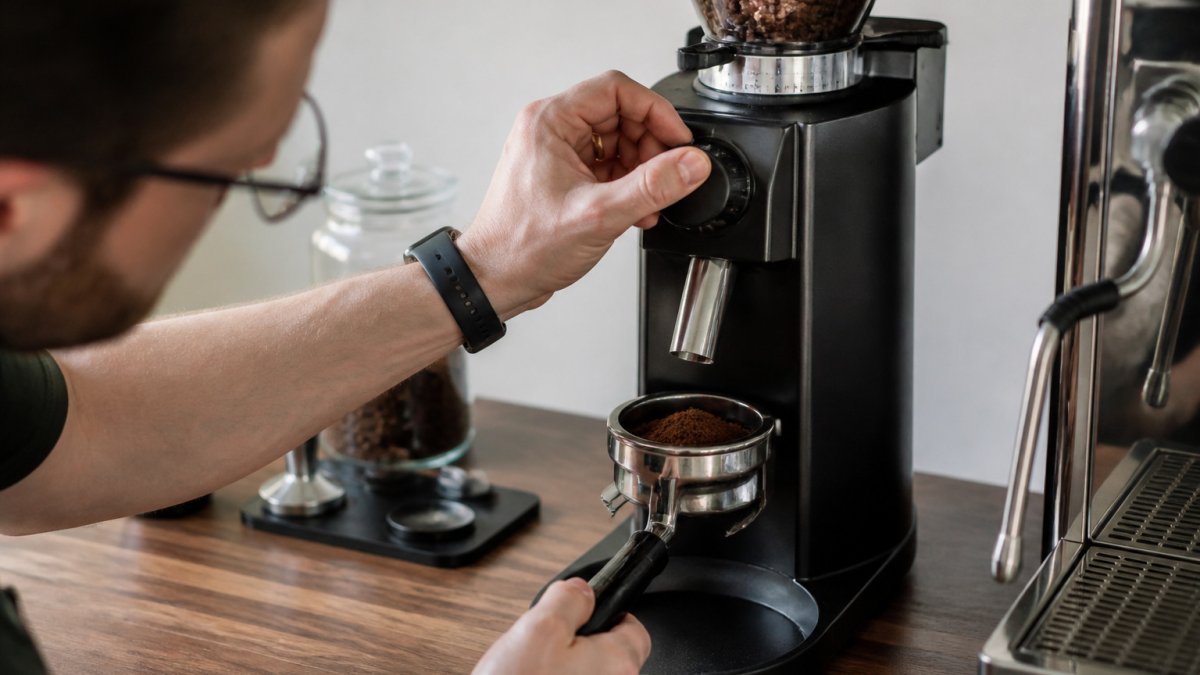
- Set your dose by weight, typically 18 grams for a standard basket.
- Set a yield, often around double the dose in liquid espresso.
- Grind at a middle setting and pull the shot.
- If the shot runs faster than about 25 seconds, grind finer. If it runs slower, grind coarser.
- Taste the shot. Sour and thin suggests under-extraction; bitter and harsh suggests over-extraction.
- Make small adjustments and repeat until the taste is balanced.
Use a light tamp and keep your technique consistent, since tamping pressure changes flow too. A WDT tool, which breaks up clumps in the grounds, also improves even extraction. Our guide to using a WDT tool for better espresso walks through the technique.
Choosing Your Home Espresso Grinder and Next Step
Pick a grinder by weighing four factors: burr type, adjustment style, workflow, and budget. A conical burr grinder with stepless adjustment suits most daily espresso drinkers. A hopper-fed model fits households that brew several cups. A single-dose setup fits people who switch coffees often.
Freshness matters as much as equipment. Cuppari Coffee roasts beans only after an order is placed and ships the same day.
Ready to start? Browse our beans and grab a grinder that fits your kitchen. Add to cart today and start dialing in your best espresso at home.
Frequently Asked Questions
What is the most important feature in a home espresso grinder?
Grind consistency matters most. Uneven particle size causes some coffee to over-extract while other grounds under-extract, which makes shots taste sour and bitter at the same time. Look for a burr grinder rather than a blade grinder, and check that the grinder offers fine adjustment steps so you can change extraction time by small amounts. Burr size and build quality affect longevity and noise.
Do I really need a dedicated espresso grinder?
If you want to pull consistent espresso shots at home, yes. Espresso needs a very fine, uniform grind, and most blade grinders and pre-ground coffee cannot deliver the particle consistency required. A dedicated burr grinder with fine adjustment lets you control dose, grind size and extraction time, which is how you dial in a shot.
What is the difference between flat and conical burrs for espresso?
Flat burrs use two parallel rings with cutting surfaces, typically producing a very uniform particle distribution. Conical burrs use a cone-shaped inner burr inside a ring, which tends to be quieter and run cooler at lower speeds, and they are common in many home grinders. Both can produce excellent espresso. Choose based on your budget, the grinder's burr size and whether the grind distribution holds up in your own tests, not on burr shape alone.
How much should I spend on a home espresso grinder?
Budget models are a reasonable starting point for home espresso if you accept some trade-offs in consistency, adjustment range and noise. Cuppari Coffee's OutIn Fino Portable Electric Coffee Grinder is listed at $179.99 and features 28 grind levels plus stepless micro-adjustment, a rotating bean hopper and a 690 g cordless design. Compare any grinder on grind consistency, adjustment precision and ease of cleaning.
