

Last Updated: November 1, 2026
Quick Summary
To start a coffee subscription business, define your target audience and subscription model, then budget roughly $600-$3,900 for a lean reseller-style launch. Partner with a roaster, price each order to protect your contribution margin, and validate demand with a small first batch before scaling inventory.
- A realistic lean launch runs about 8-12 weeks from idea to first shipment.
- Reselling roasted coffee is the lower-risk path; in-house roasting can push startup costs into the tens of thousands.
- In the worked example, a $24.00 bag leaves a $7.60 contribution margin, about 32% of the price.
- Roast on demand and ship the same day so beans reach customers inside the freshness window.
- Watch how many subscribers stay for a second delivery, not just how many sign up.
Table of Contents
- Step 1: Build Your Coffee Subscription Business Plan
- Step 2: Map Out Coffee Subscription Business Startup Costs
- Step 3: Source Coffee and Lock In Freshness
- Step 4: Set Coffee Subscription Pricing That Leaves a Margin
- Step 5: Validate Demand Before You Scale
- Step 6: Launch Your Storefront and Fulfillment
- Step 7: Run Coffee Subscription Marketing Strategies That Retain
- Test the Model With a Sample Pack Before You Commit
- Frequently Asked Questions
Step 1: Build Your Coffee Subscription Business Plan
Starting a coffee subscription business begins with one question: whose mornings are you improving? A coffee subscription business sells recurring deliveries of freshly roasted beans, turning one-time buyers into predictable recurring revenue. This guide walks the full path, from picking a model to shipping your first order.
Define Your Target Audience and the Problem You Solve
Most new sellers get this wrong. They try to serve every coffee drinker at once.
Narrow it down. Pick one group, busy commuters, home brewers tired of stale grocery bags, or offices needing steady supply, and name the customer problem in one sentence.
- Busy professionals: no time to shop, want fresh beans at the door
- Home brewers: grocery coffee sits on shelves for months
- Small offices: need consistent quality without reordering every week
Your value proposition grows straight out of that problem. If freshness is the issue, promise a roast date on every bag.
Choose Your Subscription Model and Cadence
A subscription model is the structure that decides how often customers pay and receive coffee. Three options cover most of the market:
- Weekly or biweekly delivery: best for heavy drinkers and offices
- Monthly delivery: the most common cadence for households
- Prepaid bundles: customers pay upfront for several shipments
Cadence matters more than most founders expect. Too frequent and bags pile up; too slow and customers run out and cancel. Offer two or three frequencies and let subscribers switch anytime.
If you want a deeper look at how competing services are structured, read our guide on how to choose a fresh coffee subscription before you lock in your model.
Step 2: Map Out Coffee Subscription Business Startup Costs
Coffee subscription business startup costs fall into four buckets: coffee inventory, packaging, software, and shipping. You do not need a warehouse or a big team, a spare room and a reliable roaster partner can carry your first few hundred orders.
Most launch guides stop at listing categories. The useful version is a staged budget, because pre-launch spend differs sharply from per-order spend once orders flow.
Pre-Launch Budget (Before Your First Order Ships)
| Cost Category | Typical Range | What It Covers | How to Keep It Low |
|---|---|---|---|
| Business registration and licenses | $50-$500 | LLC filing, state/local business license, sales tax permit | File in your home state; skip extras until revenue justifies them |
| Food safety compliance | $0-$300 | Food handler training, cottage-food or retail food permit if required | Confirm whether reselling sealed wholesale coffee triggers a food permit in your state |
| Initial coffee inventory | $300-$1,500 | First wholesale lots, 20-100 bags | Buy small lots from one roaster; negotiate a low minimum |
| Packaging | $150-$600 | Bags with degassing valves, labels, mailers, boxes | Order modest quantities; use plain stock bags and printed labels |
| Subscription and e-commerce software | $0-$100/month | Recurring billing, storefront, email | Start on entry tiers; many platforms bundle subscriptions |
| Payment processing setup | $0 upfront | Card processing (typically a percentage per transaction) | Compare rates; budget for chargebacks |
| Shipping supplies and postage | $100-$400 | Scale, tape, first postage batch | Weigh your most common order and price shipping into the tier |
| Branding and photography | $0-$500 | Logo, product photos | Use phone photos and a simple wordmark at first |
| Lean total | roughly $600-$3,900 |
Ordering custom-printed packaging before you have paying subscribers is the fastest way to burn cash. Start plain and upgrade later. The same goes for paid ads: prove the offer converts organically before you spend on acquisition.
Staged Launch Timeline
A realistic lean launch runs about 8-12 weeks from idea to first shipment. The stages matter more than the exact dates:
- Weeks 1-2, Plan and register. Pick your model and audience, file your business entity, and confirm state and local food and sales-tax requirements.
- Weeks 3-4, Source and sample. Vet two or three roasters, order samples, and brew them yourself. Lock in wholesale pricing and a roast-to-ship window.
- Weeks 5-6, Build the storefront. Set up product pages, subscription billing, and payment processing. Write your shipping policy and returns terms.
- Weeks 7-8, Validate. Run a landing page and waitlist, then sell a small first batch to real paying customers.
- Weeks 9-12, Fulfill and refine. Ship your first orders, track second-delivery retention, and adjust cadence and pricing before scaling inventory.
Reseller vs. In-House Roasting
The budget above assumes you buy roasted coffee wholesale. Roasting in-house changes the math substantially: a small commercial roaster, ventilation, and green coffee inventory can push startup costs into the tens of thousands of dollars, and it adds licensing, insurance, and a learning curve. For most first-time founders, reselling roasted coffee is the lower-risk path to testing demand, and you can add roasting later once subscription revenue is predictable.
Plan your launch in two budgets: a pre-launch spend you can afford to lose, and a per-order cost you must cover on every shipment. If you cannot state both numbers, you are not ready to buy inventory.
Step 3: Source Coffee and Lock In Freshness
Freshness is the product. If your beans arrive weeks after roasting, nothing else in your business can fix that.
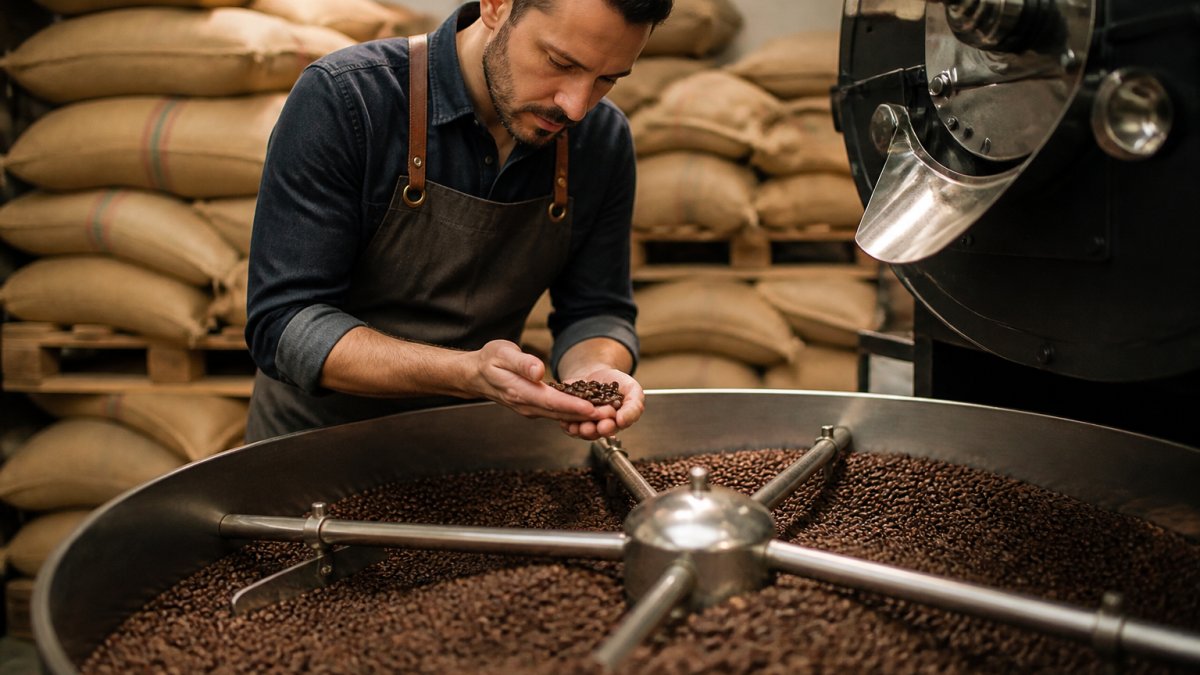
Finding and Evaluating a Coffee Roaster or Supplier
You have two paths: roast your own or partner with an established coffee roaster. For most new businesses, partnering is the smarter first move. It avoids equipment costs and lets you test demand quickly.
When you vet a supplier, ask direct questions:
- What is your typical roast-to-ship window?
- Can you print the roast date on each bag?
- Do you offer wholesale pricing at low volumes?
For a full checklist on vetting sourcing claims, see our guide on how to evaluate coffee sourcing practices.
Roast Scheduling and Inventory Forecasting
Roast on demand, not in advance. Beans roasted only after an order is placed and shipped the same day reach customers inside the freshness window. That single habit separates a real specialty service from a reseller.
Forecast simply. If you plan to hold roasted inventory between roast and delivery, our article on how to store roasted coffee beans long term covers the storage rules that protect flavor.
Step 4: Set Coffee Subscription Pricing That Leaves a Margin
Coffee subscription pricing has to cover four things: the coffee, the bag, the shipping, and your margin. Skip any one and you lose money on every order.
Most guides stop there. The part that actually decides whether your business survives is unit economics: the contribution margin on a single subscription order after every variable cost is paid. Below is a worked example you can adapt to your own supplier quotes.
A Worked Unit-Economics Example
Assume a 12 oz bag subscription at a $24.00 monthly price, shipped in a padded mailer. These are illustrative figures; replace them with your real quotes.
| Line Item | Amount | Notes |
|---|---|---|
| Subscription price | $24.00 | What the customer pays per delivery |
| Coffee (wholesale, 12 oz) | −$8.50 | Varies widely by origin and roaster |
| Packaging (bag, label, mailer) | −$1.40 | Plain stock bag plus printed label |
| Shipping postage | −$5.50 | One-pound package, ground service |
| Payment processing | −$1.00 | Roughly 3-4% of the transaction |
| Contribution margin | $7.60 | About 32% of the price |
That $7.60 is what pays for software, marketing, replacements, and your time. If you discount 15% to acquire a subscriber, the margin on that first order drops to roughly $4.00, which is fine only if the customer stays long enough to repay the discount.
The Numbers That Decide Viability
- Contribution margin per order: price minus coffee, packaging, shipping, and payment fees. Aim to keep it comfortably positive before discounts.
- Customer acquisition cost (CAC): total marketing spend divided by new subscribers. If CAC exceeds the margin from several orders, the offer does not pay back.
- Payback period: how many deliveries it takes to recover CAC. Shorter is safer; a long payback means churn can wipe out your acquisition spend.
Model three scenarios before you set a price: a full-price subscriber, a discounted first order, and a subscriber who skips every other month. If the third scenario loses money, your cadence or pricing needs work.
Setting Your Tiers
Work backward from the contribution margin, not from what competitors charge.
- Entry tier: smaller bag, single origin, lowest price point, use it to lower the barrier to a first order.
- Standard tier: the core offer most subscribers choose; this is where your margin must be strongest.
- Premium tier: rare lots or larger bags at a higher price, protects margin against rising green coffee costs.
Keep the gap between tiers modest. Big jumps push new subscribers to the cheapest option and leave money on the table. And build shipping into the tier price rather than surprising customers at checkout; a predictable all-in price converts better and makes your margin math honest.
A subscription is only viable if the contribution margin on a typical order covers acquisition and retention costs over the customer's expected lifetime. Run the arithmetic before you run the ads.
Step 5: Validate Demand Before You Scale
Market validation means proving people will pay before you spend on big inventory. Run a small test first.
Start with a landing page and a waitlist. Offer a limited first batch to friends, local cafés, and community groups. Watch two numbers: how many people sign up, and how many stay for a second delivery. Customer research at this stage beats guesswork every time.
- Build a one-page offer with clear pricing
- Collect email signups for a waitlist
- Sell a small first run to real paying customers
If people hesitate, the problem is usually price clarity or trust, not the coffee.
Step 6: Launch Your Storefront and Fulfillment
Your online storefront is where the business becomes real. Pick an e-commerce platform that supports recurring billing out of the box, because manual renewals do not scale.
Set up these pieces before launch day:
- Product pages with roast level, origin, and tasting notes
- Subscription software for billing, skips, and pauses
- Payment processing with automatic retries for failed cards
- Order management so each order prints a packing slip and label
- Fulfillment routine: roast, pack, ship, same day
Shipping costs decide your margins. Weigh your most common order and price shipping into the tier, or offer free shipping above a set order size.
Step 7: Run Coffee Subscription Marketing Strategies That Retain
Coffee subscription marketing strategies split into two jobs: getting first customers and keeping them. Most founders overwork the first and ignore the second.
For acquisition, lean on sampling, local partnerships, and a simple referral offer. For retention, watch churn rate and customer lifetime value closely.
- Offer easy skips and pauses to reduce cancellation rate
- Send a short note when a new origin ships
- Ask for feedback after the second delivery
To sharpen your messaging, review the benefits of subscription coffee services from the customer's side.
Test the Model With a Sample Pack Before You Commit
Before you sign a wholesale agreement, buy samples and brew them yourself. You cannot sell coffee you have not tasted.
Sample packs let you compare roast profiles, packaging, and shipping speed with a small spend. Taste each one, check the roast date on arrival, and note how the beans look and smell.
The hardest part of a coffee subscription business is not the launch. Our single origin lots, like our medium-roast Brazil Santos with its smooth cocoa notes, show what a freshness-first model tastes like.
Frequently Asked Questions
How much does it cost to start a coffee subscription business?
Most of the startup cost sits in inventory, packaging, and your e-commerce and subscription software. A lean launch, buying small lots of roasted coffee, mailer boxes, and a basic storefront plan, can be tested for a few thousand dollars. Costs climb once you add paid ads, extra staff, and larger green coffee commitments. Track your coffee subscription business startup costs line by line so you know your break-even subscriber count before you spend on marketing.
Is a coffee subscription business profitable?
It can be, but the margin depends on unit economics rather than subscriber count. Work out cost of goods, packaging, shipping, and payment fees per order, then compare that to your price. Recurring revenue helps because subscribers buy repeatedly, which lowers acquisition cost per bag over time. Watch churn rate and customer lifetime value closely; a subscription that loses subscribers faster than it adds them will struggle no matter how good the coffee is.
How do I get my first customers for a coffee subscription?
Start with a small sample pack and a clear reason to subscribe: freshness, roast date, and flexible delivery. Then test coffee subscription marketing strategies in order of cost, starting with your own network, local cafes, and social content before paid ads. Offer a low-risk first order so people can taste before committing to a recurring plan, so first-time buyers can convert into long-term subscribers.
What should I charge for a coffee subscription?
Set coffee subscription pricing from the bottom up: add your coffee cost, packaging, shipping, and payment processing, then add your target margin. Build tiers around bag size and delivery frequency rather than discounting deeply. Offer free shipping as a threshold or a perk, and price the top tier so it still clears a profit after fulfillment.
